Town Profile
Living in Holderness New Hampshire on Squam Lake
The Squam village, written up by the brokers who cover all five towns on the lake — the two-lake geography, the Science Center and the loons, the ledges on Rattlesnake, and a straight answer on whether this famously quiet place is your place.
See Homes for Sale in HoldernessWelcome to Holderness
The Town That Answers to a Lake
Drive Route 175 south from our Campton office and twenty-five minutes later the trees break, the water spreads out on your left, and whoever is riding with me stops talking mid-sentence. That's Holderness. I've watched that little silence happen for years, and it's the most reliable market indicator I know — because the town attached to that view is one people don't shop casually. They either move on quickly, or they spend the next decade trying to get in.
Holderness, New Hampshire holds about 1,900 year-round residents in Grafton County, its village gathered along Route 3 at the bridge over the Squam channel — the short natural passage where Little Squam Lake hands off to Big Squam, the state's second-largest lake. ZIP code 03245 covers it all: the village crossroads, the shoreline camps, the hill farms climbing toward the Squam Range. Interstate 93 is a few minutes west at Exit 24, Plymouth's services are a five-to-ten-minute hop, and Boston sits two hours off with the whole run on the highway — proximity the town wears lightly, because nothing about Holderness feels like a place on the way to anywhere.
Here's the tension that makes this town interesting to profile. Squam ranks among the most famous lakes in America — On Golden Pond made sure of that — yet Holderness has stayed among the smallest, least commercial, most deliberately undeveloped towns we work. That's not an accident; it's a hundred years of choices, and understanding those choices is the difference between admiring Holderness and actually managing to live here. What follows is the long-form edition of what I tell every Squam-curious buyer, written from the driver's seat.
At a Glance
Holderness New Hampshire at a Glance
- County
- Grafton County
- ZIP Code
- 03245
- Property Taxes
- The rate comes out of the annual NH DRA process — on Squam, the assessment behind the bill matters far more than the rate on it
- Homes for Sale Now
- 24
Getting Here and Around
- I-93 Exit 24A few minutes west through Ashland — Route 3 runs along Little Squam and delivers you straight into the village.
- PlymouthFive to ten minutes down Route 3 for the hospital, the university, the pharmacies and the weekly grocery run.
- MeredithFifteen to twenty minutes southeast when an errand calls for Winnipesaukee-side shopping and dining.
- Waterville Valley & LoonRoughly 30 to 40 minutes away on I-93 — near enough that a Squam house doubles as a ski house.
- BostonAbout 110 miles, call it two hours on I-93 with Exit 24 doing the last-mile work.
Living in Holderness
The Village Between Two Squams
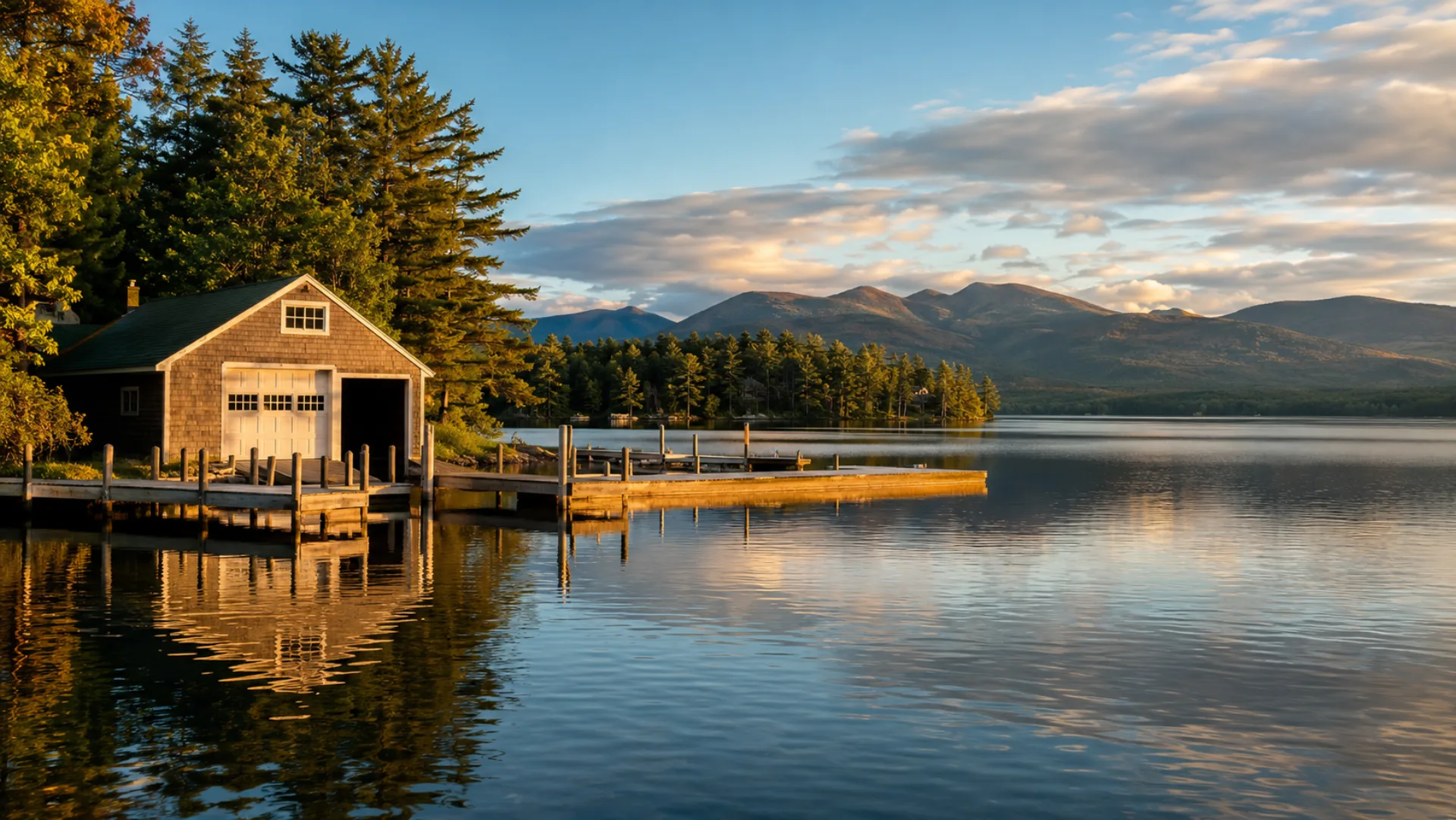
Start with the water, because the geography explains the town. Big Squam covers 6,791 acres — about seven miles long, better than four across at its widest, 99 feet deep, with 61 miles of mainland shore and some 67 islands scattered through its coves and narrows. At its western end a short channel, right in Holderness village, connects it to Little Squam, a 408-acre lake of its own stretching toward Ashland, where the lake's outlet — the Squam River — begins its run to the Pemigewasset. Holderness surrounds that channel and holds most of the big lake's western shoreline, which is why the town functions as Squam's front porch: five towns touch the water — Center Harbor, Moultonborough, Sandwich and Ashland are the others — and the lake even sprawls across three counties, but the village everyone means when they say they're 'going to Squam' is this one.
And it is genuinely a village, singular. A market, a handful of inns and restaurants — Walter's Basin sits right over the water by the bridge — the town docks, and Squam Boat Livery, which has been putting families onto this lake for generations. There's no downtown block, no retail strip, no boardwalk, and that's by choice rather than neglect. Daily life leans on Plymouth, a few minutes west, for groceries, the hospital and Plymouth State's calendar; what Holderness keeps for itself is the water, the trailheads and the quiet.
One practical fact belongs in every Holderness conversation, because it shapes both the lake's culture and its property values. Public access to Squam is real but deliberately narrow. The state's boat ramp — free, concrete, run by Fish and Game — occupies the channel's Route 3 bank in the village, open year-round, but its small first-come parking lot is the true gatekeeper on a July Saturday, personal watercraft are banned lakewide, and Squam has no sizable public swimming beach anywhere on its shore. The Squam Lakes Association maintains access points geared mostly to paddlers. Getting onto this lake casually is hard; that is precisely why living on it, or holding deeded rights to it, is worth what it's worth.
Living in Holderness
The Science Center and the Culture of a Quiet Lake
Where Routes 3 and 113 meet sits the institution that gives Holderness its public face: the Squam Lakes Natural Science Center, a 200-acre campus holding northern New England's only AZA accreditation. Its exhibit trail walks you past black bears, bobcats, river otters, a mountain lion and raptors — nearly all of them animals that couldn't return to the wild — and from May through October its naturalist-guided pontoon cruises are, in my opinion, the single best ninety minutes a prospective buyer can spend on this lake. You'll learn more about Squam's character from the water than from any tour of houses.
The cruises usually find loons, and the loons deserve their own paragraph, because on Squam they are less wildlife than governance. The Loon Preservation Committee has watched this lake since 1975 and operates a loon program devoted solely to Squam, launched after the lake lost nearly half its nesting pairs — seven of sixteen — across 2004 and 2005, a collapse that shook the watershed and put lead fishing tackle on the local blacklist for good. Today every nest is monitored, boaters give nesting coves generous room in June, and the etiquette is enforced by neighbors long before Marine Patrol gets involved. When people ask what 'quiet lake culture' actually means, that's it.
Behind the etiquette stands more than a century of organized stewardship. The Squam Lakes Association dates to 1904, formed when logging had scarred the hills and the coves needed cleaning up; the Squam Lakes Conservation Society followed in 1960 as one of New Hampshire's oldest land trusts, easing shoreline and watershed acreage permanently — including its role in the 2022 Beebe River project that protected 6,395 upstream acres. Add Rockywold-Deephaven Camps, hosting the same families on the same Holderness shore since 1897 and still cutting a couple hundred tons of ice off the frozen lake each winter to stock cottage iceboxes the nineteenth-century way, and Church Island's boat-shuttle summer services, and you get a lake that runs on continuity. Holderness is the town that institutional memory built.
Living in Holderness
A Holderness Year, Season by Season
Summer made this town's reputation, and it earns it without the crowds you'd expect. The camps fill, the livery's boats thread the islands, kids swim off docks and warm ledges, and the Science Center's parking lot turns over all day — yet even at peak the lake stays calm in a way that startles anyone raised on busier water. There's no sandbar party, no dockside dining circuit; an August evening here sounds like paddles, screen doors and loons. If that inventory of sounds excites you, you're the buyer this town was built for.
Fall might be even better. The hardwoods above the water — the Rattlesnake ridges, the Squam Range behind them — light up while the lake doubles the show in reflection, the summer people thin out after Columbus Day, and the ledges become the best foliage seats in the Lakes Region. Winter pulls the village inward: in a cold year bob houses and skaters take over the hardened coves, the Science Center's trails become snowshoe routes, and the ski math quietly works — both big mountains, Waterville Valley and Loon, sit thirty to forty minutes away by interstate, which lets a winterized Squam house moonlight as a ski base.
Spring is the honest season. Melt swells the Squam River, the loons come back at ice-out, and local trail wisdom says to leave Rattlesnake alone until the mud firms up so the path doesn't erode. It's also when the town's practical arithmetic shows its worth — because Holderness has almost no commerce of its own, nothing here really "closes for the season." Plymouth handles the errands twelve months a year, five to ten minutes away, and that division of labor is exactly what lets a town of nineteen hundred people stay this rural while remaining genuinely livable year-round.
Living in Holderness
Rattlesnake Mountain and the Trail Out Your Door
Every town in this region claims a signature hike; Holderness actually has one. West Rattlesnake Mountain, reached from Route 113 just north of the village on the Old Bridle Path, is an out-and-back of about two miles that gains roughly 450 feet — a grade a six-year-old and a grandparent can both handle — and it ends on open ledges hanging directly over Squam, islands and coves spread out below like a chart. Pound for pound it could be the Lakes Region's best-earning short climb, and locals treat it like a front porch: sunrise coffee hikes, after-work loops, engagement photos. East Rattlesnake and the connecting paths add variations when the main ledges draw a crowd.
The Rattlesnakes are the headline, but the Squam Lakes Association looks after a web of trails through the watershed — ridge walks in the Squam Range, family loops, backcountry campsites and boat-in programs that get you onto the water and islands without owning a bottom of your own. The Science Center's gardens and paths carry the season deep into autumn. It adds up to something rare: a town where the daily outdoor habit — hike, paddle, swim, repeat — requires no planning, no tickets and about five minutes of driving.
When the radius needs widening, the map cooperates. Livermore Falls, the Pemigewasset's rocky gorge and swimming spot at the corner where Holderness meets Campton and Plymouth, charges five dollars a carload. Meredith and the Winnipesaukee shoreline are fifteen to twenty minutes southeast for boat dealers, bigger restaurants and shopping. And the White Mountain trailheads open up within half an hour north. Holderness keeps every bit of that within reach while feeling, on a quiet morning, like the region's best-kept corner.
Living in Holderness
Why Squam Property Almost Never Changes Hands
Now the part every reader eventually asks about. Most of Squam's shore came together long ago as large family compounds — long reaches of frontage held in trusts, handed down, occasionally eased into permanent conservation, and only rarely sold. Institutions account for their own miles of shoreline too: Rockywold-Deephaven, the Science Center campus, parcels under easement that will never see a survey stake. What remains tradeable is a sliver, which is why true Squam waterfront sales in a typical year can be counted on one hand — and why a share of them conclude privately, between families and neighbors, before any sign reaches the road. Fame from the movie, scarcity from the land patterns, patience from owners who don't need to sell — that's the whole formula.
For buyers, the workable framework has three rungs. True waterfront — your deed touches the lake — is the scarce top of the market and behaves accordingly. Water-access properties carry deeded or association rights to shared frontage, and they're where I do most of my Squam work, with one warning I repeat until clients can recite it: rights language varies wildly, so the deed and association documents get read before anyone falls in love. Near-lake homes — the village, the Route 113 corridor, the hills — hold the town's year-round housing stock and deliver the Squam life through the ramp, the SLA, a livery rental or a marina slip. Holderness carries the lake's premium addresses; neighboring Ashland, on Little Squam, is where the watershed gets more attainable.
Ownership on this lake also comes with homework. The state's shoreland law, RSA 483-B, applies to the 250-foot band along the shore — setbacks, a vegetation buffer scored by a points grid, caps on impervious surface — which means the grandfathered lawn-to-the-shore look on an old estate cannot be recreated on a new project. Septic capacity quietly decides what an aging camp can ever become, and docks live or die by their state permit files. None of this is a reason to walk away; it's the machinery that keeps Squam looking like Squam, and every seasoned owner here treats it as part of the deal. It does mean your diligence has to be local and unhurried — which suits this lake's temperament anyway.
Live Market Data
The Holderness Market Right Now
For Sale in Holderness — Live From the MLS
For-sale figures read the live MLS feed and change as homes come on and go under contract; sold figures are Owl's Nest Real Estate closings in Holderness over the last 12 months.
The Market
The Holderness and Squam Lake Real Estate Market
Reading this market requires holding two numbers in your head at once. the median home value here stands at $331,700 in the 2023 ACS — a figure describing the village homes, hillside houses and near-lake properties that form most of the town's stock. Squam waterfront inhabits a different universe entirely, commanding more per front foot than equivalent Winnipesaukee shoreline in the rare years any of it trades, so a town-wide average tells you almost nothing about the shore. The buyers who succeed here are the prepared ones: financing set, criteria specific, alerts running, and a broker who hears about family transitions before the listing portal does. That last part is the job we've built over years of covering all five Squam towns from just up Route 175 in Campton.
The figures displayed here update live from the MLS whenever Holderness inventory shifts. Buyers will find the current Holderness waterfront and water-access listings on our Squam Lake NH homes-for-sale page, priced and photographed in real time. For owners weighing an exit, our Holderness seller guide walks through how we position lake-country property — waterfront, deeded-access and village alike — to the distinct buyer pools each one attracts, and why on Squam the quiet marketing channels count for as much as the public ones.
Holderness NH — Your Questions, Answered
What county is Holderness NH in?
Holderness is in Grafton County, New Hampshire — worth stating plainly, because the lake it fronts is a three-county sprawl: Squam's shoreline reaches into Grafton, Carroll and Belknap counties across its five towns. The town itself, though, is Grafton through and through, sharing the county with Plymouth, Campton and the Pemigewasset valley. As with every town we profile, the county rarely touches daily life — assessments, permits and tax bills all run through the Holderness town offices on Route 3, with the county's deed registry up in North Haverhill.
What is the zip code for Holderness NH?
Holderness uses ZIP code 03245 for the whole town — the village at the channel, the Squam shoreline and the rural roads along Route 113 toward Sandwich. The neighboring Squam towns carry their own codes: Ashland is 03217, Center Harbor 03226, Sandwich 03227 and Plymouth 03264. On a lake where town lines wander through coves, it's worth remembering that the mailing address doesn't settle which town assesses a property — the tax map does.
Is Squam Lake open to the public?
Yes, with real limits — and the limits are the point. The one public route onto the water is the free state boat ramp where Route 3 crosses the channel in Holderness, open year-round with a small first-come lot that fills fast on summer weekends; jet skis and other personal watercraft aren't allowed anywhere on Squam. The lake has no sizable public swimming beach — nothing comparable to Wellington on Newfound — and most of the shoreline is private. The Squam Lakes Association maintains access points suited mainly to paddlers, Squam Boat Livery in the village rents boats, and the Science Center's guided cruises from May through October are the easiest way for a visitor to actually experience the lake.
Was On Golden Pond filmed on Squam Lake?
It was — the 1981 film was shot here in 1980, with Henry Fonda and Katharine Hepburn working at a private camp along the stretch of shore shared by Holderness and Center Harbor, and the lake's own loons on the soundtrack. The picture collected three Academy Awards, Fonda and Hepburn each taking the top acting prize, and it remains the reason much of the country has heard of this lake. The filming camp stays private — locals treat its location as nobody's business — but the coves and island passages that appear on screen, Purgatory Cove among them, are open water. A canoe and a calm morning will show you the movie's scenery essentially unchanged, which is itself the best summary of how this lake has been cared for since.
Is Holderness NH a good place to live?
For a specific kind of person, it's close to perfect. Holderness offers a landscape most towns would trade anything for — two lakes, a trail network, the Science Center — plus a village K–8 school and I-93 within minutes, with Plymouth covering hospital, university and supermarket duty a few minutes west. What it doesn't offer is a downtown, nightlife, or much of anything commercial; the town outsources its errands and keeps its character. Residents tend to be people who wanted the lake and the woods as the center of daily life and consider the quiet a feature they actively paid for. If your ideal evening involves a paddle rather than a dinner reservation, you'll understand this town immediately.
How far is Holderness NH from Boston and Plymouth?
Boston is about 110 miles — call it two hours, nearly all of it on I-93, with Exit 24 in Ashland dropping you onto Route 3 for the last few minutes along Little Squam. Plymouth is five to ten minutes west, which is the distance that makes the whole town work: hospital, university, supermarkets and the highway's other exits, all inside a coffee's worth of driving. Meredith and Winnipesaukee are fifteen to twenty minutes southeast, and thirty to forty minutes north lands you at either Waterville Valley or Loon — a radius that explains why Holderness converts so many summer visitors into year-round residents.