
Squam Lake is New Hampshire's second-largest lake — 6,791 acres and 99 feet deep, shared by Holderness, Ashland, Center Harbor, Moultonborough and Sandwich — and one of the scarcest waterfront markets in New England. Only five Squam waterfront homes sold in 2025, at a $5.9 million median, and some transfers never reach the open market.
Almost everyone assumes Squam works like other lakes: search homes for sale Squam Lake NH, find a page of listings, pick one, make an offer. That's roughly how Winnipesaukee works. It is not how Squam works. This guide covers what Squam actually is, why the On Golden Pond connection still matters, why inventory is famously scarce, the three genuinely different ways to own near this lake, the rules that come with a shorefront, and — most usefully — how buyers actually land here. No manufactured urgency; just how it works.
What Squam actually is
Start with the map, because "Squam Lake" is really two lakes and five towns.
Big Squam is 6,791 acres, which makes it the second-largest lake in New Hampshire — a distant second to Winnipesaukee, and that gap is a feature, not a flaw. It runs about seven miles long and 4.6 miles across at its widest, with a maximum depth of 99 feet, an average depth of about 23 feet, 61 miles of mainland shoreline, and some 67 islands scattered across the water. The shoreline is a maze of coves, points, and narrows; you can boat Squam for years and still find pockets you've never seen.
At the western end, a short natural channel in Holderness connects the big lake to Little Squam Lake, a 408-acre lake in its own right that stretches toward Ashland, where the Squam River carries the outflow down to the Pemigewasset. Little Squam is where most of the lake's modest commercial life lives — the marinas, a general store, a couple of restaurants — and it matters to buyers for a practical reason covered below: Little Squam and Ashland are where Squam ownership occasionally gets slightly more attainable.
Five towns share the shoreline. Holderness wraps the channel and much of the western lake and is the closest thing Squam has to a village center. Center Harbor and Moultonborough hold the southern and eastern shores, Sandwich the quiet northern reach under the Sandwich Range, and Ashland anchors Little Squam. The lake actually straddles three counties — Grafton, Carroll, and Belknap — which tells you something about how it sprawls. All five towns sit within the broader Lakes Region market.
And in the middle of it all, at the channel in Holderness, sits the Squam Lakes Natural Science Center — a 200-acre campus with a live-animal trail of native New Hampshire wildlife and guided pontoon cruises on the lake from May through October. Anyone evaluating Squam as a buyer should take one of those cruises before touring a single house. Ninety minutes on the water with a naturalist teaches more about this lake's character than any listing sheet.
Squam Lake real estate
Squam Lake real estate is a five-town market with almost no inventory, and that one sentence explains most of what frustrates people searching squam lake waterfront homes or houses for sale on Squam Lake NH. Everything currently listed across the watershed sits on a single page — Squam Lake real estate and homes for sale — pulled live from the MLS. Some weeks it is short. That is not a broken feed; that is the lake.
What actually trades. Four property types make up nearly all Squam activity. Century-old family camps, often unwinterized, on lots that predate every rule now governing them. Year-round waterfront houses, the scarcest and most contested category, especially anything with a west or southwest exposure and a legal dock. Water-access homes a street or a lane back, carrying deeded rights to a shared beach, mooring field or right-of-way. And near-lake houses in the villages — Holderness, Ashland, Center Harbor — with no deeded water rights at all but the lake five minutes away. Islands change hands too, rarely, and they are their own project: barge logistics, no utilities in the ordinary sense, and a buyer pool measured in dozens statewide.
Big Squam and Little Squam are two different markets. Big Squam is the scarcity story — 6,791 acres, long private frontages, families who do not need to sell. Little Squam, the 408-acre lake at the Holderness end running toward Ashland, carries most of the watershed's commercial life and a somewhat deeper, somewhat more attainable pool of shorefront and water-access property. Buyers priced out of Big Squam frontage should be looking hard at Little Squam and the Squam River before they conclude the lake is closed to them.
The five towns, and what each one means for a search. Holderness holds the channel, the Science Center and the largest share of classic Squam frontage; it is the address most buyers picture. Ashland anchors Little Squam and has real village infrastructure — the interstate exit, a downtown, year-round housing stock — which makes it the most attainable entry point in the watershed. Center Harbor sits on the southern shore and straddles the Squam and Winnipesaukee worlds, so its inventory mixes both. Sandwich takes the quiet northern reach under the Sandwich Range, with the lowest density and the longest driveways. Moultonborough touches the eastern shore but is far better known for its Winnipesaukee frontage, which means a Moultonborough search returns two very different lakes unless you filter it.
Waterfront, water-access and view are three different purchases, and listing language blurs them constantly. A view lot on a Sandwich hillside, a deeded right-of-way to a shared beach, and 200 feet of your own frontage with a permitted dock are not variations on a theme — they are separate asset classes with separate price behaviour. The section below on the three ways to own near Squam breaks the distinction down; read it before you set a budget, because the wrong assumption here wastes more buyer time on this lake than anything else.
Why Squam prices behave differently from Winnipesaukee. Winnipesaukee is a large, liquid market: 85 waterfront home sales in 2025 and 134 in 2021 by Roche Realty Group's MLS counts, enough comparable sales to price a property with real confidence, and inventory that responds to interest rates the way normal markets do. You can watch it on the Lake Winnipesaukee real estate page. Squam is the opposite on every count — five to eight true waterfront sales in a typical year, comparables that may be years old and a mile apart in character, and sellers under no financial pressure. The practical consequences are three. Price discovery is weak, so an appraisal can be an argument rather than a number. The premium over comparable Winnipesaukee frontage is real and persistent, because nobody is making more Squam shoreline and the conservation record below makes that permanent. And values hold through soft cycles better than lakes with deeper inventory, for the same reason. If you want to see how the top of the New Hampshire lake market behaves generally, the NH luxury lake homes piece and the Lakes Region waterfront guide both cover it; every lake in the state is on the NH lake homes page.
The On Golden Pond thing
Yes, it's that lake. On Golden Pond was filmed on Squam in 1980 — Henry Fonda and Katharine Hepburn at a camp on the Holderness and Center Harbor shore, Jane Fonda alongside her father in his last screen role, the loons doing their own sound design because nobody trains a loon. The film took three Academy Awards, including Best Actor for Fonda and Best Actress for Hepburn, and forty-five years later "on golden pond Squam Lake" is still one of the most common phrases in the search data.
Two things about that are worth a buyer's attention.
First, the movie is an unusually honest advertisement. Hollywood scouted for a lake that felt untouched — no strip of motels, no wall of docks, no jet-ski hive — and Squam still shows on screen more or less the way it looks from a kayak today. The camp from the film is private, and locals will politely decline to point it out, but Purgatory Cove and the island narrows are right there for anyone with a canoe.
Second, the movie explains the market. On Golden Pond made Squam nationally famous at exactly the moment the families who owned the shoreline had every reason to hold it tighter. Fame plus scarcity plus a community that had spent eight decades organizing itself around protection — that's the recipe for the market described next.
Why so few homes ever come up for sale
If you take one thing from this guide, take this: Squam Lake real estate is scarce on purpose. Four forces built this market, and none of them are going away.
The conservation ethos is a century old. The Squam Lakes Association was formed in 1904, back when logging had stripped the surrounding hills and sawdust lay feet thick in the coves. Concerned landowners organized, cleaned up the lake, and never stopped — the SLA still stewards water quality, campsites, and boating culture today. Then in 1960 came the Squam Lakes Conservation Society, one of the oldest land trusts in New Hampshire, which exists specifically to put Squam land under permanent conservation easement. This isn't abstract. When the Beebe River watershed project closed in 2022, it permanently protected 6,395 acres of forest linking the Squam Lakes region to the White Mountain National Forest — with SLCS money helping carry it over the line. Every acre eased is an acre that will never become a subdivision, and around Squam that now describes an enormous share of the watershed.
The land came down in large pieces and mostly stayed that way. Squam shorefront was assembled generations ago into big family holdings — hundreds of feet of frontage, sometimes thousands, held in trusts and LLCs and passed down rather than sold. When a family does sell, they often sell to another family they know, or ease the land first, or subdivide once and never again. Compare that to lakes where quarter-acre lots were platted by the hundred in the 1950s, and you understand why Squam's listing count is what it is.
The institutions hold shoreline too. Rockywold-Deephaven Camps has occupied a long stretch of Holderness shorefront since Deephaven opened in 1897 (Rockywold followed in 1902), renting simple cottages to families who rebook the same week for decades — and still cutting about 200 tons of lake ice for each camp's icehouse every winter to stock the cottage iceboxes. Church Island hosts summer services reached by boat shuttle. The Science Center holds the channel. None of that shoreline is ever coming to market.
And the sellers don't need to sell. Squam owners are, as a group, patient. Nobody's carrying a distressed mortgage on a hundred-year-old family camp. So inventory doesn't respond to interest rates the way normal markets do; it responds to estates, family transitions, and the occasional change of heart.
What does that mean for price? The sample is tiny, so treat these as scale rather than a price list. Meredith-based Roche Realty Group's tallies of MLS closings show:
| Period | Squam waterfront sales | Median sale price |
|---|---|---|
| Full year 2025 | 5 | $5,900,000 |
| January–October 2024 | 5 | $3,920,000 |
| Full year 2021 | 8 | $1,925,000 |
Sources: Roche Realty Group, 2026 outlook, waterfront sales on 10 area lakes, and 2021 waterfront sales. For comparison, Winnipesaukee's 2025 waterfront median was $2.75 million across 85 sales. One estate can double a Squam median, and the range inside any year is enormous — a modest camp and a point estate with a sand beach and a boathouse are different asset classes that happen to share a lake. What holds: Squam waterfront trades at a clear premium to comparable Winnipesaukee frontage and holds value through cycles because of the scarcity above. For a specific property, the live market and the specific comp still decide.
The three ways to own near Squam
Here's the distinction that saves buyers months of confusion. Around Squam, "lake property" means one of three very different things, and listings blur them constantly.
True waterfront. The deed includes the shoreline. You control your frontage, you can pursue a dock permit, you walk from your porch to your own beach or ledge. This is the scarcest tier — the one where a few sales a year is the norm — and it's what people picture when they say Squam Lake homes for sale. Within it there's still a spectrum: a classic unwinterized camp on a shared lane is a different purchase from a year-round house with a southwest-facing point. When one of these lists publicly, it moves on relationships and preparation, not on leisurely second showings.
Water-access. The deed doesn't touch the lake, but it carries rights to it — a deeded right-of-way to a shared beach, a community association with docks or moorings, or a lane association with a common waterfront. This is the most commonly shown tier, because it delivers eighty percent of the Squam life at a fraction of waterfront cost. The diligence burden is real, though: deeded rights vary enormously in quality. Is the right-of-way ten feet wide or a hundred? Can you keep a boat, or only launch a kayak? Is there a mooring waitlist measured in years? Read the deed language and the association documents before falling in love, because "water access" on a listing sheet can mean almost anything.
Near-lake. A home in Holderness village, on the Sandwich hills, or in Ashland a few minutes from Little Squam — no deeded rights, but the lake in your daily life through the SLA's public access points, the town beaches, a boat club membership, or a slip rented at a marina. If the goal is Squam summers rather than Squam frontage, this tier is genuinely underrated, and it's where the towns' year-round housing stock lives. Ashland in particular deserves more attention than it gets: real village amenities, the Squam River and Little Squam at the doorstep, and the most attainable entry point in the watershed.
The rules that come with a shorefront
Squam waterfront comes wrapped in more regulation than almost any property type in the state, and buyers should treat that as part of the purchase, not a footnote. Three layers matter.
The Shoreland Act. New Hampshire's Shoreland Water Quality Protection Act, RSA 483-B, governs the first 250 feet back from the water on every lake this size. The headline rules: primary structures sit behind a 50-foot setback from the reference line; the first 50 feet is a waterfront buffer where tree and vegetation removal is limited by a point-and-grid system rather than a chainsaw's opinion; from 50 to 150 feet at least 25 percent of the area must stay in unaltered natural woodland; and fertilizer is prohibited within 25 feet of the water, with only slow-release products beyond that. Impervious surface — roof, driveway, patio — can cover 20 percent of the lot within the 250-foot zone before a stormwater management system is required, and more than 30 percent requires an engineer-certified stormwater plan. Towns can and do layer stricter rules on top. Practically, this means the sweeping lawn-to-the-water look on older properties is grandfathered, not reproducible, and any renovation or expansion plan needs to be tested against these rules before the offer gets written, not after.
Septic. Nearly everything on Squam runs on private septic, and state rules keep new leach fields at least 75 feet back from the water — up to 125 feet in the most permeable soils — with systems sized by bedroom count. Since September 1, 2024, RSA 485-A:39 has also required a licensed septic evaluation, paid for by the buyer, before any developed waterfront property with a system within 250 feet of the water changes hands; a system found in failure must be replaced within 180 days of the transfer. On a lake where the housing stock skews toward older camps on small or oddly shaped lots, the septic question can quietly decide what a property can ever become. A three-bedroom camp whose lot can't support a four-bedroom system is a three-bedroom camp forever. Pull the septic design and approval history on every waterfront candidate, and on the old camps budget for the possibility that the "system" is a relic that predates the rules entirely.
Docks. Docks on New Hampshire lakes are permitted by NHDES under the state wetlands law, and even a seasonal dock requires state approval — though simple seasonal docks qualify for a streamlined notification: one dock per lot, at least 75 feet of frontage, no more than 6 feet wide by 40 feet long on a lake Squam's size, at least 20 feet from the abutter's line, and removed at least five months a year. Bigger projects, and anything with five or more slips, go through full permitting with abutter notice. For a buyer the operative questions are: is the existing dock legal and grandfathered, what do the permits actually cover, and — if there's no dock — does the frontage even support one? Never assume. Squam deals get reshaped by a dock file more often than anyone expects.
None of this should scare anyone off. It's why the lake looks the way it does, and serious Squam owners regard the rules as the price of the view. But it does mean waterfront diligence here is a professional's job, and the offer timeline needs to make room for it.
Buying on Squam
The rules above are the law. This is what they do to a purchase, in the order a buyer runs into them.
Conserved land is permanent, and some of it may be the land you are buying. The Squam Lakes Conservation Society — founded in 1960 and dedicated to protecting the natural environment of the Squam Lakes region through conservation easements and land ownership — holds easements across the watershed, and the Squam Lakes Association has stewarded the lake since 1904. Two consequences for a buyer. The first is supply: an eased parcel will never be subdivided or built on, which is a large part of why the listing count stays where it is and why the view from a given dock is unlikely to change in your lifetime. The second is specific to the property in front of you — a conservation easement can run with the land you are purchasing, and where it does, it can limit subdivision, new structures, or shoreline clearing regardless of what the town's zoning would otherwise allow. Ask for the easement document before the inspection period, not after; the easement holder and its written terms, not the seller's recollection, decide what you can do.
The 250-foot protected shoreland decides what an old camp can become. The RSA 483-B rules set out above apply to your plans, not to the previous owner's. A footprint that sits inside the setback is grandfathered where it stands; moving it, enlarging it, or replacing it is a different conversation, and towns may layer stricter requirements on top of the state's. Price the renovation against the rules before the offer, and put a permitting contingency in writing if the plan depends on an approval nobody has yet.
Septic is the quiet ceiling. As a buying step: pull the septic design, approval history and as-built on every waterfront candidate, and schedule the required transfer evaluation early. The system the lot can support caps the bedroom count — and therefore the house you can eventually have, and the rental income it could ever produce.
Docks and moorings are separate permissions, and neither is automatic. For the dock, confirm the existing structure is permitted and matches what's in the water. A mooring is a separate permit issued through NH Marine Patrol. Where a house comes with one, or with association rights to one, establish who holds it, what it is permitted for, whether there is a waiting list, and whether it conveys at closing or has to be reapplied for. Get this in writing during diligence — on Squam, a mooring or a dock is frequently the difference between two otherwise similar prices.
Turning a seasonal camp into a year-round house is a project, not a decision. Plenty of Squam buyers arrive planning exactly this. It is often possible and occasionally not, and the answer lives in five places: whether the septic can be sized for year-round occupancy, whether the water supply and its line are set below frost, whether the structure can take insulation and a heating system without a gut renovation, whether the shoreland and setback rules allow the footprint or dormer you have in mind, and — the one people forget — whether the private lane is plowed and maintained in winter, and who pays for that. Many Squam camps sit on lanes that simply stop being roads in January. Ask all five before you fall in love, and get a contractor onto the property during the inspection period rather than after the closing.
Sequence beats speed. Because so much of this is document work rather than showing work, the buyer who moves fastest on Squam is the one who assembled the team first — a local agent, a real estate attorney who reads easements, a septic designer, a shoreland-literate contractor. When something surfaces on this lake it is usually reviewable in days if the team exists and fatal in weeks if it does not.
If you own a Squam place already and are weighing the other side of this, our guide to selling a lake house or second home in NH covers the tax, timing and preparation side, and a conversation with our team costs nothing.
A year on the lake
What are you actually buying into? Here's Squam through the seasons.
Summer is the classic. Squam's boating culture is the quietest of any big lake in the state — pontoon boats idling between islands, sailboats, kayaks threading the coves, and nothing resembling Winnipesaukee's weekend armada. There's no boardwalk, no big marina scene; the commercial fleet amounts to a couple of family operations on Little Squam. For Squam Lake boat rentals, Squam Boat Livery in Holderness has been the lake's livery for generations, and Riveredge Marina in Ashland handles rentals, valet, and service on the Little Squam side. Trailering your own boat is a different question, covered in our guide to New Hampshire boat launches. Anglers work the deep basins for lake trout and the rocky shorelines for smallmouth — with one hard local rule: lead tackle stays home, for reasons the next paragraph makes clear.
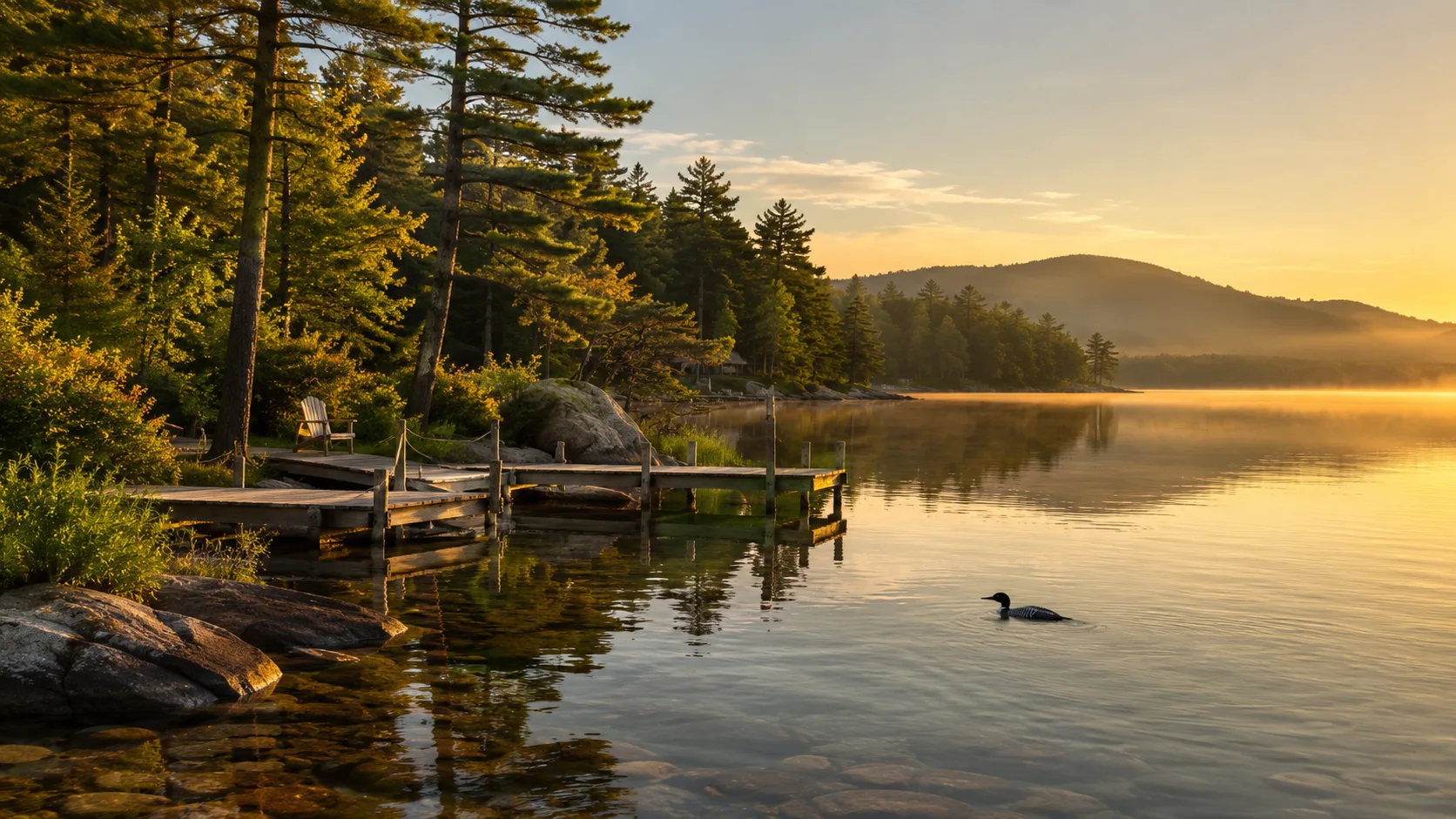
The loons are Squam's soundtrack and its conscience. The Loon Preservation Committee runs a dedicated Squam Lake Loon Initiative, born after the lake abruptly lost seven of its sixteen loon pairs across 2004–2005 — a 44 percent drop unlike anything in decades of monitoring — with lead fishing tackle and contaminants among the identified killers. The LPC has been surveying this lake since 1975; its biologists monitor every nest, and the Science Center runs summer loon cruises with them. Owners here are expected to give nesting coves a wide berth in June, and the culture enforces it more effectively than any statute.
Fall might be the lake's best-kept secret — foliage on the Rattlesnakes and the Squam Range doubled in still water, the summer boats gone by Columbus Day. Winter brings ice fishing bobhouses, cross-country skiing, and the wonderful anachronism of the Rockywold-Deephaven ice harvest, cut by hand the old way. Spring is ice-out, blackflies, and the loons returning — the annual reset.
One more seasonal note, because the search traffic shows people want it: Squam Lake rentals are a real, if tight, market. The weekly summer rental is an old Squam tradition — families have rented the same camp for generations — and renting a summer before buying is the single best diligence a serious buyer can do. It's also how some owners carry their carrying costs. For the own-and-rent math anywhere in the Lakes Region, a vacation rental management team can run those numbers honestly, including the state rental-tax registration that trips up new hosts.
Who Squam suits
The honest sorting test, the same one that gets given across a desk:
Squam is right for you if what you want is the lake itself — mornings on still water, loons at dusk, a camp your grandchildren will fight over lovingly — and you can be patient about getting it. It rewards buyers who think in decades. The conservation overlay that limits what you can do with the shoreline is precisely what guarantees the thing you fell for will still be there in thirty years, and Squam buyers who understand that trade tend to become Squam owners who never sell.
It's wrong for you if you want action — a lively sandbar scene, big-water cruising, restaurants by boat — in which case Winnipesaukee genuinely is the better lake, no judgment attached. It's also wrong if the project requires bending a property into something the shoreland rules won't allow, or if the timeline demands a purchase this quarter. Squam doesn't do deadlines.
And if the budget doesn't reach true waterfront, don't leave the watershed — that's what the water-access and near-lake tiers are for, and a well-chosen deeded-access home in Holderness or Ashland is one of the most durable buys in the whole Lakes Region.
How to actually buy here
Everything above funnels into this, because on Squam the how matters more than anywhere else in the region.
Get positioned before there's anything to buy. In a market with a handful of sales a year, the buyer who wins is the one who was ready before the listing existed — financing arranged, criteria sharp, diligence team lined up. Set up alerts on the newest listings page for Holderness, Ashland, Center Harbor, Sandwich, and Moultonborough so anything that touches the market lands in your inbox the day it appears, and browse the current lakefront inventory to calibrate expectations against what actually trades.
Take the off-market path seriously. A meaningful share of Squam transfers never see a portal — estates settled quietly, a family selling to a neighbor, an owner who'll entertain the right buyer but won't tolerate a sign at the road. This is where a local broker earns the fee: agents who work these five towns hear about transitions early, and a specific, credible buyer brief — "winterized, west-facing, three-plus bedrooms, dock rights, this range" — is something that can actually be walked up a driveway. Vague interest gets nothing on Squam. Specific patience gets calls.
Underwrite the property, not the postcard. When something does surface, the speed Squam demands comes from preparation, not recklessness: septic file, dock permits, deed rights, shoreland constraints, flood and ice questions on the low lots — all reviewable fast if the team is assembled and fatal if discovered late.
And rent a week first if you can. A week on the lake in July will tell you whether Squam's particular quiet is your kind of quiet.
Some buyers land their Squam place in three months; some wait three years and call it worth every day. Both are right, because both end up on the water. If Squam is your lake, Owl's Nest Real Estate works all five shore towns from our office twenty-five minutes away, where we also sell homes for sale in Campton NH — and knows which driveways to walk up.
Frequently asked questions
How much are homes on Squam Lake?
Squam waterfront is the priciest big-lake frontage in New Hampshire, but sales are few. Roche Realty Group's MLS tallies show five waterfront sales at a $5.9 million median in 2025 and five at a $3.92 million median in January–October 2024. Water-access homes cost a fraction of that, and village houses in Ashland or Holderness are the most attainable way in. The Squam Lake real estate page shows what is actually listed now.
Can you buy waterfront on Squam Lake?
Yes — but rarely, and usually not on your timeline. True Squam waterfront is the scarcest tier in one of the scarcest markets in New England, the frontage was assembled generations ago into large family holdings, much of the surrounding watershed is under permanent conservation easement, and a meaningful share of transfers never reach a public portal. Buyers who succeed here get positioned before there is anything to buy: financing arranged, criteria written down in a sentence a broker can repeat, and a diligence team already assembled.
Is Squam Lake public?
You can boat, paddle, fish and swim on Squam. Getting to the water is the constraint: almost the entire shoreline is private, and there is no large public swim beach on Squam equivalent to Ellacoya on Winnipesaukee or Wellington on Newfound. The Squam Lakes Association in Holderness maintains the realistic public access points, primarily for paddlers, and the Squam Lakes Natural Science Center runs guided pontoon cruises from May through October. Our guide to public beaches in New Hampshire covers where the swimming actually is, lake by lake.
Does Squam Lake have a public beach?
Not a large one. Squam is the clearest example in the state of the rule that scarce public access is exactly what makes private access valuable — which is why deeded beach rights and a shared association waterfront carry real weight in what a house sells for here. Visitors generally swim from a boat, from a rental, or at the town and state beaches on nearby lakes.
What towns are on Squam Lake?
Five. Holderness wraps the channel and much of the western lake and is the closest thing Squam has to a village center. Ashland anchors Little Squam. Center Harbor and Moultonborough hold the southern and eastern shores. Sandwich takes the quiet northern reach under the Sandwich Range. The lake straddles three counties — Grafton, Carroll and Belknap — which tells you something about how it sprawls.
How does Squam Lake compare with Lake Winnipesaukee?
Different lakes for different lives. Winnipesaukee is big, lively and liquid — a weekend armada, restaurants reachable by boat, roughly 80 to 130 waterfront home sales a year, and enough comparable sales to price a property with confidence. Squam is quiet, conserved and thin — pontoons idling between islands, no boardwalk, no marina scene, and a handful of waterfront sales a year. If you want action, Winnipesaukee is the better buy. If you want the lake itself and can wait for it, Squam rewards patience.
Are there homes for sale on Little Squam Lake?
Usually more often than on Big Squam, which is why buyers who think the watershed is closed to them should look here first. Little Squam is 408 acres at the Holderness end, connected to the big lake by a short natural channel and draining toward Ashland by way of the Squam River. It carries most of the lake's commercial life — the marinas, a general store, a couple of restaurants — and both shorefront and water-access property on it tend to be somewhat more attainable than on Big Squam.
Can you rent on Squam Lake before buying?
Yes, and it is the single best diligence a serious buyer can do. The weekly summer rental is an old Squam tradition — families have rented the same camp for generations — so the market is real if tight, and a July week will tell you whether Squam's particular quiet is your kind of quiet. Book well ahead; the good weeks go to people who had them last year.