

The New Hampshire housing market forecast for 2026 is a market that keeps rising, but slowly. Redfin's May 2026 data puts the statewide median sale price at $533,106, up 2.9% year over year, homes are going under agreement in roughly 45 days, and supply sits near 1.4 months — a seller's market by every classical measure, and one with no sign of a sharp correction. What has changed is the pace: price growth has cooled to low single digits, buyers have recovered real leverage on inspections and terms, and the gap between well-prepared listings and neglected ones is widening every quarter. The short version of the 2026 NH housing market forecast is normalization, not decline.
Updated September 2026. Statewide figures reflect Redfin's May 2026 release and the New Hampshire Association of Realtors' first-quarter report; regional figures reflect first-half 2026 data as cited below.
In this guide:
- The 2026 forecast in one paragraph
- Home prices: where they are and where they're headed
- Inventory and months of supply
- Mortgage rates and buyer demand
- Region by region: how the 2026 NH real estate market splits
- What the forecast means for sellers
- What it means for buyers
- Signals to watch through the rest of 2026
- Frequently asked questions about the NH housing market forecast
The 2026 forecast in one paragraph
The NH housing market forecast for 2026 rests on one structural fact: New Hampshire has too few homes for the households that want them, and that did not change this year. Construction remains slow, demand from Massachusetts and southern New England shows no sign of switching off, and supply at roughly 1.4 months is a fraction of the five to six months that define a balanced market. That imbalance is what has kept prices rising even as borrowing costs cooled the national market, and it argues for continued stability rather than any sharp correction. At the same time, the trend line is clearly toward normalization: slower appreciation, more negotiation, more inspection contingencies, and a wider gap between well-presented homes and neglected ones. Expect a fair market that rewards preparation, not a frenzy that rewards showing up.
Home prices: where they are and where they're headed
Three different sources tell the same statewide story. As of Redfin's May 2026 data, the median sale price in New Hampshire is $533,106, up 2.9% year over year. Zillow's home value index is consistent: an average value of about $522,944, up 2.7%. The New Hampshire Association of Realtors' first-quarter figures put the median single-family sale at $530,000, up 3.9% from a year earlier. Three methodologies, one conclusion: New Hampshire home prices in 2026 are still rising, but at a walking pace rather than a sprint.
| Statewide measure (mid-2026) | Reading | What it tells you |
|---|---|---|
| Median sale price | $533,106 (+2.9% YoY, Redfin May 2026) | Record territory, but growth has cooled to low single digits |
| Median days on market | About 45 (Redfin) | Roughly a month and a half — slower than the peak years, still brisk historically |
| Months of supply | About 1.4 (Redfin) | Far below the 5–6 months of a balanced market; sellers still hold the structural advantage |
Will home prices drop in New Hampshire in 2026?
This is the question behind most searches for a New Hampshire housing market forecast, and nobody can guarantee an answer. What the data supports is a base case of slower growth, not decline. A market with 1.4 months of supply, record medians across three independent sources, and steady in-migration does not have the ingredients of a price drop — those usually require a supply glut, a demand shock, or forced selling, and none of the three is visible in the mid-2026 numbers. The useful way to read the forecast is as a range: prices roughly flat to modestly up statewide, with the strongest submarkets — the Lakes Region above all — running well ahead of that average, and sellers who price for last year's frenzy sitting unsold.
Inventory and months of supply
The supply number is the one to watch. At roughly 1.4 months of inventory, New Hampshire remains one of the tighter housing markets in the country — a balanced market is conventionally five to six months. Every listing still meets a deep pool of buyers, many of them relocating from Massachusetts and southern New England.
But inventory has been drifting upward from its lows, and the direction matters more than the level. A listing increasingly appears next to alternatives, so homes that show well are separating from homes that don't in a way they didn't three years ago. And 45 median days on market means the average buyer is no longer panic-bidding on day one. They're comparing. That is the single most important shift in the 2026 NH real estate market. The supply forecast for the rest of the year is more of the same slow drift — inventory edging up, not surging — because new construction is not arriving fast enough to change the arithmetic.
Mortgage rates and buyer demand
Borrowing costs have been the main brake on housing demand nationally, and they cooled the national market considerably. New Hampshire's forecast is different mainly because the state's supply shortage outweighed the rate effect: even as financing became more expensive, there were still more qualified buyers than homes for them to buy, and prices kept rising.
Rates show up here in how buyers behave rather than in whether they buy. Higher monthly payments make buyers more deliberate — they tour more homes, run the tax and payment math more carefully, and push harder on inspections and concessions; the 45-day statewide median is the visible result. If borrowing costs ease through the rest of 2026, the likely effect is a faster market rather than a cheaper one, since any rate relief meets the same thin inventory. If they don't, the current pace — steady, deliberate, still tilted toward sellers — is the forecast.
Region by region: how the 2026 NH real estate market splits
Statewide medians flatten out an enormous amount of local variation. The regions Owl's Nest Real Estate works every day — from offices on Route 49 in Campton and on Main Street in Plymouth — behave like four different markets.
Lakes Region: the strongest numbers in the state
Nowhere is the gap between state and local clearer than the Lakes Region. Roche Realty Group's six-month review of the first half of 2026 counted 539 single-family sales across the region totaling roughly $436 million in volume, with a median sale price of $535,000 — up 10.3% year over year — and a median of just 16 days on market. While the state as a whole grew 2.9%, the Lakes Region grew at more than three times that rate, and well-priced homes went under agreement in barely two weeks. The top of the market is running even hotter: Roche's same review puts the Winnipesaukee waterfront median around $2.3 million for the first half, with dollar volume up roughly 43% — scarce, irreplaceable waterfront behaves almost like its own asset class, and second-home and out-of-state buyers continue to drive much of that demand.
The Lakes Region forecast for the rest of 2026 is the most confident of the four: demand is deep, waterfront supply is fixed, and the 16-day median means the market renders its verdict on a listing in the first two weekends. Waterfront comps are scarce and idiosyncratic, so property-level pricing matters far more here than any town-level median. Second-home owners have an extra wrinkle this year: the second-home surcharge proposals reported by NHPR in January 2026 have a steady stream of owners asking whether to sell. They're proposals, not law; the full question is covered in the guide to selling a lake house or second home in New Hampshire.

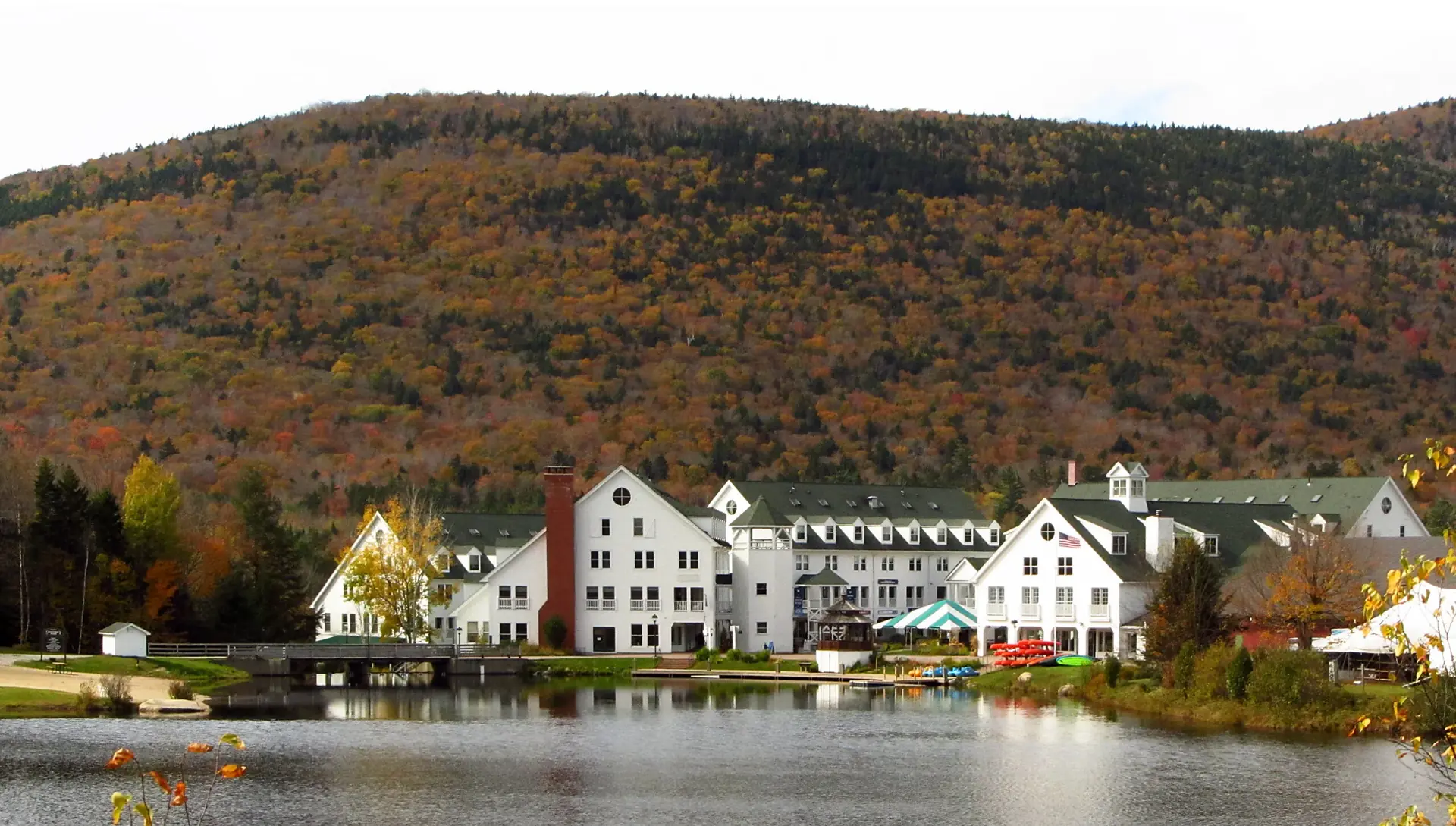
Waterville Valley and the Route 49 corridor: a condo story
Waterville Valley is a different animal from the lake towns. In the mid-2026 listing data Owl's Nest tracks, the valley's median list price works out to roughly $281 per square foot, with homes averaging around 50 days on market. Two things explain the profile. First, this is a condo-heavy market — the village grew up around the ski resort, and much of the housing stock is townhomes and condominiums rather than single-family homes, which keeps the per-square-foot figure well below waterfront territory. Second, it's a seasonal market: demand builds ahead of ski season and again in summer, and days on market stretch through the shoulder months.
Waterville Valley can't expand (the White Mountain National Forest boundary settled that long ago), so supply is permanently capped, and buyers who want walk-to-lift access have exactly one place to find it. The Route 49 corridor between the valley and I-93 — Campton, Thornton, and resort communities like Owl's Nest Resort — catches the buyers who want the mountains without the resort premium.
The forecast here is seasonal rather than directional. Condo sellers compete on condition, association health, and rental flexibility — have association documents, budget, and reserves ready before listing, because buyers' lenders will ask — and the demand wave arrives with the ski calendar: every ski Saturday from December through March, the buyer pool literally drives past the Campton office window on the way to the lifts. A roughly 50-day average market time means patience is normal in the valley; it is not a signal to cut price in week three.
Plymouth and the Pemi Valley
The I-93 corridor towns — Plymouth, Campton, Thornton, and their neighbors along the Pemigewasset — sit between the lake and mountain markets in both geography and price. Mid-2026 list-price medians in the data Owl's Nest tracks run around $419,000 in Plymouth and roughly $250,000 in Campton, though both figures are directional rather than definitive: these are small towns with small monthly sample sizes, and a handful of listings on either end can swing a median dramatically. What the corridor reliably offers is the best value math in the region — more house and more land per dollar than the resort centers — which keeps a steady stream of year-round families and second-home buyers moving through. For a closer look at the town, see Plymouth NH real estate.
Because samples are small, the Pemi Valley forecast is best read property by property: two homes a mile apart can justify very different prices depending on acreage, condition, and highway access. Two corridor-specific realities matter here. First, property tax rates change at the town line — two similar houses on opposite sides of the Campton–Thornton line can carry meaningfully different tax bills, and out-of-area buyers notice when they run their monthly payment math. Second, land enrolled in current use under RSA 79-A (the reduced assessment for open land) carries a 10% Land Use Change Tax when it leaves the program; buyers who might develop or subdivide need to understand that up front, and springing it on them mid-contract is how deals wobble.
White Mountains
The broader White Mountains market — the ski and resort towns north and east of Waterville Valley — shares the valley's profile more than the Lakes Region's. Housing stock leans toward condominiums and townhomes near the resorts, demand follows the ski and foliage calendars, and the White Mountain National Forest boundary caps how much new supply can ever be built. The mid-2026 data cited in this guide does not break out a separate White Mountains median, so the forecast here is qualitative: a capped-supply resort market with longer shoulder-season market times that rewards timing the listing to the season and pricing to condition rather than to a town median.
How the regional markets compare
One table, with an honest caveat: the statewide and Lakes Region figures are closed-sale data; the Waterville Valley, Plymouth, and Campton figures are list-price data from small samples, useful for direction rather than precision.
| Market | Median (mid-2026) | Change YoY | Median days on market | Source |
|---|---|---|---|---|
| New Hampshire statewide | $533,106 (sale) | +2.9% | ~45 | Redfin, May 2026 |
| Lakes Region single-family | $535,000 (sale) | +10.3% | 16 | Roche Realty Group, H1 2026 |
| Winnipesaukee waterfront | $2.3M (sale) | Volume +43% | — | Roche Realty Group, H1 2026 |
| Waterville Valley | ~$281/sq ft (list) | — | ~50 | Mid-2026 listing data (condo-heavy) |
| Plymouth | ~$419,000 (list) | — | — | Mid-2026 listing data (small sample) |
| Campton | ~$250,000 (list) | — | — | Mid-2026 listing data (small sample) |
What the forecast means for sellers
By the numbers, 2026 remains a genuinely good time to sell in New Hampshire. Prices are at record levels, supply is a fraction of balanced-market norms, and in the strongest submarkets homes are selling in two to three weeks at double-digit annual appreciation. But a normalizing market punishes the mistakes a frenzied market used to forgive. Three disciplines matter more this year than they have in a while.
Pricing discipline
With buyers taking 45 days statewide to commit, an aspirational price no longer gets rescued by a bidding war. Overpriced listings sit, accumulate days on market, and frequently sell below what a sharp original price would have brought. The playbook that works in 2026 is pricing at — not above — the market and letting competition do the lifting. Our NH Seller Guide walks through how we build that number, our recent sales show the results, and a free professional home valuation — a real analysis from a local team, not an algorithm — is the fastest way from a statewide median to a number for your own street.
Preparation matters as supply grows
Inventory is inching up from historic lows, which means a listing increasingly appears next to alternatives. Homes that show well — cleaned, decluttered, repaired, photographed properly — are separating from homes that don't. For sellers who don't want to front the prep costs, our Ready-to-Sell Program covers up to $2,500 in advanced preparation costs plus a complimentary pre-listing inspection for qualifying listings, settled at closing.
Timing within the year
Houzeo's analysis of New Hampshire sale data has June and July producing the strongest sale prices (medians around $599,000, roughly 2% above the annual average) and May the fastest sales at about 35 days, with December through February the slowest stretch. Locally, mud season in March is usually better spent on prep and photography than on listing, with the launch aimed at the May–July window. Foliage season brings a genuine second buyer wave, and ski condos draw their buyers in early winter. The full calendar is in the guide to the best time to sell a house in New Hampshire, the process end to end is in selling a house in New Hampshire, and the sellers page shows how Owl's Nest markets homes across the Lakes Region, Waterville Valley, and the White Mountains.
What it means for buyers
The same forecast reads differently from the other side of the table. For buyers, 2026 is the most workable New Hampshire market in several years — not because prices are falling, but because the process has become sane again. With 45 median days on market statewide, there is time to tour, compare, and think. Inspection contingencies are back on the table, and sellers of homes that have sat past the first few weekends are negotiating on price and terms in ways they were not during the peak.
The trade-off is that waiting for a price drop is a bet the data does not support. At 1.4 months of supply against a balanced-market norm of five to six, and with statewide medians still setting records, the realistic scenario for a buyer who waits is paying a little more later for a home that took longer to find. Buyers who are ready — pre-approved, clear on the town-line tax math, realistic about the 16-day pace in the Lakes Region — are the ones closing. The buyers page covers the process and the Perfect Home Finder search, and the new listings feed shows what has just come to market across the state.
Signals to watch through the rest of 2026
The forecast above is the base case. These indicators would confirm it or change it:
- Months of supply. The single most important number. A drift from 1.4 months toward two or three would signal a genuinely more balanced market; a move back toward one month would mean the frenzy is returning. Balanced is five to six months, and the state is nowhere near it.
- Days on market. The 45-day statewide median is the clearest measure of buyer behavior. Lengthening alongside rising inventory would confirm normalization; shortening would mean demand is outrunning the modest supply increase.
- Second-home policy. The surcharge proposals NHPR reported in January 2026 remain proposals, not law. If that changes, expect more Lakes Region and resort inventory from owners deciding to sell.
- The Lakes Region gap. A 10.3% first-half gain against the state's 2.9% is unusually wide. Whether second-half data narrows it or holds it is the best single read on how much of the state's price strength is waterfront-driven.
What Owl's Nest sees at closing tables in Grafton County is steadier than the headlines in either direction — solid prices, reasonable buyers, deals that close when both sides are realistic.
Frequently asked questions about the NH housing market forecast
Will NH home prices drop in 2026?
The data does not point to a drop. New Hampshire still has a housing shortage — about 1.4 months of supply per Redfin against the 5–6 months that define a balanced market — plus steady in-migration from Massachusetts and beyond, and three independent sources (Redfin at $533,106, Zillow at about $522,944, and the New Hampshire Association of Realtors' first-quarter figure of $530,000) all show prices at record levels. The realistic base case is slower growth, not decline. No forecast is a guarantee; anyone deciding whether to buy or sell should decide on their own timeline and finances rather than a prediction.
Is New Hampshire a buyer's or seller's market in 2026?
A seller's market by every classical measure — 1.4 months of supply, record medians, and homes going under agreement in roughly 45 days statewide and 16 days in the Lakes Region — but a normalizing one. Buyers have recovered real leverage on inspections and terms, and overpriced listings are no longer rescued by bidding wars. Sellers hold the structural advantage; buyers hold more procedural leverage than they have in years.
What is the best month to sell a house in New Hampshire in 2026?
Houzeo's analysis of New Hampshire sale data has June and July producing the strongest sale prices (medians around $599,000, roughly 2% above the annual average) and May the fastest sales at about 35 days, with December through February the slowest stretch. Locally, mud season in March is usually better spent preparing than listing, foliage season brings a real second wave of buyers, and ski condos in Waterville Valley and the White Mountains draw their buyers in early winter.
Is now a good time to buy a house in New Hampshire?
For a buyer who is ready, yes — and for a buyer waiting for prices to fall, the data does not support the wait. With 45 median days on market statewide, inspection contingencies back on the table, and inventory inching up from historic lows, 2026 is the most workable buying environment New Hampshire has offered in several years. With prices still rising at 2.9% statewide and supply at 1.4 months, the cost of waiting is more likely to be a higher price than a lower one.
How long do homes take to sell in New Hampshire?
The statewide median is about 45 days on market as of mid-2026, per Redfin, but the range is wide: well-priced Lakes Region homes went under agreement in a median of 16 days in the first half of the year per Roche Realty Group, while condo-heavy resort markets like Waterville Valley average closer to 50. Houzeo's data has May as the fastest month at about 35 days. Pricing accurately from day one is the biggest factor in which end of that range a home lands on.
Are home prices rising in the Lakes Region?
Faster than anywhere else in the state. Roche Realty Group's first-half 2026 review shows a 10.3% year-over-year gain to a $535,000 single-family median across 539 sales and roughly $436 million in volume — more than triple the 2.9% statewide pace Redfin reports — and Winnipesaukee waterfront dollar volume rose roughly 43% with a $2.3 million median. Scarce waterfront and steady out-of-state, second-home demand are doing most of the driving.
Find out what your home is worth in this market
Medians describe the market; they don't price a house. If 2026 might be your year to sell, start with a free professional home valuation from Owl's Nest Real Estate; if you're buying, the buyers page is the place to start. Have questions the data can't answer? Talk to our team — we live in this market year-round.
This guide is general market information for New Hampshire home sellers and buyers, not tax or legal advice. Data points reflect the sources and dates cited and will change — confirm the specifics of your situation with your agent, your CPA, and your closing attorney.