Sell With Us
Sell Your Home in Hebron New Hampshire
Six hundred residents, a National Register village green and a shore the conservation maps claimed decades ago — when a Hebron property finally lists, we make sure it sells like the rarity it is.
What's Your Hebron Home Worth?
Selling in Hebron
The Green at the Head of the Lake
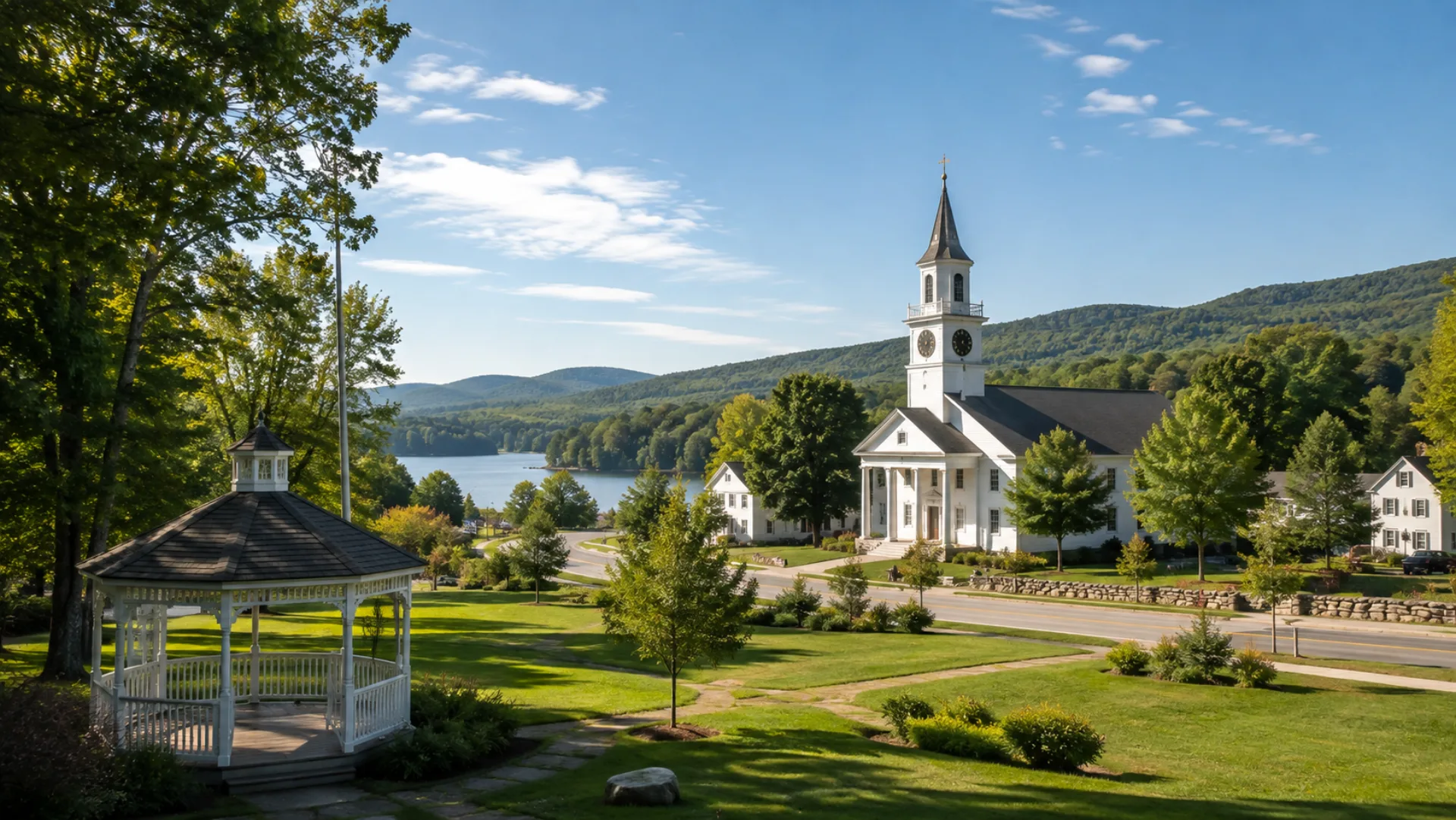
Hebron is the town people photograph when they want to explain New Hampshire to someone who has never been. At the top of Newfound Lake, where North Shore Road and West Shore Road meet the route up to Groton, sits a rectangular green the town has kept since 1799 — church, general store, town office, and a ring of houses old enough that the village core earned a National Register listing back in 1985. Roughly six hundred people live around it, and the town runs itself so that number barely moves.
We reach Hebron in about half an hour from our Campton office, and I make the drive for a reason most agents never get to enjoy: a Hebron listing. They hardly exist. Audubon's Paradise Point holds a long, rocky reach of undeveloped shore, the Hebron Marsh sanctuary wraps the wetland where the Cockermouth River enters, Grey Rocks keeps another piece of the inlet wild, and the families who hold the remaining frontage have mostly held it a long time. What the sanctuaries and the family deeds leave over is the entire market.
So this page is written for the owner facing a once-a-decade decision. The market numbers below appear when the MLS actually has Hebron closings to compute them from — in a town this small, some months it won't, and we'd rather show you nothing than something padded — along with answers to the questions north-end owners bring us, from historic-district worries to pricing a home no neighbor has tested the market with in years.
Live Market Data
The Hebron Market Right Now
For Sale in Hebron — Live From the MLS
For-sale figures read the live MLS feed and change as homes come on and go under contract; sold figures are Owl's Nest Real Estate closings in Hebron over the last 12 months.
Hebron Local Knowledge
Six Hundred People and a Shore the Maps Got to First
There is no store strip in Hebron and no plan for one. The general store on the green covers the essentials, the errands run down to Bristol or over the hill to Plymouth, and the town treats that inconvenience as a feature it maintains deliberately. What Hebron offers instead is the head of the lake itself: the water arrives shallow and sandy here, gentler than the deep basin to the south, and the residents' beach puts it within reach of every deed in town. Behind the village, the Groton hills carry Sculptured Rocks and the back roads toward Cardigan; in front of it, Newfound runs south with barely a commercial building on any shore.
The protected land is the part buyers underestimate until they stand on it. Paradise Point's nature center opens seasonally with trails and boats to rent, the marsh boardwalk draws birders at first light, and between the sanctuaries and the old family parcels, long stretches of the north end will look in fifty years the way they look today. For a seller, that permanence is not scenery — it's the guarantee under the asking price. A buyer here is purchasing a setting that can never be built out, and we write listings that say so with the maps to prove it.
Hebron Local Knowledge
Hebron NH Real Estate Is a Market of Single Sales
Down at the foot of the lake, Bristol runs a busy version of scarcity — many buyers, a short shelf of inventory, competition doing the work. Hebron is something rarer. In plenty of years the town records only a handful of residential closings, and there are stretches when nothing here is publicly for sale at all. A Hebron listing doesn't enter a market so much as briefly constitute one: no competing sign on the next road, no open house across the water splitting the weekend's attention, and an audience that has often waited through several summers for precisely this.
That solitude cuts both ways, which is why pricing matters more here than almost anywhere we work. With no contemporaries listed beside it, an overpriced Hebron home receives no correction signal — it just sits, teaching its small audience to keep waiting — while an underpriced one sells so fast that nobody ever learns what was left behind. We build the number from the whole watershed's evidence, reach deeper into the past than a livelier market would ask, separate the water's contribution from the house's, and then defend that same file to the appraiser. When your sale is the market, the price has to be right on the first day.
Hebron Local Knowledge
What an Address on the Green Is Worth
Every town has a best street; Hebron's is arranged around a lawn. The houses facing the common are a fixed set — nobody is adding another — and they carry the identity of the whole town on their clapboards, which is why the buyers who want one rarely accept a substitute a mile away. When we sell near the green we sell the scene deliberately: the store, the church, the historic-district character, and the documentary record behind it, because a period home with its paperwork in order — what was updated, when, and by whom — earns a confidence that period homes without records have to discount for.
Most Hebron sales, though, sit between the green and the water: near-lake homes whose real asset is a recorded right to shared sand on the north end. We treat that right as a headline, never a footnote. Before listing we pull the deed language and the association's terms, state exactly what a buyer may do — swim, launch, moor, park — and price the access as the distinct, scarce thing it is at the sandy end of a lake with few public entry points. A vague line about lake access costs sellers real money here; a precise one closes much of the gap toward frontage.
Hebron Local Knowledge
A Summer Economy That Whispers
We manage vacation homes across this region, so here is the manager's read on renting in Hebron rather than the brochure's. July and August book: families want the shallow, sandy head of a famously clean lake, and the small number of homes offered by the week fill with the same households season after season. Outside those weeks the calendar thins quickly — the town has no ski hill at the door and wants no nightlife — so a winterized house earns modestly as a base for Tenney, roughly twenty-five minutes from the north end, while a seasonal camp is simply a summer business and should be valued as one.
For a seller, the use of that record is straightforward. If your home has hosted paying guests, the receipts, the seasonal occupancy and the state filings put a floor under an income-minded offer. If it hasn't, the short-term-rental analysis below models what the summer weeks could return — conservatively, because we'd rather a buyer discover upside after closing than doubt during negotiation. Either way, no Hebron listing of ours leans on income as its argument. The argument is the lake, the green and the scarcity; the income is a footnote that occasionally pays for the dock.
The Buyer Pool
Who Answers When Hebron Finally Lists
Four kinds of buyers keep a standing watch on this town. Parents of young swimmers first — the gentle, sandy top of the lake is what families with small children shop for by name. Conservation-minded buyers second: people who choose a shoreline for what can never happen to it, who know Paradise Point and the marsh by their trail maps and want sanctuary land as a neighbor. Third, the north-end faithful — households who have summered around this end for years as renters and guests and are waiting on one particular road, sometimes one particular house. And fourth, the village-green romantics: buyers who want the store, the church bell and the common more than they want conveniences, and who accept the drive to Bristol as the cost of the scene they get to live in.
A sandy-shore camp, a common-facing antique and a hillside house with beach rights are three separate assignments aimed at three separate watchers, and in a town where each listing stands alone, aiming at the wrong one squanders the scarcity you own. We decide together which audience your property genuinely commands — then put it in front of them with the deed work, the maps and the photography already answering their first three questions.
What Is Your Hebron Home Worth
Start with an instant estimate computed from recorded sales around Hebron — then have us hand-price the things a town this small never gives an algorithm enough data to see.
Selling a Hebron home that earns rental income?
Our experience operating vacation rentals gives us a different perspective when evaluating potential rental properties.
Selling in Hebron — Your Questions, Answered
Our house is one of the old ones near the common. Does the historic district complicate the sale?
Less than most owners fear. The village core's National Register status is primarily an honor and a marketing asset — for a private owner it does not by itself dictate paint colors or renovations the way buyers sometimes assume. What actually governs your property are the town's own land-use rules, so before we publish anything we confirm with the town office what, if anything, applies to your particular lot. Then we put the district to work: documented age, documented character and a village scene the town has kept whole since the eighteenth century are exactly what the buyers for these houses are paying for, and we present the history file — dates, updates, records — as part of the listing rather than leaving them to wonder.
We bought our Hebron place in the 1980s. Does owning it that long change the transfer tax?
No — RSA 78-B reads only the number on the deed. New Hampshire's transfer tax runs $1.50 per $100 of the sale price no matter how long you've owned, with each side of the transaction responsible for half, so a Hebron home closing at $850,000 sends $6,375 out of your proceeds, with the buyer paying the same on their side. The tax that does care about your 1980s purchase price is federal capital gains, where decades of appreciation can matter even after the home-sale exclusion — our capital-gains guide covers that math, and it's worth reading before you pick a closing date. Long ownership changes one more practical thing: the paperwork hunt. We start early on the deed, the septic records and the improvement history, because forty-year files take longer to assemble than four-year ones.
Nothing else is listed in Hebron right now. Doesn't that mean we can ask whatever we want?
Scarcity sets your floor high; it doesn't remove the ceiling. Two referees survive even in an empty market: the buyer's appraiser, who must find evidence for the price before a lender funds it, and the buyer's patience, which in a town this small belongs to people who have already waited years and can wait longer than an overpriced listing can afford to. Our approach is to let scarcity do what it is genuinely good at — command attention, compress timelines, discourage lowballs — while the price itself stands on assembled evidence from around the watershed. That combination turns the only listing in town into the sale the town remembers, rather than the sign that stayed up two winters.
Our land borders the Audubon sanctuary. Is that worth anything when we sell?
Yes, and it's worth stating precisely. A boundary shared with protected land means the outlook from your porch is permanent — no future clearing, no new rooflines — and buyers on this lake grasp that instantly, because permanence is the scarcest commodity on any shoreline. What the listing must get right is the line between borrowing and owning: the sanctuary's trails, frontage and facilities belong to the sanctuary, and abutting them conveys no rights to them. We map the boundary from the survey, describe the neighboring protection accurately, and let the honest version — your land, beside land that will never change — carry the premium it genuinely earns.
The buyer wants to take part of our acreage out of current use for a barn and a bigger yard. Who owes the penalty?
Whoever owns the land on the day it comes out — which in your scenario is the buyer, after closing. New Hampshire's current-use program under RSA 79-A assesses a land use change tax of 10 percent of the full market value of just the portion withdrawn, while the rest of the enrolled acreage keeps its reduced assessment untouched; the sale itself triggers nothing. What we put in writing anyway is the allocation: the purchase-and-sale agreement should state plainly that a post-closing withdrawal is the buyer's cost, because the one place this goes wrong is a contract that never mentions it and a buyer who assumed otherwise. It's a paragraph of prevention on every enrolled listing we take.
We're in the village, a few minutes from the water. How much of the lake's value actually reaches our house?
More than the distance suggests. A Hebron address carries the north end with it — the residents' beach, the green, the sanctuaries, and a setting buyers cross the state for — and the people shopping this town who can't reach frontage prices are shopping for exactly your house. Our job is making that connection concrete instead of implied: minutes to the sand measured honestly, any recorded access rights pulled and stated, the summer photographed from the water side as well as the road side. Village homes here don't sell as lesser lake houses; they sell as the attainable way into a town that almost never lets anyone in — and priced on that truth, they draw from the same waiting audience the waterfront does.
Keep Exploring Hebron
Hebron for Buyers
Know the North End
Plan Your Sale
Ready-to-Sell Program
Preparing to Sell?
For qualifying listings, we help prepare your property for market — with a complimentary pre-listing home inspection and up to $2,500 in approved preparation expenses advanced upfront and reimbursed from your sale proceeds at closing.