

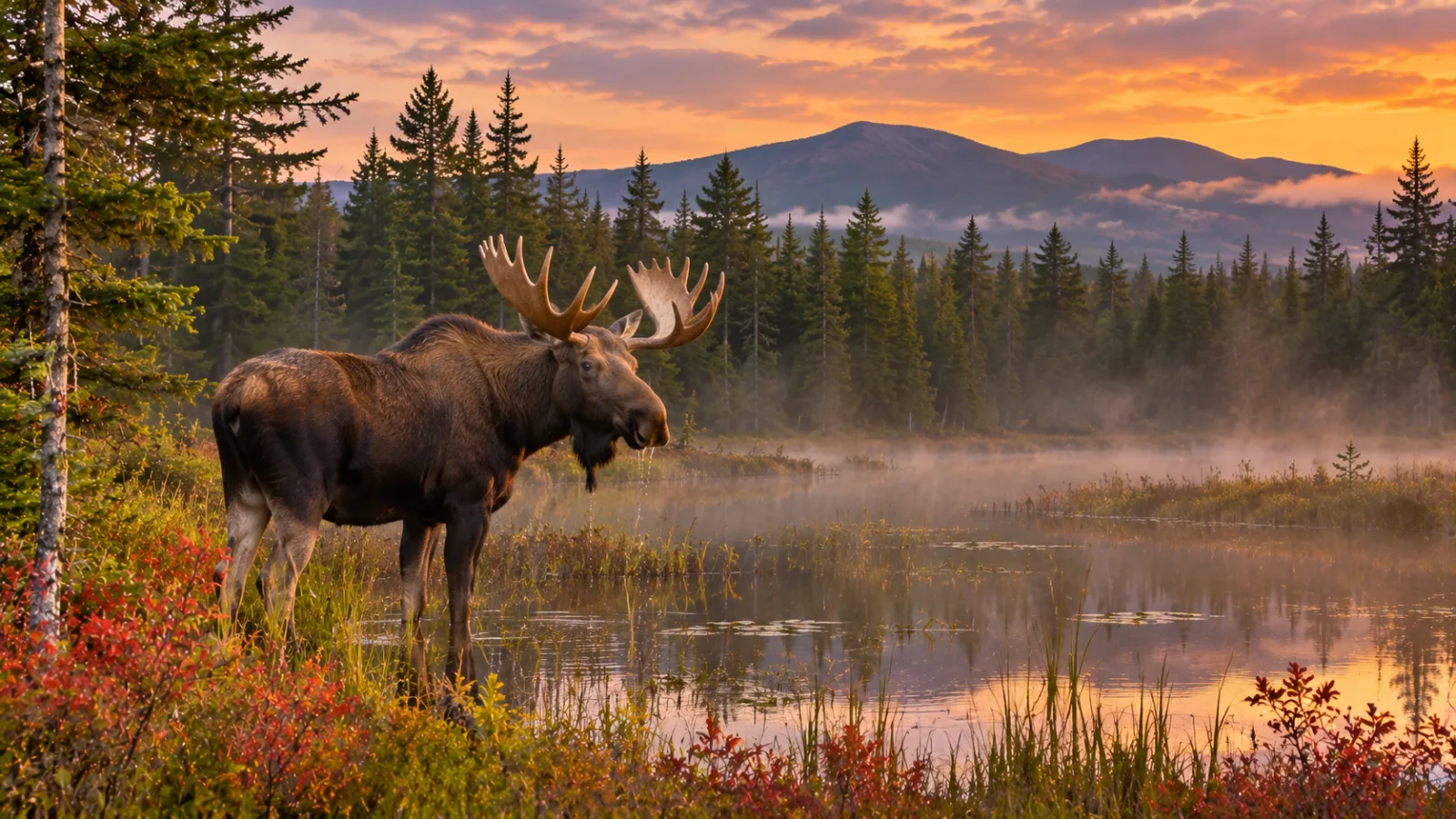
There are about 3,000 moose in New Hampshire in 2026, per NH Fish and Game, found in all ten counties and concentrated in the Great North Woods. The best place to see one is Moose Alley, Route 3 north of Pittsburg village, at dawn or dusk from late May through July. The other best places to see moose in New Hampshire, seven in all, are Route 16 between Berlin and Errol, Dixville Notch, Pinkham Notch, the Kancamagus Highway, the Route 302 corridor and the Pondicherry refuge in Jefferson.
We sell homes in Lincoln, Woodstock, Thornton, Waterville Valley and the other White Mountains towns, so the Kancamagus end of this list is in the area we work.
Key takeaways
- Population: about 3,000 moose, per NH Fish and Game's May 2026 estimate, down from 7,000 to 8,000 in the late 1990s.
- Why the decline: winter ticks. In a University of New Hampshire study, 125 of 179 radio-marked calves died over three winters.
- Best season and hour: late May to July at dawn and dusk, when moose come to roadside salt. The fall rut in late September and October is the second window.
- Near Plymouth, Campton and Waterville Valley: no source we cite names a road in these towns. The nearest named road is the Kancamagus Highway out of Lincoln.
- On the road: the state averaged 64 moose–vehicle collisions a year over the last five years, most often at dusk and at night from May through October.
In this article
- Are there moose in New Hampshire?
- How big is a New Hampshire moose?
- When are moose sightings in New Hampshire most likely?
- Where to see moose in New Hampshire: seven places in the North Country and White Mountains
- Are there moose near Plymouth, Campton and Waterville Valley?
- Moose tours in New Hampshire: Gorham and Lincoln
- Where is Moose Mountain NH, and are there moose on it?
- How dangerous are moose on New Hampshire roads?
- How does the NH moose hunt lottery work?
- Which towns put you in moose country?
- Frequently asked questions
Are there moose in New Hampshire?
Yes, there are moose in New Hampshire: about 3,000 of them, found in all ten counties, with the largest populations in the Great North Woods (NHPBS NatureWorks). The 3,000 figure is NH Fish and Game's, from its May 2026 moose lottery release. A year earlier, NHPR reported Fish and Game figures of roughly 3,000 to 4,000, against a late-1990s peak of 7,000 to 8,000.
The herd has been lower. Before European settlement New Hampshire had more moose than white-tailed deer, and by the mid-1800s, after the forests were cleared for farms, fewer than 15 moose were left in the state, according to NHPBS. The forest grew back and the moose followed it.
Winter ticks are the main cause of the current decline. The ticks look for a host in fall and feed through the winter, and a University of New Hampshire study published in the Canadian Journal of Zoology in September 2018 measured the toll. Of 179 radio-marked calves screened over the winters of 2014 to 2016, 125 died, a death rate of about 70 percent, and the calves carried an average of about 47,000 winter ticks each. Most adult moose survived but were thin and anemic, according to UNH's October 2018 release, which quotes wildlife ecology professor Pete Pekins and lists NH Fish and Game among the funders.
Fewer calves are being born, too. Wildlife biologist Eric Orff told NHPR in 2025 that fewer than half of cows now become pregnant, where nearly all older cows had twins when research began in the 1980s. In June 2022 Fish and Game and UNH began a three-year study that monitors the herd with drones and trail cameras at about 140 sites in northern New Hampshire (NHPR).
Brain worm is the second pressure. Orff told NHPR that the parasite is common in deer, does not harm them and can be fatal to moose, that it has spread south of the White Mountains, and that the deer herd in the southern half of the state has grown to around 100,000 to 120,000. The moose is not New Hampshire's state animal, either; the white-tailed deer is, as our answer on the New Hampshire state animal explains.
How big is a New Hampshire moose?
A New Hampshire moose stands about six feet at the shoulder, and a bull weighs 1,200 to 1,600 pounds with antlers that can spread four to five feet, according to NHPBS NatureWorks. Cows weigh 800 to 1,300 pounds. That size is what makes a moose a different road hazard from a deer.
Moose browse on leaves, twigs and bark, run up to 35 mph, swim at up to 6 mph and live 10 to 12 years in the wild. Temperatures above 80°F are hard on them.
When are moose sightings in New Hampshire most likely?
New Hampshire moose sightings peak from late May through July, at first light and in the hour around sunset, with a second window during the fall rut in late September and October. The cause is salt: road salt collects in roadside wet spots, and moose come to those licks.
Moose are crepuscular, most active at dawn and dusk, as the Umbagog National Wildlife Refuge in Errol puts it. Its wildlife-watching page, NH Fish and Game's Brake for Moose release and a 2017 NHPR interview with Kristine Rines, then head of Fish and Game's moose project, give this calendar:
| Months | What the sources say moose are doing |
|---|---|
| November to March | Sheltering in the woods on cold, windy or cloudy days (Umbagog refuge) |
| April and May | Coming to the roads to lick the salt left by melting snow (Umbagog refuge); the collision season starts in May (Fish and Game) |
| June to August | Roadside salt licks are "a pretty good bet" (Rines, NHPR); in forest shade on hot days, nearer roads on cloudy ones (Umbagog refuge) |
| September and October | The mating period, when moose are readily seen (Umbagog refuge); collisions stay frequent through October (Fish and Game) |
The refuge describes seasons, not months, so the month groupings are ours.
A hot July afternoon is therefore the worst time to look, and a cool, cloudy evening is the best. After dark, the refuge notes, a moose's dark coat makes it very hard to see.
Moose sightings in NH are rarer than they were. Hunting guide Dennis Witcher told NHPR in 2017 that drivers used to see 20 or 30 moose a day from the road, and that seeing 10 a day now takes five to eight miles of walking. Rines's advice in the same report was to find a young, recently clear-cut woodland in northern New Hampshire and watch it at dusk or dawn. The refuge points to roadside wallows, the muddy, trampled spots where moose feed.
Where to see moose in New Hampshire: seven places in the North Country and White Mountains
The best place to see moose in New Hampshire is Moose Alley, Route 3 north of Pittsburg village. The seven named places, in the order we would try them:
- Moose Alley: Route 3 from Pittsburg village to the Canadian border (Pittsburg)
- Thirteen Mile Woods and Pontook: Route 16 between Berlin and Errol (Errol)
- Dixville Notch: Route 26 between Errol and Colebrook (Colebrook)
- Pinkham Notch: Route 16 between Jackson and Gorham (Gorham)
- The Kancamagus Highway and Bear Notch Road: Route 112 between Lincoln and Conway (Lincoln)
- The Route 302 corridor: Zealand Road, Jefferson Notch Road and Route 115 (Twin Mountain)
- Pondicherry Wildlife Refuge: the rail trail from Airport Road to Little Cherry Pond (Jefferson)
Six of the seven are named by a wildlife refuge, a visitor bureau, a chamber of commerce or a Fish and Game biologist. The order, North Country first, is our judgment, not a measured sighting rate.
| # | Where to see a moose in NH | Who names it, and why | From Lincoln | From Plymouth | From North Conway |
|---|---|---|---|---|---|
| 1 | Moose Alley | Wikipedia's Connecticut Lakes State Forest entry: popular with moose watchers in late spring and summer | 2 hr 20 min | 2 hr 40 min | 2 hr 40 min |
| 2 | Thirteen Mile Woods and Pontook | Umbagog refuge: the road borders the Androscoggin's swampy backwaters | 2 hr 15 min | 2 hr 35 min | 1 hr 50 min |
| 3 | Dixville Notch | Umbagog refuge: a Fish and Game wildlife viewing area just before the notch; White Mountains visitor bureau | 2 hr 10 min | 2 hr 35 min | 2 hr 15 min |
| 4 | Pinkham Notch | White Mountains visitor bureau: frequent sightings reported | 1 hr 25 min | 1 hr 50 min | 30 min |
| 5 | Kancamagus Highway and Bear Notch Road | White Mountains visitor bureau: frequent sightings; Fish and Game's Rines named a moose lick on Bear Notch Road | 45 min | 1 hr 10 min | 30 min |
| 6 | Route 302 corridor | Twin Mountain–Bretton Woods chamber's moose-watching roads | 40 min | 1 hr | 50 min |
| 7 | Pondicherry Wildlife Refuge | U.S. Fish and Wildlife: 6,405 acres with moose on the mammal list; viewing platform | 55 min | 1 hr 15 min | 1 hr 15 min |
Drive times are our estimates, computed in November 2026 with a public OpenStreetMap router (OSRM) and rounded to five minutes, without traffic or stops. They are measured to Pittsburg village, Errol, Dixville Notch, the Pinkham Notch visitor center, the Bear Notch Road junction on the Kancamagus, Zealand Road and the Airport Road trailhead.
Moose Alley on Route 3 in Pittsburg
Moose Alley, the stretch of U.S. Route 3 from Pittsburg village north past the Connecticut Lakes to the Canadian border, is the best place to see a moose in NH. Its northern end runs through the Connecticut Lakes State Forest, a narrow strip on either side of the highway that draws moose watchers in late spring and summer, especially at dawn and dusk (Wikipedia).
Pittsburg is the largest town by area in New England, about 291 square miles with 800 residents at the 2020 census, and Route 3 is its only major highway (Wikipedia). Pittsburg village is about 2 hours 20 minutes from Lincoln by our estimate, so plan on staying the night. Our answer on buying a camp or land in Pittsburg covers the camps along the corridor.
Route 16 and Route 26: Errol, Thirteen Mile Woods, Dixville Notch and Pinkham Notch
Route 16 between Berlin and Errol, through the Thirteen Mile Woods and past Pontook Reservoir, is the second place to try, because the road borders the swampy backwaters of the Androscoggin River, according to the Umbagog refuge. North of Errol on Route 16, the refuge lists a small pond just north of the Errol dam and a long muddy wallow on the right about 1.5 miles north of the refuge headquarters. In Milan, it points to several wallows on Success Road, reached by crossing the Androscoggin bridge and turning right on East River Road.
Route 26 runs west from Errol through Dixville Notch to Colebrook. The refuge says moose appear at the edge of the thick woods along it, and notes a NH Fish and Game wildlife viewing area on the left just before Dixville Notch. East of Errol, it lists a wallow on Route 26 about 5 miles out, toward Upton, Maine.
Farther south, Route 16 runs through Pinkham Notch between Jackson and Gorham. The White Mountains visitor bureau names Pinkham Notch, the Kancamagus Highway and Route 26 in Dixville Notch as the places where frequent sightings are reported.
The Kancamagus Highway and Bear Notch Road near Lincoln
The Kancamagus Highway, Route 112 between Lincoln and Conway, is the moose road closest to the homes we sell, and the White Mountains visitor bureau lists it among the areas where frequent sightings are reported. Bear Notch Road, which leaves the Kancamagus for Bartlett, has a moose lick, Fish and Game's Kristine Rines told NHPR in 2017. For the rest of the area, see our guides to things to do in Lincoln NH, things to do near Loon Mountain and the best hikes and waterfalls in the White Mountains.
The Route 302 corridor: Zealand Road, Jefferson Notch Road and Route 115
The Twin Mountain side of the White Mountains has four moose-watching roads named by the Twin Mountain–Bretton Woods chamber. Zealand Road leaves Route 302 a couple of miles southeast of the Route 3 junction, at the signs for Zealand Campground. Route 115 runs from Route 3 to Route 2 in Jefferson. Mt. Clinton Road, just north of the gateway of Crawford Notch, makes a loop with Base Road and Jefferson Notch Road, which is not maintained in winter.
The chamber says locals use "Moose Alley" for the stretch from the Route 3 and I-93 junction near Franconia Notch to Bartlett village on Route 302. When a site says "Moose Alley" without a town, check which road it means.
Pondicherry Wildlife Refuge in Jefferson
Pondicherry is the one place on this list you walk to. The U.S. Fish and Wildlife Service lists the Pondicherry Division of the Silvio O. Conte refuge at 6,405 acres in Jefferson, Whitefield and Carroll, with moose, black bear and beaver on its mammal list. The rail trail into it is reached from trailheads on Airport Road and Route 115A in Jefferson, per the refuge's visitor page. The Little Cherry Pond Trail, a one-mile National Recreation Trail off the rail trail, ends at a viewing platform where its listing says moose, beaver and otter are often seen.
Are there moose near Plymouth, Campton and Waterville Valley?
Moose are found in every New Hampshire county, Grafton County included, but none of the refuge, visitor-bureau, chamber or Fish and Game sources in this guide names a road in Plymouth, Campton, Thornton or Waterville Valley as a place to see one. The nearest named road is the Kancamagus Highway, which starts in Lincoln, up I-93 from Campton and Plymouth.
NH Fish and Game says moose–vehicle collisions happen statewide and on all types of roads, so the driving advice below applies on Route 49, Route 175 and I-93 as much as on Route 3 in Pittsburg.
Moose tours in New Hampshire: Gorham and Lincoln
The two moose bus tours we could confirm for 2026 leave from Gorham and Lincoln, and both go out in the evening, when moose are most active. Gorham NH moose tours are run by the Town of Gorham's Parks and Recreation department, not a private company; Pemi Valley Moose Tours is a private company in Lincoln.
| Gorham Moose Tours | Pemi Valley Moose Tours | |
|---|---|---|
| Operator | Town of Gorham Parks and Recreation | Private company |
| Departs from | Information booth, Town Common, 69 Main Street, Gorham | 136 Main Street, Lincoln |
| 2026 season | Last tour September 5 | Opened May 16 |
| Start time | 7 p.m. | Confirm when booking |
| Length | 3 to 4 hours | Not stated |
| Fares | Not posted | $48 adults, $38 children 12 and under; $2 off per person for cash |
| Stated sighting rate | None stated | 90 percent; sightings not guaranteed |
Sources: the town's ticketing page and Pemi Valley Moose Tours, both checked in November 2026. Neither had posted 2027 dates, so confirm dates and fares with the operator.
In a 2023 Boston Globe report, the White Mountains Visitor Center said the tour companies see moose about 90 percent of the time. Directories also list moose tours out of North Conway and Freedom; we found no operator page with 2026 or 2027 dates for them, so call before you plan around one.
Where is Moose Mountain NH, and are there moose on it?
Moose Mountain, New Hampshire, is two different places, and neither is a reliable place to see a moose. The first is Moose Mountain in Hanover, an 8-mile ridge carrying the Appalachian Trail, with a North Peak of 2,303 feet and a South Peak of 2,293 feet (Wikipedia); trailheads are on Three Mile Road in Hanover and Goose Pond Road in Lyme. A map search for "Moose Mt NH" can return either place, so check the town.
The second is the Moose Mountains Reservation in Middleton and Brookfield, east of Lake Winnipesaukee, where the Forest Society owns 2,744 acres, protected in a project it began with Moose Mountains Regional Greenways in 2003 and completed in 2006. Its trails climb Phoebe's Nable (1,185 feet) and Piper Mountain from a small lot at the end of New Portsmouth Road, which isn't plowed in winter. The Forest Society says the young growth left by past timber harvests supports moose and other large mammals.
How dangerous are moose on New Hampshire roads?
New Hampshire averaged 64 moose–vehicle collisions a year over the last five years, most often at dusk and at night from May through October, according to NH Fish and Game's "Brake for Moose" release of May 2026. That is down from a five-year average of 75 in its 2023 release, which counted 58 collisions in 2022. A dark brown moose is hard to see against pavement at night.
Fish and Game's advice for driving in moose country:
- Don't drive at high speeds, and wear your seatbelt.
- Scan the sides of the road.
- Use high beams whenever possible, and be able to stop within the zone of your headlights.
- Don't depend on eye shine, because moose don't always look at an approaching vehicle.
- If you see a moose, slow down or stop if necessary until you have passed it or it has left the road.
What should you do if a moose is close or approaches?
Stay back, and stay in the car if you have pulled over. The White Mountains visitor bureau's advice is never to approach a moose and to remain inside your vehicle, because a moose that feels threatened may stand its ground or charge. The Umbagog refuge says to watch through binoculars or a spotting scope, that you are too close if the animal changes its behavior because of you, and that a cow with calves is very protective and may charge.
How does the NH moose hunt lottery work?
The NH moose hunt is by lottery permit only, and the number of permits has fallen with the herd. NH Fish and Game issued 33 permits for 2026, the same as 2025. The 2026 drawing pulled from 5,914 applicants, with odds of 1 in 109 for residents and 1 in 495 for nonresidents; the 2025 permit holders took 23 moose, a 72 percent success rate.
The hunt began in 1988 with 75 permits for a three-day North Country season, per Fish and Game. The 2026 entry deadline was May 29, with a $15 fee for NH residents and $25 for nonresidents, and the nine-day season ran October 17 to 25 across eight Wildlife Management Units.
Which towns put you in moose country?
Pittsburg, Errol, Berlin and Gorham sit on the North Country moose roads above; Lincoln and Woodstock are at the west end of the Kancamagus; and Thornton, Waterville Valley, Campton and Plymouth are down I-93 from it. Our camps for sale in New Hampshire guide covers what to check on a Pittsburg camp, and the live listings for Pittsburg, Errol and Gorham are on their town pages. For Berlin, see why homes in Berlin NH are so cheap.
Along I-93, Lincoln, Woodstock, Thornton, Waterville Valley and Franconia are the towns we work nearest the Kancamagus and the Route 302 corridor. For more to do in the region, see our list of things to do in the White Mountains. When you're ready to look at a specific camp or ski house, our buyer's page explains how we work.
Frequently asked questions
How many moose are in New Hampshire?
New Hampshire has about 3,000 moose in 2026, per NH Fish and Game. The moose population peaked at 7,000 to 8,000 in the late 1990s and has fallen by more than half. Moose are found in all ten counties, with the largest populations in the Great North Woods.
Why is the moose population in New Hampshire declining?
Winter ticks are the main cause of the moose decline in New Hampshire. In a University of New Hampshire study published in the Canadian Journal of Zoology in 2018, 125 of 179 radio-marked calves died over the winters of 2014 to 2016, about 70 percent, and calves carried an average of about 47,000 ticks. Brain worm, a parasite carried by deer, is the second pressure.
Where is the best place to see a moose in New Hampshire?
Moose Alley, the stretch of Route 3 from Pittsburg village north to the Canadian border, is the best place to see a moose in New Hampshire. Route 16 between Berlin and Errol, Route 26 at Dixville Notch, Pinkham Notch, the Kancamagus Highway, the Route 302 corridor near Crawford Notch and the Pondicherry refuge in Jefferson are the other six of the seven named places.
Where can I see moose in New Hampshire's White Mountains?
In the White Mountains, the regional visitor bureau reports frequent moose sightings along the Kancamagus Highway and in Pinkham Notch. Fish and Game's Kristine Rines named a moose lick on Bear Notch Road, off the Kancamagus, and the Twin Mountain–Bretton Woods chamber lists Zealand Road, Route 115 and Jefferson Notch Road. Watch roadside wet areas at dawn and dusk.
When is the best time to see moose in NH?
Late May through July at dawn and dusk is the best time to see moose in NH, when the animals come to roadside salt licks. The fall rut in late September and October is the second window. Avoid hot afternoons: the Umbagog refuge says moose move into forest shade on hot days and are more likely to be near roads on cloudy ones.
Is there a moose tour in New Hampshire?
Yes. The two we could confirm for 2026: the Town of Gorham runs Gorham Moose Tours from the information booth on the Town Common at 69 Main Street, with 7 p.m. starts on its 2025 and 2026 ticket pages. Pemi Valley Moose Tours runs evening bus tours from 136 Main Street in Lincoln, $48 for adults in 2026, and claims a 90 percent success rate. Neither guarantees a moose.
What is Moose Alley in New Hampshire?
Moose Alley is the local name for U.S. Route 3 from Pittsburg village north past the Connecticut Lakes to the Pittsburg–Chartierville border crossing, New Hampshire's only Canadian border crossing. The road runs through forest and bog and draws moose watchers at dawn and dusk. The Twin Mountain–Bretton Woods chamber uses the same name for the Route 3 and Route 302 stretch from Franconia Notch to Bartlett.
What should I do if I see a moose on the road?
If you see a moose on the road, slow down or stop if necessary until you have passed it or it has left the road, NH Fish and Game advises. Its Brake for Moose guidance adds: use high beams whenever possible and be able to stop within the zone of your headlights. If you stop to watch, pull over to the side, stay in the car and do not approach.
How many moose hunting permits does New Hampshire issue?
New Hampshire issued 33 moose hunting permits by lottery in 2026, the same number as in 2025, according to NH Fish and Game. The 2026 drawing had 5,914 applicants, with odds of 1 in 109 for residents and 1 in 495 for nonresidents.