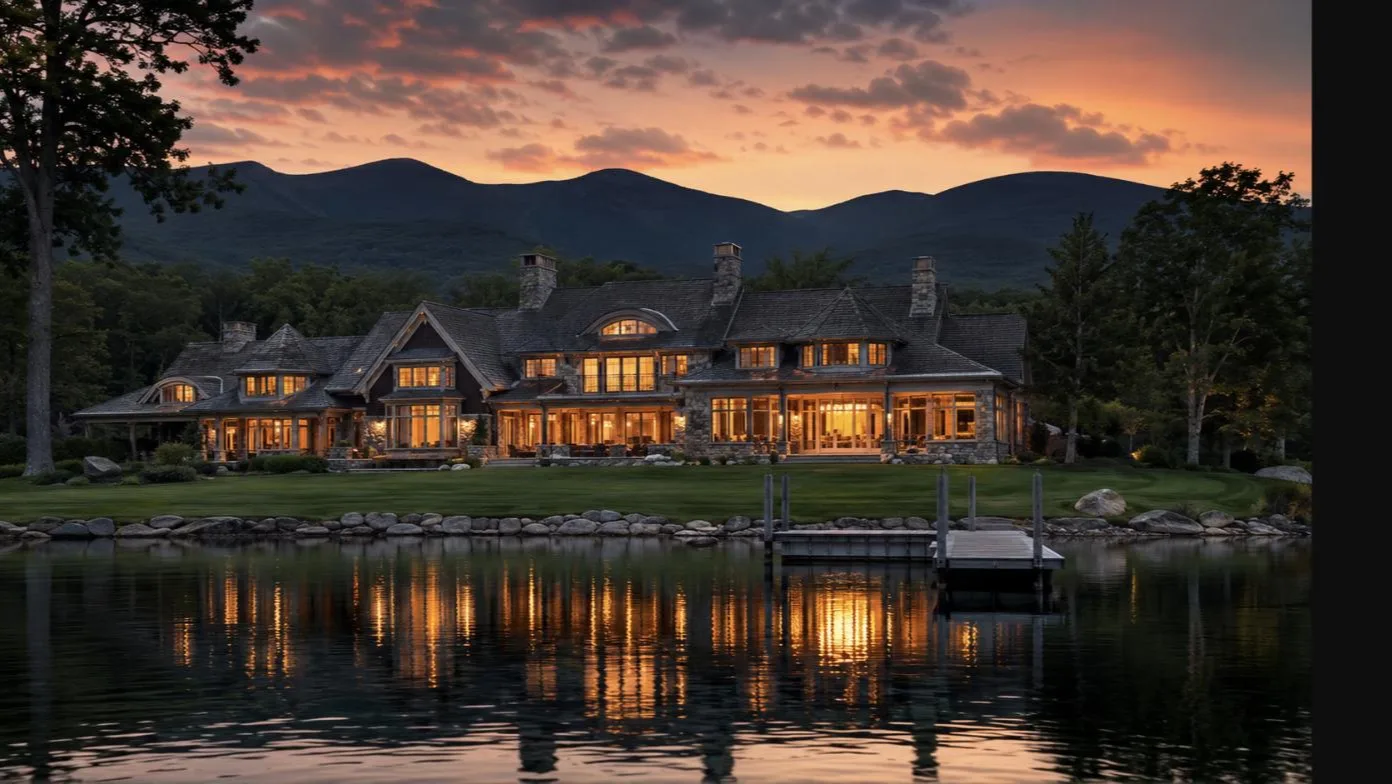

Luxury homes in central New Hampshire start where most of the state's market ends. Above $1 million, the inventory stops being a spread of houses and becomes a short list of holdings: lakefront compounds in the Lakes Region, mountain estates with protected views, rural properties measured in acreage rather than square feet, and resort homes inside golf-and-ski communities like Owl's Nest and Waterville Valley. It is a small market spread across a very large map, and it behaves differently from luxury real estate in southern New Hampshire or on the Seacoast. This guide covers what "luxury" actually means up here, where the inventory concentrates, and how the buying process itself changes at this tier.
One scoping note first: if the search is specifically for a grand lake house, the deep dive already exists — our tour of New Hampshire's grandest lake homes walks the top of the waterfront market lake by lake, from the $5 million club to the record sales and what frontage feet and southwest exposure really do to a price. This guide treats the lakes as one corridor among several and stays at the map level; keep that piece open for the water-specific detail.
What "luxury" means in central New Hampshire
New Hampshire's luxury market has three distinct centers of gravity, and they price on different logic.
On the Seacoast, luxury means oceanfront scarcity along a famously short stretch of Atlantic coastline — and it holds the state's ceiling. The two most expensive homes ever sold in New Hampshire are both oceanfront in Rye, topping out at $25 million in late 2022. In southern New Hampshire, luxury mostly means executive homes within commuting reach of Boston — large new construction on landscaped lots in low-tax towns near the Massachusetts border, priced substantially on proximity.
Central New Hampshire prices on none of that. Here, luxury means land, water, view, and recreation: how many feet of shoreline, how many acres between the house and the road, whether the view of the Sandwich Range or Franconia Ridge is protected, how far the mudroom door sits from a chairlift or a first tee. The freshwater record for the state — a Wolfeboro estate on Lake Winnipesaukee that closed at $12.3 million in 2022 — was, underneath the number, a purchase of 841 feet of private shoreline. That is the tier's honest unit of account: the irreplaceable thing the house happens to sit on.
The other defining trait is thinness. As of August 2026, roughly 200 active listings statewide ask $2.5 million or more, and about a third of those are on the water. Spread the remainder across the White Mountains, the Lakes Region hills, and the rural towns between, and most individual towns hold a handful of true luxury listings at any moment — sometimes none. That scarcity shapes everything about how this market is searched, priced, and negotiated, which is where this guide ends up.
The three corridors
Nearly all of central New Hampshire's luxury inventory falls into three corridors. Most serious buyers end up choosing between them — and the choice says more about how they want to live than about budget.
Lakes Region waterfront
The deepest luxury market in the state's interior, anchored by Lake Winnipesaukee and its estate corridors around Wolfeboro, Meredith, and Moultonborough, with Squam Lake playing the quiet, scarce counterpart — a lake where conservation land and family trusts keep most of the shoreline off the market permanently, so budget clears almost everything that lists and the real constraint is that almost nothing does. Smaller lakes like Newfound and Winnisquam offer estate-quality water at ceilings closer to where the trophy lakes begin. Waterfront is where central New Hampshire's biggest numbers live, and it is the corridor most governed by fixed supply: state shoreland rules make new frontage effectively impossible to create. The full tier-by-tier treatment is in the lake homes deep dive, and the live waterfront inventory across the state is on our New Hampshire lake homes page.
White Mountains resort towns
The second corridor runs up I-93 and Route 49 into the mountains: Waterville Valley, the Lincoln–Woodstock corridor, and the resort communities around Campton and Thornton. Luxury here looks different — less about shoreline, more about slopeside and fairway position, mountain views, and turnkey amenity. The clearest example is Owl's Nest Resort, where new-construction single-family homes and townhomes wrap a championship golf course with the Sandwich Range as the backdrop, and ownership comes bundled with the resort layer — golf, racquet sports, dining, a lake club — rather than assembled piece by piece. Waterville Valley plays the legacy version: an alpine village ringed by national forest, where the constraint is that the town simply cannot sprawl. Resort-corridor luxury tends to be newer, lower-maintenance, and easier to lock-and-leave than its lakefront equivalent, which matters to second-home owners who would rather ski than winterize.
Rural estates
The third corridor has no signage: the hill farms, view parcels, and horse properties scattered through towns like Sandwich, Holderness, Center Harbor's back roads, and the Baker River valley. This is where acreage is the headline — long driveways, big timber, mountain views across owned fields, barns and outbuildings. Prices per square foot can look modest next to the waterfront; prices per unit of privacy are the point. These properties trade less often, market more quietly, and reward buyers who know what restored post-and-beam construction, managed woodlot, and current-use land enrollment actually mean on a tax card.
One boundary note: to the southwest, the Dartmouth–Lake Sunapee area runs its own luxury market on similar logic — a deep, cold lake with Mount Sunapee's ski slopes minutes from the shoreline. Buyers weighing central New Hampshire against Sunapee are usually deciding between Winnipesaukee's boating scale and Sunapee's ski-and-lake compactness; the mechanics of buying at this tier, covered below, are the same in both.
The trade-off that sorts every buyer: privacy versus amenity
Ask enough buyers at this tier what they want and the same tension surfaces every time. Privacy and amenity sit at opposite ends of one axis, and nearly every central New Hampshire luxury property is a position on it.
At the privacy end: the rural estate or the big-frontage lake compound. Nobody in the sightline, total control of the land, and total responsibility for it — plowing, caretaking, dock and barn maintenance, a property that needs managing whether or not anyone is home. At the amenity end: the resort home, where the golf course, trails, pools, and restaurants are somebody else's job to run, the house can sit empty for six weeks without worry, and the trade is association fees and neighbors within sight.
There is no right answer, but there is a right answer per buyer, and it is worth settling before touring anything — because the two ends of the axis are in different towns, and a search that hasn't chosen will zigzag across two hours of map for a season. A useful test: picture arriving on a Friday night in February. If the fantasy is silence and your own tracks in the snow, shop the privacy end. If it's dropping bags and walking to dinner, shop the resort end.
How buying changes above $1 million
The mechanics of a luxury purchase in central New Hampshire differ from the mid-market in ways that surprise even experienced homeowners.
Comparables get scarce, so pricing gets interpretive. In a market where a town may see a few sales a year at this tier, there is often no clean comp for the property in front of you. Appraisals take longer and lean on judgment; asking prices reflect seller conviction as much as market evidence; and the spread between ask and eventual sale price tends to widen as prices climb. Buyers at this tier benefit from an agent who can build the value case from components — land, frontage, view protection, build quality — rather than from three recent sales that don't exist.
A meaningful share of the market never hits the portals. Estate-grade properties here are often held for decades and sold quietly — owners who will transact at the right number without ever wanting a sign at the road, listings tested privately before going public. Working this tier means working relationships: brokers who hear about properties early, and buyers who are positioned — financing settled, criteria sharp — to move when something surfaces.
Discretion runs both directions. Sellers at this tier frequently want privacy around the sale; buyers often want privacy around the purchase, from showing logistics to how the ownership is structured. Expect confidentiality to be a normal part of the conversation rather than an exotic request, and expect your representation to treat it that way.
Diligence gets heavier. Waterfront permits and shoreland setbacks, current-use land enrollment and the tax recapture that comes with changing it, private roads and road associations, wells and septic sized for guest houses, view easements — the due-diligence surface of a central New Hampshire estate is wider than a subdivision colonial's, and the expensive surprises live in deeds and tax cards, not in the photos. Build time for real diligence into any offer.
The carrying-cost math
New Hampshire sweetens the luxury purchase in ways buyers from other states don't expect: no broad income tax, no sales tax, and no mansion tax. What every sale pays is the state's real estate transfer tax — $0.75 per $100 of price from each side, 1.5 percent combined — and what every year pays is the local property tax, set town by town.
That town-by-town spread is a genuine strategic variable at this tier. Moultonborough's 2025 rate was $5.33 per $1,000 of assessed value — among the lowest in New Hampshire, courtesy of a shoreline-heavy tax base — while the statewide average ran about three times that. On a multi-million-dollar assessment, the town line compounds into six figures over a holding period, which is part of why the quiet corners of the map hold so much quiet money. The full system — rates, equalization ratios, current-use recapture — is in our New Hampshire property taxes guide.
Who buys here
The buyer pool at this tier is more varied than the marketing photography suggests, but a few profiles recur. Boston-and-southern-NH families buying the long-term second home — the largest group, typically shopping the resort corridor or the lakes, planning around school vacations and a two-hour Friday drive. Relocators and remote-work primaries trading a metro house for a full-time life here, often landing in the rural corridor where their budget buys land and quiet no suburb can match. Legacy buyers — people who summered on a lake as children and are buying their way back, usually the most patient and most specific searchers in the market. And retirees consolidating, selling elsewhere and buying the one property everything now revolves around, for whom single-level living, proximity to Plymouth or Meredith services, and lock-and-leave ease quietly outrank acreage.
What unites them: almost nobody at this tier needs to buy. That makes the market slower-moving and more deliberate than the entry tiers — and it makes preparation, not urgency, the buyer's real advantage.
Selling a luxury property in central New Hampshire?
Everything about thin comps and off-market discretion applies double for sellers. At this tier the marketing question is not "list it where everyone looks" but "put it in front of the specific buyer pools who transact here" — and the pricing question is a value case built from components, because the three recent comps usually do not exist. Whether you want a full public launch or a quiet test of the market first, start with a confidential home valuation and a look at how we handle selling at the estate tier.
Frequently asked questions
What counts as a luxury home in central New Hampshire?
In practice the tier starts around $1 million, and it thins fast: as of August 2026, roughly 200 active listings statewide asked $2.5 million or more, about a third of them on the water. Spread across the region's map, most individual towns hold only a handful of true luxury listings at any moment — sometimes none.
Which New Hampshire lakes have luxury waterfront homes?
Lake Winnipesaukee carries the deepest luxury waterfront market in the state's interior, with estate corridors around Wolfeboro, Alton, Meredith, and Moultonborough. Squam Lake holds some of the most expensive — and least available — water in New Hampshire, with much of its shoreline in conservation. Newfound Lake, Lake Wentworth, and Lake Winnisquam offer estate-quality water below the trophy-lake ceiling, and Lake Sunapee anchors its own luxury market to the southwest. The tier-by-tier tour is in our grandest lake homes piece.
Which towns in central NH have the most luxury homes?
On the water: Wolfeboro, Moultonborough, Meredith, Alton, and Tuftonboro on Winnipesaukee, plus Holderness and Sandwich around Squam. In the mountains: Waterville Valley, Campton, and Thornton, where resort communities like Owl's Nest concentrate the new-construction tier. Moultonborough deserves special mention for pairing heavy shoreline with one of the lowest tax rates in the state.
What is the most expensive home ever sold in New Hampshire?
An oceanfront estate in Rye, which closed at $25 million in late 2022. The freshwater record is a Wolfeboro estate on Lake Winnipesaukee that closed at $12.3 million the same year — a purchase that was, underneath the number, 841 feet of private shoreline.
Do luxury homes in New Hampshire sell off-market?
A meaningful share do. Estate-grade properties are often held for decades and sold quietly — tested privately before ever going public, or transacted without a listing at all. Access at this tier runs on broker relationships and on buyers who are prepared to move when something surfaces.
Does New Hampshire have a mansion tax?
No — no mansion tax, no broad income tax, no sales tax. Every sale pays the state's real estate transfer tax of 1.5 percent combined, split evenly between buyer and seller, and the cost that genuinely shapes ownership is the annual town-set property tax.
Where to start
Central New Hampshire's luxury market rewards specificity. Settle the corridor question first — water, resort, or land — then let the search be patient and the preparation be complete. The live inventory, filterable by town, price, and waterfront, is on our property search; the lake-specific tier is mapped in detail in the grandest lake homes tour; and if the resort corridor is calling, start with what it's actually like to live at Owl's Nest. When something worth moving on surfaces — on the market or off — the buyers who get it are the ones who were ready before it appeared.