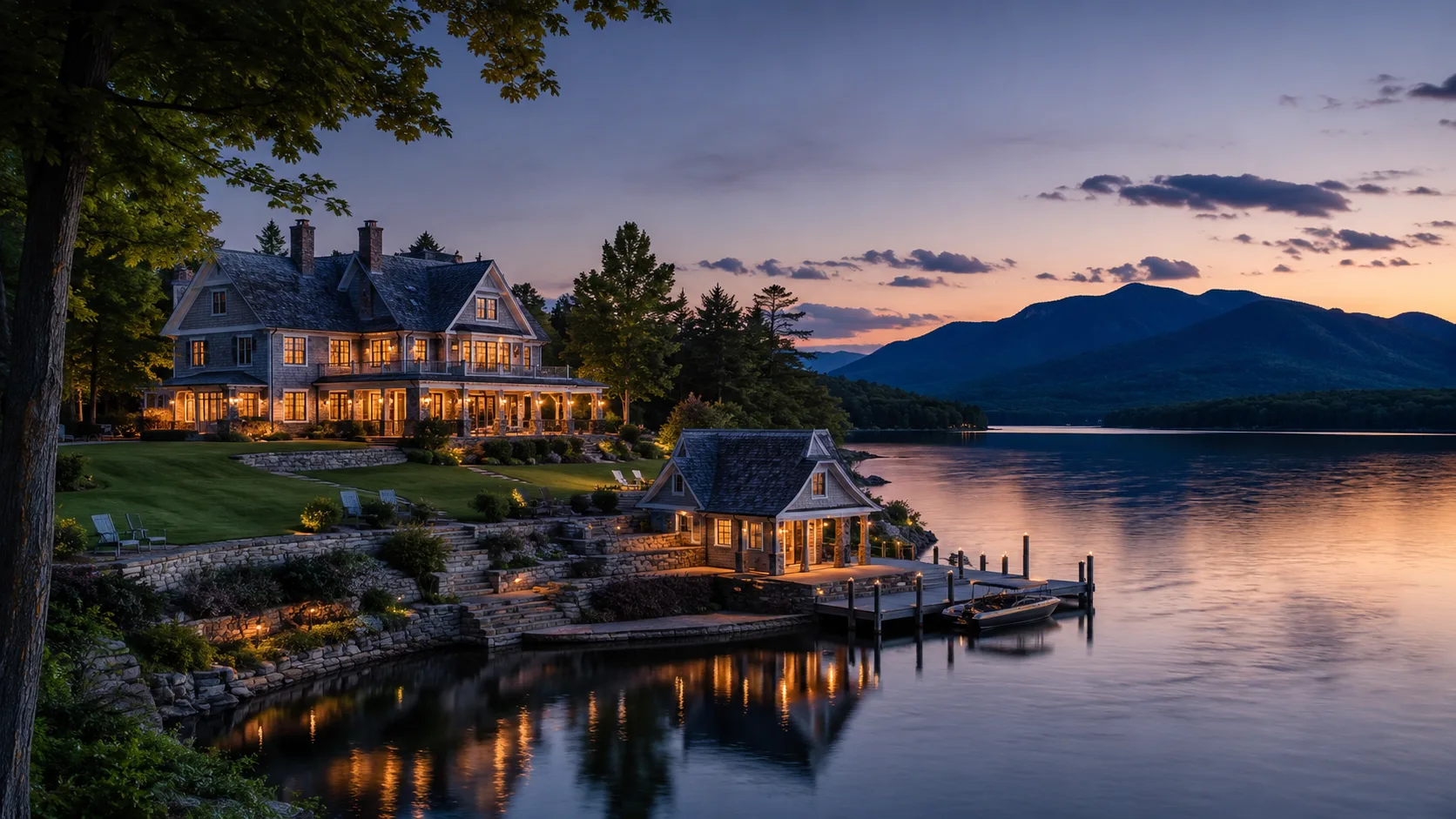

Lake houses for sale in NH run from $400,000 camps to eight-figure Winnipesaukee estates — and the market at the very top is smaller and stranger than people assume. Most buyers shopping lake homes for sale in NH spend their search between $400,000 and $1.5 million — camps, capes, ski condos, the occasional point lot — but sooner or later everyone touring a lake asks the same question, usually between the second and third showing: what do the really big ones go for?
Fair question. Most of what's written about this tier is either a listing portal or a slideshow of superlatives. This is the other thing — a broker's tour of the actual top of the market, with numbers pulled from the MLS in August 2026. Who's asking what, on which lake, for how many feet of shoreline, and what the handful of genuine record sales tell us about where the ceiling really is.
If you're shopping this tier — or just calibrating a serious budget against it — our lakefront homes page carries the live waterfront inventory across every lake we work, updated daily, and our New Hampshire lake homes for sale page covers lake houses for sale across NH at every price point. Keep them open in another tab. The rest of this article is the context that makes those listings make sense.
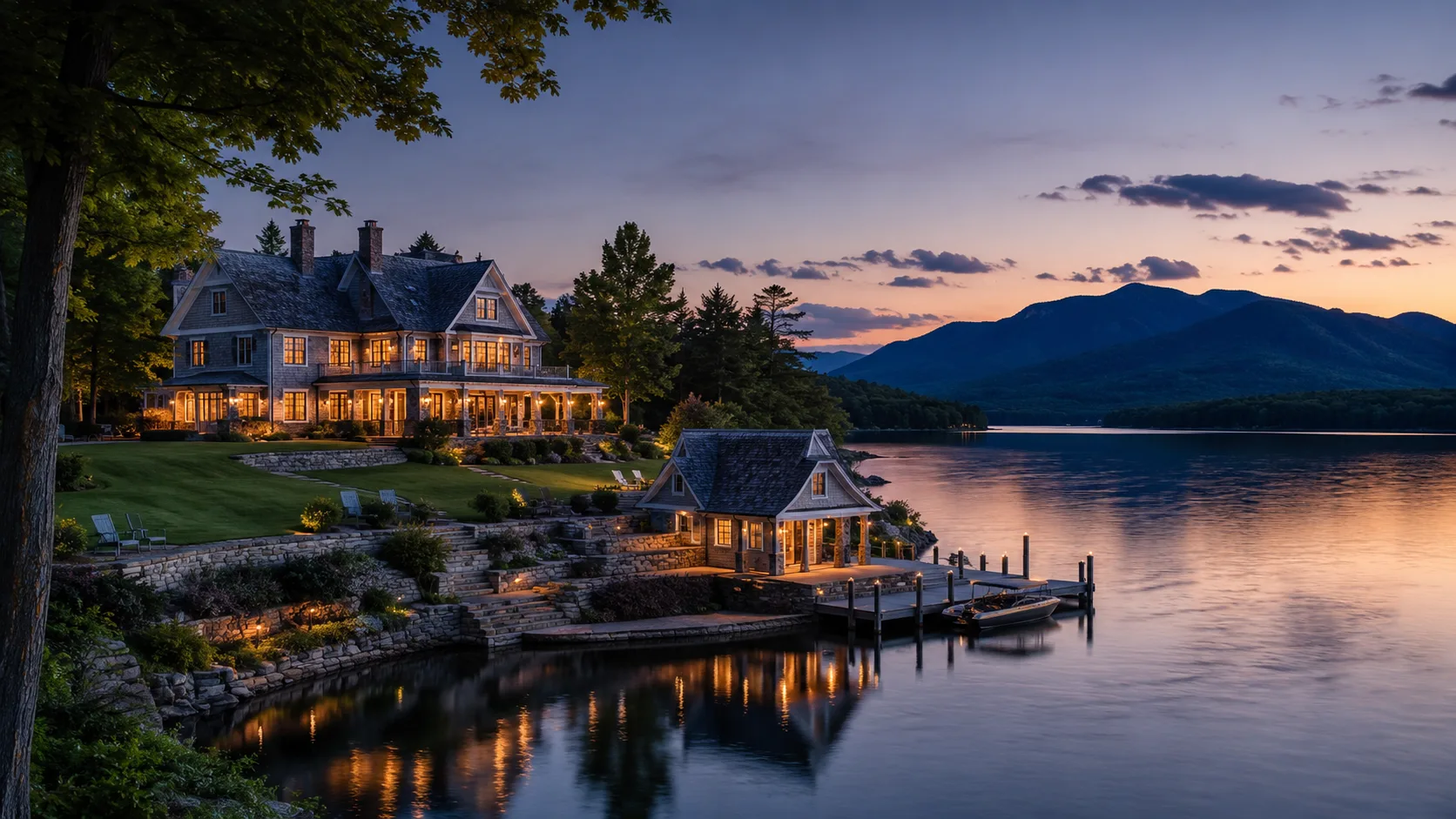
Lake houses for sale in NH: the top of the market, counted
Let's define the tier before we admire it. As I write this, there are 66 active waterfront-flagged listings in New Hampshire asking $2.5 million or more — that's the whole state, every water body, oceanfront included. Out of roughly 200 active listings statewide asking $2.5 million and up, in other words, about a third are on the water, and nearly all of the rest are trying to see it from a hill.
The shape of those 66 tells you how fast this market thins. Twenty-six of them sit between $2.5 and $3.5 million. Another 25 fill the band from $3.5 to $5 million. And then there's the $5 million club: fifteen listings statewide, which — once you delete a duplicate entry and one Rye oceanfront — comes to about a dozen actual freshwater properties. That's the whole inventory. A patient buyer with $5 million can tour every competing property in New Hampshire in two unhurried days, and I've done that drive.
Price per square foot at this tier runs right around $1,400 as a median, which sounds precise until you notice the spread — the top of the lake market prices land and shoreline, not drywall. A 1,129-square-foot cottage in Tuftonboro is asking $3.5 million right now, which pencils to more than $3,000 per square foot and is really a land trade with a roof on it.
Two ceilings worth knowing. The highest waterfront-flagged ask in the state is a Tuftonboro estate at $12.9 million — though it's worth being precise about what that is: 114 hilltop acres with an equestrian setup, a 7,868-square-foot main house from 2008, and big views of Winnipesaukee and the Ossipee Range, with its actual frontage on a private pond. The highest ask with true big-lake frontage is a Wolfeboro Neck estate on Winnipesaukee at $10.95 million — 14,778 square feet, seven bedrooms, 6.2 private acres, and 430 feet of shoreline with uninterrupted south-to-southwest exposure across the Broads. That one is the current king of the lake market, and it's the correct kind of king: the money is in the land, the frontage, and the light.
The records, so we're calibrated
Before anyone quotes you a number with the word "trophy" in the sentence, here's what the top of this market has actually done — not asked. Done.
The most expensive home ever sold in New Hampshire is not on a lake. It's 30 Straws Point in Rye, oceanfront, which closed at $25 million in December 2022; the runner-up, 17 Straws Point, sold for $18.5 million in May 2024, a few doors down — the two sales that top the state's all-time list. The Seacoast holds the state's two priciest closings, and lake people should know that going in. There's a postscript that says everything about how this tier really works: the $25 million buyers went on to pick up the house next door for another $8.5 million, and the plan on file is to level both and build new. Even the state record was, underneath the number, a land trade.
The freshwater record belongs to Wolfeboro: 144 Springfield Point Road, which closed at $12.3 million in October 2022 — about 19,300 square feet, eight bedrooms, 7.1 acres, and 841 feet of exclusive Winnipesaukee frontage. Two details make it the most instructive sale in the state. First, the same house set the record once before, at $8.97 million in 2014 — an eight-year, 37 percent appreciation story at the very top of the market. Second, it was listed at $19.5 million before selling at $12.3 million. Even record-setters negotiate.
And then the cautionary tale every luxury seller in New Hampshire should have framed above the desk. Longview, the Bahre family compound at the south end of the Broads in Alton — 38,000-plus square feet of it — went to market in 2014 at $49 million, the most ambitious ask in state history. It eventually sold in 2019 as two separate properties for roughly $5.6 million and $5.4 million. Eleven million total, against a $49 million ask. New Hampshire's top end is real, but it is not infinitely deep, and it prices land and water far more reliably than it prices marble.
So when I'm asked whether some $25 million Winnipesaukee sale actually happened — a number that floats around cocktail hours on the lake every summer — the answer is no. No New Hampshire lake sale has yet crossed $13 million. The market's been climbing toward that line for a decade, and I'd guess the Wolfeboro Neck listing or something like it eventually breaks it. But as of August 2026, $12.3 million is the summit on fresh water.
What actually sets the price
Strip the photography away and lake estates in New Hampshire are priced on about five things. In rough order of weight:
Frontage feet. The unit of account at the top of this market is not square feet of house — it's feet of owned shoreline. The state's Shoreland Water Quality Protection Act makes shoreline effectively impossible to manufacture and difficult even to modify, so the supply of 300-foot-plus parcels is fixed forever. Look back at the numbers above: 430 feet at $10.95 million, 841 feet on the record sale, 300 feet holding up a $5.2 million ask in Meredith on a house built in 1932. The house is negotiable. The frontage is the asset.
Exposure. Southwest is the magic bearing — sun on the dock all afternoon, sunset over the water at dinner. Listings at this tier say "southwest exposure" the way downtown listings say "corner unit," and the premium is real; the Wolfeboro Neck estate leads with it, and so does nearly every eight-figure ask I've ever seen on Winnipesaukee. North-facing frontage on the same lake, same feet, trades at a visible discount. It's the cheapest expensive lesson in lake valuation.
The boathouse. For decades this was the cleanest grandfathered premium in the state: NHDES prohibited new boathouses built out over the water, so an existing over-water boathouse — like the mahogany-and-fieldstone one anchoring a $9.5 million Wolfeboro listing right now — was an irreplaceable artifact you could buy but never build. That changed quietly on July 1, 2025, when a new statute, RSA 482-A:26-a, ended the long-standing prohibition and DES revised its wetlands rules to match: new over-water boathouses are now possible on natural ponds over 10 acres, capped at 18 feet high, one story, boat-gear storage only, and only after an elaborate permitting process that must show the boathouse is the least-impactful way to meet your docking needs — with town rules layered on top, and existing boathouses barred from adding height or floors. The practical read: the grandfathered premium has softened from "irreplaceable" to "very hard to replicate," and permits in hand are now worth real money. One Alton estate asking $5.99 million leads its listing with exactly that — a granted permit for a two-slip boathouse and breakwater, waterfront for five boats. Five years ago that sentence would have been legally impossible.
Privacy and acreage. Six-plus acres with no neighbor in the sightline is the difference between a big lake house and an estate. Winnipesaukee's shore was subdivided generations ago, so assembled acreage — like a 40-acre, two-parcel Winter Harbor offering on the market now at $9.8 million, anchored by an 1812 cottage — trades partly as land banking. There are only so many of these left, and the families who own them know it.
The tax line. Carrying costs shape the top end more than buyers expect, and the famous case is what gets called the Moultonborough advantage: the town's 2025 rate is $5.33 per $1,000 of assessed value, among the lowest in New Hampshire, thanks to a nearly $7 billion tax base and a small-town budget. On a $5 million assessment, the annual gap between Moultonborough and a mid-teens-rate town is a six-figure decision every few years. Tuftonboro historically runs nearly as low, which is part of why the quiet northeast corner of Winnipesaukee holds so much quiet money. Rates reset every fall — verify before you underwrite — but the pattern has held for decades.
The fine print under "waterfront"
Two things the slideshow articles never mention, because they only show up in deeds and tax cards.
First: "waterfront" in the MLS is a checkbox, and the checkbox covers a spectrum. At one end is exclusively owned, deeded frontage — the thing every number in this article is really pricing. At the other end are shared association beaches, rights-of-way across a road, and "water access" that amounts to a path and a hope. My 66-listing count is waterfront-flagged inventory; at the true estate tier nearly all of it is owned frontage, but the closer you shop to the entry of the tier, the more often the fine print diverges from the photograph. Two hundred feet of deeded shoreline and two hundred feet of shared shoreline are not the same asset, and the gap between them at appraisal is enormous. Read the deed, not the checkbox — or bring a broker who does it reflexively. Our Lakes Region waterfront buyer's guide walks the full deed, dock, shoreland, and septic due-diligence list at every price tier.
Second: the big acreage that makes an estate an estate is often enrolled in current use, New Hampshire's RSA 79-A program that taxes open land on its productive value instead of its market value. That's why a 114-acre hilltop or a 40-acre two-parcel assemblage can carry a surprisingly civilized tax bill. The catch is the exit: pull acres out of the program — build on them, subdivide them, change their use — and the state collects a land use change tax of 10 percent of the land's full market value at the moment of change. On estate-grade lakes-area land, that is not a rounding error; it's a six-figure line item hiding inside your guest-house plans. Before you buy the big parcel, ask exactly which acres are enrolled and price the recapture into anything you intend to build. The sellers' brokers rarely bring it up. I always do, because the alternative is a very unpleasant phone call in year two.
Winnipesaukee, the deep market
Every serious luxury search in this state starts on Winnipesaukee, because it's the only lake with actual depth at the top. My count this week: 60 active listings with true Winnipesaukee frontage across the eight shore towns, with a median ask of $1.75 million. Twenty-nine of them ask $2 million or more, 22 ask $2.5 million or more, and eight ask $5 million-plus — which means Winnipesaukee alone holds the clear majority of New Hampshire's $5 million lake market. Median price per square foot in the $2.5 million-and-up tier is right around $1,380.
The estate corridors are where they've always been. Wolfeboro Neck and the Winter Harbor shore carry the biggest asks on the lake right now — the $10.95 million, $9.8 million, and $9.5 million offerings above are all Wolfeboro, which is also why Wolfeboro's overall market carries an average asking price north of $1.5 million across everything in town, waterfront or not. Meredith Neck delivers the west-side version: the $5.2 million legacy property with 300 feet of frontage sits between Meredith and Center Harbor, a 1932 house on 2.7 acres where — say it with me — the frontage is the asset. Moultonborough pairs the tax rate with some of the lake's calmest water; the current top ask there is $4.8 million for a 2013 build on a level lot with 134 feet of sandy-bottom shoreline, western exposure, and a dock big enough to live on. And Gilford's Governors Island, the lake's premier bridged-island address, is the dog that isn't barking: nothing on the island is on the market at all as I write this, and Gilford's top waterfront ask is a modest $1.1 million — on this lake, the best addresses often simply don't trade in a given year.
If you're weighing the two east-side anchors against each other, I wrote a whole piece on Meredith versus Wolfeboro; at the estate tier the short version is that Wolfeboro has the corridors and the record, Meredith has the convenience and the Neck.
For calibration on what actually closes: by Roche Realty's year-end count, 2025 saw 85 Winnipesaukee sales at a median of $2.75 million, topping out at $8.1 million. The lake's depth is real — but notice that even in a record year, nothing printed above the 2022 record. Asks lead; closings follow at a distance.
Squam, where scarcity does the pricing
Squam is the inverse of Winnipesaukee, and the numbers this week make the case better than adjectives can: on the entire second-largest lake in New Hampshire, exactly two active listings ask more than $2.5 million. Two. The larger of them is the perfect Squam artifact — an 1898 family retreat in Holderness, held by the same family since it was built, 200 feet of frontage on 1.4 acres, asking $3.75 million for 1,614 square feet. That's over $2,300 per square foot, and nobody involved thinks they're buying a house. They're buying a century-old position on a lake where conservation land and family trusts have taken most of the shoreline off the market permanently.
This is what I tell $5 million buyers who call about Squam: your budget clears almost everything that ever lists here — the problem is that almost nothing ever lists. A handful of waterfront sales is a normal Squam year. The estate buyer's playbook on this lake is patience, relationships, and a broker who hears about things early, and even then you may wait two seasons. Winnipesaukee rewards decisiveness; Squam rewards standing quietly in line. Which lake fits you is a personality question — one I took a full ranking's worth of positions on in my best lakes in New Hampshire piece.
Sunapee, the third trophy
The Lakes Region gets the headlines, but Lake Sunapee is the state's third genuine trophy lake, and right now it's arguably the most interesting one to shop. My count this week: 21 active listings with true Sunapee frontage across Sunapee, Newbury, and New London, with a median ask of $2.3 million and nine listings at $2.5 million or more. That's a deeper top tier than every lake in the state except Winnipesaukee.
The ceiling is a $5.995 million Newbury offering that reads like a checklist of everything this article has covered: 53 acres, 131 feet of prime shoreline, and a two-bay boathouse built in 2016 with over-water recreation space — a structure from the tail end of the old regulatory era, now paired with a new-construction main house. Below it, a $4.4 million custom home sits right on Sunapee Harbor with 130 feet of shoreline and a private dock a short walk from dinner. And the lake has recent proof at the high end: a vintage Sunapee waterfront closed at $9.5 million in April 2025, the biggest lake sale in the state that year. Sunapee's pitch to the comparison shopper is simple — Winnipesaukee-grade water and history, a fraction of the boat traffic, and Boston access via I-89 that the Lakes Region can't quite match.
Winnisquam and Newfound, where the ceiling is attainable
Here's the part of the tour most luxury articles skip, and the part I find most useful in practice: two of my favorite lakes top out where the trophy lakes begin.
On Winnisquam — the state's fourth-largest lake, ten minutes from Winnipesaukee's restaurants — the current ceiling is about $3.5 million, for a west-facing waterfront sanctuary on the Laconia shore, with a former inn on 250 feet of Sanbornton frontage asking $3 million right behind it. On Newfound, the spring-fed lake with the clearest water in the region, five true lake-frontage listings are active this week, running from $1.1 million to a $3.995 million ceiling on Whittemore Point in Bridgewater — a 2006 custom build at the water's edge with westerly views across conservation land to the Ledges, two moorings, and Bridgewater's low taxes doing quiet work in the background.
Read those ceilings against the big lake and the arbitrage is obvious. The best house currently for sale on all of Winnisquam costs less than a mid-pack Winnipesaukee waterfront. The best house on Newfound buys 134 feet of sandy cove on Winnipesaukee, and not much more. Whether that trade favors the big lake's prestige and boat-to-dinner depth or the small lakes' quiet and clarity is — again — a personality question. But a $3.5 to $4 million buyer is the absolute top of the market on two beautiful lakes, and one of thirty on Winnipesaukee. There are worse things than being the ceiling.
What $2 million, $5 million, and $10 million buy right now
The comparison shopper's summary, from this week's inventory. Prices are asks, August 2026, and every property below is real and currently listed.
$2 million buys genuine waterfront on every lake in the state — but wildly different waterfront. On Winnipesaukee it's the entry to the serious tier: a reimagined 4,274-square-foot Laconia lakefront with 86 feet of shoreline and its own boat slip at $2.2 million, or an Alton property running a long-established rental operation on 240 feet of frontage at $2.1 million. On Sunapee, $2.3 million is the median — you're an average buyer there, with real choices. On Winnisquam or Newfound, $2 million puts you within sight of the best property on the lake.
$5 million is where the market gets thin enough to count on your fingers. Statewide, roughly a dozen freshwater properties are asking this or more; on Winnipesaukee you'd be choosing among eight, including a 9,973-square-foot Alton estate with that granted two-slip boathouse permit at $5.99 million and the 300-foot Meredith legacy parcel at $5.2 million. On Sunapee, $5 million-plus is a market of one. On Squam, it's a market of none — and a waiting list.
$10 million buys the best thing on the market in New Hampshire, nearly literally. Two active freshwater listings crack eight figures: the Wolfeboro Neck estate at $10.95 million and the Tuftonboro hilltop compound at $12.9 million. At this tier you are no longer comparison shopping — you're negotiating against the record books, and the record says $12.3 million is where the state's lake market has actually cleared. The gap between what's asked and what's ever been paid is your leverage. Use it politely.
Questions buyers ask us
Where are the mansions in New Hampshire, actually
Two places: the Seacoast — Rye holds the state's two record sales — and the lakes, overwhelmingly Winnipesaukee, with Wolfeboro Neck, Winter Harbor, Meredith Neck, Governors Island, and Moultonborough's shore as the established estate corridors. Sunapee is the quieter third pole. Inland "mansion" listings exist, but the state's top-end money is on the water, and our lakefront homes page is where nearly all of it lists.
What's the most expensive home in New Hampshire
Ever sold: 30 Straws Point in Rye, at $25 million in 2022. On a lake: Wolfeboro's 144 Springfield Point Road at $12.3 million, also 2022. Currently asking: $12.9 million in Tuftonboro, with the biggest true-frontage ask at $10.95 million on Wolfeboro Neck. Asks and sales are different sports here — Longview asked $49 million and sold, in pieces, for about $11 million total.
Why are Winnipesaukee homes so expensive
Fixed supply, mostly. The Shoreland Act means no one can manufacture new frontage, the lake was subdivided generations ago, and Winnipesaukee is the only lake in the state with real depth at the top — so nearly all of New Hampshire's trophy-lake money competes for the same finite feet of shoreline. Layer on the premiums that actually move price — frontage feet, southwest exposure, a boathouse, privacy acreage — and you get a market where the median waterfront ask is $1.75 million and the 2025 median sale was $2.75 million. It's not hype; it's arithmetic on a supply that ended in 1900.
Does New Hampshire have a mansion tax
No. There's no mansion tax, no general income tax, and no sales tax. What every sale pays is the state's real estate transfer tax — $1.50 per $100 of price, or 1.5 percent, split evenly between buyer and seller at 75 cents per $100 each. On a $5 million closing that's $75,000 total, $37,500 a side, and it's flat: the rate on a $12 million estate is the same as on a $400,000 cape. The tax that genuinely shapes this tier is the annual property tax bill, which is set town by town — the Moultonborough math above — and which I walk through in our property taxes guide.
Are there really no big listings on Squam Lake
Right now, two above $2.5 million on the entire lake, and that's a normal year, not a drought. Squam's shoreline is heavily conserved and family-held, so the estate market there works on patience and relationships rather than inventory. If your timeline is this season, Winnipesaukee or Sunapee; if your timeline is "the right one, whenever," Squam rewards the wait like nowhere else.
Do luxury lake homes hold their value
The record house is the best answer in the state: $8.97 million in 2014, $12.3 million in 2022, same property. Frontage-driven value has compounded steadily because shoreline supply is fixed by law. The caveat is Longview: over-improved buildings on any amount of frontage can badly outrun what the market will pay. Land and water appreciate; marble depreciates.
Is it true you can build a boathouse over the water now
As of July 1, 2025 — yes, narrowly. RSA 482-A:26-a ended the decades-long prohibition, but new over-water boathouses are capped at 18 feet, one story, boat-gear storage only, and require an elaborate state permitting case plus local approval. Existing grandfathered boathouses still can't grow taller. A listing with a boathouse — or a granted permit for one — still carries a premium; it's just no longer priceless.
If you're shopping the top
Here's my honest pitch, as the broker from Campton rather than the one with the yacht-club blazer: the top of New Hampshire's lake market is small enough to know completely. Sixty-six waterfront listings over $2.5 million. A dozen over $5 million. Two over $10 million. I can walk you through every one of them, tell you which asks are anchored to frontage and which to wishful thinking, and — on Squam, Governors Island, and the corridors where the best properties never hit the portal — make the calls that surface what's quietly available. Start with the live inventory on our lakefront homes page, read the lake guides for the water that fits your life, and then call the office. I still answer my own phone, and at this tier, that phone call is usually where the good ones start.