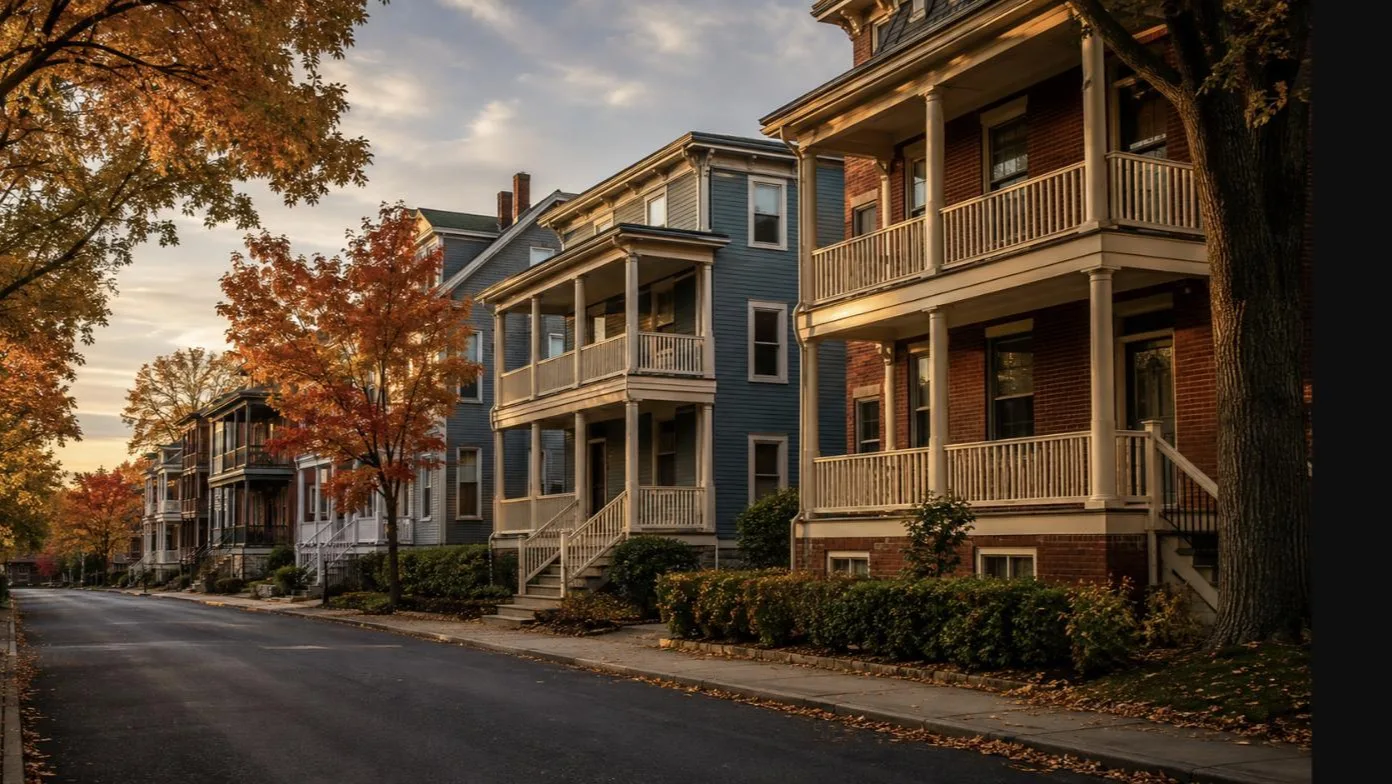

Buying investment property in New Hampshire usually means one thing in the MLS: residential income property — the two-family to four-unit multifamily buildings that let an owner collect rent, or live in one unit while tenants cover much of the mortgage. New Hampshire's stock of these buildings is concentrated in its older city and mill-town centers — Concord, Nashua, Laconia, Franklin, Berlin, and their neighbors — and demand for them has stayed persistent for a simple reason: the state's rental supply is tight, and small multifamily is one of the few ways ordinary buyers can own income-producing real estate without becoming full-time operators. This guide covers what actually counts as residential income property, where the inventory is, the step-by-step buying process, house-hacking, financing paths, the metrics that matter, short-term versus long-term rental strategy, landlording in New Hampshire, the mistakes that hurt first-time investors, and how investors eventually exit.
Key takeaways
- In MLS terms, "residential income" generally means 2–4 unit buildings; 5+ units is classed and financed as commercial property.
- New Hampshire's multifamily stock clusters in former mill towns and city centers, where the housing was built for workforce density in the first place.
- House-hacking — living in one unit of a small multifamily — is the lowest-barrier entry into NH investment property, largely because owner-occupant financing is far more accessible than investor financing.
- Underwrite on real numbers: actual rents, actual expenses, a vacancy allowance, and a capital-repair reserve — not the listing sheet's best case.
- New Hampshire has no state income tax on wages and no state capital gains tax, but property taxes are high and vary meaningfully town to town — they belong at the center of the underwrite.
- New Hampshire landlord-tenant law has real procedural requirements; learn them (with an attorney) before your first lease, not after your first dispute.
What counts as residential income property
The dividing line that matters is unit count. Two- to four-unit buildings — duplexes, the classic New England triple-decker, four-unit conversions — are generally classed in the MLS as residential income and, crucially, can be financed with residential mortgages. Owner-occupants can often buy them with the same kinds of loans used for a single-family home, which is what makes the house-hacking strategy work.
Five or more units crosses into commercial territory: commercial financing, commercial underwriting based on the building's income, and a different buying process. Plenty of investors graduate to that scale, but it's a different game than this guide covers.
A note on NNN properties. Searches for "NNN properties in New Hampshire" refer to triple-net-leased commercial buildings — freestanding retail, medical, or industrial properties where the tenant pays taxes, insurance, and maintenance. That's a commercial-brokerage specialty, not residential real estate; if NNN is what you're after, a dedicated commercial broker is the right call. Our lane — and this guide's — is the residential income side.
How to buy an investment property in New Hampshire, step by step
- Decide the strategy first. House-hack, long-term rental, short-term rental, or a hybrid — the strategy picks the towns, the financing, and even the building type.
- Get financing shaped early. Investor loans and owner-occupant loans have different down payments and rules (details below); a lender conversation before you shop tells you your real price range.
- Pick two or three target markets and learn their rents, their tax rates, and their tenant pools — not the whole state at once.
- Search the Residential Income class in the property search, and ask a local agent about buildings that trade before they're listed — small multifamily often does.
- Underwrite before you offer. Real rents, full expenses, vacancy, reserves — the discipline section below. If it only works in the best case, it doesn't work.
- Offer with the right contingencies. Inspection (by someone who knows old New England buildings), financing, and a review of current leases, deposits, and rent rolls.
- Verify the tenancies during due diligence. Leases, deposit ledgers, payment history, and estoppel-style confirmation of who lives there on what terms — you inherit the tenancies at closing.
- Close, then transfer correctly. Security deposits transfer to you with legal obligations attached; notify tenants properly and get the legal setup (lease forms, deposit handling, screening) right from day one.
Where the multifamily stock is
New Hampshire's small multifamily buildings are where its workers used to live: the mill-era city and town centers.
- Concord — the state capital, with a steady employment base (government, healthcare, education) and walkable neighborhoods of two- and three-family homes. Investors searching "investment properties in Concord NH" are mostly hunting this stock.
- Nashua and Manchester — the state's biggest concentration of multifamily, from triple-deckers to small apartment buildings, supported by southern NH's proximity to the Boston-area job market.
- Laconia and Franklin — Lakes Region mill towns whose downtown housing stock has drawn increasing investor and redevelopment interest as the region's profile has risen. Laconia adds a seasonal-demand layer from the lakes economy.
- Berlin and the North Country — historically the lowest entry prices in the state, paired with smaller rental pools and economies; the math is different and worth walking through carefully with local eyes.
- College and hospital towns like Plymouth, Durham, and Keene — smaller markets with structural rental demand from students and healthcare workers.
The qualitative pattern: the further south and the closer to employment centers, the more you pay and the deeper the tenant pool; the further north, the lower the entry price and the more the building's success depends on local rental demand you should verify, not assume.
House-hacking: the owner-occupant advantage
The most common first investment property in New Hampshire isn't bought by an investor at all — it's bought by an owner-occupant. Buy a 2–4 unit building, live in one unit, rent the others, and let the rental income carry a large share of the housing cost. The advantages compound: owner-occupant financing is generally more accessible than investor financing, you learn landlording with your tenants a staircase away rather than a town away, and when you eventually move out, you keep the building as a straight rental. For a buyer who can tolerate sharing a building, it's the lowest-barrier path from renter to owner-investor that exists.
How do you finance an investment property in New Hampshire?
The financing path depends on whether you'll live in the building:
- Owner-occupant loans (the house-hack path). If you occupy one unit of a 2–4 unit building as your primary residence, you can generally use the same categories of financing as a house buyer — including government-backed programs known for lower down payments. Occupancy rules, self-sufficiency tests on larger buildings, and program limits all apply, so confirm the specifics with a lender.
- Conventional investor loans. For a pure rental with no owner occupancy, expect meaningfully larger down payments — commonly in the 20–25% range — plus somewhat higher rates and reserve requirements. Lenders will count a portion of the building's rental income toward qualification.
- DSCR loans. Debt-service-coverage-ratio loans qualify the property rather than your personal income — the building's rent has to cover the mortgage payment by the lender's required margin. They suit self-employed buyers and investors scaling past conventional loan limits, typically at investor-level down payments.
- Portfolio loans from local banks. New Hampshire's community banks and credit unions hold loans on their own books and know the mill-town building stock well — often the most flexible path for quirky older buildings that don't fit agency boxes.
Whichever route, talk to the lender before you shop: the financing determines the price range, the required reserves, and how fast you can close — which in a tight market is part of the offer.
The metrics that matter (and the one that's overrated)
You don't need a finance degree, but you do need a shared vocabulary with lenders and sellers:
- Cash-on-cash return — annual pre-tax cash flow divided by the actual cash you put in (down payment, closing costs, initial repairs). For most small investors this is the number, because it measures what the deal does with your money.
- Cap rate — net operating income divided by purchase price, ignoring financing. Useful for comparing buildings and markets to each other; less useful as a stand-alone target, and heavily dependent on whose expense numbers you believe.
- DSCR — net operating income divided by annual debt service. Lenders live on this one; if the rent doesn't cover the mortgage with margin, the loan gets harder and the deal deserves skepticism.
- The 1% rule — the old screen that monthly rent should approximate 1% of purchase price. In today's New Hampshire market, most quality buildings in the strong markets won't hit it; treat it as a first-pass filter that flags deals worth a real underwrite, not a rule that decides anything.
We've deliberately given you no cap-rate targets or rent figures — those change with the market and the town, and any number printed in a guide would be stale by the time you read it. Run the metrics on current local data your agent and lender can pull.
Short-term or long-term rental?
Strategy should follow location. Long-term rentals — the traditional year-lease model — fit the employment-center markets: steadier, lower-touch, and less exposed to seasonality and regulation. Short-term rentals can outperform in the tourism corridors (the White Mountains, the Lakes Region, ski-town markets), but they're an operating business: furnishing, turnover, marketing, guest management, and town-by-town rules that vary and change — always verify a town's current position on STRs before underwriting around them.
If you're weighing the short-term route, our short-term rental analysis tool does the heavy lifting on evaluating a specific property's earning potential, and our guide to vacation rental property management in NH covers what operating one actually involves. Many owners in our area land on a hybrid — long-term units in town, a short-term unit where tourism demand supports it.
The ADU angle. Not every rental starts as a multifamily. New Hampshire law now requires most towns to allow accessory dwelling units alongside single-family homes, which makes an ADU — a converted barn, a walkout-basement apartment, a small detached unit — a legitimate income strategy on a property you already own or are buying anyway. Our NH accessory dwelling unit guide covers the current law and process; buyers starting from bare ground should read our guide to buying land in New Hampshire first.
Underwriting basics: how to run the numbers
You don't need a finance degree to underwrite a four-unit building, but you do need discipline. The habits that matter:
- Use actual rents, not pro-forma rents. Ask for the current leases and the last year or two of real income. "Market rent" projections on a listing sheet are aspiration, not data.
- Count every expense. Taxes, insurance, heat (many older NH multifamilies have owner-paid heat — a major line item), water and sewer, trash, snow removal, lawn care, common-area electric, management if you won't self-manage.
- Budget vacancy and turnover. Even in a tight market, units sit empty between tenants and cost money to turn over. Underwrite with a vacancy allowance, not with 100% occupancy.
- Reserve for capital repairs. New Hampshire's multifamily stock is old. Roofs, boilers, wiring, plumbing stacks, and porches all have remaining-life questions — have the building inspected by someone who knows old New England construction, and hold a reserve for the big items.
- Respect property taxes. NH funds local government through property taxes, and the effective burden varies meaningfully town to town — a real factor in which of two similar buildings actually cashflows. Our guide to New Hampshire property taxes explains how to read a town's numbers.
Should you self-manage or hire a property manager?
For a local owner with one 2–4 unit building, self-management is realistic and is how most New Hampshire small landlords operate — the trade is your time and your willingness to take the 2 a.m. call. Professional management typically charges a percentage of collected rent (often quoted in the high single digits, plus leasing fees), and earns it three ways: tenant screening, maintenance dispatch, and keeping you procedurally compliant with landlord-tenant law. The cases where hiring one is usually right: you live far from the building, you're operating a short-term rental you can't service, or the portfolio has grown past what evenings and weekends can cover. Whichever way you go, put the management cost in the underwrite — your time isn't free either.
Being a landlord in New Hampshire
New Hampshire regulates the landlord-tenant relationship, and the procedural side is where new landlords get hurt. At a general level: residential tenants have legal protections around evictions, notice, security deposits, and habitability, and the eviction process runs through the courts on defined steps — self-help remedies are not an option. The specific requirements are exactly the kind of thing to get from a New Hampshire landlord-tenant attorney before your first lease is signed, and a good local property manager earns their fee partly by keeping you on the right side of that process. Budget for competent legal setup — a proper lease, correct deposit handling, a screening process that complies with fair-housing law — as part of the acquisition, not as a cost to defer.
Common first-time investor mistakes in New Hampshire
- Underwriting the listing sheet. Pro-forma rents and "estimated" expenses flatter every building. Demand actuals.
- Ignoring owner-paid heat. In an old triple-decker with one boiler, heat can be the biggest expense line in the building — and it's the buyer's problem in February.
- Skipping the town-level tax check. Two similar buildings in adjacent towns can cash-flow differently on property taxes alone.
- Buying the cheapest building in the thinnest market. A low price with no tenant pool isn't a bargain; verify local rental demand before the price convinces you.
- Underestimating capital condition. Century-old buildings hide their expensive problems in roofs, sills, wiring, and plumbing stacks — inspect accordingly and reserve accordingly.
- Learning eviction procedure during an eviction. Get the lease, deposit handling, and screening process legally right before the first tenant, not after the first dispute.
- Underwriting a short-term rental on last summer's screenshots. STR income is seasonal and rule-dependent; verify the town's current position and use conservative occupancy.
The exit: selling and the 1031 question
Investment real estate is bought with the exit in mind. When the day comes, selling a tenanted multifamily has its own playbook — tenant-occupied versus vacant sale, lease timing, and the tax layer of depreciation recapture and capital gains — all covered in our guide to selling a rental property in New Hampshire. Two pointers worth knowing from day one: New Hampshire has no state capital gains tax, but federal tax on the gain and on depreciation recapture is real (our capital gains guide covers the mechanics), and a 1031 exchange can defer that federal bill by rolling proceeds into another investment property — a move that takes planning before the sale, with a CPA and attorney involved early. When you want a read on what a building would bring today, start with a home valuation.
Frequently asked questions
What counts as a residential income property in New Hampshire?
In MLS terms, residential income generally means two- to four-unit buildings — duplexes, triple-deckers, and small conversions — which can be bought with residential financing. Five or more units is classed and financed as commercial property, a different market with a different buying process.
Where is the best place to buy investment property in New Hampshire?
There's no single answer — it's a trade between price and tenant depth. Concord, Nashua, and Manchester pair the state's largest multifamily stock with the deepest employment-driven tenant pools; Laconia and Franklin offer lower entry prices with a rising regional profile; the North Country has the lowest prices and the thinnest rental markets. Match the location to the strategy, and verify local rental demand rather than assuming it.
How much down payment do you need for an investment property in NH?
If you'll live in one unit of a 2–4 unit building, owner-occupant programs can bring the down payment well below investor levels. For a pure rental, conventional investor loans commonly want roughly 20–25% down, with DSCR and portfolio loans in a similar range. Requirements vary by lender, program, and building — get the real number from a lender before you shop.
Can I buy a multi-family home in NH with a regular mortgage?
Generally yes, for two- to four-unit buildings — that's what separates residential income property from commercial. Owner-occupants in particular can often use the same kinds of loans available for a single-family home, which is what makes house-hacking work. Loan programs, down-payment requirements, and occupancy rules vary, so confirm the specifics with a lender before you shop.
Is New Hampshire a good state for rental property investment?
The fundamentals that draw investors are real: rental supply is tight, small multifamily stock is concentrated and well-understood, demand near the employment centers and the Boston corridor is persistent, and the state levies no income tax on wages and no state capital gains tax. The offsetting realities are equally real: the building stock is old, property taxes are high and vary town to town, and landlord-tenant law has procedural requirements you need to learn before your first lease. It rewards careful underwriting more than optimism.
Do you inherit the tenants when you buy an occupied building?
Yes — the tenancies, leases, and security-deposit obligations come with the building at closing. Review every lease and deposit ledger during due diligence, confirm who lives there on what terms, and handle the deposit transfer and tenant notification properly with your attorney's help.
The bottom line
New Hampshire's residential income market is small-scale, old-stock, and local: 2–4 unit buildings in mill-town and city centers, bought by owners willing to underwrite honestly and manage carefully — or to live in one unit and let the building pay for itself. Pick your market for its tenant demand, shape the financing early, run the numbers on real figures, get the legal side right before the first lease, and buy with the exit in mind. If you're looking at a specific building — in Concord, Nashua, the Lakes Region, or up north — talk to our team and we'll help you pressure-test the numbers and the neighborhood before you commit.