
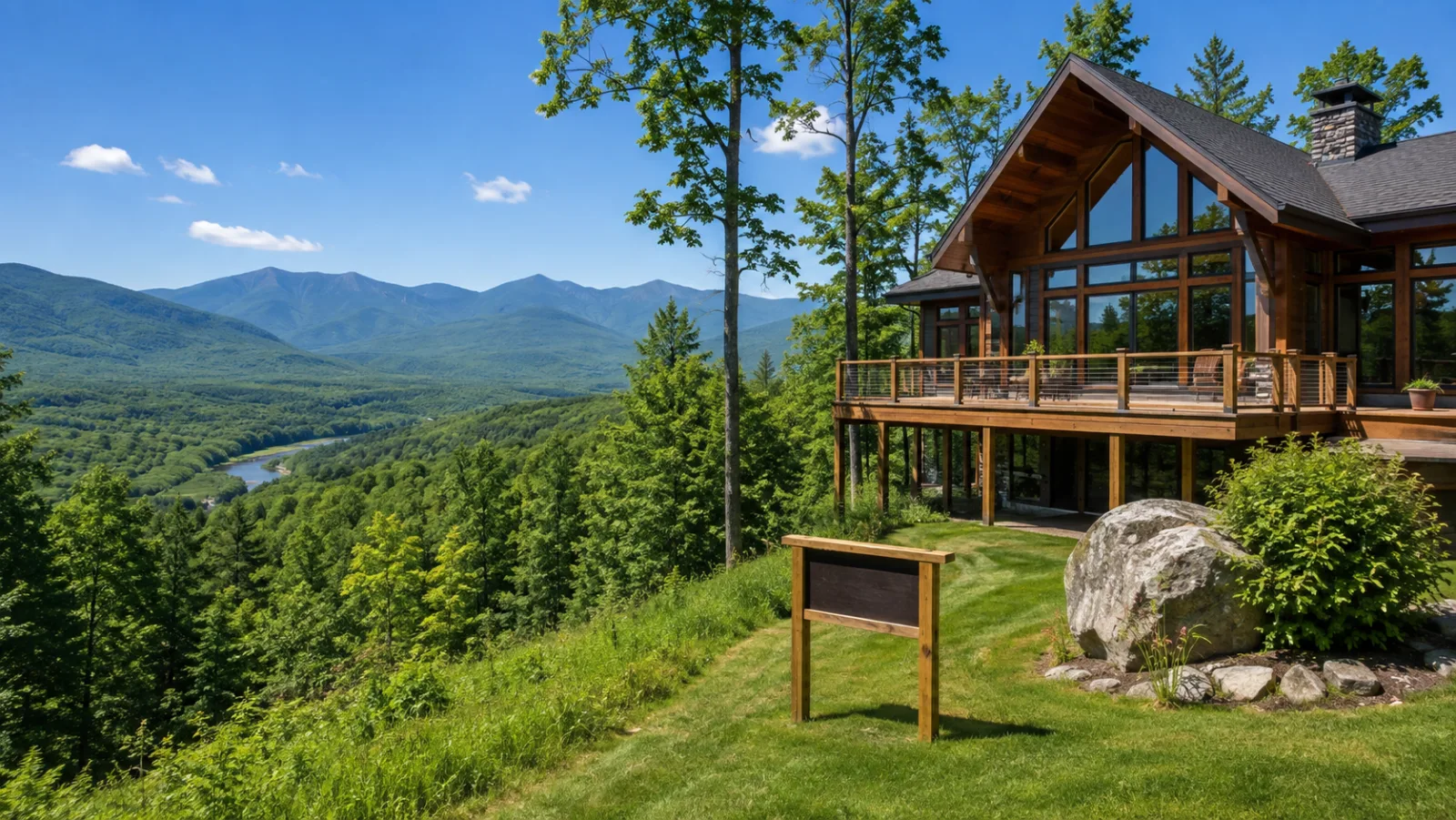

Selling a house in Campton NH comes down to three things: matching the house to the right buyer (year-round commuter, ski-country second-home buyer, short-term-rental investor or Waterville Estates family), assembling the well, septic, fee and rental paperwork before listing, and timing the launch to the ski-and-foliage calendar. Everything below expands on those three.
/images/blog/selling-a-house-in-campton-nh-guide-hero.webp
How to sell a house in Campton NH, step by step
- Get a comps-based number. Start with an instant estimate built from MLS sold data around town, then refine it against recent closings on the sold listings page.
- Decide which buyer the house is for. A village cape, a hillside build with acreage and an Estates chalet sell to different people through different marketing (see below).
- Assemble the file. Well and septic information for the written disclosure, the tax bill, plowing and road arrangements, and — for Waterville Estates or a condo — dues, district tax, water bills and association documents. Rental properties add a revenue ledger and a booking schedule.
- Fix what a buyer cannot price. Test the well, pump and inspect the septic, and put any handshake road agreement in writing.
- Pick the launch window. Early fall for chalets and rentals, spring for year-round homes, summer for river and golf property.
- Negotiate, then close with an attorney or title company. The transfer tax, prorated taxes and any rental-booking credits are settled at closing.
An estate-owned chalet or camp adds a step before all of these: the executor needs court appointment and authority to sign the deed. Our guide on how to sell a probate house in NH covers that process.
Who buys in Campton NH
Campton — about 3,300 people (3,343 in the 2020 Census) in Grafton County, ZIP 03223 — has two I-93 exits (27 and 28), and exit 28 is where Route 49 starts its eleven-mile run up the Mad River to Waterville Valley. Four buyer groups show up for Campton NH real estate listings, and they rarely want the same house — they are the buyers our Campton and Thornton buyer's guide is written for.
| Buyer | What they want | What sells it |
|---|---|---|
| I-93 commuters and remote workers | Year-round house, Campton Elementary (K–8, then Plymouth Regional High School in SAU 48), plowable driveway | Tested well and septic, internet confirmed at the address, heating and roof ages |
| Ski-and-golf second-home buyers | More house for the money than a resort village, about 20 minutes to Waterville Valley and 25 to Loon | Views, mudroom and storage, who plows, winter access |
| Short-term-rental investors | Documented income, septic sized for the bedroom count | Platform statements, Meals and Rentals license history, furnishings list |
| Waterville Estates buyers | Pools, the Estates ski hill and the community as much as the house | Dues, district tax and water bills presented together |
Plymouth's hospital, university and groceries are about ten minutes south of Campton village, and Boston is roughly two hours down I-93. Part of Owl's Nest Resort lies on the Campton side of the town line, so golf brings its own buyer from May into October.
Campton sells at two speeds
The village and river-valley homes — Blair by the covered bridge over the Pemigewasset, Campton Hollow, West Campton along Route 3, and the farmhouses and newer builds on the hillsides — are the year-round market. They run on the school-calendar rhythm, and clean single-families with views or a few acres move quickly because relocators and ski families chase the same short supply.
Waterville Estates and the Route 49 condo communities are the second speed. Anything that works as a short-term rental draws investor attention within days when priced right, on a calendar set by ski season and foliage. What slows either market is the unknown a buyer cannot price: an untested well, a septic sized for fewer bedrooms than the listing sleeps, or an Estates home listed without its dues and district-tax numbers. Our Plymouth vs Campton vs Thornton comparison covers how buyers weigh the town against its neighbors, and current price and inventory trends are in the New Hampshire housing market 2026 report.
Selling a Waterville Estates home
Waterville Estates — roughly 700 homes and condos in the hills above the Mad River valley — has a cost structure most buyers have never seen, so the seller who explains it up front wins. There are up to four separate lines on top of the Campton town tax:
| Cost line | Who bills it | 2025–26 figure | How it is paid |
|---|---|---|---|
| Association dues | Waterville Estates Association (private HOA) | $948.85 for 2026 ($796.89 recreation + $151.96 administration) | Annually, due June 1 |
| Village district tax | Waterville Estates Village District (a unit of NH government) | About $5.67 per $1,000 in 2025, for an effective rate near $23.13 with Campton's $17.46 | On the property tax bill; rates reset each fall |
| Water | Village district water department | Set by the district's own rate schedule | Billed separately, twice a year |
| Condo fee (condos only) | The unit's condominium association | Varies by association | Monthly or quarterly |
The water line trips up out-of-town agents. The district is funded by property taxes and water rates, but the water system runs on its own rates, billed twice a year — it is not paid for by the district tax. Presented next to the dues and the district tax, it is a line buyers accept; found late, it is a reason to walk.
The amenities — indoor pools open year-round, heated outdoor pools in summer, hot tubs, the Community Center and the Estates' own ski hill at Campton Mountain — are why rental history is a selling point here specifically. The association runs a guest-pass system for the Community Center, and a chalet where guests can swim indoors in February books better than one in the woods. For a condo, New Hampshire's Condominium Act (RSA 356-B) gives buyers the association documents, so order the declaration, budget, reserves and rental rules before listing. The Waterville Estates guide is the page most of these buyers have already read.
Selling a Campton home that earns rental income
To an investor, a Campton Airbnb with a track record is evidence, and it should be presented like evidence: platform statements and tax returns rather than projections, revenue and occupancy by season, and the costs that make the numbers real — cleaning, management, plowing, hot-tub service and utilities. Most of a year's revenue lands in roughly twenty weeks: ski season, foliage and the July–August core.
The tax paperwork is specific. Stays under 185 consecutive days carry New Hampshire's 8.5% Meals and Rentals tax; the operator holds a Meals and Rentals license from the Department of Revenue Administration, and RSA 78-A:4-a requires that license number on every online listing. The license does not transfer with the deed — the buyer registers for their own. As of September 2026 we know of no separate Campton short-term-rental permit or registry, but uses are governed by the town zoning ordinance and rules can change at the March town meeting, so confirm with the Campton land use office before stating it in a listing.
Two more items belong in the file. Furnishings: list what conveys. The booking calendar: future stays can strengthen an investor sale, but the purchase-and-sale agreement has to say whether the buyer honors them, who receives the revenue, and how collected deposits are credited at closing — in practice, a schedule of every confirmed booking with dates, rates and deposits, attached to the contract.
The full playbook is in the guide to selling a short-term rental in New Hampshire. The Campton NH Airbnb guide covers the operating side, selling a rental property in New Hampshire covers tenant mechanics, and owners weighing whether to keep the income can read the vacation rental property management guide.
Pricing a Campton home
Campton NH home values do not move as one number. The comps that matter are property-level, and they fall into recognizable bands.
Riverside capes and village homes. Older housing along the Pemi and the Mad River and near the village crossroads, where value turns on frontage and floodplain status, the age of the systems, and whether the well and septic are tested and documented.
Newer mountain-view builds and acreage. Priced on views, usable acreage, the state of the road in February and — for larger parcels — current-use status under RSA 79-A. Current use stays with the land, but the contract should say who bears the 10% land use change tax (RSA 79-A:7) if the buyer's plans would trigger it.
Chalets and condos. Waterville Estates and the Route 49 communities, where the rental comp set matters as much as the sales comp set: bedroom count against septic capacity, a hot tub, amenity access, association health and documented income all move the number.
A comps-based estimate of what your home is worth is the starting point, refined by hand against recent closings — the Campton seller page shows live market data and recent sales in town.
What to fix and disclose before listing
Outside the village-district water systems, most Campton homes run on a private well and septic, and RSA 477:4-c requires the seller to disclose in writing what is known about both. No law requires a pre-listing inspection, but nearly every buyer tests the well and inspects the septic anyway, and rental properties get extra scrutiny because septic systems are approved for a set number of bedrooms. Since January 1, 2025, the buyer notifications under RSA 477:4-a also cover PFAS and federally designated flood hazard zones — relevant along the Pemi and the Mad. The statute-by-statute list is in our guide to New Hampshire seller disclosure requirements.
| Item | Why Campton buyers ask | What to have ready |
|---|---|---|
| Private well | Most homes outside the village districts | Recent water test (bacteria, arsenic, radon, PFAS) |
| Septic | Bedroom count drives rental value | State-approved design and bedroom count, last pumping, a pre-listing evaluation |
| Driveway and road | Steep hillside and Estates drives; lenders ask about private roads | Who plows, and a written road maintenance agreement for a private road |
| Internet | Remote workers and rental guests | Provider and speed at the address — NH Electric Co-op's NH Broadband fiber has been expanding through Grafton County, but service varies street to street |
| Estates or condo fees | Four possible cost lines | Dues statement, district tax bill, water bill, association documents and rental rules in one package |
The statewide checklist in the New Hampshire home seller guide covers the rest.
When is the best time to sell in Campton?
Campton runs on the ski calendar as much as on spring. Second-home and investor buyers shop hardest from early fall through the holidays because they want keys before ski season, and a rental listed with next winter's bookings on the calendar is a stronger investor sale. On winter Saturdays Route 49 carries a steady stream of ski traffic past every listing sign between the highway and the mountain; ski-country open houses work best mid-morning Sunday.
| Season | Strongest for | Watch out for |
|---|---|---|
| September–December | Chalets, condos, rental properties | Foliage weekends book agents and inspectors early |
| January–March | Estates homes shown in snow, ski buyers on site | Driveway access and roof snow load on showings |
| April–June | Year-round village and river-valley homes | Mud season on dirt roads in April |
| July–August | Riverfront and golf-side homes | Buyers compare you against peak-summer rentals |
April and November are soft everywhere in the Whites. The best time to sell a house in New Hampshire guide covers each regional clock.
What does it cost to sell a house in Campton NH?
New Hampshire's real estate transfer tax under RSA 78-B:1 is $1.50 per $100 of the sale price, split evenly, so the seller pays $0.75 per $100 — $3,375 on a $450,000 Campton sale, collected at closing. There is no separate town transfer tax. Property taxes are prorated to the closing date, and for an Estates property that includes the district share of the bill. Add attorney or settlement fees, deed preparation and any agreed buyer credits.
Commission is the largest line and it is negotiable; the right structure depends on the property, the price point and the competition for the listing. The line-by-line breakdown is in the guide to seller closing costs in New Hampshire, and owners considering skipping the listing agent entirely will find the trade-offs in our guide to for sale by owner in New Hampshire. Selling a second home or a rental that was never a primary residence usually means federal capital gains tax — see capital gains tax when selling a home in New Hampshire.
Choosing a listing agent in Campton
The test for a Campton NH realtor is whether they can sell all three Camptons. A listing agent here should be able to explain the Waterville Estates dual structure and its separately billed water rates without a phone call, read a short-term-rental ledger the way an operator does, know what the Campton–Thornton line does to a tax bill at Owl's Nest, and reach out-of-state buyers.
Owl's Nest Real Estate lists and sells Campton homes from its main office at 399 NH Route 49 in Campton and operates vacation rentals across town, which is how we package a property's rental performance the way an investor underwrites it. For the questions to ask any candidate, see choosing a listing agent in New Hampshire.
Frequently asked questions
How much does it cost to sell a house in Campton NH?
The seller pays half of New Hampshire's transfer tax — $0.75 per $100 of the price, or $3,375 on a $450,000 sale — plus prorated property taxes, attorney or settlement fees, deed preparation and a negotiable commission. There is no separate Campton town transfer tax. On a Waterville Estates home, the proration also covers the village-district portion of the tax bill, and any outstanding water charges are settled at closing.
What must a seller disclose on a Waterville Estates home?
Buyers need the current association dues ($948.85 for 2026), the village-district tax on top of the Campton rate, the district's separately billed water charges, and the Community Center guest-pass and rental rules. For a condo, add the unit association's declaration, budget, reserves and fees. The statewide written well, septic and insulation disclosures and the RSA 477:4-a notifications apply as they do anywhere in New Hampshire.
Can a Campton Airbnb be sold with future bookings on the calendar?
Yes. Attach a schedule of every confirmed stay — dates, rates and deposits collected — to the purchase-and-sale agreement, and state whether the buyer honors the bookings and how deposits are credited at closing. The New Hampshire Meals and Rentals license does not transfer with the deed; the buyer applies for their own and must show that number on any listing under RSA 78-A:4-a.
Is a well and septic inspection needed before listing in Campton?
No law requires one, but RSA 477:4-c requires a written disclosure of what the seller knows about the private water supply and sewage system, and nearly every buyer will test the well and inspect the septic during due diligence. A pre-listing water test and septic evaluation cost far less than a renegotiation, and for a rental they confirm the bedroom count the septic is approved for.
Does Campton require a permit for short-term rentals?
As of September 2026 we know of no Campton-specific short-term-rental permit or registry; the state requirement is the Meals and Rentals license and 8.5% tax on stays under 185 days. Uses are governed by the town zoning ordinance, and New Hampshire towns can change rules at the March town meeting, so confirm current requirements with the Campton land use office before listing a property as an income investment.
When is the best time to sell a house in Campton NH?
Early fall through the holidays suits chalets, condos and rental properties, because ski-season buyers want to close before the lifts open. Spring brings the deepest traffic for year-round village and river-valley homes, and summer favors riverfront and golf-side properties near Owl's Nest. April mud season and November stick season are the slowest stretches everywhere in the White Mountains.
Start with the free estimate of what your home is worth, browse current Campton listings on our town page, and see the Campton seller page for live market data and recent sales. For closings across the wider region, browse the homes we have sold.