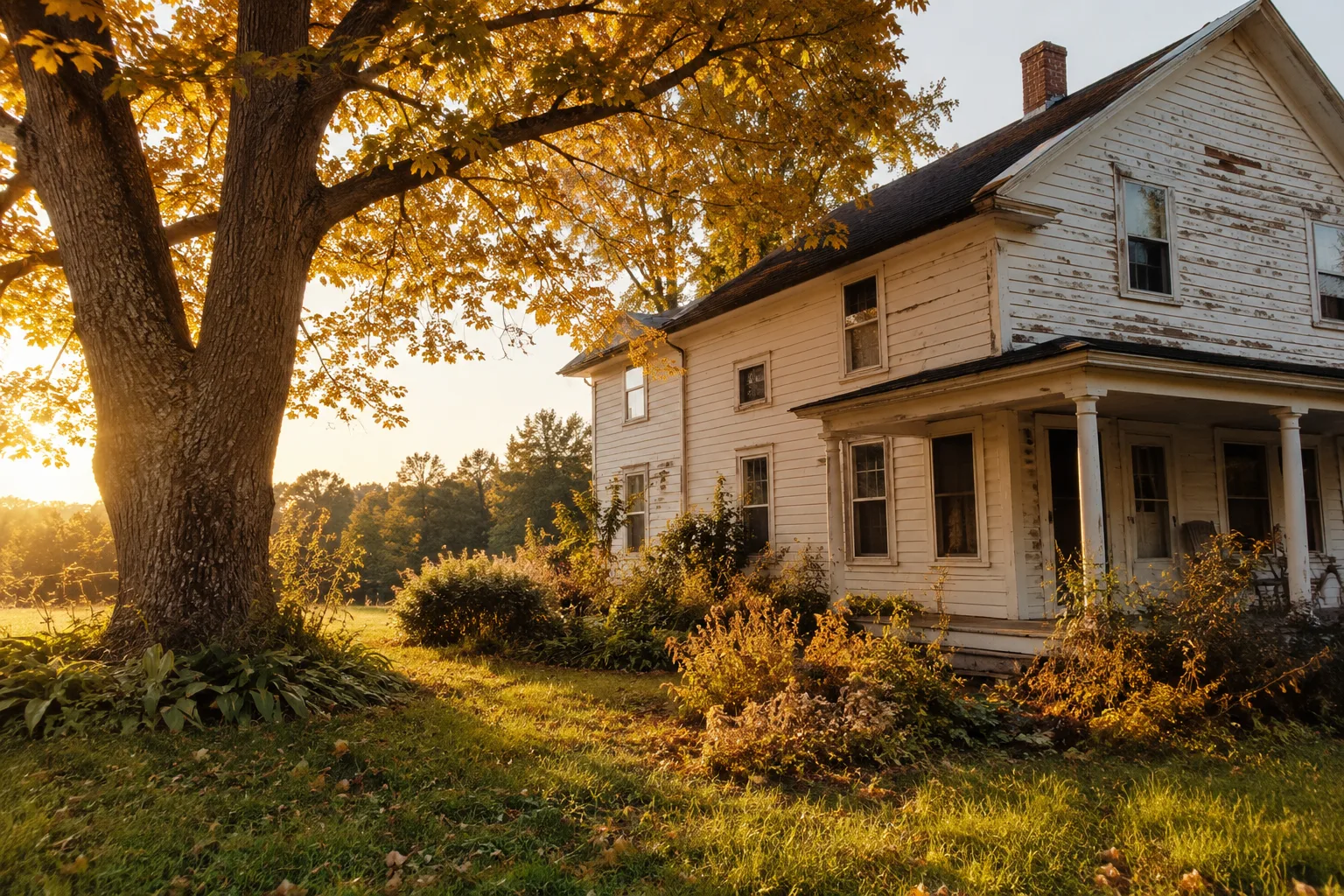

Selling an inherited house in New Hampshire comes down to four moves: secure and insure the property, open the estate with the Circuit Court Probate Division, confirm the executor's authority to sell — either a power of sale in the will or a court-issued license to sell — and then sell it like any well-marketed listing, usually with little or no federal capital gains tax thanks to the stepped-up basis rule (IRC §1014). The full estate arc commonly runs 6 to 12 months, though the house itself is often listed and sold well inside that window.
That is the mechanical answer. The real experience is rarely just a transaction — usually it is a parent's home, or the lake camp where every summer happened, and the paperwork arrives tangled up with grief, siblings, and a probate court you have never dealt with before. Search the topic online and you will mostly find national cash-buyer sites promising to "take the property off your hands" — which tells you what they think the house is worth to them. This guide is the opposite of that: a local, step-by-step walkthrough from a team that handles inherited sales in the White Mountains and Lakes Region regularly, written to help you slow down, understand the process, and keep the value the family spent decades building. Probate and estate taxation are legal and tax matters and the details turn on the will and the estate — use this as a map, and confirm specifics with a New Hampshire probate attorney and your CPA.
In this guide
- First steps: secure the house
- Does the estate need probate?
- The probate sale, step by step (with timelines)
- Power of sale vs. license to sell
- Taxes: stepped-up basis and what NH does not charge
- Inheriting a vacation home from three states away
- Emotional pacing
- Selling as-is vs. light preparation
- Frequently asked questions
Key takeaways
- A solely owned New Hampshire home almost always passes through the Circuit Court Probate Division before sale; most estates run roughly 6 to 12 months open to close, but the house can usually be sold inside that window.
- The executor needs authority to convey a deed — a power of sale in the will or a license to sell from the probate court — before accepting an offer.
- Stepped-up basis (IRC §1014) resets your cost basis to the home's date-of-death value, so heirs who sell reasonably soon typically owe little or no federal capital gains tax.
- New Hampshire has no inheritance tax, no state estate tax, and no state tax on home-sale capital gains; the main state cost at closing is the seller's transfer tax share of $0.75 per $100 under RSA 78-B — $4,500 on a $600,000 sale.
- Out-of-state heirs can run the entire process remotely with a local team handling date-of-death valuation, caretaking, prep, and the sale itself.
First steps: secure the house before you sell the house
In the first days and weeks, the goal is not selling — it is stabilizing. Three things come first:
- Secure and maintain the property. Change or collect the keys, keep the heat on (a frozen pipe in a February vacancy is the classic New Hampshire estate disaster), arrange plowing and lawn care, and check on the house — or have someone local do it — regularly.
- Call the insurance company. Homeowner's policies often limit or exclude coverage once a house sits vacant. Tell the insurer the owner has died and ask about vacant-home coverage; an uninsured loss can dwarf every other cost in this process.
- Locate the will and open the estate. New Hampshire estates run through the Circuit Court Probate Division. The named executor (or an administrator, if there is no will) files to open the estate and receives the court's appointment — the document banks, buyers, and title companies will all ask for.
None of this commits you to anything. It simply stops the clock on damage and starts the clock on authority.
Does the estate need probate at all?
If the house was owned solely by the person who died, or as a tenant in common, it almost always passes through probate before it can be sold and the proceeds distributed. Property held in a living trust, or owned jointly with rights of survivorship, generally bypasses probate — one reason estate attorneys set things up that way. If you are not sure how the deed reads, a title search or a call to a probate attorney answers it quickly. New Hampshire also offers streamlined options (such as waiver of administration) for certain simple estates, which your attorney can assess.
The New Hampshire probate sale, step by step
Every estate is different, but the sequence below is the shape of nearly all of them. The timeline ranges are realistic planning figures from the estate sales we work on, not statutory promises — your attorney will refine them for your county and your facts.
- Locate the will and file to open the estate (weeks 1–4). The original will, a death certificate, and the court's petition forms go to the Circuit Court Probate Division for the county where the property sits — Grafton County for most of our market.
- Executor or administrator is appointed (roughly 2–6 weeks after filing). The court issues a certificate of appointment. This is the document that lets you act for the estate — open an estate bank account, deal with the insurer, and sign listing paperwork.
- Inventory the estate, including the real estate (generally within about 90 days of appointment). The inventory needs a value for the house as of the date of death. Get this number professionally documented — it is also the number that sets your stepped-up basis for taxes, so it earns its keep twice. A professional market valuation or a formal appraisal pegged to the date of death is the standard approach.
- Confirm authority to sell (immediate if the will grants a power of sale; budget roughly 4–8 extra weeks if you must petition for a license to sell). More on this distinction below — it is the single biggest fork in the timeline.
- Prepare and list the property (runs in parallel; typically 2–8 weeks of prep). Cleanout, deep clean, small repairs, photography, pricing. This is where our Ready-to-Sell Program does its best work for estates with no liquidity — a complimentary pre-listing inspection plus up to $2,500 in approved prep costs advanced and reimbursed at closing, for qualifying listings.
- Accept an offer and close (commonly 30–60 days from contract to closing). Proceeds are paid to the estate, not directly to heirs. The buyer's title company will verify the executor's authority before the deed is accepted, which is why step 4 happens before, not after, you go under contract.
- Wind down the estate (most estates close in roughly 6–12 months total; contested ones run longer). Creditors get a statutory window to present claims against the estate (RSA 556), the executor accounts to the court, and only then are proceeds distributed. This is why the estate rarely closes in under six months even when the house sells fast — and why nobody should promise heirs their share by a specific date until the attorney signs off.
The honest takeaway: inherited sales run on a different clock than ordinary sales, but the clock mostly runs in parallel. What we see at closing tables in Grafton County is that the estates that go smoothly are the ones that started the valuation, cleanout, and authority questions in month one — not the ones that rushed the listing.
One local timing note worth knowing: if the estate opens in fall or winter, resist the instinct to list a mountain or lake property immediately into the December–February slow season. Carrying the house through mud season and listing into the late-spring wave — when lake properties show best and Route 49 fills with buyer traffic — often nets the estate more than a winter fire-sale, and the probate timeline usually absorbs the wait anyway. Timing strategy is covered in our guide to the best time to sell a house in New Hampshire.
Who has authority to sell: power of sale vs. license to sell
This is the step that trips up the most families, so here it is plainly. The executor's authority to sell estate real estate comes from one of two places:
- A power of sale in the will. Many well-drafted wills expressly authorize the executor to sell real estate without further court involvement. If the will grants it, the sale proceeds much like a normal transaction once the executor is appointed.
- A license to sell from the probate court. If the will is silent (or there is no will), the executor or administrator generally must petition the Circuit Court Probate Division for a license to sell — a court order authorizing the conveyance — before a deed can be delivered.
Which situation you are in changes the timeline and the paperwork, and buyers' attorneys and title companies will check. Confirm your authority with a NH probate attorney before you accept an offer — signing a purchase and sale agreement you cannot yet perform helps no one. When we list estate properties, we coordinate directly with the estate's attorney so the listing timeline and the court timeline stay in sync.
Taxes when selling an inherited house in New Hampshire
Here is the news most heirs do not expect: the tax picture is usually far better than they fear, for two reasons.
Stepped-up basis usually erases most of the gain
When you inherit property, your cost basis for federal capital gains purposes "steps up" under IRC §1014 to the property's fair market value at the date of death — not what your parents paid for it decades ago. A worked example makes the point:
| Sold after inheriting (stepped-up basis) | If it had been gifted before death (carryover basis) | |
|---|---|---|
| Parents paid (1989) | $120,000 | $120,000 |
| Value at date of death | $600,000 | — |
| Your basis | $600,000 | $120,000 |
| Sale price (8 months later) | $615,000 | $615,000 |
| Taxable gain (before selling costs) | ≈ $15,000 | ≈ $495,000 |
Sell reasonably soon after the date of death and the taxable gain is typically just the appreciation since death, minus selling costs — often close to zero. This is why a professional valuation or appraisal pegged to the date of death matters: it documents your stepped-up basis. Hold the property for years and let it appreciate, and the gain above the stepped-up value becomes taxable at federal long-term capital gains rates; note that the §121 primary-residence exclusion generally will not help unless an heir actually moves in and makes it a primary residence for two of the five years before selling. As always: confirm your numbers with a CPA, and see our broader guide to capital gains tax when selling a home in New Hampshire.
No New Hampshire inheritance or estate tax
New Hampshire has no inheritance tax and no state estate tax, and no state income tax on capital gains — the Interest & Dividends tax was fully repealed effective January 1, 2025. The state costs that do apply at sale are the ordinary ones every seller pays, led by the real estate transfer tax under RSA 78-B: $0.75 per $100 of the sale price on the seller's side (the buyer pays a matching $0.75 per $100). On that $600,000 sale above, the estate's share is $600,000 ÷ 100 × $0.75 = $4,500. Our guide to seller closing costs in New Hampshire itemizes the rest — title work, attorney, recording, prorated property taxes. Very large estates can still face federal estate tax, but the federal exemption is high enough that most New Hampshire families never touch it — one more thing your attorney or CPA can confirm quickly.
Inheriting a vacation home from three states away
This is the version we see most often in our market: the family lake camp or ski condo in the White Mountains, inherited by adult children who now live in Boston, New York, or further. The house is two, four, eight hours from your life, it needs to be emptied and maintained through a New Hampshire winter, and nobody in the family is positioned to manage that from a distance.
This is exactly the situation a full-service local brokerage exists for, and it is worth being concrete about what "we handle it locally" means in practice:
- Date-of-death valuation, documented. A written professional valuation tied to the date of death, in a form your CPA and the probate inventory can both use. This is usually the first thing we produce for an estate, before anyone decides anything.
- Caretaking through the seasons. Key-holding, walk-throughs after storms, heat and frozen-pipe checks, plow contracts, draining or maintaining the hot tub before it becomes a January casualty. We operate vacation rentals across these towns ourselves, so winterizing and property checks are our daily work, not a favor we improvise.
- Cleanout and contents. Coordinating estate cleanout crews, donation runs, dumpsters, and — when the contents warrant it — a local estate-sale company, with photos to the family at each stage so decisions about keepsakes are made by the family, not a crew on a deadline.
- Prep without the estate fronting cash. Through the Ready-to-Sell Program we scope the light work that actually moves value — clean, paint, small repairs — advance up to $2,500 in approved costs for qualifying listings, coordinate the contractors ourselves, and get reimbursed at closing.
- Remote paperwork. Listing documents are e-signed, and New Hampshire closings are customarily handled by a closing attorney or title company, who can usually arrange mail-away or remote signing for out-of-state sellers — heirs routinely close without a single trip north. Your attorney will confirm what your closing requires.
Some families discover mid-process that they are not ready to sell at all — in which case renting the home seasonally is sometimes a bridge, and our vacation rental management team can talk through whether that is realistic for the specific property. Go in clear-eyed: town short-term rental rules vary and keep evolving, New Hampshire's Meals & Rentals tax of 8.5% applies to stays under 185 days, and nobody should promise the house will pay for itself. But for a family that needs a year to decide, a managed rental season can cover the plow contract and the insurance while the decision breathes. If a rental is on the table, keeping records of that STR history also becomes an asset when the property eventually sells — see our short-term rental analysis.
Emotional pacing: the decision is allowed to take time
A word the cash-buyer websites never use: grief. The house you inherited is full of your family's things and your family's history, and the sorting — practical and emotional — takes longer than anyone expects. Our experience with estate sales has taught us two things. First, do not let anyone rush you; the "sell instantly" pitch exists because urgency benefits the buyer making it, and (as we cover in our guide to selling a house fast in New Hampshire) investor cash offers typically come in well below market value. The probate timeline actually removes the pressure to decide this week.
Second, when siblings share the inheritance, decide the process before you decide the price. Agree early on who communicates with the attorney and the agent, how decisions get made (majority? consensus?), and what happens to the contents. Most sibling conflict in estate sales is not really about money — it is about process and feeling unheard. A neutral third party helps here too: a professional market valuation replaces three competing opinions of what Mom's house is worth with one documented number, which is often the single most de-escalating step a family can take. If one heir wants to keep the property, that same number becomes the basis for a fair buyout.
Selling as-is vs. light preparation
Estate properties are usually dated — and that is fine. Buyers in our market expect a 1980s kitchen in a 1980s lake house, and "as-is, priced accordingly" is a legitimate strategy, especially when the estate has no cash for improvements. But there is a middle path that usually nets the estate more: skip the renovation, do the light work — cleanout, deep clean, small repairs, fresh paint where it counts — and let the house show at its best. Our Ready-to-Sell Program is built for exactly this situation, and the complimentary pre-listing inspection means an estate learns about the tired water heater before the buyer's inspector announces it mid-transaction. One more estate-specific note: even when heirs know little about the house, New Hampshire's seller disclosure requirements still apply — the law allows "unknown" as an answer on systems like the well and septic, but it must be given honestly and in writing.
Whichever route you choose, the fundamentals from our guide to selling a house in New Hampshire apply: price to the market, not to memory; photograph it properly; and let the marketing reach every buyer, not just the investor who mailed you a postcard. Recent results across our area are on our sold listings page if you want to see what estates and second homes have actually brought.
Frequently asked questions
Do I pay taxes on an inherited house in New Hampshire?
New Hampshire has no inheritance tax and no state estate tax, and no state tax on capital gains. Federally, your basis steps up to the home's value at the date of death under IRC §1014, so if you sell reasonably soon, the taxable gain is usually small or zero. You will pay the ordinary NH real estate transfer tax ($0.75 per $100 on the seller's side under RSA 78-B) and standard closing costs at sale. Confirm your specific situation with a CPA.
Can I sell the house before probate closes?
Often, yes. The sale usually does not have to wait for the estate to fully close — but the executor must have authority first, either through a power of sale in the will or a license to sell from the Circuit Court Probate Division, and proceeds typically flow to the estate until distribution. A NH probate attorney can confirm the sequence for your estate.
How long does probate take in New Hampshire?
Most New Hampshire estates take roughly 6 to 12 months from opening to closing, in part because creditors get a statutory window to present claims, with simple estates sometimes qualifying for streamlined handling and contested estates running longer. The house itself can often be prepped, listed, and sold within that window rather than after it.
What is a license to sell in New Hampshire probate?
A license to sell is a probate court order authorizing the executor or administrator to convey estate real estate. It is needed when the will does not grant a power of sale, or when there is no will. Petitioning for one typically adds several weeks to the timeline, which is why confirming your authority is one of the first questions to settle with a probate attorney.
Can I sell an inherited house in NH if I live out of state?
Yes — this is common in vacation markets like ours. A local team can document the date-of-death valuation, maintain and winterize the property, coordinate cleanout and prep contractors, and run the sale, while listing paperwork is e-signed and the closing attorney arranges remote or mail-away signing. Most out-of-state heirs we work with never need to make more than one trip, if that.
What if the heirs disagree about selling?
Start with process: agree on how decisions get made and get a neutral, professional valuation so everyone is arguing from the same number. If one heir wants to keep the home, the valuation anchors a buyout. If disagreement hardens, a probate attorney can outline the formal options — but in our experience, most families find their way once the facts replace the guesses.
Local hands for a long-distance decision
If you have inherited a home anywhere in the Waterville Valley, Pemi Valley, White Mountains, or Lakes Region area, you do not have to figure this out alone or from a distance. Start with a free professional home valuation — including the date-of-death documentation your tax preparer will thank you for — read our NH Seller Guide for the road ahead, or simply reach out to our team and tell us where things stand. We will meet the process, and the family, wherever you are.
This guide is general information for New Hampshire heirs and estate executors, not tax or legal advice. Rules change — confirm the specifics of your situation with your CPA and a New Hampshire probate attorney.
Sources and further reading
- New Hampshire Judicial Branch — Circuit Court Probate Division
- RSA 556 — Actions By and Against Executors and Administrators (creditor claims)
- IRS — Gifts & Inheritances (basis of inherited property)
- McLane Middleton — Real Estate Tax Considerations in New Hampshire
- RSA 78-B — New Hampshire Real Estate Transfer Tax