
Waterville Estates in Campton, New Hampshire is a private community of roughly 700 homes and condos with two indoor pools, its own small ski hill, and chalet prices that look too good for the White Mountains — until you understand the structure behind them: two tax bills, an association fee, and a set of rules that nobody explains well online. There isn't a catch, exactly. There is a dual structure — a homeowners' association and a real village district government — that drives both the costs and the amenities. This guide covers what the Estates actually is, what it genuinely costs to own here (2026 dues: $948.85; effective 2025 tax rate about $23.13 per $1,000 on the Campton side), how rentals perform, and who the community suits.
What Waterville Estates actually is
Waterville Estates is a private residential community of roughly 700 homes and condos in the hills above the Mad River valley, mostly in Campton with some addresses spilling over the line into Thornton. The development dates to the late 1960s, when the Locke family carved an 863-acre second-home community — complete with its own small ski hill — out of the shoulder of Campton Mountain. The homeowners' association, the Waterville Estates Association, was incorporated in 1972 to run the recreational side of things.
Here's the part almost everyone misses. The Estates isn't just an HOA — it's also a real unit of New Hampshire government. The Waterville Estates Village District is a taxing entity, organized under state law as an overlay of portions of Campton and Thornton, that provides the secondary roads, the recreational facilities, and the community water system. It's run by three commissioners elected by the district's registered voters. Two funding streams, and the distinction matters: the roads and recreation side is paid for by the district property tax, while the water department is independently funded through its own rate system — water rates are set by the district and billed to customers twice a year, not covered by anyone's tax bill.
So buying here means joining both an association and a village district. That dual structure drives the costs — and the amenities — that make the Estates what it is.
Who does it suit? Families who want a base near three ski areas without resort pricing, second-home owners who want their kids in a pool ten minutes after arriving, and buyers who like the idea of a community that runs its own show. Anyone who wants five private acres and no neighbors should look elsewhere — and deserves to hear that before the drive up.
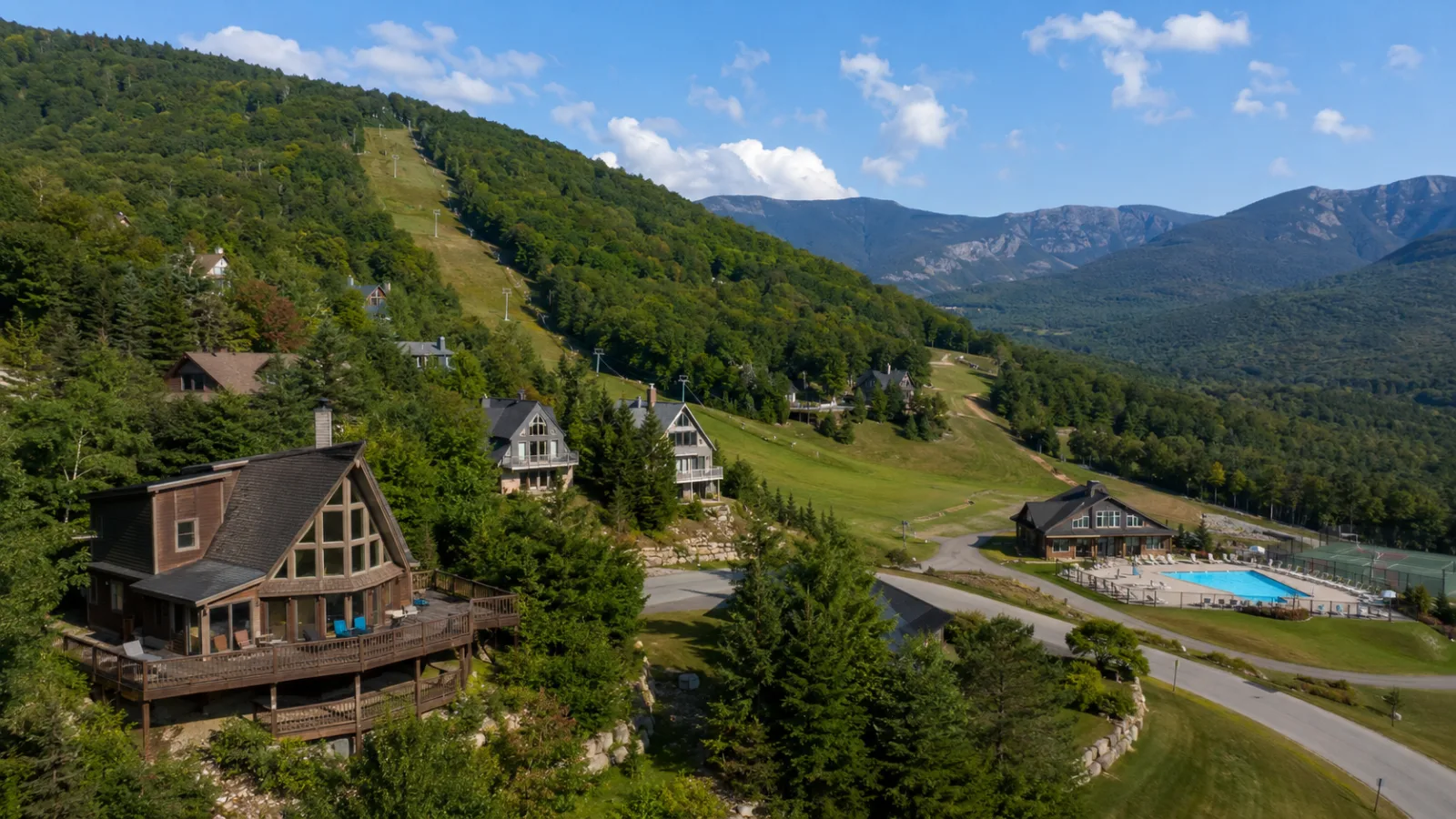
The amenities are the draw
Nobody buys in the Estates for the architecture. They buy for what's at the bottom of the hill.
The Community Center is the heart of it: two indoor pools open year-round, two heated outdoor pools that run Memorial Day through September, indoor and outdoor hot tubs, saunas, a fitness room, a game room, and two places to eat and drink — the Summit Lounge and the Mountain View Pub. On a February afternoon when it's five below, the indoor pool area is full of kids and the hot tub is full of parents. That's the product.
Outside, the district maintains tennis and pickleball courts, basketball courts, a sand volleyball court, a pond with a sandy beach and diving raft, a playground, and more than six miles of walking and hiking trails.
Then there's the ski hill. Campton Mountain is the community's own alpine area — about 313 feet of vertical, served by a double chairlift and a surface lift, with a base lodge and weekend night skiing in season. It closed for a stretch in the 2000s and reopened in 2011, and today it's exactly what it should be: the place kids learn to ski for a fraction of what a lesson-and-lift day costs at a destination resort. Nobody's running gates here. That's the point.
For a deeper look at the big-mountain skiing twenty minutes up Route 49, see Waterville Valley through the seasons.
What it really costs to own here
This is the section nobody else writes, and it's the reason this guide exists. Two numbers matter: the association dues and the tax bill.
Association dues. The Waterville Estates Association bills every homeowner annually in June, with a cost-of-living adjustment each year. For 2026, homeowner dues are $948.85 — roughly $797 of that funds recreation at the Community Center and about $152 covers administration. Owners of unbuilt lots pay just the administrative portion, about $152. For context, 2025 dues were $923 and 2024 dues were $900, so the trajectory is steady, modest increases rather than surprise jumps. Amenity access runs on a membership pass system; passes renew each July, and extra guest passes are available (a full-year guest pass was $550 as of the 2025 policy update).
The two-tax-bill reality. Because the village district is a real taxing authority, Estates properties pay a district rate on top of the normal town, school, and county rate. In 2025, Campton's base rate was $17.46 per $1,000 of assessed value, and the Waterville Estates Village District added about $5.67 per $1,000, bringing the effective rate in the Campton portion of the Estates to about $23.13. Thornton's 2025 town rate was lower — $11.74 — so the handful of Thornton-side addresses work out differently. Rates reset every fall, so confirm the current numbers with the town and the NH Department of Revenue Administration before writing offers.
That district tax isn't dead money — it's what pays for the plowed roads and the rec facilities above. Water is the one thing it does not cover: the district's water department is independently funded through its own rate system, with rates set and billed twice a year, so treat water as a separate utility line rather than something the tax bill takes care of. Either way, the district tax absolutely belongs in the monthly math from day one. Condo buyers add that unit association's fee on top; those vary building to building, so pull the current figure for any listing under serious consideration.
Homes or condos
The housing stock splits into two camps, and they suit different buyers.
The single-family side is classic 1970s-and-onward ski country: chalets, A-frames, and raised ranches on wooded lots, with newer construction scattered through the later phases. The walkthrough priorities: the age of the systems — roofs, boilers, and especially septic, since these are private systems and a failed leach field is a five-figure conversation — and the road, driven in the mindset of February. How steep is the last quarter mile, and where does the plow put the snow?
Condos and townhomes cluster in their own associations within the Estates. They're the lower-maintenance, lower-buy-in path, and the usual first showing for buyers who plan to rent when they're not here. Read the condo association's documents as carefully as the WEA's — each one has its own fee, reserve situation, and rules.
How rentals really perform
The property-manager's view, not the listing agent's pitch:
The Estates has historically been a rental-friendly community — the association publishes guidance for owners who rent, and there's an established system of guest passes and vouchers so renters can use the Community Center. That amenity access is the whole game. A three-bedroom chalet in the woods is a nice listing; a three-bedroom chalet where the kids can swim indoors, ski a private hill, and hit the game room books materially better in every season, and guests say so in the reviews.
Two honest caveats. First, the association holds owners accountable for renter conduct — if guests break the rules, it's the owner's passes and wallet on the line, which is why WEA-compliance language and a deposit belong in every rental agreement. Second, rules evolve; confirm the current rental and pass policies with the association office before buying on a rental-income thesis, and budget for guest pass costs in the projections.
Demand-wise, this pocket of Campton runs a genuine four-season calendar — ski winters, summer pool-and-hiking weeks, and foliage — and the drive-to convenience from I-93 keeps occupancy honest in the shoulder seasons. The full numbers picture, town rules included, is in the guide to whether Campton is a good place for an Airbnb.
Living here year-round
A meaningful share of the Estates is full-time now, and the year-round question comes down to logistics.
Winter first. These are mountain roads at elevation, and the village district plows them — that's part of what the district tax buys. Still: get a vehicle with proper snow tires, and look at the specific driveway before falling in love with the house. Internet service in the community has improved a lot in recent years, but it can vary street to street, so verify the options at the specific address as part of due diligence — especially for remote work.
Schools are a quiet strength. Campton kids attend Campton Elementary School for grades K–8, part of SAU 48, and then go on to Plymouth Regional High School in Plymouth.
For getting around: the community sits minutes from Exit 28 on I-93 — off Route 49, then Route 175 to Winterbrook Road — which puts Waterville Valley Resort and Loon both within about a half hour's drive, Plymouth's shops and hospital about fifteen minutes south, and Boston roughly two hours door to door. That Exit 28 corridor is a big part of why this area works for commuting weekenders, and it's covered in more depth in the Campton and Thornton buyer's guide.
Some buyers look at the Estates and decide they'd rather build. There's still land in and around Campton and Thornton, and an unbuilt Estates lot carries only the administrative portion of the dues while the plans come together.
Is it right for you
The honest sorting test: the Estates is right for you if you'll actually use the amenities — if your family will be in that pool, on that beach, and on that ski hill, the dues and district tax buy more than the equivalent money buys anywhere else in the region. It's wrong for you if you want privacy and acreage and would resent paying for facilities you never visit. Most owners land firmly in the first camp, and the ones who sell usually do it because life changed, not because the community disappointed them.
Quick answers to the most-asked questions:
What are the fees, all in? For 2026, WEA homeowner dues are $948.85 per year, plus the village district tax (about $5.67 per $1,000 in 2025) on top of the town rate, plus the district's water rates — billed separately twice a year, since the water department funds itself — plus a condo association fee for condo buyers. Get current figures from the association office and the town before committing — dues adjust every year and tax rates reset every fall.
Can I rent my place short-term? The association has historically been rental-friendly and provides a framework for owners who rent, with guest passes for amenity access. Owners are responsible for renter conduct, and condo associations may layer on their own rules — confirm current policies before buying with rental income in mind.
Is the ski hill real skiing? It's 313 vertical feet with a double chair, a lodge, and night skiing on winter weekends. It's a learning hill and a convenience, not a substitute for Waterville Valley or Loon — which are each within about half an hour.
Can I bring my dog? Single-family owners generally can, subject to community rules. Condo associations within the Estates set their own pet policies, and they vary — if a pet is non-negotiable, say so up front so the condo docs get screened before any tour.
Seeing the Estates in person
Reading about the two tax bills is one thing. Standing in the Community Center on a Saturday, watching the double chair spin out the window, is what actually tells a family whether this place fits.
Owl's Nest Real Estate lists homes here, manages rentals here, and can put the real numbers behind any property that catches your eye — dues, taxes, rental history, the works. Browse the newest Campton and Thornton listings to see what's on the hill right now.