

Plymouth vs Campton vs Thornton NH comes down to services versus taxes: Plymouth has the downtown, hospital and university but a 2025 tax rate of $23.77; Campton is the middle at $17.46; Thornton has the land and the lowest rate, $11.74. All three share Plymouth Regional High School and sit within fifteen minutes of each other on I-93.
They do not share a housing stock, a water supply, an electric utility or a personality, and the differences are bigger than twelve miles of the Pemigewasset valley suggests. Every number below is sourced and dated — 2025 tax rates from the NH Department of Revenue Administration, home values from Zillow's August 2026 index, land area from the Census Bureau, road classes from the state road inventory. Where a figure could not be confirmed, the gap is named.
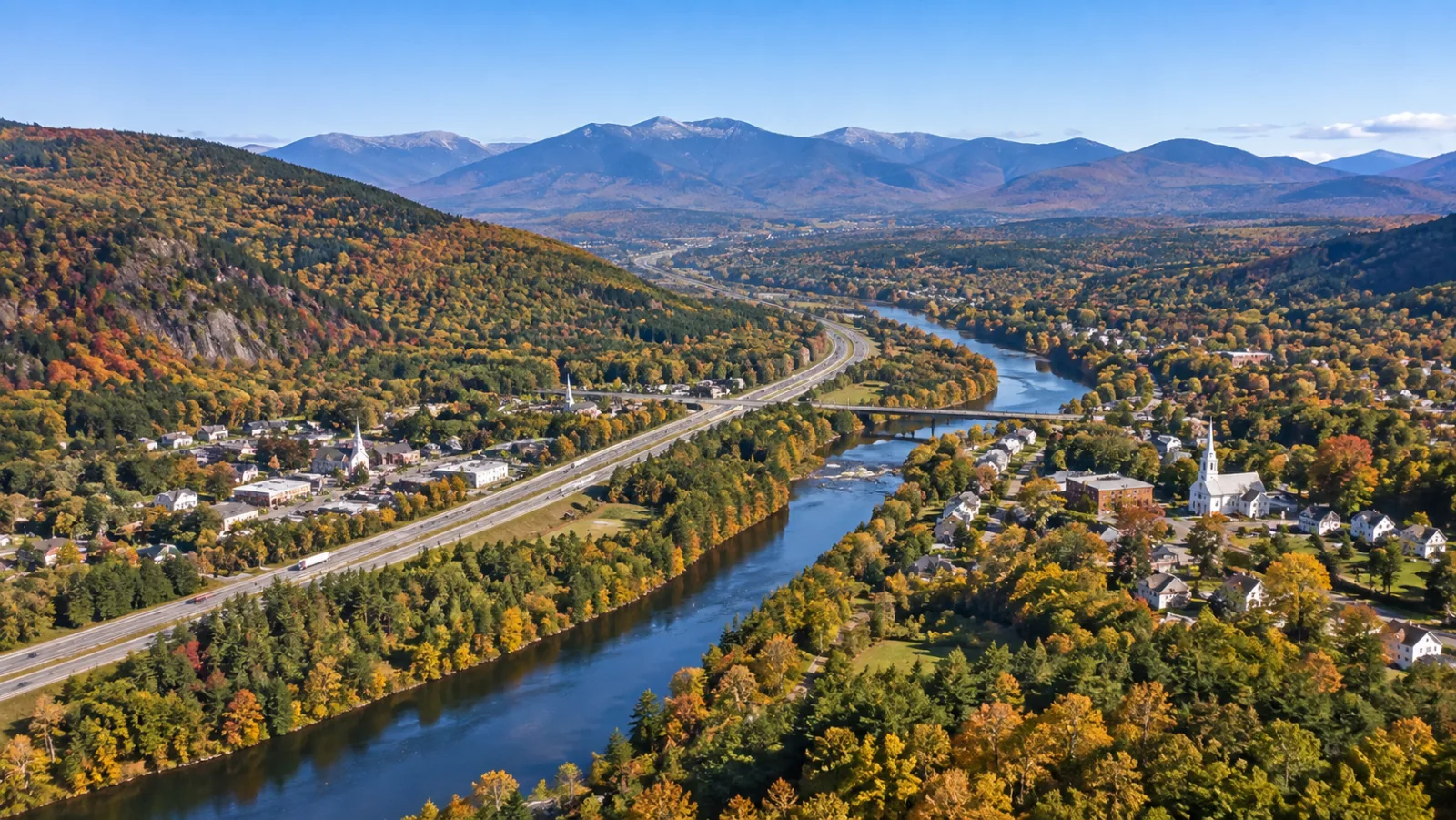
The three towns at a glance
All three are in Grafton County, all three are in the same regional high school district, and all three are within twenty minutes of each other. Everything else varies.
| Plymouth | Campton | Thornton | |
|---|---|---|---|
| County | Grafton | Grafton | Grafton |
| ZIP | 03264 | 03223 | 03285 |
| Population, 2020 Census | 6,682 | 3,343 | 2,708 |
| Population, 2024 state estimate | 6,712 | 3,479 | 2,906 |
| Land area | 28.1 sq mi | 51.8 sq mi | 50.1 sq mi |
| People per square mile (2024) | 237.8 | 67.0 | 57.8 |
| I-93 exits | 25 and 26 | 27 (Blair Road) and 28 (Route 49) | 29 (US 3), with 30 to the north |
| 2025 total tax rate | $23.77 | $17.46 | $11.74 |
| Same rate inside Waterville Estates | n/a | $23.13 | $17.16 |
| Typical home value, Aug 2026 (Zillow) | ~$377,000 | ~$423,000 | ~$432,000 |
| Est. tax on that value at the 2025 rate | ~$8,960 | ~$7,380 | ~$5,070 |
| Elementary school | Plymouth Elementary | Campton Elementary | Thornton Central |
| High school | Plymouth Regional | Plymouth Regional | Plymouth Regional |
| Municipal water and sewer | Yes, in the village | Precinct and district systems only | No town system |
| Electric territory | Entirely NH Electric Co-op | Co-op in limited areas only | Co-op in limited areas only |
| Fiber internet | NH Broadband sells here | NH Broadband sells here | NH Broadband sells here; more under construction |
| Town-maintained road | 42.1 mi | 58.4 mi | 48.8 mi |
| Class VI road | 5.0 mi | 4.2 mi | 0.7 mi |
Sources for that table, in order: population from the 2020 U.S. Census and the NH Office of Planning and Development's 2024 municipal estimates, published August 8, 2025; land area from the U.S. Census Bureau's 2024 Gazetteer file, which measures land only and excludes water; tax rates set by the NH Department of Revenue Administration between December 1 and December 9, 2025; typical home value from the Zillow Home Value Index for August 2026, explained in its own section below (the estimated tax row simply multiplies that value by the 2025 rate, as if assessed at market); electric territory from New Hampshire Electric Cooperative's filed tariff; road mileage from the state road inventory published through NH GRANIT, queried September 2026.
Those 2025 rates are still the current ones. As of September 2026 the DRA has published municipal and village district tax rates only through 2025; the 2026 rates get set town by town in the autumn, and both Campton's and Thornton's own offices were still posting the 2025 figures when this was written.
One number in that table does most of the work. A $600,000 assessment costs about $14,260 a year in Plymouth, about $10,480 in Campton, and about $7,040 in Thornton. That is the single biggest reason buyers who start in Plymouth end up looking north.
How long the drives actually take
The towns sell themselves on access, so here is what access means in minutes. These are off-peak driving estimates from town center to destination; a February storm or a Sunday afternoon southbound on I-93 will beat them up.
| From | Plymouth | Waterville Valley | Lincoln (Loon) | Concord | Boston |
|---|---|---|---|---|---|
| Plymouth | — | ~30 min (19 mi) | ~30 min (23 mi) | ~50 min (43 mi) | ~2 hr 10 min (110 mi) |
| Campton (Exit 28) | ~15 min (8 mi) | ~25 min (13 mi) | ~25 min (18 mi) | ~1 hr (49 mi) | ~2 hr 20 min (116 mi) |
| Thornton | ~15 min (11 mi) | ~25 min (15 mi) | ~20 min (15 mi) | ~1 hr (53 mi) | ~2 hr 20 min (120 mi) |
Manchester-Boston Regional Airport is about 1 hour 20 minutes from Plymouth and about 1 hour 30 minutes from Campton or Thornton. The Loon and Waterville Valley figures land you in the resort village; add a few minutes for the base lodge parking lot.
The practical takeaway is that the difference between these towns is never more than about ten minutes of driving. Nobody should choose Plymouth over Thornton to save time. People choose Plymouth because the things they need are in it.
Why the tax rates are so far apart
Three towns, twelve miles, and a rate spread of more than two to one. The DRA's own 2025 breakdown explains it.
| 2025 component (per $1,000) | Plymouth | Campton | Thornton |
|---|---|---|---|
| Municipal | $9.97 | $5.16 | $2.46 |
| County | $1.15 | $1.04 | $0.97 |
| State education | $1.10 | $1.32 | $0.97 |
| Local education | $11.55 | $9.94 | $7.34 |
| Total | $23.77 | $17.46 | $11.74 |
| Total town valuation | $791.3M | $851.5M | $977.4M |
| Total tax commitment | $19.26M | $16.50M | $11.89M |
Read the bottom two rows together and the story is obvious. Thornton has the largest grand list of the three — $977 million of taxable value — and the smallest tax bill to raise against it, $11.9 million. Plymouth has the smallest grand list and the largest commitment. Plymouth runs a full-service town: police, fire, public works, a downtown, sidewalks, parking, a public library and a share of a school budget educating the most students. Thornton spreads a light municipal budget across a valuation swollen by Owl's Nest Resort, Waterville Estates property and a long stretch of riverfront land, over a population under 3,000.
That is also why Plymouth's rate is not the scandal it looks like. Plymouth's assessments are its own, and its municipal rate buys services that Campton and Thornton residents drive to Plymouth to use. Our Plymouth property tax guide works through the mechanics — assessment ratios, abatements, exemptions and what the rate actually funds.
The Waterville Estates district tax, which buyers miss
This is the thing that catches people, and it catches them after they have already made an offer.
Waterville Estates is not a subdivision with an HOA. It is a village district — a separate municipal body under New Hampshire law with its own elected commissioners, which levies its own property tax on top of the town rate. It spans both Campton and Thornton, and it is responsible for the roads, the water system and the community properties inside the district, including the community center and the ski lodge.
For the 2025 tax year, DRA set the district rate at $5.67 per $1,000 on the Campton side and $5.42 on the Thornton side. Layered onto the town rates, that gives:
- Campton, inside Waterville Estates: $23.13 — a whisker under downtown Plymouth.
- Thornton, inside Waterville Estates: $17.16 — roughly Campton's ordinary rate.
Separately, there are Waterville Estates Association dues and fees for recreation, and district water rates. A buyer comparing a Waterville Estates house against a house half a mile down the hill on the ordinary Campton rate is comparing two very different carrying costs for the same sticker price. The district buys real things — plowed private-standard roads, a pool, a ski hill, a beach — but it is not free, and it should be in the spreadsheet before the offer, not after. Our Waterville Estates buyer's guide covers the community itself in depth.
For the record, Campton also has a small Campton Village Precinct (2025 rate $0.23, for a total of $17.69), and Plymouth's Village Water & Sewer District levied a district tax rate of $0.00 in 2025 — it runs on user rates, not a property tax.
This is general information, not tax or legal advice; your attorney and the town assessor have the current answers for a specific property.
Living in Plymouth, the only one with a downtown
Plymouth is the hub, and it is the only town in this comparison that functions without a car trip. Main Street has a common at one end and Plymouth State University at the other. Speare Memorial Hospital has a 24-hour emergency department. The district courthouse is here. So are the full-size supermarkets, the pharmacies and the big-box retail along Tenney Mountain Highway. If you have ever wondered why Campton and Thornton residents talk about "going to town," this is the town — and there is enough of it that we wrote a separate piece on things to do in Plymouth.
Who it suits. Anyone who wants to walk somewhere. Retirees who want the hospital close. Families who want their kids inside the school and sports orbit rather than driving to it. Anyone working at the university, the hospital or the school district. Remote workers who want a coffee shop and the region's least fragile internet — Plymouth is the only one of the three that sits entirely inside co-op territory — rather than a view.
What you give up. The highest tax rate of the three, by a distance. Smaller lots. And a town whose rhythm is set by an academic calendar — the blocks near campus are loud in October and empty in July.
The rental market is its own asset class. Plymouth State's enrollment plus a hospital plus a courthouse produces genuine year-round rental demand in a region where most rental stock is seasonal. Multi-families near campus and in the village trade on their rent rolls, not on their kitchens, and they compete for buyers with second-home money that has no interest in them. If you are house-hunting rather than investing, that competition mostly works in your favor. Our guide to Plymouth NH neighborhoods goes through the town street by street, the guide to moving to Plymouth NH covers schools and commutes, anyone renting first should read our guide to rentals in Plymouth NH, and there is a separate piece on homes near Plymouth State University for anyone buying with a student tenant in mind.
Living in Campton, the value middle
Campton is two towns wearing one name, and understanding the split is most of what a buyer needs.
The valley floor runs along Route 175 and Route 49 either side of Exit 28, following the Pemigewasset and the Mad River. This is where the commercial cluster is, where our office is, where the covered bridges are — Blair Bridge and Bump Bridge, both under town weight limits — and where most of the year-round housing sits. Ten to fifteen minutes to Plymouth, twenty-five to Waterville Valley, and a highway on-ramp you can reach in under three minutes.
The hill is Waterville Estates, up Route 175 and Winterbrook Road: a large planned community of vacation and year-round homes with its own water system, roads, ski hill and recreation, and the district tax described above. Its buyers are mostly weekenders and short-term rental owners.
Between the two sits a long tail of back-road Campton — Eastern Corners Road, the Perch Pond and Beech Hill side of town — where you find acreage, older capes, and the occasional farmhouse.
Who it suits. The buyer who wants a real house on real land, a short drive to everything, and a tax rate a third below Plymouth's. Weekenders who want to be ten minutes from the highway. Short-term rental owners who want both Waterville Valley and Loon inside half an hour.
What you give up. There is no downtown. Groceries are in Plymouth. And the town's two halves have different markets, different costs and different buyer pools, so "Campton comps" is a phrase to distrust unless the comps are on the same side of the hill.
Campton is also home to roughly half of Owl's Nest Resort, which straddles the Campton–Thornton line. The Campton and Thornton buyer's guide walks through the offer, inspection and closing process in both towns.
Living in Thornton, the quiet one with the land
Thornton is the least visible of the three and the one whose numbers surprise people. It has the lowest tax rate by a wide margin, the largest total valuation, and about 2,900 residents spread across fifty square miles. There is no village center; the town is organized along US Route 3 and the Pemigewasset, with side roads climbing east toward Welch and Dickey and the national forest.
The land is the product. Thornton is where a buyer in this region gets five, ten or twenty acres without a resort premium attached, and where river frontage on the Pemi still trades. It also spreads a lot of road over very few people: the town maintains 48.8 miles of Class V highway for about 2,900 residents, roughly two and a half times as much town road per person as Plymouth. That ratio is the thing you feel in February. Campton, worth noting, carries even more town road in absolute terms — 58.4 miles — so this is a valley-floor-versus-hill-town difference, not a Thornton peculiarity.
Owl's Nest distorts the median, and you should know that before you read one. The resort's clubhouse campus, Lake Harold beach club and much of its home inventory carry Thornton addresses. That creates a price tier in Thornton that has essentially no relationship to the rest of the town — a resort home and a 1970s ranch on Route 3 are both "Thornton sales," and averaging them produces a number that describes neither. When someone quotes you a Thornton median, ask whether Owl's Nest is in it. The figure we publish below deliberately is not a median for exactly this reason.
Schools. Thornton Central School handles the elementary and middle grades in town, and students go on to Plymouth Regional High School with Campton's, Plymouth's and the rest of the district's. Some families who want a K–12 building under one roof look at the Lin-Wood district in Woodstock and Lincoln instead; that is a genuine reason people choose those towns over Thornton.
Who it suits. Buyers who want acreage, privacy and the lowest carrying cost in the corridor, and who are content to drive fifteen minutes for a gallon of milk. Skiers who want to be closest to Loon — our roundup of ski resorts in New Hampshire sets out what is within range from here. Anyone building.
What you give up. Services, sidewalks and streetlights. Longer private drives to plow. And parts of the back half of town where the fiber is a scheduled project rather than a working connection — Thornton is one of the 23 communities in the co-op's 2026 broadband grant, which is the polite way of saying some of it is still unserved.
Schools, district by district
Every town in this comparison except Woodstock sends its high schoolers to Plymouth Regional High School, which is run by the Pemi-Baker Regional School District and serves ten towns.
| Town | Elementary / middle | High school |
|---|---|---|
| Plymouth | Plymouth Elementary School (SAU 48) | Plymouth Regional |
| Campton | Campton Elementary School (SAU 48) | Plymouth Regional |
| Thornton | Thornton Central School (SAU 48) | Plymouth Regional |
| Holderness | Holderness Central School (SAU 48) | Plymouth Regional |
| Rumney | Russell Elementary School (SAU 48) | Plymouth Regional |
| Waterville Valley | Waterville Valley Elementary School (SAU 48) | Plymouth Regional |
| Ellsworth | No school in town; students tuitioned to other SAU 48 schools | Plymouth Regional |
| Ashland | Ashland Elementary School (SAU 2, K–8) | Plymouth Regional |
| Woodstock | Lin-Wood Public School, Lincoln (Lincoln–Woodstock Cooperative) | Lin-Wood |
Two practical consequences. First, the high school is not a differentiator between Plymouth, Campton and Thornton — it is the same building, the same teachers and the same bus system, so a family choosing between the three is really choosing an elementary school and a commute. Second, Ashland is the odd one out administratively: its own district runs the K–8 school under SAU 2, while its teenagers go to Plymouth Regional.
Amenities and services
| Plymouth | Campton | Thornton | |
|---|---|---|---|
| Walkable downtown | Yes | No | No |
| Full-size supermarket | Yes | No | No |
| Hospital with 24-hour ER | Speare Memorial, in town | ~15 min to Plymouth | ~15 min to Plymouth |
| University | Plymouth State | — | — |
| Highway convenience cluster | Exits 25/26 | Exit 28 | Exit 28, a few minutes south |
| Town library | Yes | Yes | Yes |
| Ski area within 30 min | Waterville Valley, Loon | Waterville Valley, Loon | Waterville Valley, Loon |
| Municipal water/sewer | Village district | Precinct and Waterville Estates district only | Waterville Estates district only |
Wells, septic, and what municipal water actually changes
This is the difference that shows up at inspection and never shows up in a listing photo.
Plymouth is the only one of the three with a genuine public system: the Plymouth Village Water & Sewer District serves the built-up village. Buy inside it and you get treated water, a sewer connection, quarterly bills and no leach field to worry about. Buy on the outskirts of Plymouth and you are back on a well and septic like everyone else.
Campton has a small village precinct and the Waterville Estates district water system on the hill. Everything else is private.
Thornton has no town-wide system at all; outside the Waterville Estates portion and a handful of association systems, every house is on its own well and its own septic.
What that means when you are buying here:
- Get the septic located, pumped and inspected. Systems on 1960s–1980s houses in Campton and Thornton frequently predate any state design on file. A system with no approved design at the NH Department of Environmental Services is not automatically bad, but it is unknown, and unknown is what you are paying to remove.
- Test the well water properly, not just for bacteria. Arsenic, radon and uranium come out of the bedrock across this part of Grafton County and are invisible, odorless and treatable. The test is cheap; skipping it is how people inherit a $4,000 treatment system.
- Ask about the drilled versus dug distinction. Older camps and river-side houses sometimes still run on shallow dug wells that fail in a dry August.
- Steep-lot septics are the local specialty. On the hill neighborhoods and the Thornton back roads, pump chambers and mound systems are common. They work; they also have parts that fail and power they depend on.
- Frost, not flood, is the winter problem. Shallow lines on a long private drive freeze. Ask the seller what they do in January.
Internet, electricity and cell service
Internet is the most decisive practical issue in this corridor, and the single most useful fact about it is that the fiber here belongs to the electric co-op.
New Hampshire Electric Cooperative owns NH Broadband, launched in 2020 and built with Conexon Connect, and it markets 100 percent fiber in Plymouth, Campton and Thornton today. That tells you where the fiber goes: it hangs on the co-op's own poles, so availability follows electric territory — and electric territory here is not townwide.
That is the catch. The co-op's tariff filed with the New Hampshire Public Utilities Commission lists its service area town by town and marks some towns "limited areas only." Plymouth is listed without that qualification — the whole town is co-op territory. Campton and Thornton are both marked limited areas only, so each contains addresses the co-op does not serve, which the fiber build has no particular reason to reach.
Nor is the construction finished. On May 12, 2026 the co-op announced a $5.58 million BEAD award to build 126 miles of fiber to about 2,500 homes and businesses in 23 communities — Thornton among them, with Holderness, Warren, Wentworth and Groton. Plymouth and Campton are not on the list. Parts of Thornton were still classed as unserved or underserved in 2026: scheduled, not connected.
So, the honest advice, which is also what we do for our own buyers:
- Check the exact address, not the town. Two houses a quarter-mile apart on the same Thornton road can have completely different options, because the plant stops where it stopped when it was built. Run the address through NH Broadband's availability check and the FCC's national broadband map, then call the provider and ask whether that specific drop is serviceable. The FCC map refuses automated queries, so it is a tool to use by hand rather than a figure anyone can quote you at the town level.
- Ask the seller for a current bill. It names the provider, the plan and the speed actually being paid for, and settles the question in thirty seconds.
- If you work from home, make it a contingency. We have had buyers walk over upload speed, and sellers install service to save a deal.
- Have a fallback. Fixed wireless and low-earth-orbit satellite reach addresses fiber never will, at a cost and a latency you should understand before relying on them.
On the electricity itself. The co-op is not a normal utility. It is member-owned and nonprofit, with more than 71,000 members across 118 communities, and buying inside its territory makes you a member rather than a customer — a vote in director elections, an allocation of capital credits, and rates set through that structure rather than by an investor-owned company. Whether that applies to a specific house in Campton or Thornton depends on which side of the territory line it sits on, and the closing statement will not tell you. Ask before you assume, particularly if you are budgeting for a heat pump or an EV charger.
Cell coverage follows the same shape as everything else: fine along I-93 and the valley floors, patchy up the hill roads and in the notches, and effectively absent in parts of the national forest. Wi-Fi calling solves most of it at home. And none of the three towns has natural gas distribution — heat here is oil, propane, wood, pellets or heat pumps, and a woodstove is a resale feature, not a quirk.
Short-term rentals, town by town
Every third buyer we walk through Campton or Thornton asks whether the house can be rented out. The answer is not a town-level yes or no, and the three towns differ far more than their reputations suggest. Here is what each town's own ordinance says as of September 2026.
| Plymouth | Campton | Thornton | |
|---|---|---|---|
| STR-specific ordinance | No, but zoning restricts transient use | None | None found |
| Transient rental in residential zones | Not a permitted use | No town rule against it | Unconfirmed — ask the land use office |
| Registration / permit | — | None | None published |
| Usually the binding rule | Zoning | Covenants, Waterville Estates rules | Covenants, association rules |
Plymouth is the strict one, which nobody expects. Its zoning ordinance (as amended March 11, 2025) never says "short-term rental," but it defines a dwelling as non-transient and a separate tourist home — "sleeping accommodations … for transient guests" — that must be owner occupied. Tourist homes are permitted in the Village Commercial, Highway Commercial and Industrial and Commercial Development zones, by special exception in the Agricultural zone, and not at all in the Single-Family or Multi-Family Residential zones. If rental income is in your Plymouth plan, establish the parcel's zone first.
Campton has no short-term rental ordinance. Its zoning ordinance (adopted 1974, last amended March 12, 2024) has no registration, permit, cap, occupancy limit or owner-occupancy rule for renting a house by the week; hotels, B&Bs and "tourist accommodations" are separate lodging uses. The binding constraint is usually private: the Waterville Estates district regulations and subdivision covenants.
Thornton adopted a new zoning ordinance on March 10, 2026. No short-term rental ordinance or rental registration form appears among the town's published ordinances and forms, but we could not retrieve the new ordinance's text (the town site blocks document downloads), so treat Thornton as no evidence of a registration scheme rather than a confirmed negative, and ask the land use office before you build a rental pro forma.
Two things are true in all three towns regardless. Private rules — condominium documents, association covenants, district regulations — are often stricter than the town, and they are the ones a neighbour actually enforces. And the state taxes the activity: New Hampshire levies its 8.5% Meals and Rentals tax on rental occupancies under RSA 78-A, and you register with the Department of Revenue Administration before you take a booking.
For contrast, look one exit north. Lincoln regulates short-term rentals explicitly and in detail, which is the model people assume applies everywhere in the White Mountains; our Lincoln short-term rental investment guide works through what that regime requires. The difference between Lincoln's approach and Campton's absence of one is, for a rental buyer, a bigger deal than ten minutes of driving.
Roads, winter and the Class VI question
New Hampshire classifies every public road, and the class determines whether the town has to plow it. Under RSA 229:5, Class V highways are the town roads a town has a duty to maintain regularly. Class VI highways are the rest — ways discontinued subject to gates and bars, or not maintained in suitable condition for travel for five successive years or more.
That matters to a buyer for one blunt reason. Under RSA 674:41, a building permit generally cannot issue for a lot whose access is a Class VI highway unless the local governing body has voted, after review by the planning board, to authorize permits on that road; the municipality assumes neither maintenance responsibility nor liability; and notice of those limits has been recorded at the registry of deeds. The same conditions apply to lots on private roads. A beautiful cheap lot on a Class VI road is cheap for a reason.
Which roads these actually are
None of the three towns publishes a road-classification list — Campton's highway department page has a "Road Resources" section with nothing in it. The state road inventory does carry the classification, though, and here is what it says for these three towns as of September 2026:
| Class V, town-maintained | Class VI | |
|---|---|---|
| Plymouth | 42.1 mi | 5.0 mi |
| Campton | 58.4 mi | 4.2 mi |
| Thornton | 48.8 mi | 0.7 mi |
The Class VI roads in Campton are Chandler Road, which is much the longest at about a mile and a half, plus Brayman Road, Webster Road, Strong Road, Vintinner Road, Latuch Road, and a third of a mile at the far end of Eastern Corners Road — which the state inventory spells without the s, a small illustration of why you ask the town rather than a database. In Thornton there is very little: about half a mile of Thornton Gore Road, a short piece of Applebee Road, and one unnamed stub. In Plymouth, which surprises people, there is more Class VI mileage than in either of the others — most of it Pike Hill Road and Hunt Road, with shorter pieces on Chaisson Road, Fox Park Drive and Edmunds Court.
Treat those names as a prompt, not as title work. Classifications get changed at town meeting, a road can be Class V for part of its length and Class VI beyond a point — Eastern Corners Road is exactly that — and only the town's own record governs. If the access road to a lot you like appears on that list, or simply looks unloved, ask the land use office for the classification in writing before you write an offer.
Winter here is also administered, not just endured. Campton, for example, has a town seasonal road ban policy — the mud-season weight limits that close soft roads to heavy trucks each spring, which is why oil deliveries and moving trucks get scheduled around March — along with weight limits on the Blair and Bump covered bridges, a weight limit on Eastern Corners Road, and an ordinance against pushing snow into the roadway. Every town up here has some version of these. The practical questions for a buyer are: is my road Class V, how long is my private drive, who plows it, and what does that cost. Ask all four.
What things cost, and where the price bands sit
We could not source a published median sale price for towns this small: New Hampshire Housing's website states that its raw datasets are not currently available for download, and the state Realtors' town-level tables were not reachable. What is publishable is the Zillow Home Value Index, which is not a median sale price — it estimates the typical value of homes in the middle third of the market, between the 33rd and 67th percentiles. Here that construction is a feature, because trimming the top third is exactly what stops a handful of Owl's Nest and Waterville Estates sales from writing the number.
| Zillow Home Value Index | Plymouth | Campton | Thornton |
|---|---|---|---|
| August 2026 | $377,119 | $422,802 | $432,015 |
| August 2025 | $374,682 | $397,454 | $412,366 |
| One-year change | +0.7% | +6.4% | +4.8% |
| August 2021 | $268,131 | $285,951 | $286,922 |
| Five-year change | +41% | +48% | +51% |
| 2025 tax rate | $23.77 | $17.46 | $11.74 |
| Est. annual tax at that value | ~$8,960 | ~$7,380 | ~$5,070 |
Figures are Zillow's city-level ZHVI for all homes, smoothed and seasonally adjusted (August 2026 release, as downloaded September 2026; Zillow revises back months, so earlier-published figures differ slightly). Nearby, for scale: Rumney and Ashland ~$365,000, Woodstock ~$434,000, Waterville Valley ~$440,000, Lincoln ~$492,000 and Holderness ~$667,000 on the same measure and month.
Read the top row against the tax table and the real trade-off appears. Plymouth is the cheapest of the three to buy into and by far the most expensive to hold. Thornton is the dearest to buy and the cheapest to carry. That is not a paradox but the same fact twice: Plymouth's stock is older, smaller and denser and its rate is high because the town does more, while Thornton's is newer and larger on more land and its rate is low because a big grand list carries a small budget. The one-year rows add a second signal — Plymouth essentially flat, Campton and Thornton still climbing, which is what you would expect where the demand is second-home and rental money rather than local wages.
Underneath the index, the three markets are shaped differently:
- Plymouth has the deepest supply of ordinary year-round housing at the bottom of the range — village capes, ranches, condominium units and small multi-families — plus a modest band of larger homes on the town's edges. It is where a first-time buyer in this region most often lands, and our guide to buying a home in Plymouth breaks those bands down. Below that band, across all three towns, sit the park and owned-lot manufactured homes, which are the genuine entry point here and finance differently from a stick-built house.
- Campton is the value middle in the most literal sense: more house and more land per dollar than Plymouth, less than Thornton, with a strong short-term rental floor under anything near Route 49. Waterville Estates is its own sub-market, priced on the amenities and carried by the district tax.
- Thornton has the widest spread of the three. Ordinary Route 3 and back-road houses sit at the affordable end; acreage and river frontage sit in the middle; and Owl's Nest sits on a tier of its own, well above anything else in town. Land is where Thornton beats both neighbours — see current Thornton NH land for sale, and the Plymouth land for sale guide for how much thinner the supply is a town south.
Across all three, the number that decides affordability is not the price — it is the price plus the rate plus the district tax plus the plow contract plus the propane. Two houses at the same asking price in Campton and Thornton can differ by several thousand dollars a year in carrying cost.
How to choose, in one page
A decision rule, rather than a shrug:
- If anyone in the household needs to walk to things, or needs the hospital close, buy in Plymouth. Nothing else in this comparison substitutes for a downtown, and the tax rate is the price of it.
- If you want land, the lowest carrying cost, and you are content to drive, buy in Thornton. You will spend the difference on gas and on a longer driveway, and still come out ahead.
- If you want neither extreme — a real house, a short drive, a highway on-ramp and a tax rate that does not sting — buy in Campton. It is the default answer for a reason.
- If it is a weekend and rental property first, compare Campton's Route 49 corridor with Thornton's resort inventory, and run the numbers with the district tax and any association dues included.
- If schools are the deciding factor, stop comparing these three — they share a high school. Compare the elementary schools, or look at Lin-Wood in Lincoln and Woodstock for a K–12 building.
And run the same three checks in every town before you fall in love with a house: the actual annual tax bill on that parcel, the internet at that address, and who plows that road. Our New Hampshire home buyer guide walks through the purchase process itself.
The towns buyers put in the same basket
Almost every buyer who looks at these three ends up looking at some of these. One clear reason for each.
Holderness — Squam Lake, and the lowest tax rate within fifteen minutes of Plymouth ($9.42 in 2025). You buy Holderness for the water and the conservation culture that has kept the shoreline undeveloped; you pay for it in price per square foot.
Ashland — a compact village at Exit 24 with Little Squam on one side and Plymouth ten minutes away, plus something no other town here has: its own municipal electric department, with rates set by the selectboard. The 2025 tax rate is $19.19, second only to Plymouth in this group.
Rumney — the Baker River valley west of Plymouth, and the answer for anyone who wants farm land, a climbing crag out the window or Stinson Lake. Sixteen minutes to Plymouth, a 2025 rate of $14.50, and more open land per dollar than anywhere on the I-93 side.
Ellsworth — the extreme version of Thornton. Ninety-seven residents in 2024, 21.4 square miles of land, no school in town, no I-93 exit of its own, and the lowest tax rate in this comparison at $7.36. People buy in Ellsworth NH for absolute quiet and for the price of land, and they accept a half-hour drive to a supermarket to get it.
Woodstock — the Lin-Wood school district, a village with an inn and a brewery, and the shortest drive to Loon of anywhere in this article. A 2025 rate of $12.37 and a rental market that runs hard in both winter and summer.
Waterville Valley — a town that is also a ski resort, reached only by eleven miles of Route 49 from Exit 28, with a 2025 rate of $9.96 and a housing stock that is overwhelmingly condominium. You buy here to walk to the lifts and to own something you can hand to a management company. You give up land, supply and a grocery store.
For the wider view, our roundup of the best towns to live in New Hampshire sorts the whole state by the kind of life each town fits.
Frequently asked questions
Is Plymouth or Campton NH better to live in?
Plymouth if you want services within walking distance — a hospital, a university, supermarkets, a Main Street — and will pay the 2025 rate of $23.77 per $1,000 for them. Campton if you want more land and a lower bill and do not mind a fifteen-minute drive for groceries. On a $600,000 assessment the 2025 rates work out to roughly $14,260 a year in Plymouth against $10,480 in Campton.
Campton vs Thornton NH — which has lower taxes?
Thornton, by a long way. The 2025 rates were $11.74 in Thornton and $17.46 in Campton, so the same assessment costs about a third less to carry in Thornton. The exception is Waterville Estates, which spans both towns and adds its own village district tax — $5.42 on the Thornton side and $5.67 on the Campton side in 2025 — for all-in rates of $17.16 and $23.13.
How much do homes cost in Plymouth, Campton and Thornton?
On Zillow's Home Value Index for August 2026 — the typical home in the middle third of the market, not a median sale price — Plymouth is about $377,000, Campton about $423,000 and Thornton about $432,000. Plymouth is the cheapest to buy into and, at $23.77 against Thornton's $11.74, by far the most expensive to hold. Campton and Thornton rose about 5–6% over the year; Plymouth was essentially flat.
Is Campton NH a nice place to live?
For the right household, yes. Campton puts a house on real land ten to fifteen minutes from Plymouth's hospital and supermarkets and twenty-five minutes from Waterville Valley and Loon, with fiber across much of town and a 2025 tax rate of $17.46. The trade-offs: no downtown or grocery store, a real winter, and a town split between the valley floor and Waterville Estates, which carries its own district tax.
Do Campton and Thornton have town water and sewer?
Largely no. Neither town runs a town-wide public water or sewer system; most properties are on private wells and septic. The exceptions are the Waterville Estates Village District water system in both towns, the small Campton Village Precinct, and a few private community systems. Plymouth is the only one of the three with a municipal water and sewer district, and it serves the village, not the whole town.
Can you run a short-term rental in Plymouth, Campton or Thornton?
Campton has no short-term rental ordinance. Thornton publishes no registration or permit scheme, though its new March 2026 zoning ordinance should be checked with the land use office. Plymouth is the strict one: its zoning does not permit transient rental in either residential zone. In all three, condo documents, covenants and Waterville Estates rules are often stricter, and the state's 8.5% Meals and Rentals tax applies.
Is there fiber internet in Campton and Thornton NH?
Yes, though not at every address. NH Broadband, New Hampshire Electric Cooperative's fiber subsidiary, sells service in Plymouth, Campton and Thornton, but coverage follows the co-op's lines, and both Campton and Thornton are only partly co-op territory. In May 2026 the co-op won $5.58 million in federal BEAD funding for 23 communities including Thornton, so some Thornton addresses are scheduled rather than connected. Check the exact address.
Which town is best near I-93 in the White Mountains?
For self-sufficiency, Plymouth, at Exits 25 and 26. For value with highway access, Campton at Exits 27 and 28. For the most land for the money and the lowest tax rate, Thornton at Exit 29. All three put you within about thirty minutes of Waterville Valley and Loon Mountain and roughly two and a quarter hours from Boston, and all three send teenagers to Plymouth Regional High School.
Owl's Nest Real Estate works this corridor every day from an office on Route 49 in Campton, and Plymouth, Campton and Thornton are the towns we know house by house and road by road. If you are weighing two of them against each other, talk to us — we will tell you which one the house you are looking at actually belongs in.