
Commercial property for sale in New Hampshire is a smaller and more idiosyncratic market than the national listing portals suggest, and the largest cost of owning it is usually not the mortgage — it is the property tax bill that resets when your purchase price is recorded at the registry of deeds. The state puts almost its entire public burden on real estate: roughly 1.4 million people across 234 municipalities, one metropolitan corridor with institutional depth, a seasonal tourism economy in the mountains and lakes, and no general sales tax or wage income tax to carry the load instead.
That cuts both ways. The absence of sales and wage income tax is why so many operating businesses want a New Hampshire address. The cost is that the town assessor is your largest recurring expense, that the environmental history of a 140-year-old main-street block is rarely clean, and that a change of use from one occupancy to another can trigger a state septic approval, a fire code upgrade and a planning board hearing before you collect a dollar of rent.
This guide covers what actually trades here, where, and the mechanics a buyer has to understand before writing an offer: the taxes, the permits, the environmental work, the financing, the valuation math and the honest risks of owning commercial real estate in a rural state.
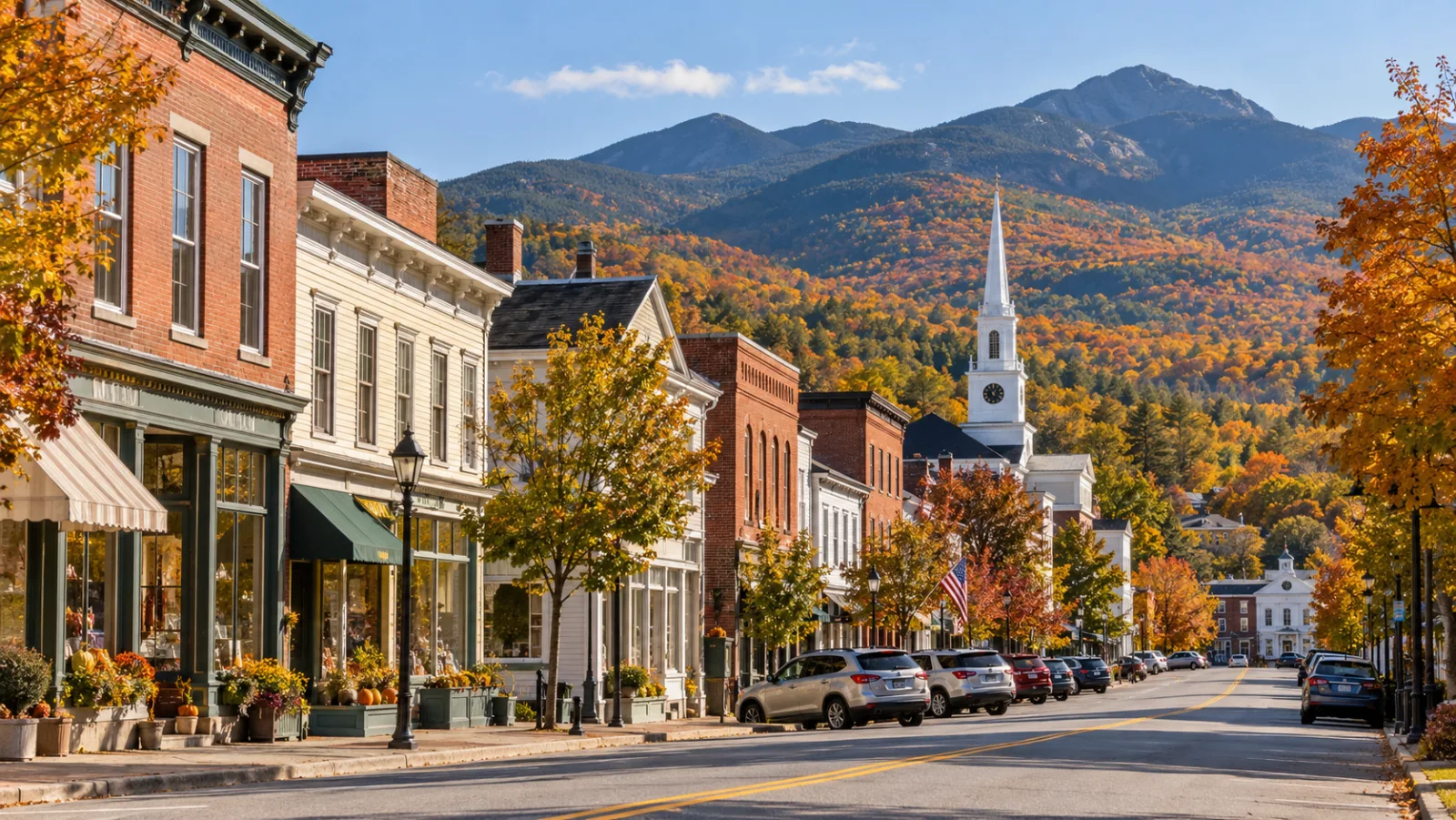
What actually trades in New Hampshire
Statewide inventory sorts into a handful of classes. The ones that move quickly and the ones that sit for two years are not the same.
| Class | Where it concentrates | What a buyer should expect |
|---|---|---|
| Main-street retail and storefronts | Every town center; Plymouth, Laconia, Lincoln, Wolfeboro, Littleton | Older masonry or wood-frame blocks, tight parking, second-floor space that is hard to lease |
| Mixed-use blocks (apartments over commercial) | Village centers statewide | The residential income usually carries the deal; the storefront is the volatile half |
| Industrial and flex | I-93 and Route 3 south of Concord, Rochester, Claremont, Berlin | The tightest, most institutional segment in the state |
| Self-storage | Everywhere, especially near lakes and ski areas | Seasonal demand spikes; land-hungry; increasingly competitive |
| Hospitality — inns, motels, lodges | White Mountains, Lakes Region, Seacoast | Business value and real estate value are tangled; meals and rooms tax applies |
| Restaurants | Tourism corridors and town centers | Liquor license, grease trap, septic capacity and equipment are the real diligence |
| Marinas and campgrounds | Winnipesaukee, Squam, Newfound, the Pemi valley | Heavily regulated shoreland and wastewater; short earning season |
| Ski-area and resort commercial | Lincoln, Waterville Valley, Bartlett, Bretton Woods | Condo-hotel, retail pads and base-area commercial with association overlays |
| Surplus municipal buildings | Any town that closed a school, church or town garage | Cheap to buy, expensive to convert; unique statutory process |
| NNN and net-leased pads | Highway commercial strips, mostly southern NH | Thin supply; priced off the tenant's credit, not the dirt |
A second sorting matters as much as the class: who the next buyer is. Multi-tenant retail in Nashua has an obvious resale market. A single-tenant 9,000-square-foot former hardware store on a state highway in Grafton County has perhaps a dozen plausible buyers in the whole state, and you will meet several of them at the closing table when you sell.
The rest of this guide works through what that costs — in tax, in permits, in time.
Where the commercial markets are
The I-93 corridor — Salem, Londonderry, Manchester, Bedford, Nashua, Concord. The only part of New Hampshire with institutional-quality inventory and a deep buyer pool. Industrial and flex behave like an extension of the Boston market, priced against Massachusetts alternatives. Colliers' New Hampshire industrial report for the second quarter of 2026, published July 20, 2026, put statewide industrial vacancy at 6.1% — up 0.7 points year over year, against a historic low of 2.7% — with an average asking rate of $11.92 per square foot NNN, up 6.3% on the year. That is a market normalising from pandemic-era lows, not softening. Office is the weaker leg, with a clear split between renovated Class A product and everything else.
The Seacoast — Portsmouth, Dover, Rochester, Somersworth. Portsmouth carries the highest rents and the lowest availability in the state, and the supply of downtown commercial buildings is essentially fixed. Dover and Rochester are where the value plays are, with older mill space and a strong conversion pipeline.
The Concord and Lakes Region belt — Concord, Tilton, Laconia, Meredith, Franklin. A hybrid economy: state government and healthcare in Concord, tourism and second-home services around Winnipesaukee, outlet and highway retail at Exit 20 in Tilton. Laconia carries the only real downtown redevelopment pipeline north of Concord, and anchors the Lakes Region commercial market.
The North Country and White Mountains. A tourism economy with a resident base too small to support most commercial uses on its own. Revenue is seasonal — a February week and an October weekend carry the year — and the businesses that survive are the ones built for that curve. This is the White Mountains commercial market: lodging, food, outfitters, service trades and the buildings that house them. Which mountain a building sits near matters to its winter revenue; our roundup of ski resorts in New Hampshire is the fastest way to see how the season is distributed.
The corridor our office actually works
Our office sits in Campton and Plymouth, at the point where I-93 leaves the Lakes Region and enters the notch. The commercial inventory in this corridor is specific enough to describe building by building.
Plymouth's Main Street is a compact brick downtown anchored by Plymouth State University and Speare Memorial Hospital. The blocks are mostly two- and three-story, built between roughly 1880 and 1930, with retail or restaurant space at grade and apartments or offices above. The upper floors are the economics: student and workforce housing demand in Plymouth is persistent in a way that a storefront's is not, which is why the mixed-use blocks here trade better than pure retail does. If student housing is the actual thesis, read our batch companion on homes for sale near Plymouth State University before you buy a downtown block on that assumption.
The Tenney Mountain Highway — Route 25 running west out of Plymouth from Exit 26 — is the corridor's highway retail strip: the supermarket-anchored plaza, auto uses, chain quick-service pads, contractor yards and the flat, sewered land that any new commercial development in Plymouth is most likely to use. It is also where the town's site plan review gets its most serious workout. Our piece on Tenney Mountain and the Plymouth real estate around it covers what has and has not happened with the ski area at the end of that road, which is the single biggest variable in the strip's long-run demand.
Lincoln's Main Street, Route 112 off Exit 32, is the densest tourism commercial block north of the Lakes Region: Loon Mountain base-area retail, restaurants, outfitters, motels and the buildings serving the Kancamagus traffic. Revenue here is unapologetically seasonal, and buildings are frequently valued on what a good ski year plus a good foliage season produce. Our Lincoln town page shows residential inventory in the same market, and the guide to Lincoln condos near Loon Mountain explains the base-area association structures that also govern much of the commercial space there.
Ashland, Bristol, Meredith and Laconia round out the trade area. Ashland has a small mill-village commercial core, a sewer system and the best access to I-93 Exit 24 in the region. Bristol's downtown sits at the foot of Newfound Lake with a genuine village center. Meredith's commercial property is priced off Winnipesaukee tourism. Laconia is the region's only city, with the deepest commercial building stock and the most institutional lenders paying attention.
Two things follow from this geography, and both of them cost buyers money when they are discovered late. First, sewer is the constraint that decides what a building can become. Public sewer in the corridor is concentrated in the Plymouth, Ashland, Lincoln and Bristol village systems; most of the rest of the trade area is on private septic, and a village district's willingness to grant capacity is a separate question from whether the pipe runs past the property. Confirm both with the town or the district — parcel by parcel, in writing — before you underwrite a use that generates flow. Second, land suitable for a new commercial site along the Route 3 and Route 25 corridors trades on the residential MLS as often as on any commercial platform, which is why buyers here should be watching both. If you are weighing which of these towns to buy in, Plymouth vs. Campton vs. Thornton sets out how the three differ on taxes, services and access.
Before you buy a raw parcel for commercial use, run the same checks any land buyer runs — soils, frontage, access permit, wetlands, utilities. Our guide to buying land in New Hampshire covers those, and the Plymouth land and lots page shows current inventory in the corridor.
Residential income property and mixed-use blocks
The most common "commercial" purchase in New Hampshire is not a strip center. It is a three- to eight-unit residential income property, or a village block with two storefronts and four apartments over them. Both are financed commercially once you pass four units, both are assessed and taxed as commercial or multi-family by the town, and both live or die on the same arithmetic.
It is also the best-documented segment of the state's investment market, which matters when you are trying to price something. Colliers' New Hampshire multifamily report for midyear 2026, published August 31, 2026, put combined-market occupancy at 95.4% — up 0.9 points year over year — on $451.9 million of first-half sales volume, with per-unit pricing up 4.3%; the companion commentary noted six-unit buildings trading alongside institutional deals at an average of roughly $180,000 per unit statewide. Those are statewide figures weighted heavily toward Salem, Nashua and Manchester, and a six-unit building in Grafton County will not price there — but no equivalent series exists for retail or office in this state at all.
What separates the good ones here:
- Heat. Whether the units are separately metered and separately heated is the single largest variable in a northern New Hampshire multi-family. An owner-paid oil boiler serving six units in Grafton County is a January liability. Ask for three winters of fuel deliveries, not one.
- Water and septic. In-town properties on municipal water and sewer are straightforward. A six-unit building on a well and a septic system designed for a single family is a problem you inherit, and NHDES rules treat an increase in flow or a change in wastewater characteristics as a change requiring a new subsurface approval.
- Parking. Village-center zoning often requires more spaces than the lot physically holds. Confirm whether the existing use is conforming, grandfathered or simply unenforced.
- The rent roll versus the market. Long-tenured tenants at below-market rents are common in small New Hampshire towns and are a value-add opportunity and a vacancy risk at the same time.
- Short-term rental exposure. Some mixed-use blocks in tourist towns carry nightly-rental units. That is a different business with different rules — a meals and rooms operator's license among them — and it changes what the building is worth to the next buyer. We cover the operating side on our vacation rental management page, and the exit in our guide to selling a short-term rental in New Hampshire.
For the underwriting side — how to model a New Hampshire rental, what the state does and does not regulate, and how the numbers actually pencil — see our New Hampshire investment property guide and the current Plymouth investment properties inventory.
Closed schools, churches and other surplus municipal buildings
New Hampshire has a steady supply of surplus public buildings — closed elementary schools, consolidated town offices, decommissioned churches, old town garages and fire stations — and almost nobody explains how they are actually sold. This is the most underserved corner of the state's commercial market, and the one where a buyer who knows the statute has the largest edge, because the process is public, scheduled and written down.
How a town sells a building. Under RSA 41:14-a, in a town that has adopted the authority under RSA 41:14-c, the select board may sell town-owned land or buildings only after referring the proposed sale to the planning board, the conservation commission, the heritage commission and, if the building lies within a defined district, the historic district commission, for review and recommendation — where those boards and commissions exist. The board must then hold two public hearings at least 10 but not more than 14 days apart, and vote no sooner than 7 and no later than 14 days after the second hearing. A written petition from 50 registered voters, filed before the board's vote, moves the whole question onto the town meeting warrant instead.
Two practical consequences. The calendar is published, so a buyer who reads select board agendas knows about a disposition before it is marketed. And RSA 41:14-a, II lists property the select board simply cannot sell under this section no matter what it agrees with you: town-owned conservation land managed by the conservation commission under RSA 36-A, any part of a town forest established under RSA 31:110, and real estate given or bequeathed to the town for charitable or community purposes. If the parcel you want is any of those, the deal is not slow — it is unavailable on these terms.
How a school district sells a school — and the right of first refusal nobody mentions. School districts are separate corporate bodies from the town. Under RSA 194:2 a district holds and disposes of its own real property, and in practice a sale goes to the district's voters as a warrant article. But the rule that actually decides these deals is RSA 194:61, and it is the single most important thing to know before you bid on a closed New Hampshire school.
RSA 194:61, II requires every superintendent to report the district's unused facilities to the Department of Education each July 1, and requires the Department to maintain that list publicly on its website. An "unused facility" is a district-owned school building not being used for academics, extracurriculars, administration or sports and with no school-board-approved written plan to put it back to such a use within two years. That list is, in effect, a free statewide inventory of New Hampshire schools for sale, published by the state, months before most of them reach a broker.
The catch is in RSA 194:61, III. If the district's school board extends an offer to purchase or lease an unused facility to anyone other than an approved chartered public school operating in New Hampshire, the contract must be made subject to a right of first refusal in favor of approved charter schools. Once your offer is accepted, the district notifies the Department's charter school administrator, who notifies every approved charter school in the state, and the statute fixes the expiration of that right at 60 days after the notification. A charter school that lets the window pass forfeits any claim on the building; one that exercises it has six months from its written offer to complete the purchase or lease at a negotiated price (RSA 194:61, V).
What that means at the closing table: your purchase and sale agreement needs a contingency and a timeline that assume a 60-day statutory window opening after your offer is accepted, not a surprise letter three weeks before closing. You can lose the building at your own negotiated terms — price that risk.
What you are actually buying. Old school buildings are cheap per square foot and expensive per usable square foot. Budget for:
- Hazardous materials. Pre-1980 schools routinely contain asbestos floor tile, pipe insulation and roofing, and lead paint. A pre-purchase hazardous materials survey is not optional.
- Mechanical systems. A single large boiler, often oil or steam, sized for a use you are abandoning. Underground heating-oil tanks are common.
- Occupancy change. Moving from Group E (educational) to business, assembly, storage or residential occupancy under the 2021 International Existing Building Code is a full design exercise — egress, fire separation, sprinklers, accessible route, energy code.
- Septic and water. A rural school's septic system was designed for a school day, not for apartments. Any change of use that increases the load requires a new NHDES subsurface approval.
- Zoning. Many schools sit in residential districts where the school was a permitted institutional use and your proposed use is not. Confirm you need a variance or a special exception before you go under contract, not after.
Churches carry a similar profile with an added wrinkle: deed restrictions, burial grounds and steeple structural work are all live issues, and the congregation's disposition process is governed by its denomination rather than by statute. There is no charter school right of first refusal on a church — but there is frequently a bishop, a diocesan property committee or a regional conference whose approval is the real closing condition.
NNN and net-leased property in New Hampshire
Buyers searching for New Hampshire NNN properties for sale are usually looking for the same thing as buyers everywhere: a single-tenant building on a long lease with a creditworthy tenant and no landlord responsibilities. The supply here is thin.
What exists falls into three groups. Corporate-credit pads — pharmacy, quick-service restaurant, dollar store, bank branch, auto parts — sit on highway commercial strips, mostly in the southern half of the state, and trade nationally through 1031 exchange buyers who never visit. Regional-credit net leases are the larger and more interesting group: a building leased to a New Hampshire bank, a healthcare practice, a veterinary clinic, a state agency or a franchisee operator. Pricing turns entirely on how you underwrite that tenant. Ground leases and quasi-NNN deals show up when a landowner leases a pad rather than selling it.
Three things to check on any New Hampshire net-leased deal:
- What "NNN" means in this specific lease. Absolute net, where the tenant owns roof and structure, is rare outside corporate pads. Read who pays for the roof, the parking lot and the HVAC replacement.
- Tax reassessment risk. Your purchase price is a recorded sale at the registry of deeds, and the town's assessor will see it. On a triple-net lease the tenant pays the taxes, so a reassessment does not hit your NOI directly — but it does hit the tenant's total occupancy cost and therefore their renewal decision.
- Residual value. When the lease ends, you own a building designed for one user in a town with a small buyer pool. Underwrite the dark value, not just the cap rate.
New Hampshire also attracts 1031 buyers exchanging out of Massachusetts and Connecticut for the tax reasons below. That demand compresses pricing on the handful of genuinely institutional net-leased assets in the state and rarely reaches anything north of Concord. Colliers made the same point from the brokerage side at midyear 2026: the gap between investment-grade credit tenants and everything else is wider than it has been in some time, with lower-quality product moving selectively and at wider spreads. On a regional-credit net lease in a small town, the tenant is the asset — underwrite it the way you would underwrite a business you were buying.
The New Hampshire tax math
This is where New Hampshire is genuinely different, and where most out-of-state buyers get their model wrong in both directions.
What the state does not tax
No general sales tax, no personal income tax on wages, and no Interest and Dividends Tax — the last of those was repealed for tax periods beginning on or after January 1, 2025. For an operating business choosing between New Hampshire and a neighbor, that is the reason commercial demand here runs ahead of what the state's population would predict.
What the state does tax
Every figure below is taken from the Department of Revenue Administration's own published pages and from the statutes, as they stood in September 2026.
| Tax | Rate | Notes |
|---|---|---|
| Business Profits Tax (RSA 77-A) | 7.5% | For taxable periods ending on or after December 31, 2023; filing required where gross business income from all activities exceeds $109,000, for taxable periods beginning on or after January 1, 2025 |
| Business Enterprise Tax (RSA 77-E) | 0.55% | For taxable periods ending on or after December 31, 2022, on compensation, interest and dividends paid; filing required above $298,000 in gross receipts or enterprise value tax base, for taxable periods beginning on or after January 1, 2025 |
| Meals and Rooms (Rentals) Tax (RSA 78-A) | 8.5% | For taxable periods beginning October 1, 2021; applies to prepared meals, motor vehicle rentals and sleeping accommodations, and RSA 78-A:4 requires an operator's license before you open |
| Real Estate Transfer Tax (RSA 78-B) | $0.75 per $100, each side | Imposed on both buyer and seller — 1.5% of the price in total; where the price or consideration is $4,000 or less the tax is $20 |
DRA adjusts both business tax filing thresholds biennially, so check the department's current figure rather than reusing one from an old closing file.
What changed in 2026, and when it bites. The BET is a gross-receipts-style tax that a business pays whether or not it is profitable, and it is creditable against the BPT — which is why a low-margin operating business in New Hampshire often pays BET and no BPT. That is about to get lighter. HB 155 was signed by Governor Ayotte on July 10, 2026 and became chapter 280 of the Laws of 2026. It raises the statutory BET filing threshold to gross business receipts over $400,000 — up from the $250,000 statutory base that DRA's biennial indexing had already carried to $298,000 — and adds an automatic rate-reduction formula: for each $100 million of certified business tax surplus the BET rate drops by 0.05 percentage points, to a floor of 0.25% below which it cannot fall without new legislation.
The timing matters if you are modelling a deal now. Both changes apply to taxable periods beginning on or after January 1, 2027. For the 2026 tax year, the rate and thresholds in the table above are the ones that apply.
On the transfer tax: buyers frequently assume New Hampshire's 1.5% is a seller cost, as it is in many states. It is not. Half of it — $0.75 per $100 — is statutorily yours, and on a $2 million commercial purchase that is $15,000 due at closing before anything else.
Property tax is the operating expense that matters
New Hampshire funds local government almost entirely from property tax. Analyses of fiscal year 2022 data found New Hampshire municipalities relied on property taxes for a higher share of total revenue than any other state, and the Tax Foundation puts property taxes at roughly 59.5% of all state and local tax revenue here. For a commercial owner that translates into an operating expense line that in many towns exceeds insurance, maintenance and management combined.
How assessment works:
- RSA 75:1 requires assessment at market value — "full and true value" — and RSA 75:8-a requires a full revaluation at least every fifth year, with annual adjustments in between.
- Commercial property is valued using the same three approaches an appraiser uses, but income capitalization carries the most weight on income-producing property. That matters, because the town's capitalization rate assumption is arguable.
- The equalization ratio published by DRA tells you how the town's assessments compare to actual sales. An assessment-to-sale ratio well below 100% in a town that has not revalued recently is a warning that your purchase price will reset your assessment upward.
Abatement. If the assessment is wrong, RSA 76:16 is the remedy. You apply in writing to the select board or assessors by March 1 following the notice of tax; the municipality must decide by July 1; if you disagree, you appeal to the Board of Tax and Land Appeals or the superior court — one or the other, not both — by September 1. Commercial abatements usually turn on an income approach and an appraisal, and the deadline is jurisdictional. Missing March 1 costs you the year. Our New Hampshire property taxes explained guide walks through rates, ratios and how the bill is built, and the Plymouth property taxes guide works one town's bill through in detail.
Two programs commercial buyers should know
RSA 79-E, the Community Revitalization Tax Relief Incentive. In a town that has adopted it, an owner who substantially rehabilitates a qualifying structure in a designated downtown or village district can apply for temporary property tax relief in exchange for a recorded covenant preserving a public benefit. For a buyer planning a gut renovation of a main-street block, this is the most valuable and least-used tool in the state, and the statute is more generous than most people assume.
RSA 79-E:5 sets the term. The governing body may grant relief for up to 5 years from completion of the substantial rehabilitation (I), or from completion of construction where a qualifying structure is replaced rather than rehabilitated (I-a). It may add up to 2 more years for a project that results in new residential units, and up to 4 more for a project that includes affordable housing (II). And it may add up to a further 4 years for rehabilitating a structure listed on, or determined eligible for, the National Register of Historic Places or the state register, or located within and important to a locally designated historic district — provided the work follows the U.S. Secretary of the Interior's Standards for Rehabilitation (III). A main-street block with apartments above the storefront in a historic district can therefore qualify for well more than the five years most owners assume, at the governing body's discretion.
Two pieces of fine print decide whether you get any of it. Relief is calculated only on value above the original assessed value — the assessed value at the time the governing body approves the application and you grant the covenant — and only on assessment increases attributable to the rehabilitation itself, not to market movement (RSA 79-E:13, I). And under RSA 79-E:13, II the relief applies only to work that commences after approval and after the covenant is granted. A buyer who closes, starts demolition, and then walks into the planning office to ask about 79-E has already lost it. Ask whether 79-E is adopted and what district it covers before you close, and file before a contractor lifts a tool.
RSA 162-N, the Economic Revitalization Zone tax credit. A business creating at least one net new full-time job and making qualifying capital improvements in a designated zone can claim a credit against the BPT, with any unused portion applied against the BET. The credit is capped at $240,000 per application and $40,000 per year, with $825,000 available statewide annually, and the program is currently set to be repealed effective January 1, 2028.
Current use. If your commercial parcel includes ten or more contiguous acres of undeveloped land, some of it may be enrolled in current use under RSA 79-A and assessed at farm, forest or unproductive value rather than development value. Two consequences: your tax bill is lower than the acreage implies, and developing that land later triggers the Land Use Change Tax at 10% of the full market value of the land removed. Check for a recorded notice of contingent lien before closing.
This is general information, not tax or legal advice; your attorney and the town assessor have the current answers for a specific property.
Environmental due diligence — assume you need it
Every commercial building in New Hampshire older than about 1985 deserves a Phase I Environmental Site Assessment, and on main streets assume one is required. Nearly every New Hampshire village center has at some point contained a gas station, an auto repair shop, a dry cleaner, a printing operation or a coal and fuel-oil dealer, and underground heating-oil tanks sit under a great many older commercial buildings — often abandoned in place rather than removed.
The standard. A Phase I performed to ASTM E1527-21 satisfies EPA's All Appropriate Inquiries rule, which is what preserves the innocent landowner and bona fide prospective purchaser defenses under CERCLA. EPA formally recognized E1527-21 in a rule effective February 13, 2023. The report has a 180-day shelf life for its critical components — interviews, lien search, records review, site reconnaissance and the environmental professional's declaration — so a Phase I that has been sitting in a seller's file for a year does not protect you.
When a Phase II follows. If the Phase I identifies a recognized environmental condition, a Phase II puts borings, monitoring wells and soil or groundwater samples in the ground. Lenders will usually require it. Budget weeks, not days, and negotiate the inspection period accordingly.
New Hampshire-specific resources. NHDES runs a Brownfields program — assessment, a cleanup revolving loan fund, periodic grants and a Brownfields Covenant program addressing liability for prospective purchasers of contaminated sites. It also administers Petroleum Reimbursement Funds, which provide excess coverage for corrective action and third-party damages at eligible petroleum storage facilities, including home heating oil tanks. For a village block with an old UST, whether the tank is registered and eligible is a material question.
Permits, code and change of use
A change of use is where rural commercial deals stall. The relevant approvals are split between the state and the town, and the state half does not care whether your town has a building department.
NHDES approvals to check:
- Alteration of Terrain (RSA 485-A:17). NHDES requires an AoT permit whenever a project proposes to disturb more than 100,000 square feet of terrain — 50,000 square feet if any disturbance falls within the protected shoreland as defined by RSA 483-B — or disturbs any area of 25% or steeper slope within 50 feet of surface water. It applies to commercial and industrial development and to earth-moving operations such as gravel pits alike. Any meaningful parking expansion on a commercial site is worth checking against this threshold early, because it is 100,000 square feet of disturbance, not of new pavement.
- Shoreland (RSA 483-B). The protected shoreland is everything within 250 feet of the reference line of a public water body. Impervious surface is capped inside that band, which is exactly the constraint a lakefront restaurant, marina or campground runs into when it wants more parking.
- Wetlands (RSA 482-A). Any dredge or fill in a wetland or surface water needs a permit, and most rural New Hampshire commercial parcels have wetlands somewhere on them.
- Subsurface systems (Env-Wq 1000). NHDES defines increasing the load on a sewage disposal system to include both increasing flow and changing the wastewater characteristics through a change of use. Converting retail to a restaurant, or a school to apartments, is a change of use in the septic sense even if the building's footprint never changes.
Building and fire code. New Hampshire has a statewide building code under RSA 155-A that adopts the 2021 International Building Code, International Existing Building Code, International Residential Code, International Plumbing Code and International Mechanical Code, along with the 2018 International Energy Conservation Code and the 2023 National Electrical Code. The State Fire Code incorporates NFPA 1 and the NFPA 101 Life Safety Code, 2021 editions. The code applies whether or not the town enforces it: many smaller New Hampshire towns have never established a building department, and the Division of Fire Safety administers a state building permit program for municipalities without their own enforcement mechanism. A buyer who hears "this town has no building inspector" and concludes there are no requirements is buying a problem.
ADA. The Americans with Disabilities Act is federal and applies to places of public accommodation regardless of building age. Existing buildings face a continuing obligation to remove architectural barriers where doing so is readily achievable; alterations must comply with the 2010 ADA Standards to the maximum extent feasible, and an alteration affecting a primary function area triggers path-of-travel obligations. On a New Hampshire main street this usually means the front step, the door width and the restroom — and it is usually the single most expensive line in a storefront conversion.
How a small-town planning board actually works here
Under RSA 674:43, a municipality with a zoning ordinance and subdivision regulations may authorize its planning board to review and approve or disapprove site plans for the development, or the change or expansion of use, of tracts for non-residential uses or for multi-family dwellings of more than two units. Most towns in our corridor have done exactly that. Some things that follow from it, which out-of-state buyers consistently underestimate:
- Change of use alone can require site plan review. You do not have to build anything. Converting a former auto shop into a brewery can trigger full review on traffic, parking, lighting, drainage and screening.
- Boards are volunteers and meet monthly. A Plymouth or Campton planning board meets on a fixed evening each month, with a submission deadline two to four weeks ahead. Missing a deadline costs a month. A design revision costs another month. A four-month approval is normal; a year is not unusual when an engineering review or a state permit is in the loop.
- The town's technical review is outsourced. Small towns retain an outside engineer to review drainage and traffic, and the applicant pays those fees through an escrow account.
- Abutters show up. New Hampshire's public hearing culture is real and participatory. Talk to the direct abutters before the hearing, not at it.
- Conditions of approval are recorded. Read the conditions of approval on the existing use before you buy — they run with the land, and a prior owner's unmet condition becomes yours.
The practical advice: make your offer contingent on site plan approval for your intended use, with a realistic timeline, and go to a pre-application meeting with the board before you spend money on engineering. In our experience the boards in Plymouth, Campton, Thornton, Ashland and Lincoln are all willing to hold a conceptual conversation, and it is the cheapest hour a commercial buyer will ever spend.
Financing commercial property in New Hampshire
SBA 504. For an owner-user — a business buying the building it will operate in — the 504 program is usually the best structure available. It provides long-term fixed-rate financing for real estate and major fixed assets through a Certified Development Company, up to $5.5 million in SBA debenture, with 10-, 20- and 25-year maturities. The conventional structure is roughly 50% bank first mortgage, 40% CDC/SBA debenture and 10% borrower equity. The catch is occupancy: SBA requires the operating business to occupy at least 51% of an existing building, or 60% of new construction. The program cannot be used for rental real estate investment, so a passive landlord does not qualify.
SBA 7(a). More flexible, up to $5 million, usable for real estate plus working capital, equipment and business acquisition in a single loan — which is why it is common on restaurant, inn and retail-business purchases where you are buying a business and its building together. Rates are typically variable and the same 51% owner-occupancy rule applies to real estate.
Local banks and credit unions. For investment property, which the SBA programs will not touch, the New Hampshire commercial lending market is dominated by community banks and credit unions that hold loans in portfolio. Expect, as a general shape rather than a guarantee: 20–30% down, a 20- to 25-year amortization with a 5- or 10-year rate reset or balloon, a debt service coverage ratio requirement typically in the 1.20–1.30x range, and full recourse with personal guarantees. Terms tighten as the property gets more rural, more special-purpose or more seasonal.
The New Hampshire Business Finance Authority. The BFA is a state authority that credit-enhances loans made by conventional lenders. Its guarantee programs cover up to 90% on a term loan and up to 75% on a line of credit, with the guarantee fee equal to 1% of the guaranteed portion annually. Requests come from the bank, not from the borrower, and approval runs through the BFA board and the Governor and Executive Council. If a deal is close but not quite bankable, ask your lender whether a BFA guarantee closes the gap.
Appraisal on a rural commercial building. This is where rural deals die. An appraiser needs comparable sales, and in a town with two commercial transactions in five years there are none. The appraiser will reach into adjacent towns and adjust, or lean on the cost approach, and the number can come back well below the contract price. Two defenses: give the appraiser a complete package — rent roll, leases, three years of operating statements, tax bills, survey, environmental report — and ask your lender early whether they want a full narrative appraisal, because those take four to eight weeks in New Hampshire and should be ordered the day the inspection period opens.
How commercial property is valued here
The mechanics are the same as anywhere. The inputs are not.
Net operating income. Effective gross income minus operating expenses, before debt service and before capital expenditure. In New Hampshire the expense side is dominated by property tax, and a buyer who models the seller's current tax bill rather than the bill that follows a reassessment at the purchase price will overstate NOI. Model both.
Capitalization rate. NOI divided by value — and the honest position is that no one publishes a New Hampshire cap rate series by asset class. The research the brokerage houses put out on this state reports vacancy, asking rents, occupancy and sales volume; it does not report cap rates by property type, and neither does the state. Treat any single statewide number you are handed as a sales tool and ask which sales it came from.
Two data points are citable, and the distance between them is the useful part. Colliers' New Hampshire midyear 2026 commentary, published July 30, 2026, put net lease retail cap rates at around 6.55% — a national figure quoted in a New Hampshire report, not a New Hampshire figure. The Boulos Company's 2025 Capital Markets Outlook, published April 8, 2025 on 2024 sales, reported cap rates from the low 5% range to over 12%, averaging in the high 8s, for Maine — the nearest northern New England market anyone publishes a range for. Those two numbers describe different risks, and the spread between them is roughly what you are being asked to accept when you buy in a town with one traffic light.
The drivers you can reason about directly: liquidity — how many buyers exist for this asset in this town; tenant credit — a national pharmacy lease and a local retailer's lease do not price the same; lease term — years of remaining term is the most valuable thing a small commercial property owns; seasonality — a building earning 70% of its revenue in five months carries more risk than one earning evenly; and replacement cost, which in rural towns sets a ceiling the income approach cannot exceed, because buildings frequently sell below the cost to build them. Southern New Hampshire and Seacoast assets price tighter than North Country assets, and multi-tenant tighter than single-tenant.
Replacement cost. On a rural commercial building, ask what it would cost to build this today — our guide to building a new home in New Hampshire covers the current cost and permitting environment, and the site work and utility numbers in it carry over to commercial construction. If the answer is meaningfully above the asking price, you are buying below replacement cost, which is a real margin of safety, as long as the use is still viable. If the answer is below the asking price, you are paying for the business or the location, and you should be able to say which.
The business versus the real estate. On inns, restaurants, marinas and campgrounds, part of the price is the operating business — goodwill, licenses, bookings, equipment. Allocate it in the purchase and sale agreement. It affects your depreciation schedule, your lender's collateral analysis and, on a resale, what you are actually selling.
Your due diligence checklist
| Item | Why it matters here |
|---|---|
| Title and survey | Boundaries in rural New Hampshire are frequently described by monuments that no longer exist; rights of way and old easements are common |
| Phase I ESA to E1527-21 | CERCLA liability protection and lender requirement; 180-day shelf life |
| Hazmat survey (pre-1980) | Asbestos and lead drive renovation cost and schedule |
| Zoning and use verification letter | Confirm the existing use is legal and your use is allowed |
| Site plan approval history and conditions | Conditions run with the land |
| NHDES file review | Existing approvals, septic design on record, any release history |
| Septic design and capacity for the intended use | A change of use that increases load needs new approval |
| Property tax card and equalization ratio | Model the post-sale assessment, not the seller's bill |
| Leases, estoppels and rent roll | Verify every lease; get estoppel certificates from every tenant |
| Three years of operating statements | Separate real estate income from business income |
| Roof, structural, mechanical and building envelope inspection | Northern climate; ice damming and frozen-pipe history matter |
| Utility capacity | Municipal sewer allocation, three-phase power availability, broadband |
| Insurance quote before closing | Older masonry buildings and hospitality uses are underwriting outliers |
| Licenses and permits transferring | Liquor licenses, meals and rooms operator licenses, campground and food service licenses do not automatically convey |
The honest risks of rural commercial
We tell every buyer the same four things about commercial real estate outside the I-93 corridor.
The buyer pool is thin, and you are in it. A rural commercial building is attractively priced because very few buyers want it. That works in your favor once, and against you when you sell. Marketing periods of 12 to 24 months for a special-purpose rural building are ordinary, not a sign something is wrong.
Single-tenant risk is total. A two-tenant building that loses one tenant is at 50% occupancy. A single-tenant building that loses its tenant is at zero, with a full tax bill, a full insurance bill and heat to keep on through a New Hampshire winter. Underwrite a vacancy: can you carry this building empty for 18 months?
Seasonal revenue is real revenue, but it is not level. A Lincoln restaurant or a Waterville Valley retail space earns most of its year in winter and foliage season. Snowfall, gas prices and a wet October all move the number. Lenders know this and size loans accordingly.
Deferred maintenance in a northern climate compounds. A roof problem in Grafton County becomes an ice dam, which becomes a wall, which becomes a mold remediation. A building under-maintained for ten years is not a discount; it is a capital plan you have not written yet.
None of that argues against buying. It argues for buying with a use in mind, a reserve in the bank and an exit you can describe. The buyers who do well here are operators buying their own building and long-hold owners of mixed-use village blocks — not people looking for a quick spread.
Frequently asked questions
How much is the real estate transfer tax on commercial property in New Hampshire?
Under RSA 78-B the transfer tax is $0.75 per $100 of the price or consideration, imposed on both the buyer and the seller — a combined 1.5% of the purchase price, with each side responsible for its own half. Where the consideration is $4,000 or less there is a $20 minimum per side. Unlike many states, New Hampshire's transfer tax is not by default a seller-only closing cost, so a commercial buyer should budget 0.75% of the price at closing.
Does New Hampshire tax commercial rental income?
There is no personal income tax on wages, and the Interest and Dividends Tax was repealed for tax periods beginning on or after January 1, 2025. Rental activity conducted as a business is, however, subject to the Business Profits Tax at 7.5% and the Business Enterprise Tax at 0.55%, above the filing thresholds — $109,000 of gross business income for the BPT and $298,000 of gross receipts or enterprise value tax base for the BET, for taxable periods beginning on or after January 1, 2025, per the Department of Revenue Administration. HB 155, signed July 10, 2026 as chapter 280 of the 2026 laws, raises the statutory BET filing threshold to $400,000 and adds an automatic rate step-down, but only for taxable periods beginning on or after January 1, 2027. Short-term lodging is also subject to the 8.5% Meals and Rooms tax and requires an operator's license under RSA 78-A:4.
How do I buy a closed school building in New Hampshire?
Closed schools are usually sold by the school district, and a sale typically requires a warrant article approved by district voters. RSA 194:61, III also requires that when a district's school board extends an offer to purchase or lease an unused facility to anyone other than an approved chartered public school operating in New Hampshire, the contract include a provision making it subject to a right of first refusal in favor of approved charter schools. After your offer is accepted the district notifies the Department of Education's charter school administrator, who notifies every approved charter school; the right of first refusal expires 60 days after that notification, and a charter school that exercises it has six months from its written offer to complete the purchase or lease at a negotiated price. Build that 60-day window into your purchase and sale agreement. Buildings owned by the town rather than the district follow RSA 41:14-a instead, which requires referral to the planning board and other commissions, two public hearings 10 to 14 days apart, and a board vote 7 to 14 days after the second hearing.
Are there NNN properties for sale in New Hampshire?
Yes, but supply is limited and concentrated in the southern half of the state — highway retail pads leased to national credit tenants, plus a larger group of regionally leased buildings occupied by banks, medical practices, franchisees and state agencies. Because the inventory is thin and 1031 exchange buyers from Massachusetts compete for it, pricing on the genuinely institutional assets is tight. Read the lease before you read the cap rate: absolute net leases where the tenant owns roof and structure are the exception, not the rule.
What environmental testing does a commercial building in New Hampshire need?
A Phase I Environmental Site Assessment conducted to the ASTM E1527-21 standard, which EPA recognized as satisfying All Appropriate Inquiries effective February 13, 2023 — that is what preserves your CERCLA liability defenses and it is what a lender will require. On older village-center buildings expect the Phase I to flag heating-oil underground storage tanks, former gas stations, auto repair or dry cleaning uses, and expect a Phase II with soil and groundwater sampling to follow. NHDES's Brownfields program and its Petroleum Reimbursement Funds can defray some assessment and cleanup costs on eligible sites.
Can I use an SBA loan to buy commercial property in New Hampshire?
If your business will occupy the building, yes. The SBA 504 program funds owner-occupied real estate through a Certified Development Company with 10-, 20- and 25-year terms and up to $5.5 million in debenture, typically structured as a 50% bank loan, 40% SBA debenture and 10% borrower equity. The 7(a) program goes up to $5 million and is more flexible, covering real estate plus working capital and business acquisition. Both require the operating business to occupy at least 51% of an existing building or 60% of new construction, so neither works for a pure investment purchase.
How much are property taxes on commercial property in New Hampshire?
There is no single answer, because rates are set town by town and vary by a factor of three or more across the state — but property tax is the dominant operating expense on New Hampshire commercial real estate, and municipalities here rely on it more heavily than anywhere else in the country. Assessments must reflect market value under RSA 75:1, with a full revaluation at least every fifth year under RSA 75:8-a, so a purchase at a price above the current assessment will usually reset the bill upward. If the assessment is wrong, RSA 76:16 allows an abatement application to the select board or assessors by March 1, a municipal decision by July 1, and an appeal to the Board of Tax and Land Appeals or superior court by September 1.
Where can I find a list of New Hampshire schools for sale?
Start with the state, not a listing portal. RSA 194:61, II requires every school superintendent to report the district's unused facilities to the NH Department of Education each July 1, and requires the Department to maintain that list publicly on its website. An unused facility is a district-owned school building not in use for academics, extracurriculars, administration or sports, with no board-approved plan to return it to such a use within two years. That list is the closest thing the state has to a statewide inventory of closed schools, and buildings appear on it before most reach a broker. Town-owned buildings — old town offices, garages, fire stations — are not on it; for those, read select board agendas, since RSA 41:14-a makes the disposition a public, scheduled process.
Where do I find New Hampshire residential income properties for sale?
Three- and four-unit buildings and small village blocks are listed on the residential MLS in this state rather than on commercial platforms, which is why buyers searching only commercial sites miss most of the inventory. Financing crosses to commercial underwriting above four units, and the town assesses and taxes the building as commercial or multi-family regardless. Colliers put New Hampshire multifamily occupancy at 95.4% at midyear 2026 on $451.9 million of first-half sales volume, with six-unit buildings trading alongside institutional deals at roughly $180,000 per unit statewide — a figure weighted toward Salem, Nashua and Manchester, not Grafton County. Our Plymouth investment properties page and the New Hampshire investment property guide cover the underwriting.
What are cap rates on commercial real estate in New Hampshire?
No one publishes a New Hampshire cap rate series by asset class, so trace any statewide figure you are quoted back to actual sales before you use it. The nearest citable reference points are one national and one regional: Colliers' New Hampshire midyear 2026 commentary, published July 30, 2026, put net lease retail cap rates at around 6.55% nationally, while The Boulos Company's 2025 Capital Markets Outlook, published April 8, 2025 on 2024 sales, reported a Maine range from the low 5% range to over 12%, averaging in the high 8s. Rural single-tenant property in northern New Hampshire prices far closer to the second, because the buyer pool is small and the residual value thin. Underwrite the dark value and the remaining lease term before you argue about the cap rate.
Where should I look for commercial property in the White Mountains and Lakes Region?
Lincoln and North Woodstock along Route 112 hold the densest tourism commercial block in the mountains; Plymouth's Main Street and the Tenney Mountain Highway carry the Pemi-Baker region's downtown and highway retail; Ashland, Bristol, Meredith and Laconia serve the Lakes Region, with Laconia offering the deepest building stock and the most lender interest. Commercially usable land in the corridor frequently appears on the residential MLS rather than a commercial platform — check both, or start with our property search and the Plymouth town page. If you are on the other side of the transaction and looking to dispose of a parcel, our guide to selling land in New Hampshire covers the seller's process.
Owl's Nest Real Estate works the Pemi-Baker and Lakes Region corridor from offices in Campton and Plymouth, and we spend as much time on mixed-use blocks, income property and commercial land as we do on houses. If you are weighing a main-street building, a closed school or a commercial lot on Route 3 or Route 25, talk to us — we know which towns say yes and how long they take.