
Plymouth NH property taxes run higher than in most of the towns around it: the 2025 tax rate, set by the New Hampshire Department of Revenue Administration on December 9, 2025, is $23.77 per $1,000 of assessed value. On a house assessed at $450,000 that is $10,696.50 a year, or about $891 a month — usually the second-largest line in a Plymouth buyer's monthly payment after the mortgage principal and interest, and often larger than the insurance and PMI combined.
That number surprises buyers, and it surprises buyers from Massachusetts most of all, because the Massachusetts habit is to read a tax rate as a small number and a tax bill as one of several state taxes. In New Hampshire the property tax is the whole bill. There is no tax on wages, no sales tax, and as of January 1, 2025 no interest-and-dividends tax either. Everything a town, its schools and its county spend comes off the taxable value of the land and buildings inside the town line.
This is the Plymouth-specific companion to our New Hampshire property tax guide. Every rate below is labeled with the tax year it covers, and every one of them comes from the Department of Revenue Administration or the Town of Plymouth itself.
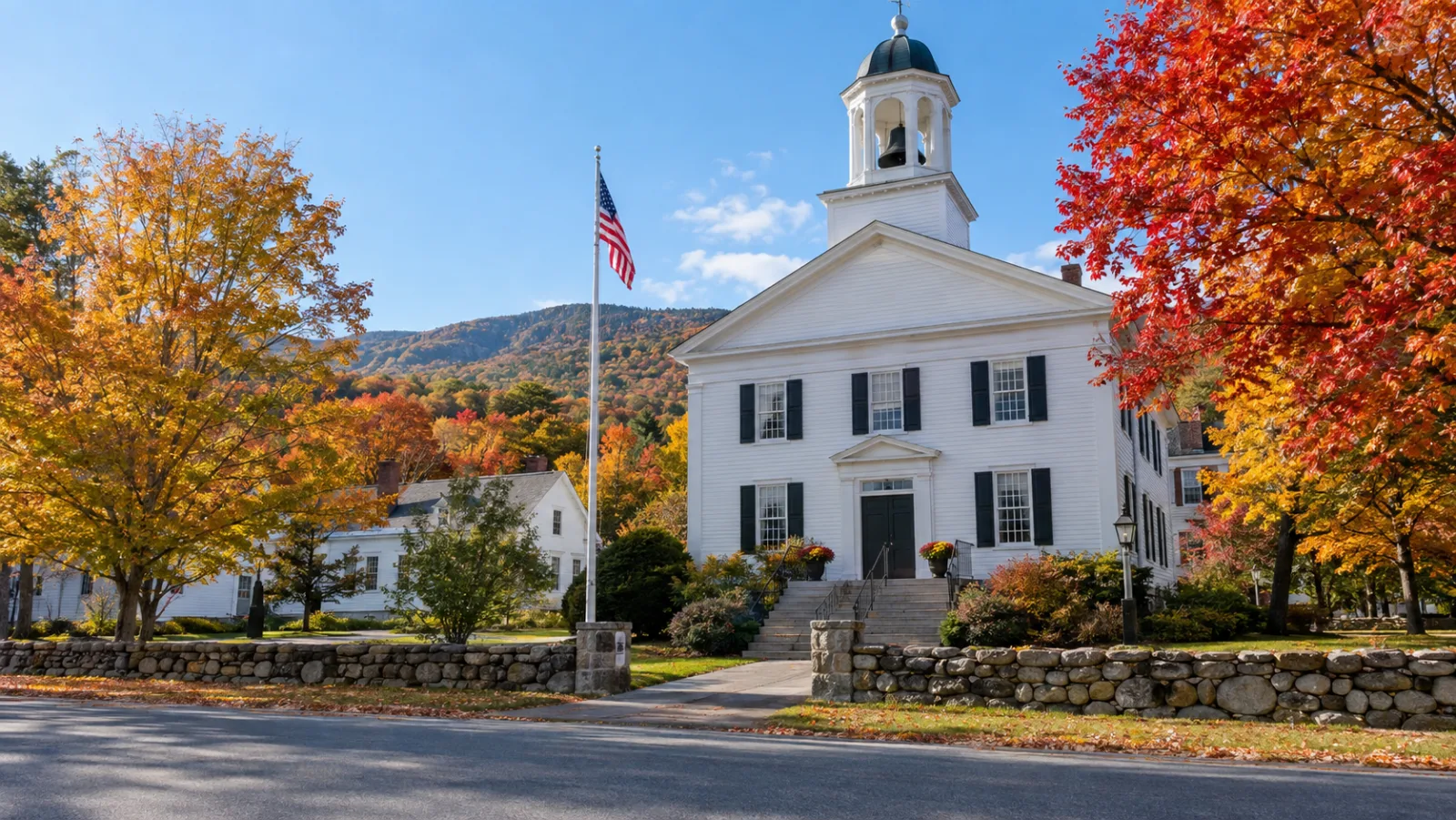
The four parts of a Plymouth tax bill
A New Hampshire tax rate is not one number. It is four separate rates, set by four different bodies, added together and printed as a total. Plymouth's 2025 rates break down like this.
| Component | 2025 rate per $1,000 | Bill on a $450,000 assessment | What it pays for |
|---|---|---|---|
| Town (municipal) | $9.97 | $4,486.50 | Police, fire, ambulance, highway, town offices, library, recreation, debt service |
| Local school | $11.55 | $5,197.50 | The Plymouth School District and Plymouth's assessed share of the Pemi-Baker Regional School District |
| State education | $1.10 | $495.00 | The statewide education property tax, retained locally for Plymouth's schools |
| County | $1.15 | $517.50 | Grafton County — the nursing home, the courts complex, the sheriff, the registry of deeds |
| Total | $23.77 | $10,696.50 |
Three things are worth noticing in that table.
- The school lines are more than half the bill. Local school plus state education is $12.65 of the $23.77 — 53% of what a Plymouth owner pays. When people say New Hampshire funds schools with property taxes, this is what they mean, literally.
- The county line is small. Grafton County costs a Plymouth owner about $518 a year on a $450,000 house. County is almost never the reason one town's rate differs from another's.
- The state education line is not a state tax in the ordinary sense. Under RSA 76:3 the Department of Revenue Administration must set the statewide education property tax to raise $363 million a year across New Hampshire. For the 2025 tax year it did that with a uniform rate of $1.120 per $1,000 of each town's 2023 equalized valuation without utilities, and warranted 259 municipalities to raise $363,515,748 between them. Plymouth's warrant was $868,029. The town raises it, and the town keeps it for its own schools. It does not leave Plymouth.
Here is what the 2025 total rate produces across the range of assessments we actually see in Plymouth.
| Assessed value | Annual tax at $23.77 | Roughly per month |
|---|---|---|
| $250,000 | $5,942.50 | $495 |
| $350,000 | $8,319.50 | $693 |
| $450,000 | $10,696.50 | $891 |
| $600,000 | $14,262.00 | $1,189 |
| $850,000 | $20,204.50 | $1,684 |
If you are running payment math on a specific house, use the assessment on the tax card, not the asking price — they are frequently different, and after a revaluation year they can be different by a lot. Manufactured homes are taxed as real estate in New Hampshire whether or not you own the pad underneath, which catches buyers out; our guide to mobile and manufactured homes covers how that works. Our Plymouth home buying guide covers what those houses cost; this guide covers what holding them costs.
Why Plymouth's rate is one of the highest around here
This is the question we get most often, and the honest answer has three parts. None of them is "Plymouth is badly run."
About a quarter of Plymouth's real estate is tax-exempt. Plymouth is about 28 square miles with roughly 6,700 residents, and inside those 28 square miles sit Plymouth State University — a 170-acre campus, state property, exempt from municipal taxation under RSA 72:23 — plus Speare Memorial Hospital, Plymouth Regional High School and Plymouth Elementary, the town's own buildings, the Plymouth District Court, the Village Water and Sewer District, and the usual churches and nonprofits.
Here is the size of it. The Town of Plymouth's 2025 revaluation file, published by the Assessing Department on September 19, 2025 and covering every parcel in town at its April 1, 2025 value, lists 2,563 parcels carrying $1.135 billion of assessed value. The parcels held by exempt owners in that file add up to roughly $272 million — about 24% of all the real estate in Plymouth. Plymouth State University and the University System of New Hampshire account for 29 of those parcels and $178.9 million on their own, close to one dollar in six of everything in town. Behind them: Speare Memorial Hospital at $27.6 million, Plymouth Regional High School and the Pemi-Baker district at $16.4 million, the churches at $12.8 million, the town's own 50 parcels at $10.3 million, the Plymouth School District at $8.8 million, the Village Water and Sewer District at $4.9 million, Grafton County at $3.8 million.
Set that against the figure the Department of Revenue Administration actually used to set the 2025 rate: a net taxable valuation of $791,255,910, or $816,145,510 with utilities included. Roughly a quarter of the town's real estate is carrying none of the load.
That is the mechanism, in numbers. Exempt property does not lower the levy; it concentrates the levy on a smaller taxable grand list, and a smaller base under the same levy means a higher rate per $1,000. It is the single biggest structural reason Plymouth's rate sits above Campton's and Thornton's.
What carries it instead is the Tenney Mountain Highway retail strip and the in-town rental stock. The single largest taxable parcel in Plymouth is the Walmart at 683 Tenney Mountain Highway, assessed at $17.0 million in the same file — more than the Plymouth School District's entire campus. That commercial base is doing a lot of work, which is one reason the town's commercial property market and its zoning decisions get more attention here than the size of the town would suggest.
Two caveats on that count. It is our own tally from the town's published parcel file, not a line lifted off the official MS-1 inventory of valuation — the Assessing Department has the MS-1, it is a public document, and it is the number to cite if you need the official one. And the 2025 file is the preliminary revaluation list; a handful of values moved between it and the December bills.
Plymouth is the service center for a much larger area than its own population. The downtown, the hospital, the university, the two I-93 exits and the Route 3 / Route 25 junction mean Plymouth's daytime population is far larger than its resident count. Police, fire, ambulance and highway budgets are sized for the town that shows up, not the town that sleeps there. (How much larger is harder to state than it should be: Plymouth State's own site describes roughly 4,100 undergraduate and 3,000 graduate students, while the federal IPEDS count for 2024–25 puts total enrollment at 3,707. The published numbers genuinely conflict, largely because much of the graduate program is online and off-campus, so treat any single enrollment figure with caution.) That daytime load is also why Plymouth has the amenities that make people want to live here — the moving to Plymouth guide and the roundup of things to do in Plymouth cover what the money buys — and it is not free.
The school rate reflects the taxable base per student, not the spending per student. Plymouth belongs to SAU 48 along with Campton, Ellsworth, Holderness, Rumney, Thornton, Waterville Valley and Wentworth, and Plymouth Regional High School serves the Pemi-Baker regional district those towns fund together. Several of those towns have a far larger taxable base relative to the number of children they send — Holderness has Squam Lake frontage and Waterville Valley has a resort's worth of condominiums, and neither sends many students. The same dollar of school cost spread over a much bigger grand list produces a much smaller rate. It is not that Plymouth spends extravagantly; it is that Plymouth's grand list is ordinary and its neighbors' are not.
If you want the town-by-town version of that argument in plain terms, our comparison of Plymouth, Campton and Thornton walks through what each town gives you for its rate.
The equalization ratio and why comparing raw rates is a trap
The most common mistake buyers make is to compare two towns' rates and stop. A rate means nothing without knowing what fraction of market value the town assesses at.
The Department of Revenue Administration measures that every year. It compares actual arm's-length sale prices against the assessments on those same properties and publishes an equalization ratio — the weighted mean of assessed value to sale price — for every municipality. Plymouth's 2024 equalization ratio was 80.2%, which means that in 2024 the town's assessments averaged about 80 cents on the market dollar. The town's own notice of its 2025 revaluation update put the 2024 average sales-to-assessment ratio at 81.8%, the same story from the town's own sales file.
The town publishes its whole ratio history, and it shows how far the number can drift between revaluations. Plymouth's ratio was 98.8% in the 2018 revaluation year, 89.1% in 2019, 89.2% in 2020, 77.4% in 2021 and 57.3% by 2022 — assessments had fallen to barely more than half of market value while the rate climbed to $31.44. The 2023 revaluation snapped it back to 95.1%.
Run the arithmetic on what that actually did to a 2024 bill:
- A Plymouth house assessed at $450,000 in 2024 was, on average, worth about $561,000 on the open market ($450,000 ÷ 0.802).
- The 2024 rate was $25.12 per $1,000 of assessed value — but against real market value that worked out to about $20.15 per $1,000 ($25.12 × 0.802).
- So the effective rate a 2024 Plymouth buyer paid on what they actually paid for the house was roughly $20.15, not $25.12. The DRA's own published full-value tax rate for Plymouth in 2024 — computed on total equalized valuation rather than by multiplying through a single ratio — is $20.09, the same answer to within six cents.
Now look at what happened next, because this is the part that catches people. Plymouth completed a revaluation update for the 2025 tax year, bringing assessments to estimated market value as of April 1, 2025. The ratio went back toward 100%. And the 2025 rate fell by $1.35, from $25.12 to $23.77.
A rate that falls is not a tax cut. The assessments underneath it rose. A revaluation raises no money; it redistributes the same levy across a re-sorted list of values. If your assessment went up by more than the town average your bill went up even though the rate went down, and if it went up by less your bill went down.
The practical rule: never compare two New Hampshire towns on nominal rate alone. Compare the actual bill on the actual assessment. If you want a fair cross-town comparison, multiply each town's rate by its equalization ratio — or skip the arithmetic and read the DRA's published full-value tax rate, which is exactly that number, town by town. Both are in the comparison table further down. The DRA publishes the ratio list annually; the assessor will tell you the current one over the phone.
The revaluation cycle and what happens to a bill after one
RSA 75:8-a requires every New Hampshire city and town to reappraise all taxable property at full and true value at least once in every five years. In between, assessors run statistical updates when the market has moved far enough that the ratio has drifted.
Plymouth's recent history, reported by the town:
| Tax year | Town | Local school | State education | County | Total |
|---|---|---|---|---|---|
| 2018 | $9.98 | $11.36 | $2.23 | $1.73 | $25.30 |
| 2019 | $10.44 | $13.87 | $1.83 | $2.05 | $28.19 |
| 2020 | $11.40 | $13.32 | $1.81 | $1.96 | $28.49 |
| 2021 | $12.06 | $14.72 | $2.00 | $1.71 | $30.49 |
| 2022 | $13.28 | $15.14 | $1.36 | $1.66 | $31.44 |
| 2023 | $11.09 | $10.89 | $1.22 | $1.18 | $24.38 |
| 2024 | $10.93 | $11.77 | $1.35 | $1.07 | $25.12 |
| 2025 | $9.97 | $11.55 | $1.10 | $1.15 | $23.77 |
The 2018–2024 rows come from the Town of Plymouth's own 2024 tax rate release; the 2025 row is the DRA's 2025 municipal tax rate setting. Read the 2022-to-2023 drop carefully — the rate fell more than $7, from $31.44 to $24.38, and nobody's taxes fell by 22%. That was the town-wide revaluation: Plymouth's taxable valuation base jumped from roughly $495 million to about $739 million. A much larger denominator under a similar (in fact somewhat larger) levy produces a much smaller rate. The town reported the base at $737 million going into 2024 and $747 million coming out of it — ordinary year-to-year drift, no revaluation.
What this means for you as a buyer:
- A low rate in a revaluation year is not a bargain, and a high rate in the fifth year of a cycle is not a penalty. Look at the bill.
- After a revaluation, check your own assessment against your own sale price. If you paid $420,000 and the town says $510,000, you have an argument — see the abatement section.
- Know where the town is in its cycle. Plymouth has revalued in 2004, 2008, 2013, 2018 and 2023 — a steady five-year rhythm — and ran a statistical update for 2025. On that pattern and the RSA 75:8-a deadline, the next full revaluation is due by the 2028 tax year. This is not a surprise; it is a date you can plan around.
Semi-annual billing, the July estimate and the December true-up
New Hampshire towns that have adopted semi-annual collection under RSA 76:15-a send two bills a year, and the two bills are not the same kind of thing.
The July bill is an estimate, not half your taxes. Under the statute the first bill is computed by taking the prior year's assessed valuation times one-half of the previous year's tax rate. It is mailed by mid-June and is due July 1. Nobody knows this year's rate in July — it has not been set.
The December bill is the true-up. The DRA sets the town's rate in the fall (Plymouth's 2025 rate was set December 9, 2025; its 2024 rate was approved in mid-November 2024). The tax collector then computes the full year's tax at the new rate on the new assessment, subtracts what you already paid in July, and bills the remainder. If the rate rose, or your assessment rose, or both, the December bill is bigger than the July bill — sometimes much bigger. When the rate is set late, the second bill is mailed late and is due roughly 30 days after mailing rather than on a fixed calendar date, so read the due date printed on the bill rather than assuming December 1.
What late costs. Under RSA 76:13 unpaid property taxes accrue interest at 8% per annum — the rate since April 1, 2019, when the legislature cut it from 12% — running from the due date, except that a bill mailed on or after November 2 and before April 1 does not start accruing until 30 days after it goes out. That is the cheap stage. Once the collector executes a tax lien against the property, redemption costs 14% per annum on the whole recorded lien under RSA 80:69, plus the lien and notification costs, and the lien is recorded and public. If you pay the town directly rather than through escrow, set a calendar reminder for both bills; the December one in particular tends to land in the middle of the holidays.
Owners 65 or older, and owners eligible for Social Security disability benefits, can also ask the assessing officials for a tax deferral under RSA 72:38-a. Deferred tax accrues at 5% and is capped at 85% of the equity in the home. It is a lien, not forgiveness, but it is a real option for a house-rich, cash-poor owner.
The Town of Plymouth takes payments online as well as at the tax collector's counter. The Assessing Department and the Tax Collector are both at 6 Post Office Square — assessing at (603) 536-1731 x100, the tax collector at (603) 536-4733.
How to read a Plymouth tax card and find it online
The "tax card" — properly, the property record card — is the assessor's file on a parcel, and it is a public record. Plymouth's parcel data and tax maps are online through AxisGIS at axisgis.com/PlymouthNH, where you can search by owner, address or map-and-lot; the Assessing Department will print or email the full card for any parcel if you ask.
One habit of this particular town office is worth knowing. In a revaluation or update year Plymouth posts the whole town's preliminary values before the bills go out, in three sortable lists — by owner, by location and by map and lot — along with the qualified sales the assessor used. For the 2025 update those went up on September 19, 2025, with an appointment window at Town Hall on September 25–26 and September 29 through October 1 for anyone who wanted to argue about a number. That is the cheapest moment to fix a value: before the rate is set, before the bill, and without filing anything. The 2023 revaluation was run by Whitney Consulting Group; the 2025 update was done in-house, and the assessing data sits in Avitar.
What is on it, and what to check:
- Map and lot, and acreage. Compare against the deed and the survey. Acreage errors are more common than you would think on rural Plymouth parcels, and they move the land value.
- Land value and building value, listed separately. In Plymouth the land line is driven by the site, the zone, road frontage and utilities. A lot inside the Plymouth Village Water and Sewer District carries a different land value than an unserviced lot on a class VI road up Plymouth Mountain or the back of Texas Hill. Condominium units — the Boulder Point and Riverside Landing buildings, the Town West and Hamilton Way clusters — show no land line at all, only building and feature value, so there is nothing on the card to sanity-check the site against.
- Living area, and how it was measured. Assessors work from exterior dimensions and a sketch. Finished basement space, an enclosed porch counted as heated living area, or a second full bath that does not exist are the classic errors.
- Grade and condition codes. These are the assessor's judgment of construction quality and current state. A house that was "average/good" before the roof and the heating system failed is a legitimate conversation.
- Style, year built, and any additions or permits picked up. Permits are how assessors learn about changes; an unpermitted finish that got picked up anyway should be checked.
- Exemptions and credits applied, and whether any land is enrolled in current use.
- The sales history. The card shows prior transfers and their prices, which is the fastest way to see whether the town's value tracks the market on that particular house.
Pull the card before you write an offer, not after you close. It takes ten minutes and it tells you the carrying cost of the house you are about to bid on. If you are selling, the card matters for a different reason — it is the first thing a buyer's agent looks at, and an inflated assessment scares buyers. Our Plymouth seller page and a current home valuation will tell you how the assessment compares to what the house will actually bring.
The abatement process and the March 1 deadline
If you believe your assessment is wrong, New Hampshire gives you a specific, time-limited remedy.
The deadline is March 1. Under RSA 76:16, any person aggrieved by an assessment may apply in writing to the selectmen or assessors for an abatement by March 1 following the date of notice of tax — that is, following the December bill. Miss March 1 and you wait a full year. Plymouth points applicants at the standard abatement form published by the Board of Tax and Land Appeals at btla.nh.gov, and takes it hand-delivered or postmarked at the Assessor's office.
The town must answer by July 1. The selectboard reviews the application and grants it for good cause shown or denies it in writing by July 1. Silence counts as a denial.
Then you have until September 1 to appeal. A dissatisfied taxpayer may appeal to the New Hampshire Board of Tax and Land Appeals or to the superior court — in Plymouth's case, Grafton County Superior Court — but not both, and generally by September 1. The Town of Plymouth spells out exactly this sequence in its own annual tax rate notice.
What actually wins an abatement. The question is not whether your taxes feel high. It is whether your assessment exceeds market value, or exceeds the level at which comparable properties in town are assessed. Evidence that works:
- A recent arm's-length purchase price for the property itself, if you bought at or below the assessment in a normal marketed sale. This is the strongest single piece of evidence there is.
- A licensed appraisal with an effective date of April 1 of the tax year in question. April 1 is the assessment date in New Hampshire; an appraisal dated in October is answering a different question.
- Comparable sales, adjusted, in the same town — not the same county.
- Factual errors on the tax card. Wrong square footage, a bathroom that is not there, acreage that contradicts the survey, a garage that burned down. These are the easiest wins because they are not matters of opinion.
- Assessment inequity. Your house is assessed at 100% of market while similar houses on your street sit at 80%. This takes work and a spreadsheet, but the ratio study makes it a real argument.
The math on whether it is worth it. At Plymouth's 2025 rate, every $10,000 of assessment removed saves $237.70 a year. A $50,000 reduction is $1,188.50 a year, and it persists until the next revaluation. If you think you are over-assessed by $50,000 or more, the application costs you an afternoon and a stamp and is clearly worth filing. If the gap is $10,000, it probably is not — and a weak abatement application, in a small town where the assessor also sets your neighbors' values, is not a costless thing to file.
Start with a conversation at the counter. In our experience a card error is usually fixed by the assessor without a formal fight; a difference of opinion about value is what the abatement process is for.
Exemptions and credits available in Plymouth
New Hampshire's exemptions and credits are a mix of state statute and local adoption, and this is the part of the system that generates the most bad internet advice. The statutory framework is statewide; the dollar amounts, income limits and asset limits are adopted town by town, so the only number that matters for your house is the one Plymouth has voted. Here is what Plymouth has actually adopted, as reported to the Department of Revenue Administration for the 2024 tax year and cross-checked against the Assessing Department's own handouts.
| Relief | RSA | Plymouth's adopted amount |
|---|---|---|
| Elderly exemption, age 65–74 | 72:39-a | $35,000 off assessed value |
| Elderly exemption, age 75–79 | 72:39-a | $45,000 off assessed value |
| Elderly exemption, age 80+ | 72:39-a | $55,000 off assessed value |
| Veterans' tax credit | 72:28 | $750 off the tax — the statutory maximum |
| All veterans' tax credit | 72:28-b | $750 off the tax |
| Surviving spouse tax credit | 72:29-a | $2,000 off the tax |
| Service-connected total disability credit | 72:35 | $2,000 off the tax |
| Blind exemption | 72:37 | $35,000 off assessed value |
| Combat service credit | 72:28-c | not adopted |
| Disabled exemption | 72:37-b | not adopted |
| Deaf exemption | 72:38-b | not adopted |
| Solar, wind and wood-heating systems | 72:62, 72:66, 72:70 | none adopted |
| Battery storage and renewable generation | 72:85, 72:87 | none adopted |
Three of those rows are worth reading twice.
The elderly exemption has income and asset tests, and Plymouth's are tight. Net income, Social Security included, may not exceed $27,500 single or $37,500 married, and net assets may not exceed $60,000 either way, excluding the residence and the land under it up to the greater of two acres or the minimum lot size in the zoning ordinance. An applicant must be 65 on or before April 1 of the tax year and a New Hampshire resident for the three consecutive years before it. At the 2025 rate a $35,000 exemption is worth $831.95 a year and a $55,000 exemption $1,307.35.
Plymouth has taken the veterans' credit to the statutory ceiling. $750 is the most a New Hampshire town is allowed to adopt under RSA 72:28, and Plymouth applies the same $750 to the all veterans' credit, which reaches peacetime service. A credit is better than it sounds — it comes off the tax owed, dollar for dollar, not off the assessment. Note that a handout still posted on the town's website shows the older $500 figure; the DRA's 2024 report shows $750, so confirm which is current before you budget on it.
Plymouth has adopted none of the energy exemptions, and it has not adopted the disabled exemption. If you are pricing a solar array, a battery or a wood-heating system here, the value it adds to the property is taxable — and the RSA 72:37-b exemption for a permanently disabled owner is not available either. Both are local options, both are common in other New Hampshire towns, and both are things generic advice will tell you that you have when you do not.
Applications are made on the DRA's PA-29 permanent application form, filed with the Assessing Department, and Plymouth's filing deadline is April 15. If you are buying a house that currently carries an exemption or credit, it does not transfer to you. The seller's elderly exemption comes off the card when the seller leaves, and the assessment you inherit is the full one. We have watched more than one buyer build a budget from a tax bill that included somebody else's exemption.
If price point is the constraint, the Plymouth homes under $500K page and the 03264 zip code page are the two searches that show the most realistic inventory — and at $23.77 per $1,000, the difference between a $400,000 and a $500,000 assessment is $2,377 a year, which is worth putting into the search filter rather than discovering in December.
Current use, briefly, if you are buying acreage
If the parcel comes with real land, ask whether any of it is enrolled in current use under RSA 79-A. Ten acres or more of farmland, forest or unproductive land — or a smaller tract earning at least $2,500 a year from crops — can be assessed at its use value instead of its development value, which drops the tax on the land to a fraction of what it would otherwise be. The house, the outbuildings and the land under them stay at full value. Enrollment runs with the land, so it transfers to you automatically; taking land out triggers a Land Use Change Tax of 10% of the full market value of the acres removed.
It is not a fringe program here. The current-use credit column in the town's 2025 revaluation file runs to about $52.5 million across Plymouth's parcels — the second-largest thing keeping value off the taxable grand list after the exempt institutions, and the only one an ordinary buyer can actually inherit.
That is the short version, because it is not this article's subject. Our Plymouth land guide covers what acreage costs here, the buying land in New Hampshire guide covers the diligence, selling land in New Hampshire covers the change-tax trap from the seller's side, and the farms and farmhouses guide goes deepest on current use itself.
Escrow, and why the first year is usually wrong
Nearly every Plymouth buyer with a mortgage escrows taxes, and nearly every one of them gets a shortage letter in year one. At closing your lender funds the escrow account based on the most recent tax bill it can see — which, if you close in the spring or summer, is a July estimate computed on the prior owner's assessment at half the prior year's rate. Then three things happen in your first year:
- The town revalues, or the rate is reset, and the December bill comes in at the current rate on the current assessment.
- Your assessment catches up to your purchase price. If you paid meaningfully more than the assessment, the assessor will often move the value at the next update, and after a town-wide revaluation the move can be large.
- Any exemption or credit the seller carried disappears, as above.
The result is a December bill the escrow account was never sized for. Your servicer runs an annual escrow analysis, finds the shortage, and does two things at once: it spreads the shortfall over the next twelve months and it raises the ongoing monthly deposit to cover the new, higher annual figure. That is how a payment quoted at $2,650 becomes $2,980 fourteen months after closing, with nothing about the loan having changed.
Three ways to avoid the surprise:
- Budget from the rate and the price, not from the seller's bill. Take your purchase price, apply $23.77 per $1,000, divide by twelve, and use that as your monthly tax figure from day one. It is the honest number.
- Ask the lender to fund escrow at the current rate, not at the last bill. Most will if you ask before the closing disclosure is issued.
- Read the proration on the settlement statement. New Hampshire closings prorate the year's taxes between seller and buyer as of the closing date, often using the prior year's bill when the current rate is not yet set, with a reconciliation clause. Know which convention your purchase and sale agreement uses. Our seller closing costs guide covers the other side of that ledger, including the state's real estate transfer tax, which is split between buyer and seller at closing.
How Plymouth compares to the towns around it
Every rate in the first column is a 2025 tax rate, set by the New Hampshire Department of Revenue Administration between November 4 and December 18, 2025 — the most recent year for which rates are final. As of September 2026 no 2026 rate has been set anywhere in New Hampshire; the DRA does not begin setting them until late autumn.
The third column is arithmetic, not a real bill: it is the published 2025 rate multiplied by 450, which is what a $450,000 assessment in that town would pay at that town's 2025 rate. The last two columns come from the DRA's 2024 Equalization Survey — the most recently published ratio year — and they are the honest comparison.
| Town | 2025 total rate per $1,000 | Tax on a $450,000 assessment at the 2025 rate | 2024 equalization ratio | 2024 DRA full-value rate |
|---|---|---|---|---|
| Plymouth | $23.77 | $10,696.50 | 80.2% | $20.09 |
| Ashland | $19.19 | $8,635.50 | 82.0% | $14.99 |
| Campton | $17.46 | $7,857.00 | 93.2% | $15.95 |
| Rumney | $14.50 | $6,525.00 | 99.6% | $14.32 |
| Bristol | $13.16 | $5,922.00 | 48.8% | $11.49 |
| Thornton | $11.74 | $5,283.00 | 101.1% | $11.47 |
| Waterville Valley | $9.96 | $4,482.00 | 100.9% | $9.11 |
| Holderness | $9.42 | $4,239.00 | 74.7% | $6.42 |
| Bridgewater | $6.35 | $2,857.50 | 96.6% | $5.20 |
Read that table with three caveats, or it will mislead you.
First, every town is somewhere different in its revaluation cycle. The rates in column one are nominal rates applied to each town's own assessed values, and those values sit at different fractions of market value — that is what the ratio column measures. The full-value rate in the last column is the DRA's own correction for that: what a town's 2024 tax actually cost per $1,000 of real market value. Plymouth's nominal 2024 rate of $25.12 was a full-value rate of $20.09. Rumney, assessing at 99.6%, was measuring in almost the same units it was charging in; Plymouth, at 80.2%, was not.
Bristol shows what this does to a headline. Its 2024 ratio was 48.8% — assessments at less than half of market — and its 2024 nominal rate was $23.62. Bristol revalued for 2025 and the rate came out at $13.16. Nothing about Bristol got 44% cheaper. The denominator roughly doubled.
One limit on those last two columns: 2024 is the latest ratio year the DRA has published, and both Plymouth and Bristol revalued for 2025, so their 2025 ratios will land far closer to 100% than the figures shown here. Use the ratio column to understand the gap between towns, not to adjust the 2025 rate arithmetic.
Second, the bottom of the table is explained by waterfront and resort value, not by thrift. Bridgewater has Newfound Lake frontage and few children; Holderness has Squam Lake; Waterville Valley has a ski area and a condominium village. Enormous taxable value, modest municipal and school demand, very low rate. The houses are not cheap. A $6.35 rate on a $1.4 million lake house is $8,890 — more than a $23.77 rate on a $350,000 house in Plymouth.
Third, the bill is what matters, not the rate. The whole point of the table's right-hand column is that $450,000 buys a different house in each of these towns. In Plymouth $450,000 buys a solid in-town or near-town single family; in Holderness it buys considerably less. Compare the tax on the house you would actually buy in each place.
If the rate difference is enough to move you a town over, read the Plymouth neighborhoods guide first — the in-town village, the Texas Hill and Fairgrounds areas and the rural edges of Plymouth carry very different prices for the same rate, and a cheaper town with a longer commute and a well and septic is not automatically the cheaper answer. The two sub-markets where the assessment and the price diverge most are the streets near the Plymouth State campus, where rental income drives the price, and Tenney Mountain, where the ski area's on-and-off history has left assessments chasing a moving market. Current inventory across the town sits on the Plymouth town page.
The honest trade-off for a buyer coming from Massachusetts
New Hampshire's property tax looks brutal next to a Massachusetts rate sheet because you are comparing one tax against one tax. Take Chelmsford, a normal Route 3 commuter town. In fiscal 2025 Chelmsford's residential rate was $13.90 per $1,000, its average single-family assessed value was $634,510, and its average single-family tax bill was $8,820 — figures from the Chelmsford Board of Assessors' own FY2026 tax classification presentation. Put that same $634,510 assessment in Plymouth at the 2025 rate and the bill is about $15,082. Plymouth costs roughly $6,262 a year more in property tax on the same assessed dollars.
Now add back the taxes New Hampshire does not charge.
- Massachusetts income tax is a flat 5% on most personal income, with a 4% surtax above roughly $1.08 million of taxable income. A household with $150,000 of Massachusetts taxable income pays about $7,500 a year. In New Hampshire that is zero — on wages, on self-employment income, on retirement distributions, on capital gains, and since January 1, 2025 on interest and dividends as well.
- Massachusetts sales tax is 6.25% with no local add-on. A household that spends $25,000 a year on taxable goods pays about $1,562.
On those assumptions the move is roughly $6,262 worse on property tax and roughly $9,000 better on income and sales tax — a net gain of a few thousand dollars a year, before the difference in house price. Change the income and the answer changes: a retired couple with modest taxable income and a large house gets less benefit than a two-earner household with a smaller one. Run your own numbers rather than repeat the slogan. Our moving from MA to NH guide and the New Hampshire cost of living breakdown cover the rest — insurance, heat, vehicle registration, and the things that are genuinely more expensive up here.
One more honest point that the relocation blogs leave out. Massachusetts has Proposition 2½, which caps how fast a municipality's total levy can grow without a ballot override. New Hampshire has no statewide equivalent. A New Hampshire town meeting can raise the levy, and the only structural brake is the voters in the room in March. That cuts both ways — it is why rates here can move several dollars in a year — and it is a reason to read the town warrant and the school district's budget before you buy, not after. They are posted publicly every February.
Frequently asked questions
Why are Plymouth NH property taxes so high?
Three reasons together. About a quarter of Plymouth's real estate is tax-exempt — counting the parcels in the town's own 2025 revaluation file, roughly $272 million of the $1.135 billion assessed in town, with Plymouth State University alone at $178.9 million — which concentrates the levy on a taxable base of $791.3 million. Plymouth is also the service center for a region much larger than its own 6,700 residents, so municipal budgets are sized accordingly. And the towns around it with low rates have unusually large grand lists from lake and resort property spread over few students.
What is the Plymouth NH tax rate?
Plymouth's 2025 tax rate is $23.77 per $1,000 of assessed value, set by the New Hampshire Department of Revenue Administration on December 9, 2025. It breaks down as $9.97 town, $11.55 local school, $1.10 state education and $1.15 Grafton County. The 2024 rate was $25.12. As of September 2026 the 2026 rate has not been set; the DRA sets municipal rates in the late autumn.
How much of a Plymouth tax bill goes to Grafton County?
$1.15 per $1,000 for the 2025 tax year, or $517.50 on a house assessed at $450,000 — about 5% of the total bill. That pays Plymouth's apportioned share of Grafton County government: the county nursing home, the courts complex in North Haverhill, the sheriff's department, the house of corrections and the registry of deeds. The county line is the smallest of the four and it is almost never what makes one New Hampshire town's rate differ from another's.
What is the interest rate on late property taxes in New Hampshire?
8% per annum on unpaid property taxes under RSA 76:13, running from the due date printed on the bill — except that a bill mailed on or after November 2 and before April 1 does not start accruing until 30 days after it goes out. That rate has been 8% since April 1, 2019. Once the tax collector executes a lien on the property, redeeming it costs 14% per annum on the whole recorded lien under RSA 80:69, plus costs.
When are property taxes due in NH?
In towns on semi-annual billing, the first bill is mailed by mid-June and is due July 1, and the second bill is mailed after the fall rate setting and is typically due about 30 days later, in December. The July bill is an estimate computed at half the prior year's rate on the prior year's assessment; the December bill applies the new rate to the new assessment and trues up the difference. Always use the due date printed on the bill.
How do I find my Plymouth NH tax card?
Plymouth's parcel data and tax maps are online through AxisGIS at axisgis.com/PlymouthNH, searchable by owner, address or map and lot. For the full property record card — land and building values, sketch, living area, grade and condition, exemptions and sales history — contact the Plymouth Assessing Department at 6 Post Office Square, (603) 536-1731 x100. It is a public record and they will provide it.
How do I appeal my Plymouth property assessment?
File a written abatement application with the Plymouth Assessing Department by March 1 following the December tax bill, under RSA 76:16. The selectboard must grant or deny it in writing by July 1, and silence counts as a denial. If you disagree with the decision you may appeal to the New Hampshire Board of Tax and Land Appeals or to Grafton County Superior Court — one or the other, not both — generally by September 1.
Does a New Hampshire revaluation raise my taxes?
Not by itself. A revaluation redistributes the same levy across updated values; it does not create new revenue. If your assessment rises by more than the town average your bill goes up, and if it rises by less your bill goes down. Plymouth's 2025 update is a good example of why the headline rate is misleading: the rate fell from $25.12 to $23.77 while assessments were being brought up to April 1, 2025 market value.
Are there property tax exemptions for seniors or veterans in Plymouth?
Yes. Plymouth's adopted elderly exemption is $35,000 off the assessed value at ages 65–74, $45,000 at 75–79 and $55,000 at 80 and over, with net income limits of $27,500 single and $37,500 married and a $60,000 asset limit. The veterans' tax credit is $750 — the statutory maximum — and the all veterans' credit matches it at $750; the surviving spouse credit is $2,000 and the service-connected total disability credit is $2,000. The blind exemption is $35,000. Plymouth has not adopted the disabled exemption, the combat service credit or the solar exemption. Those are the amounts Plymouth reported to the Department of Revenue Administration for the 2024 tax year; file on the DRA's PA-29 form with the Assessing Department by April 15, and confirm the current figures with them first.
Do property tax exemptions transfer to me when I buy?
No. Exemptions and credits are personal to the qualifying owner. If the seller had an elderly exemption or a veterans' credit, it comes off the property when they leave, and your first full-year bill will be higher than the bill you saw during due diligence. Budget from the assessment and the rate, not from the seller's tax bill.
This is general information, not tax or legal advice; your attorney and the town assessor have the current answers for a specific property.
Owl's Nest Real Estate works out of Plymouth and Campton, and running the real carrying cost on a house — not the listing-sheet version — is part of how we represent buyers here. If you want the tax picture on a specific Plymouth property before you write an offer, talk to us; we will pull the card with you.