
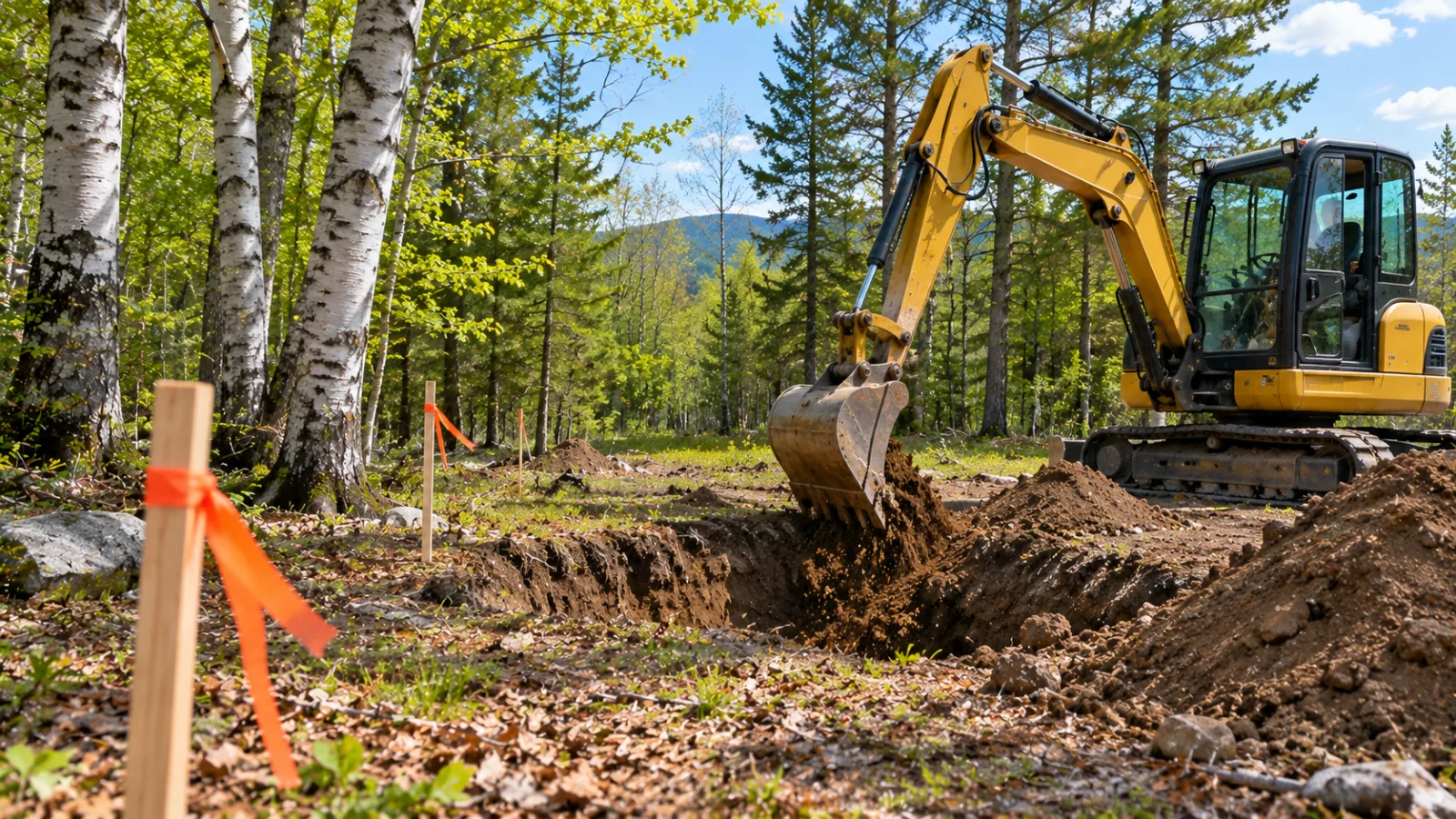

You know land in New Hampshire is buildable when four things check out: legal access with the road frontage town zoning requires, soils that pass NHDES test pits for a state septic approval, a house site clear of wetlands and shoreland limits, and a safe driveway location. Since July 1, 2026, a lot on a Class VI road can be permitted under RSA 674:41 without a select-board vote.
Knowing how to find out if land is buildable matters because none of these four checks shows up in a listing photo. Our guide to buying land in New Hampshire covers the whole purchase, from current use tax to financing.
On this page
- How do you find out if land is buildable before you buy?
- What makes land not buildable in New Hampshire?
- Can you build on a Class VI road in New Hampshire?
- Frequently asked questions
How do you find out if land is buildable before you buy?
You find out if land is buildable by checking the town's records, the state's records and the ground itself, in that order, and by writing the open items into the P&S as contingencies. The steps we follow on a lot purchase:
- Confirm it is a legal lot of record. Ask the town's planning or zoning office whether the parcel meets, or is grandfathered from, the district's minimum lot size, road frontage and setbacks. Get the answer in writing.
- Confirm legal access. Frontage on a town-maintained Class V road is the benchmark. A deeded right of way, a private road or a Class VI road can work, each with its own paperwork.
- Search for an existing septic approval. NHDES approvals and well completion reports are public records. An NHDES approval for construction is valid for four years unless the system is built and approved for operation, so an older unused one usually means a redesign.
- Dig test pits. A permitted septic designer digs test pits to find ledge and the seasonal high water table, then designs for a stated bedroom count.
- Map the wet ground and the water. A wetland delineation shows where the house and drive can go, and a frontage on a lake, pond or large river brings the shoreland rules into play.
- Find a driveway location. A driveway onto a state road needs an NHDOT permit under RSA 236:13, and one onto a town road needs a town permit. Both depend on sight lines.
Test pits need unfrozen ground, so a winter land deal often carries a spring contingency date. Around Plymouth and Campton, that timing is normal.
What makes land not buildable in New Hampshire?
Land in New Hampshire is most often unbuildable because of soils that can't support a septic system, missing legal access or frontage, or wetlands and shoreland limits that leave no room for a house. Most of rural New Hampshire has no municipal sewer, so the septic question decides more land deals than any other.
Ledge near the surface or a high water table can shrink the buildable envelope or force a costlier engineered system. A lot under five acres that isn't on sewer generally needs NHDES subdivision approval before it can get a septic approval. Env-Wq 1003.11 exempts some older lots, such as those created before July 1, 1967 within 1,000 feet of surface water, or before July 1, 1971 elsewhere, so a small lot with no state approval on record needs an early answer.
Water brings two more permits. Dredging or filling a wetland needs an NHDES permit under RSA 482-A. Building within 250 feet of a lake or pond over 10 acres, or of a fourth-order or larger river, falls under the Shoreland Water Quality Protection Act (RSA 483-B), which sets a 50-foot setback for the house. That covers lots on Squam, Newfound and qualifying reaches of the Pemigewasset and Baker rivers. Whether a tiny house is allowed on a lot is a separate zoning question, covered in our guide to tiny homes in New Hampshire.
Can you build on a Class VI road in New Hampshire?
Yes, you can build on a Class VI road in New Hampshire, and since July 1, 2026 the RSA 674:41 process no longer needs a select-board vote. Instead, the owner signs and records a waiver that the town won't maintain the road or accept liability, and shows the lot and buildings are insurable.
Zoning, frontage, no winter plowing and cautious lenders still apply. Our guide to selling land in New Hampshire compares each access type and its effect on price.
If you are shopping now, our Plymouth NH building lot costs guide and the current Campton land and lot listings show what the local market offers.
Frequently asked questions
Can you build on land without a perc test in New Hampshire?
You can't build a house that needs a septic system in New Hampshire without the soil testing a "perc test" stands for. In New Hampshire, a house on septic needs a state-approved septic design, and that approval rests on test pits dug by an NHDES-permitted designer. "Perc test" is the common shorthand for that whole evaluation.
How do you know if a lot is buildable from the listing?
A listing shows a lot is likely buildable when it names an NHDES septic approval number, the bedroom count it allows, and the road frontage. If the listing says only "buildable" with no approval on file, treat buildability as unproven and make your offer contingent on test pits.
Do you need a survey to know if land is buildable?
A current boundary survey is the only way to know a lot's real frontage, setbacks and easements, so we recommend one on almost every land purchase. Older New Hampshire deeds often describe bounds by stone walls and trees that have since moved or gone.