

Since September 13, 2026, New Hampshire law defines a tiny house as a detached dwelling of 600 square feet or less, not counting lofts, that meets the state building code and sits on a stable surface or foundation. Towns may permit one as a single-family home or an accessory dwelling unit, but they are not required to. Whether you can live in one depends on your town's zoning.
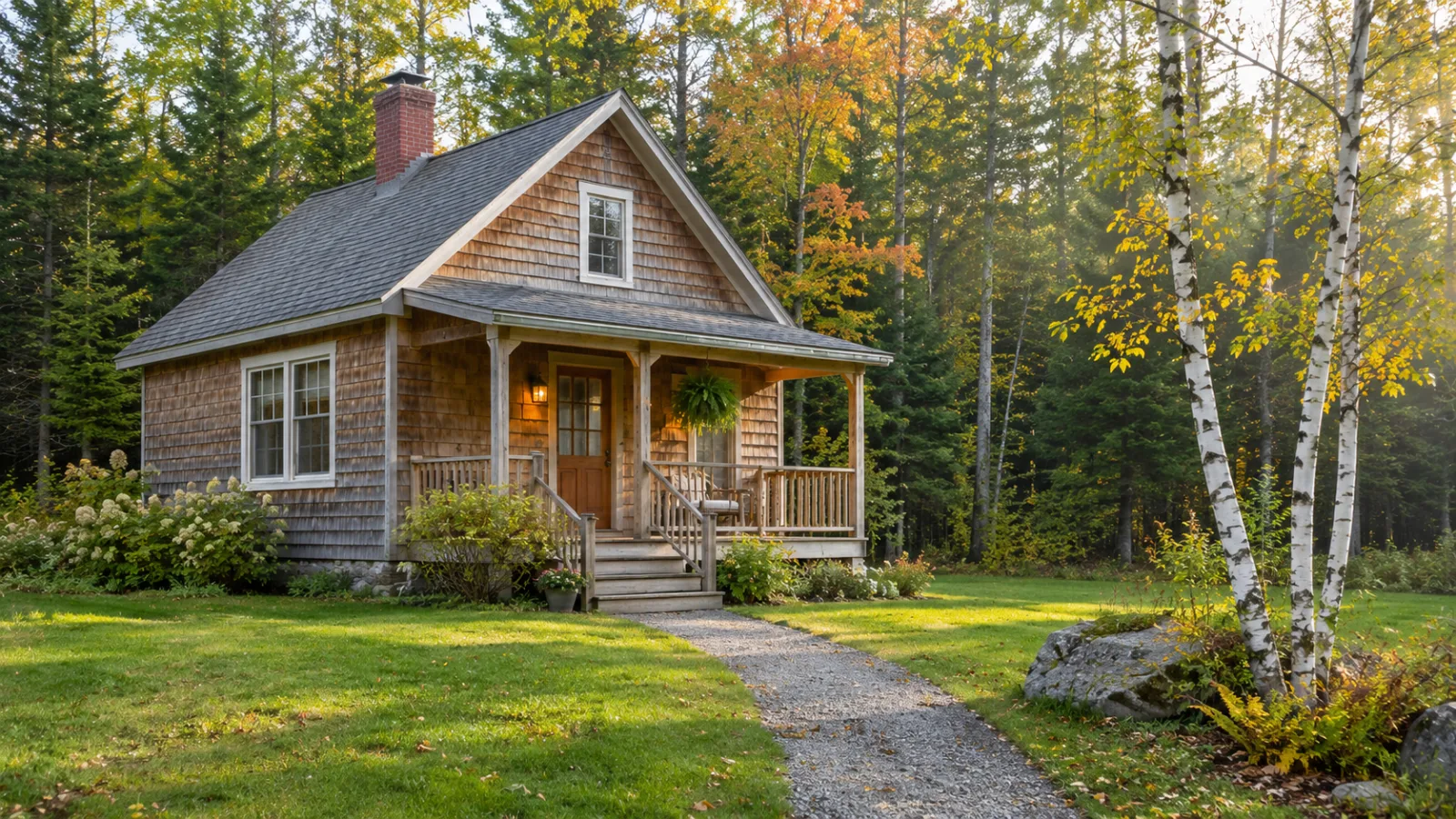
This guide covers what the new law says about tiny homes in NH, where a tiny house can legally go, how it differs from a camper or a manufactured home, what the building code and septic add, and who builds and sells them. Owl's Nest Real Estate is based in Campton, at I-93 exit 28, with a second office in Plymouth. We work the Plymouth and Campton core, the White Mountains and the Lakes Region, and this is a statewide topic: the town ordinances quoted below are the ones we could read, several are outside our core market, and none of this replaces a call to your own town's zoning office. If you are comparing a small home with a conventional one, our guide to building a new home in New Hampshire covers the full-size path.
Key takeaways
- State law: HB 1681 (Chapter 330 of 2026), approved by Governor Ayotte on July 15, 2026, took effect September 13, 2026. It created RSA 674:82 to 674:84 (numbered 674:81 to 674:83 in the bill, renumbered because HB 1195 took 674:81) and defines tiny houses, tiny houses on wheels and yurts as "innovative housing structures."
- Towns decide: under RSA 674:83 a municipality "may permit" these structures on a single-family lot or as an accessory dwelling unit. The statute does not make towns allow them.
- Size: a tiny house is 600 square feet or less of floor area, not counting lofts, and must comply with the tiny home provisions of the state building code.
- Wheels: a tiny house on wheels is built on a trailer chassis without motive power and, when built for living in, is not treated as a camper or RV under the law. A town can still say no to it.
- Campers are different: the town ordinances we read limit an RV or guest trailer to 30, 90 or 150 days, and Effingham bars an RV as a permanent home.
- Septic is the gate: outside a sewer district, the lot needs state septic approval for the dwelling, and the law directs NHDES to write wastewater rules for these structures.
In this guide
- What counts as a tiny house under New Hampshire law?
- Is it legal to live in a tiny house in New Hampshire?
- Foundation or wheels: which one can you live in?
- Can a tiny house be an ADU?
- How is a tiny house different from a manufactured home or a camper?
- How long can you live in a camper on your own land?
- Do towns set a minimum dwelling size?
- Can tiny houses be built in a community or cluster?
- What building code applies?
- What about septic and a well?
- Who builds tiny homes in New Hampshire?
- Where to purchase a tiny home in New Hampshire
- Frequently asked questions
What counts as a tiny house under New Hampshire law?
Under RSA 674:82, a tiny house is a detached dwelling with permanent provisions for living, sleeping, eating, cooking and sanitation that is 600 square feet or less in floor area (not counting lofts), complies with the tiny home provisions of the state building code, and sits on a stable ground surface or foundation (HB 1681, text as enrolled, on a bill-tracking site). The same section defines three related terms:
| Term in RSA 674:82 | What the bill text says |
|---|---|
| Tiny house | Detached dwelling, 600 square feet or less excluding lofts, state building code compliant, on a stable ground surface or foundation |
| Tiny house on wheels | A tiny house built on a trailer chassis without motive power; not considered a camp trailer or recreational vehicle when built for habitation |
| Yurt | A tiny house style that is round or similar in shape, freestanding, built with modern materials and intended as a permanent or long-term residence |
| Off-site construction | A closed-construction tiny house made in a factory, then installed on the site; excludes units labeled under the federal manufactured housing standards, and RVs and park trailers |
The bill text was read on a legislative-tracking site, and the bill's docket there records the governor's approval on July 15, 2026 as Chapter 330, effective September 13, 2026 (HB 1681 docket). Public radio reporting in August quoted a builder pointing to September 13 as the date the law takes effect, and described tiny homes, including yurts, as now defined in state law at 600 square feet or less (NHPR, August 21, 2026). We could not open the General Court's own page (the request failed), and we found no other readable official copy, so confirm the final text with an attorney or your town before relying on a detail.
Is it legal to live in a tiny house in New Hampshire?
Yes, in the sense that we found no state law that bans a tiny house, and since September 13, 2026 state law has a definition for one. In practice it is legal only where your town's zoning allows that use on that lot. RSA 674:83 says a municipality may permit these structures on an individual lot where single-family homes are allowed, or as an accessory dwelling unit under RSA 674:72, subject to all applicable land use requirements. For zoning purposes a permitted structure is treated as a single-family dwelling or an accessory dwelling unit, and it must meet the state's drinking water and wastewater rules.
The law gives towns a vocabulary and a permission, not a mandate. Reporting before the final vote described the bill the same way: these structures would face the same local zoning oversight as any other residence (NHPR, April 22, 2026). Ask the planning or zoning office whether your town has adopted language under the new section, and get the answer in writing.
Foundation or wheels: which one can you live in?
A tiny house on a foundation is the simpler case: it needs a building permit, state building code compliance, a septic approval or sewer connection, and a lot that meets the town's frontage and setback rules. The statute's phrase is "a stable ground surface or foundation," so it does not say a concrete foundation is required; your building official decides what the code needs for the site.
A tiny house on wheels is harder. The law says that when it is built for habitation it is not a camp trailer or RV, which matters because many town ordinances limit RV occupancy by the day (see the table below). But being outside the RV definition does not make a wheeled house permitted: the town must still allow the use on the lot, and the structure must meet the tiny home provisions of the building code. RSA 674:84 adds one practical rule: a structure permanently built on a flatbed trailer chassis that meets roadworthiness requirements may move to its dwelling site, or between dwelling sites after a sale, under a dealer plate or a temporary DMV trailer plate.
Can a tiny house be an ADU?
It can be, if the town permits it as one. RSA 674:83 lets a municipality allow these structures as an accessory dwelling unit under RSA 674:72, and for zoning purposes a permitted structure is treated as an ADU. The accessory dwelling unit rules matter a great deal here, because since July 1, 2025 every New Hampshire town with zoning must allow one ADU, attached or detached, by right wherever single-family homes are allowed. Our accessory dwelling unit guide summarizes what towns can still require under HB 577, including owner occupancy, a two-bedroom cap and a size band of 750 to 950 square feet; confirm those points with the town or an attorney.
What we could not confirm from the text is how the two laws fit together: whether a tiny house on a lot automatically counts as the one by-right ADU, or only where the town has chosen to permit it under the new section. They were passed a year apart (HB 577 in 2025 and HB 1681 in 2026) and the text we read does not settle it. Treat that as a question for the town and, for a purchase or a build, for your attorney.
How is a tiny house different from a manufactured home or a camper?
Three categories get confused, and the law treats each differently:
- Tiny house (RSA 674:82): a dwelling built to the state building code, on site or in a factory under the off-site inspection rules in RSA 155-A:3-d. It is not a federal-label product.
- Manufactured housing: a unit built to the federal HUD Code, carrying a red HUD label. Towns cannot zone it out entirely: our guide to mobile and manufactured homes summarizes RSA 674:32, which (as that guide reports it) requires municipalities to give manufactured housing reasonable and realistic opportunities on individual lots in most residential districts or in parks and subdivisions. HB 1681 excludes units labeled under the federal manufactured housing standards from its off-site construction definition. Many towns also have a separate ordinance for mobile home parks.
- Recreational vehicle or park model: built to RV standards (ANSI A119.2 or A119.5) and meant for temporary living. Town definitions run from 400 square feet and under for a travel trailer (Meredith, Effingham) to park models up to 12 feet wide in travel mode (Effingham, RV info sheet).
A buyer who wants a small home that a lender and a town will both treat as a house should start by asking which of the three the unit is.
How long can you live in a camper on your own land?
Not full-time, in the ordinances we read. RV rules are set town by town, and they differ a lot:
| Town | What its ordinance says | Source and date |
|---|---|---|
| Meredith | An RV may be occupied on a private lot for not longer than 30 days in a calendar year, as an accessory use to an existing dwelling that has utilities including septic or sewer. A travel trailer is defined as up to 400 square feet. Mobile homes may not be used as a residence outside a mobile home park or subdivision. | Meredith ordinance, amended March 10, 2026 |
| Effingham | No RV may be a permanent dwelling. One RV may stay up to 150 consecutive days between April 1 and October 31 with a Seasonal Use Permit; it must be mobile, registered and have lawful waste disposal. Not permitted in the Historic District or Province Lake District. | Effingham RV info sheet, April 1, 2022 |
| Bradford | A property owner may accommodate one trailer or mobile home of a non-paying guest for not more than 90 days in a year. | Bradford ordinance, headed "Approved as of June 22, 2026" |
| New London | A property owner may accommodate one trailer of a non-paying guest for not more than 30 days in a year. Temporary use of a trailer during construction needs selectmen approval. | New London ordinance, amendments to March 11, 2025 |
Meredith is in the Lakes Region, Effingham is in Carroll County, and Bradford and New London are in Merrimack County, outside our core market. We chose them because we could read the full text. We did not read the Campton, Thornton or Plymouth ordinances, so we do not state those towns' RV or dwelling-size rules. Ashland's ordinance, as amended March 11, 2025, defines a recreational vehicle in its flood-plain provisions as 400 square feet or less on a single chassis, and treats a park trailer or travel trailer left on a site more than 180 days as a manufactured home for flood-plain purposes only.
Do towns set a minimum dwelling size?
Some may. The one we read: Meredith's accessory apartment rule requires a minimum of 300 square feet of net floor area for an accessory apartment approved by special exception (Meredith ordinance, amended March 10, 2026). We did not find a minimum dwelling size in the Ashland ordinance (amended March 11, 2025) when we searched the text, but a minimum can sit in a definitions section, a dimensional table or a district rule, so ask your town for any minimum floor area for a dwelling unit. Whether an older minimum applies to a structure now defined under RSA 674:82 is a question the text we read does not answer.
Can tiny houses be built in a community or cluster?
Only where a town's zoning allows the density, since a community needs more than one dwelling on a parcel. Meredith's Cottage Court Housing Ordinance (Article XXII, adopted March 10, 2026) is a published example: the Planning Board may grant a conditional use permit in the Central Business, Commercial (Meredith Center and Route 3 South) and Residential districts, with up to 12 units per acre, a 10,000-square-foot minimum lot, a 20-foot height limit, a ground floor of up to 1,000 square feet per cottage and 800 square feet of common open space per cottage. Short-term rentals are not permitted inside a cottage court, and where there is no public water or sewer, density is limited by soils under NHDES standards (Meredith ordinance).
We did not find a New Hampshire tiny home community with its own site that we could read, so we name none. If a listing, builder or developer says "tiny home community," ask for the town's approval (conditional use permit, subdivision or site plan) and the septic approval before you pay a deposit.
What building code applies?
The state building code under RSA 155-A applies to a tiny house on a foundation and to the tiny home provisions the law refers to. The New Hampshire Building Officials Association lists the 2024 residential code (IRC 2024) among the adopted editions, with a grace period from July 1 to December 31, 2026 in which permits may follow either the 2021 or the 2024 ICC codes, and the 2018 energy code remaining in force (NHBOA). The bill text we read directs the state building code review board to amend the code to reflect the new law. We could not confirm from the sources we could open which edition of the International Residential Code's tiny house appendix the board has put in force, so ask your building official which provisions they will apply.
The law also sets out how a factory-built tiny house is inspected. A tiny house built on its dwelling site must comply with the state building code. For a house built in a factory, the bill text says the factory-built parts may follow either the building code or the modular building law (RSA 205-C), and may be reviewed by the appointed building official in the New Hampshire municipality where the factory is, if certified as a residential inspector by the International Code Council, or by the state fire marshal or a designee. If the factory-built parts conform, the local building official at the dwelling site must accept that approval when issuing a certificate of occupancy, and the town may review the other parts of the project (RSA 155-A:3-d, in HB 1681).
What about septic and a well?
A permanent dwelling outside a sewer district needs a state-approved septic system, and RSA 674:83 says a permitted structure must meet the state's drinking water and wastewater rules. HB 1681 also adds a paragraph to RSA 485-A:41 directing the state to adopt wastewater rules for these structures. We did not find the resulting rules, so we cannot say how a small house will be sized. Our other guides report the process for any new dwelling as follows (confirm with NHDES): a permitted designer digs test pits, a lot under five acres not on sewer generally needs NHDES subdivision approval, and an approval for construction is valid for four years (buying land in New Hampshire; how to know if land is buildable). Those guides also say systems are designed for a stated bedroom count, so ask NHDES or a septic designer before buying a lot with a tiny house in mind.
Who builds tiny homes in New Hampshire?
Builders exist, and their products differ: some build on wheels, some on foundations, some in a factory. We name only a business whose own site we read, state what that site says, and do not rank or endorse.
Backcountry Tiny Homes (backcountrytinyhomes.com) says on its site that it builds tiny homes on wheels, not on foundations or on site, at 10 to 16 homes a year, one at a time, and that it is open by appointment only (FAQ). Its process page, marked last updated November 2026, gives a lead time of 8 to 10 months for a turnkey home and 7 to 9 months for a shell, a $99 quote that covers a two-hour budgetary discussion, and a $2,000 design payment (Our Process). The pages we read did not state a price range, a town or code certifications. This is a dated note on what one business publishes, not an endorsement.
Other tiny home builders in NH, and national firms that deliver here, are easy to find, but we did not read their sites and do not name them. Public radio reporting in August 2026 quoted one New Hampshire builder putting tiny homes at $100,000 to $200,000, against a statewide median single-family price the report gave as $580,000 (NHPR, August 21, 2026). Treat that as one builder's statement, not a market price. Ask any lender and the town assessor how a tiny house would be financed and taxed before you sign a contract.
Questions to put to any tiny house builders in New Hampshire: Is the home built to the state building code, to RV standards, or to the federal manufactured housing standard (get it in writing)? Who inspects it, and will the town's building official accept that for a certificate of occupancy? What does the price include, and what happens to deposits if the town says no?
Where to purchase a tiny home in New Hampshire
There are three routes. You can order one from a builder, as above. You can buy a used unit from a private seller or a listing site, where the first question is which category it is (tiny house, RV or park model, or manufactured home). Or you can buy a small conventional house, cottage or camp that is already permitted and on an approved septic system, which avoids the permit question. Our camps and cabins guide and log cabins guide cover that older small-structure market.
If you are buying land for a tiny house, make the purchase contingent on the town's written answer and on septic approval. Our land buying guide has the due diligence list, and you can browse land and small homes through our property search.
For more on land and zoning, see how to know if land is buildable in NH and our town pages for Campton, Thornton, Plymouth, Ashland and Meredith. To talk through a specific lot, contact our team or see our buyer services.
This article reflects HB 1681 (Chapter 330, Laws of 2026, effective September 13, 2026) as read on a legislative-tracking site, and town ordinances and builder pages as they stood when we read them in November 2026. We could not open the General Court website. Section 330:7 of the act renumbers its new sections RSA 674:81 to 674:83 as 674:82 to 674:84 if HB 1195 became law, and the HB 1195 docket on the same site shows it did (Chapter 217, signed July 2, 2026, adding a child care center section as RSA 674:81), so this article uses the renumbered citations. We did not see the renumbering on the official RSA page. It is general information, not legal advice. Confirm current rules with your town, NHDES and an attorney.
Frequently asked questions
Are tiny houses legal in New Hampshire?
Yes, where a town permits them. No state law bans tiny houses, and HB 1681 (Chapter 330), effective September 13, 2026, defines a tiny house as a detached dwelling of 600 square feet or less, not counting lofts. RSA 674:83 says a municipality "may permit" one as a single-family home or an accessory dwelling unit, so each town still decides.
Can you live in a tiny house on wheels in NH?
Only if the town permits it. RSA 674:82 says a tiny house on wheels, built for habitation on a trailer chassis without motive power, is not a camp trailer or RV, but the use still has to be allowed on the lot. The town ordinances we read limit an RV or guest trailer to 30, 90 or 150 days, and Effingham bars an RV as a permanent home.
How big can a tiny house be in New Hampshire?
The statutory definition caps a tiny house at 600 square feet of floor area, not counting lofts. A town may have its own rules, such as a minimum dwelling size or, for an accessory dwelling unit, the 750 to 950 square foot band in our ADU guide. Ask your town which size rules it applies to a structure defined under RSA 674:82.
Can I put a tiny house in my backyard in NH?
Possibly, as an accessory dwelling unit. RSA 674:83 lets a town permit one as an ADU, and since July 1, 2025 each town with zoning must allow one ADU on a single-family lot by right. We could not confirm whether a tiny house automatically qualifies as that ADU. You also need a building permit and septic capacity for the extra dwelling.
Do tiny houses need septic approval in New Hampshire?
Outside a sewer district, yes. RSA 674:83 requires a permitted structure to meet the state's wastewater rules, and HB 1681 directs the state to adopt wastewater rules for these structures. Treat a lot as unbuildable for a tiny house until a septic designer and NHDES say otherwise.
Is a tiny house the same as a manufactured home?
No. A manufactured home is built to the federal HUD Code and carries a HUD label. A tiny house under RSA 674:82 is built to the state building code. HB 1681 excludes units labeled under the federal manufactured housing standards, and RVs and park trailers, from its off-site construction definition.
How much does a tiny house cost in NH?
We could not source a market price. A New Hampshire builder quoted by NHPR in August 2026 put tiny homes at $100,000 to $200,000. The one builder site we read states a $99 quote fee and a $2,000 design payment but no total price. Land, septic, utilities and delivery are additional.
Are there tiny house communities in New Hampshire?
A community needs a town that allows several small dwellings on one parcel. Meredith adopted a Cottage Court Housing Ordinance on March 10, 2026, allowing up to 12 units per acre by conditional use permit in certain districts. We did not find a New Hampshire tiny home community with its own site to read, so we name none.