
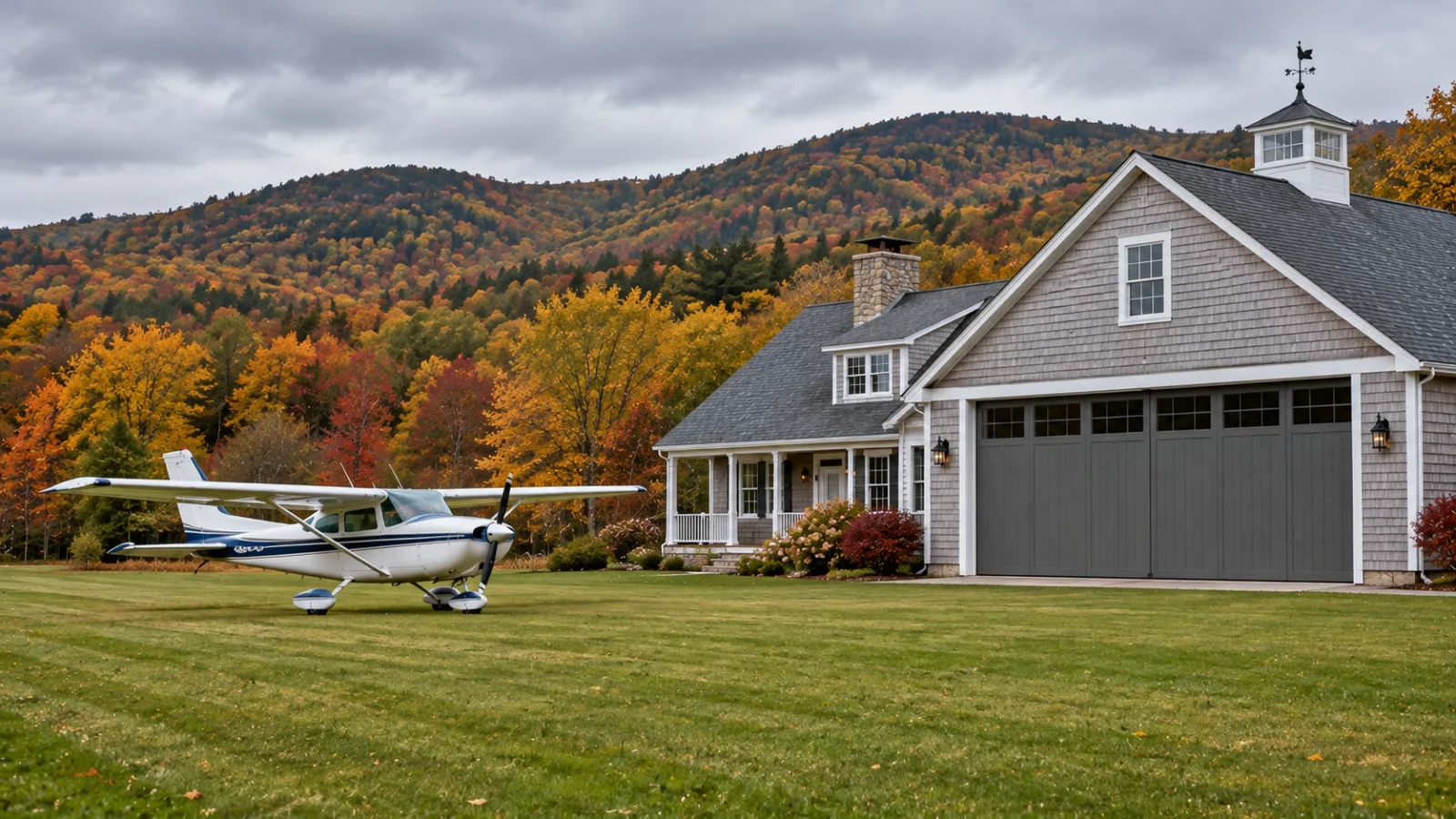

A hangar home is a house built together with an aircraft hangar, attached to the living space or standing beside it on the same lot, with a legal right to taxi from the property to a runway. Most hangar homes sit in residential airparks, also called fly-in communities, where owners share an airstrip. In New Hampshire they're rare, so each one is a special-case purchase.
With a hangar home, the runway access matters more than the house. If you're thinking of building one, start with our guide to buying land in New Hampshire.
On this page
- What makes an airplane hangar house different from a big garage?
- How do residential airparks and through-the-fence access work?
- What about zoning, insurance and financing for aircraft hangar homes?
- Frequently asked questions
What makes an airplane hangar house different from a big garage?
An airplane hangar house is defined by its access to a runway, not by the size of its door. A wide hangar with no recorded right to reach an airstrip is just a large outbuilding. What turns it into an aircraft hangar house is paperwork, so before you fall for the floor plan, get copies of:
- The access right: a recorded easement, covenant or written agreement that lets the lot use the taxiway and runway, and says whether it passes to the next owner.
- The runway's status: who owns the strip, whether it's public-use or private-use, and whether its owner can close it.
- The association documents: dues, who pays for mowing, plowing and paving the runway, and any limits on aircraft size, fuel storage or hours.
- The town's approvals: permits for the hangar itself and for any runway on the property.
How do residential airparks and through-the-fence access work?
Residential airparks come in two forms: homes on a private airstrip owned by the residents or a developer, or homes beside a public airport with a gate onto it, which the FAA calls residential through-the-fence access. The second kind is governed by federal grant rules. Section 136 of the FAA Modernization and Reform Act of 2012 lets the sponsor of a general aviation airport enter into a residential through-the-fence arrangement, while commercial service airports may not permit one (Federal Register, April 13, 2012).
Section 136 also requires a written agreement in which the homeowner pays access charges comparable to on-airport tenants', bears the cost of the access infrastructure, keeps the property residential, and allows no aircraft refueling on it (FAA final policy, Federal Register, July 16, 2013).
For a buyer, that agreement is the asset. Read its term, its fees and its exit terms.
We haven't been able to confirm a residential fly-in community in New Hampshire from FAA or NH Department of Transportation sources. The state's aviation is mostly public airports and seaplane bases, such as the state-owned Alton Bay Seaplane Base and Ice Runway (B18) covered in our Alton Bay guide. If a listing advertises a private landing strip, confirm its status with NH DOT's Bureau of Aeronautics and the FAA before you count on it.
What about zoning, insurance and financing for aircraft hangar homes?
Aircraft hangar homes run into three issues that ordinary houses don't: zoning, insurance and lending. New Hampshire towns write their own zoning, so a hangar may be allowed as an accessory building in one town and need a special exception or variance in the next, and a runway is a separate question again. Read the zoning ordinance and talk to the planning office before you buy, as our answer on how to know if land is buildable explains.
On insurance, don't assume a homeowners policy covers the plane or flying from the property. Aircraft are normally insured under a separate aviation policy, so ask your agent in writing what the homeowners policy covers in the hangar, and get both quotes during the inspection period.
On lending, a shortage of comparable sales can make the appraisal hard. When an appraiser can't find other hangar homes nearby, the hangar may be valued as an outbuilding, which can leave a gap between price and value that the buyer covers in cash. If you're building rather than buying, our guide to building a new home in New Hampshire covers construction loans and permits. Our New Hampshire home buyer guide covers the rest of the process.
Frequently asked questions
Can you build an airplane hangar home on your own land in New Hampshire?
You can build a hangar on your own land in New Hampshire if the town's zoning allows it, but a hangar alone doesn't make an airplane hangar home. You also need a legal way to fly in and out: a runway on the property with the FAA and state steps that come with it, or a recorded right to use a neighboring strip. Check both with the town and NH DOT's Bureau of Aeronautics before you buy the lot. Our Plymouth land guide covers lot checks in our part of the state.
Are airplane hangar homes hard to resell?
Airplane hangar homes sell to a narrower group of buyers than ordinary houses, so the right buyer can take longer to find. Resale depends most on whether the runway access is permanent, transferable and well maintained.
Is a hangar home the same as a house with a detached garage?
A hangar home is not the same as a house with a detached garage, because a hangar home comes with a recorded right to taxi to a runway. Without that right, the building is valued as a large garage or barn.