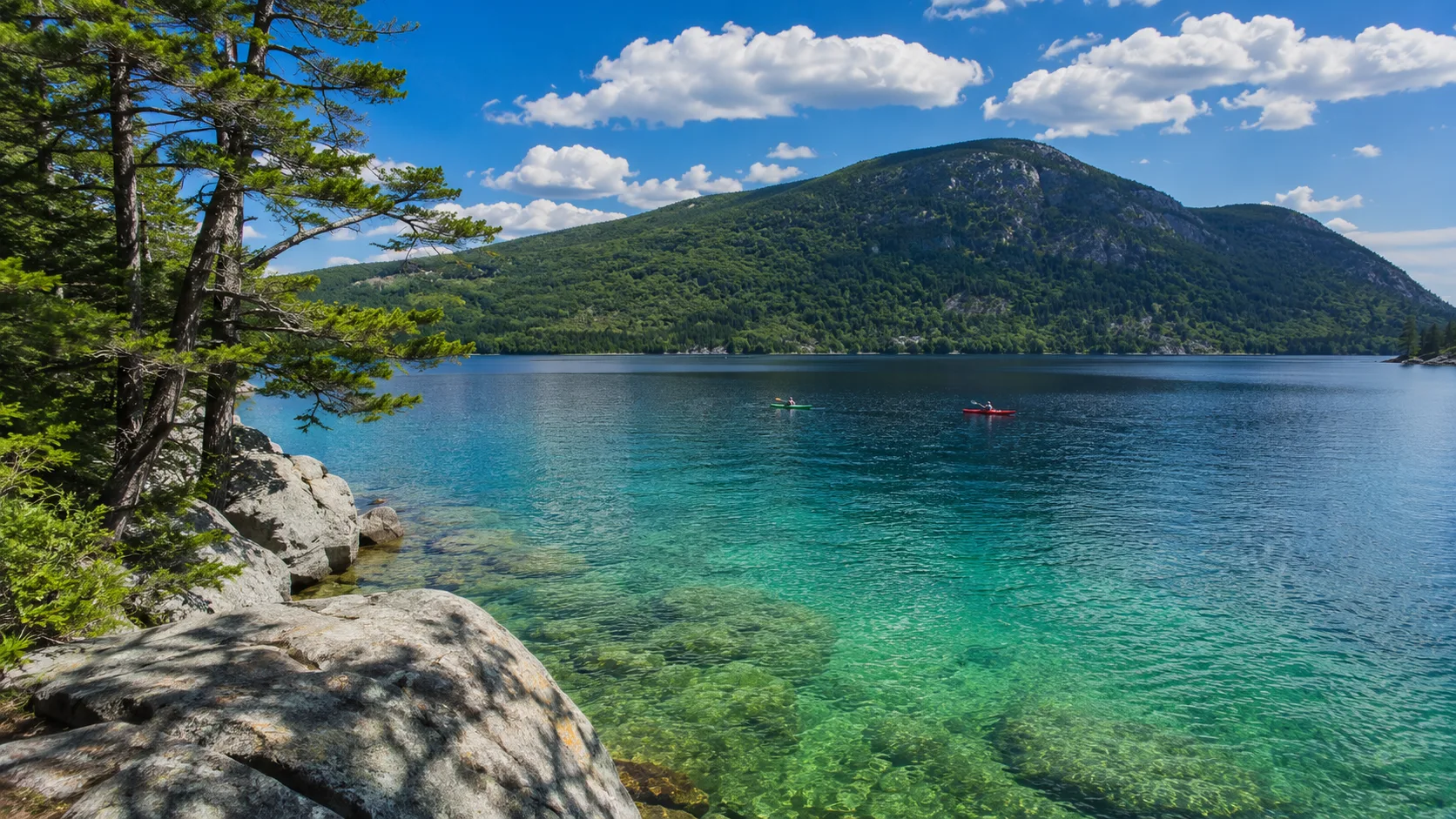

Newfound Lake buyers start by falling for the lake — the clarity, the quiet — and then discover, usually later than they should, that they're not buying a lake. They're buying a town. The full buyer's guide to Newfound covers the water itself — the clarity, the shoreland rules, the camps-versus-year-round question. This piece is the companion: the towns.
And on Newfound, which town matters more than on almost any lake in the state. Four towns share the shoreline — Bristol, Bridgewater, Hebron, and Alexandria, with Groton in the hills behind — and they are genuinely different places with different tax rates, different school arrangements as of last year, and completely different amounts of property for sale. The spread in 2025 tax rates alone runs from $6.35 per thousand in Bridgewater to $19.87 in Alexandria. Same lake. Same clear water. A tax bill that can differ by a factor of three.
So this is the town-by-town piece: what each of the Newfound towns is actually like to live in, what it costs to hold property there, what the school shake-up of 2025 means for buyers with kids, and where the listings actually are — with real numbers from the MLS as I write this in late summer 2026. If you want the lake itself explained first, start with the Newfound guide and come back.
One lake, four tax bills
Let's start with the money, because no listing portal puts this next to the photos.
New Hampshire towns set property tax rates each fall through the state Department of Revenue Administration, and the 2025 rates around Newfound — compiled town by town — tell the whole story of how differently these towns run themselves. Bridgewater came in at $6.35 per thousand of assessed value, one of the lowest rates of any full-service town in the state. Hebron sits at $9.06. Bristol is at $13.16. Groton, the hill town, at $15.23. And Alexandria — the town everyone calls the value play — carries $19.87, the highest of the group and above the statewide average of $17.10.
Two caveats before you build a spreadsheet on those numbers, the same ones I give in my New Hampshire property taxes guide. First, a rate only means something against that town's assessments — towns revalue on different schedules, and a low rate on full-value assessments can cost more than a high rate on stale ones. Second, every one of these numbers resets each fall. But the structural story underneath them is durable: Bridgewater and Hebron hold long stretches of high-value Newfound waterfront on small town budgets, so their rates stay low; Bristol runs an actual downtown with actual services and prices accordingly; Alexandria has a big rural road network and, until recently, a full share of a seven-town school district, with much less waterfront value to spread it across.
One more mapping note that surprises people: all five of these towns sit in Grafton County, not Belknap. Most of what people picture as the Lakes Region — Laconia, Meredith, the Winnipesaukee towns — is Belknap County. Newfound is the Lakes Region's northwestern outpost, which means Grafton County services, Plymouth (and Speare Memorial Hospital) about twenty minutes north, and a county tax line on your bill set in North Haverhill rather than Laconia.
The school map just changed
If you're buying with kids, this section is worth more than any photo gallery, because the ground moved in 2025 and most out-of-town buyers haven't heard.
For decades all of these towns belonged to the seven-town Newfound Area School District (SAU 4), headquartered in Bristol, where Newfound Memorial Middle School and Newfound Regional High School sit. That's no longer the whole picture. Bridgewater, Hebron, and Groton voted to withdraw — Bridgewater's town meeting passed it 291 to 28 — and as of July 1, 2025 those three towns operate their own Pasquaney School District (SAU 108), running K–8 out of the Bridgewater-Hebron Village School between the lake and the river.
Bristol and Alexandria remain in the Newfound Area School District, so a Bristol or Alexandria address still means the Newfound schools in town. I'm not going to referee which arrangement is better — that argument filled a lot of gymnasiums around here for a couple of years — but as a broker I'll tell you it's now a real difference between a Bridgewater NH address and a Bristol one, and you should ask the current questions (high school arrangements especially) about whichever town you're buying in, because these are new districts and details are still settling.
What hasn't changed is the thing that quietly ties all these towns together: the Tapply-Thompson Community Center — everyone says TTCC — on North Main Street in Bristol, which has run youth sports, day camps, after-school programs, and teen nights for the whole Newfound area for generations. It serves Bristol, Bridgewater, Hebron, Alexandria, Groton, and beyond, whichever school district the town belongs to, and it's one of the reasons this cluster of small towns functions like one community.
Bristol
Bristol, New Hampshire is the gateway and the working heart of this whole market, and it's where I start with most buyers. It holds the southern shore and most of the west side of the lake — including Wellington State Park — and it's the only Newfound town with a real downtown. A bit over 3,000 people live here year-round, which makes it the metropolis of the group.
And the downtown is genuinely good now. Central Square — the brick-front historic district where the Newfound River drops through the old mill buildings — is on the National Register, and the revitalization that New Hampshire Magazine wrote up has filled it with places you'll actually use: Shackett's Brewing pouring its Newfound Nutbrown in one of the old mills, the Purple Pit Coffee Lounge across the way, the Mill Fudge Factory in a gristmill that dates to the 1700s, the Bristol Diner for breakfast, a hardware store, groceries, services. It's a five-minute drive from the town beach end of the lake to a working square — no other Newfound town offers anything like that. There's a reason so much of the search traffic for this lake types "Newfound Lake Bristol NH" as a single phrase: for most of the world, the town and the lake are the same place.
Bristol is also where the inventory is. As I write this, Bristol carries 13 of the 35 active residential listings across the five Newfound towns — strip out a couple of properties the MLS double-entered under two categories and it's 11 distinct homes, still more than any two other towns combined. The spread runs from a $169,000 mobile home through village homes in the $500,000s — the median asking price is $547,000 — up to true lake frontage: a 2007 waterfront home at $1,099,000 that was two days old on the market as I wrote this, and the town's current ceiling at $1,595,000 for a 1920 four-bedroom on six-tenths of an acre of shorefront. Bristol also holds most of the lake's entry points: in-town condos in the $200,000s, and brand-new construction townhouses on the Newfound River — river frontage, not lake — in the high $400,000s.
The honest part, because I promised honesty: Bristol's approach on Route 104 is a strip — gas stations, chain stores, the standard commercial corridor — and it's the first thing you see, which sells the town short. And the year-round economy is thinner than the summer one; downtown businesses turn over more than anyone likes (the longtime Irish pub on Lake Street, a local anchor for years, has closed), and a February Tuesday on Central Square is a quiet thing. I consider Bristol's downtown a genuine success story, but it's a small-town success story, not a resort town — Wolfeboro this is not, in either direction.
Bridgewater
Bridgewater NH runs up the east side of the lake — including Whittemore Point, the long wooded peninsula that holds some of the most coveted frontage on Newfound — and it is the quiet-money town, the purest expression of the low-tax New Hampshire model I can show you.
Roughly a thousand people. No downtown, no commercial strip, no school bureaucracy of its own until the Pasquaney district launched. The town's police department provides about 40 hours a week of patrol coverage with the State Police backing the rest — that's not a criticism, it's the design. Small budget, big waterfront tax base, and the result is that $6.35 rate, roughly a third of the statewide average. On a million-dollar waterfront assessment, the difference between Bridgewater's rate and Alexandria's is over $13,000 a year, every year. Buyers can be forgiven for treating the town line as part of the property — it's the same arithmetic that pulls so many of my Massachusetts buyers over the border in the first place.
What Bridgewater doesn't have is much for sale. Seven distinct active listings as I write this, and the spread tells you exactly what kind of town it is: a couple of mobile homes and modest houses from $94,000 to the $500,000s on the wooded roads up off the lake, then a jump to the water — an 1826 farmhouse on 48 acres with pond frontage at $1.2 million, and the current ceiling of the entire Newfound market, a 2006 lakefront home asking $3,995,000. There is essentially no middle. When true Bridgewater lake frontage comes up, it prices like Whittemore Point and it does not linger.
Hebron
Hebron NH owns the north end of the lake and it is, as I said in the lake guide, the postcard — the white church and general store on the village common, the shallow sandy north-end water families love, NH Audubon's Paradise Point keeping a stretch of shoreline forever wild. Roughly 600 people live here, the 2025 tax rate is $9.06, and with Bridgewater and Groton it now runs the little Pasquaney school district out of the village school. If you asked a painter to invent a New Hampshire town, this is what they'd hand you.
Here's what the postcard doesn't show: there is almost nothing to buy. Seven active listings in Hebron as I write this — and the number that actually matters is this one: not one of them fronts Newfound Lake. The only waterfront-flagged listing in town is on a river. The rest is village and hill property, from a $439,000 cape on five acres through a 1902 village four-bedroom at $774,900 — the highest median asking price of the four towns — up to a $2.6 million ten-bedroom lodge-style property on 19 acres. That's Hebron's market in one sentence: the town trades on scarcity, the lakefront is locked up in families and conservation, and what does come up is village charm at a premium. When Hebron lake frontage lists — it happens a few times a decade in a good stretch — it's an event, and the buyers who get it are the ones who told their agent to call the moment it happened.
Alexandria
Alexandria NH is the biggest town by land and the smallest by lake — it touches Newfound only along a short piece of the southwest shore off West Shore Road, the same road that carries you to Wellington State Park's beach, the largest freshwater swimming beach in the state park system. The rest of Alexandria is the New Hampshire that predates the lake economy: about 1,800 people, old farms, dirt roads, and the whole eastern flank of Mount Cardigan, with the AMC's Cardigan Lodge and its trail network at the end of Shem Valley Road.
Alexandria is the value play on purchase price — your dollar buys acreage and views here that the shore towns can't touch — but I owe you the honest asterisk: it carries the highest 2025 tax rate of the group at $19.87, so the cheap-to-buy town is the expensive-to-hold one, relative to assessed value. Run both numbers before you decide the farmhouse is a bargain.
The market is tiny. Three distinct active listings as I write this: a $339,900 two-bedroom condo at the entry, a 2002 three-bedroom on five acres at $799,000, and the one I'd go see for fun — a 1986 three-bedroom sitting on 47.5 acres at $899,900. No waterfront listings at all, which is typical; Alexandria properties trade on land, and a fair number carry deeded rights to shared beach access on the lake, which is exactly the kind of deed language I pull and read before any buyer of mine writes an offer.
And Groton, the honorable mention up the Cockermouth valley: three listings, from a $185,000 camp to a $945,000 three-bedroom on 146 acres with reservoir frontage. No lake shoreline, but Sculptured Rocks — the granite gorge that's been the local swimming hole for generations — and the deepest value in the whole market.
Where the water actually is
Now let me put the waterfront numbers together, because this is where the four-town picture gets sharp.
Across all five towns, the MLS shows 35 active residential listings as I write this — call it 31 distinct homes once you collapse the double entries. Eleven of those carry a waterfront flag. But here's the diligence point that justifies working with someone who reads past the flag: when I pull the actual water body on each one, the flags include river frontage on the Newfound and Cockermouth, a pond, and a reservoir. Strip it down to properties that front Newfound Lake itself and the honest count today is four: three in Bristol — at $1,099,000, $1,299,900, and $1,595,000 — and Bridgewater's $3,995,000 ceiling, one of the small set of properties statewide I'd put in the true luxury lake tier. That's the entire true-lakefront market on a 4,100-acre lake, and it's why my lake guide spends so much time on water-access properties as the smart middle tier.
That $1,299,900 Bristol listing is worth a paragraph on its own, because it's the purest lesson in lake pricing I can offer: it's a 1950 camp, three bedrooms, 955 square feet, on less than a quarter acre. Thirteen hundred dollars a square foot for knotty pine. Nobody is paying for the house — they're paying for the frontage under it, and on Newfound that math is normal. Meanwhile the $1,099,000 listing — a 2007 build, modern and turnkey — had been on the market two days when I pulled these numbers. Well-priced Newfound frontage moves at that speed.
One more piece of local mechanics that belongs here, because it catches fall shoppers every year: Newfound is a state-managed lake, and each autumn the Department of Environmental Services draws it down about two feet through the dam on the Newfound River in Bristol — the drawdown starts just after Columbus Day, and the lake isn't back to full summer level until spring. So if you're touring waterfront in October or November, the exposed rock and sand below the summer waterline is the drawdown, not the property — and if the listing has a dock, ask how it's rigged for two fewer feet of water, because that's when owners do their dock and shoreline work. On Hebron's shallow, sandy north end, two vertical feet can walk the water's edge out a surprising distance. I keep summer water-level photos on my phone for exactly this conversation.
Read that four-listing count against the lakes I compared in my best lakes in New Hampshire rundown and you'll understand why Newfound behaves differently. Winnisquam usually offers a dozen true waterfront listings at a time; Winnipesaukee offers dozens. Newfound offers a handful, feeding on a reputation — the 8th-clearest-lake ranking, the NLRA's forty years of water-quality data — that keeps demand permanently ahead of supply. If Newfound's thinness frustrates you, my Winnisquam guide makes the case for the lake with ten times the inventory, half an hour southeast.
The honest trade-offs
Every town section above has its asterisk, so let me collect them in one place, the way I would across a desk.
Bristol gives you the downtown and the services and most of the inventory, and in exchange you take the Route 104 strip on the way in, a middle-of-the-pack tax rate, and a winter economy that runs on the year-round locals rather than any resort engine. Bridgewater gives you the lowest carrying costs on the lake and Whittemore Point sunsets, and in exchange you accept minimal town services, a brand-new school district still finding its footing, and a market so thin you may wait two years for the right house. Hebron is the most beautiful village in this part of the state and functionally unbuyable on the lake in any given season — near-lake and village property is the realistic play. Alexandria and Groton are where the land and the value live, and in exchange every errand is a drive — the grocery store is in Bristol, the hospital is in Plymouth, and some of those pretty dirt roads ask real questions of your car in March. And Alexandria's tax rate means the value play is at purchase, not in the annual bill.
None of these are complaints — they're the terms of four different deals, and every one of them is a good deal for the right buyer. What I push back on is buyers assuming the towns are interchangeable because they share the water. A Bridgewater buyer and a Bristol buyer are buying different lives that happen to share a lake.
Which town is yours
The shortcut version I give in the car between showings:
- You want a year-round life with services, schools in town, and the most choices: Bristol, and it's not close. Start there, and let the downtown surprise you.
- You're buying significant waterfront and you plan to hold it for decades: Bridgewater, where the tax math compounds in your favor every single year — the same math I walk people through in my retiring to New Hampshire guide — and get in line early, because the good frontage is spoken for before it lists.
- You want the village postcard and you're patient: Hebron NH, hunting near-lake and village property with beach rights, with a standing instruction to your broker for the lakefront that surfaces once in a blue moon.
- You want land, a view of Cardigan, and a ten-minute drive to your boat: Alexandria — or Groton if you want the price floor of the whole region and don't mind the extra miles.
Whichever way you lean, the mechanics are the same as everywhere around this lake: decide your product before you shop, get your financing fully underwritten, and set up listing alerts for all four towns — because with 31 homes on the market across an entire lake region, the buyers who win are the ones who see new inventory the day it lands, and ideally hear about it before that.
Questions buyers ask me
Is Bristol, NH a good place to live?
For a year-round life on this lake, I think it's the best answer, and I say that as someone who sells in all four shore towns. You get a real downtown, groceries and a hardware store, schools and the TTCC in town, and the most housing choices in the market — all a few minutes from a lake this clean. The honest caveats are the ones I gave above: the Route 104 approach is a strip, and winters are quiet. If you're weighing the broader affordability question, my cost of living in New Hampshire piece puts Bristol-sized towns in context.
Which town on Newfound Lake has the lowest property taxes?
Bridgewater, and by a wide margin — $6.35 per thousand in 2025, against Hebron's $9.06, Bristol's $13.16, and Alexandria's $19.87 (Groton, just off the lake, is $15.23). Remember the caveat: a rate only means something against that town's assessments, and every rate resets each fall. My property taxes guide shows how to run the comparison properly.
Is Newfound Lake's water really that clean?
Yes — this is one lake reputation that survives diligence. Newfound has been ranked the 8th-clearest lake in the United States, and the NLRA has four decades of monitoring data behind that standing, not just a marketing line. The lake guide covers why — and what the shoreland rules ask of owners to keep it that way.
What school district serves each Newfound Lake town?
As of July 1, 2025: Bristol and Alexandria remain in the Newfound Area School District (SAU 4), with the middle and high schools in Bristol. Bridgewater, Hebron, and Groton now run their own Pasquaney School District (SAU 108) out of the Bridgewater-Hebron Village School. If schools drive your decision, verify the current high school arrangements for the Pasquaney towns before you offer — the district is new and details are still settling.
Can you enjoy Newfound Lake without owning waterfront?
Easily — that's most of the lake's population. Wellington State Park in Bristol is the largest freshwater swimming beach in the state park system, Bristol has a town beach, and a lot of near-lake property carries deeded beach rights, which is the smart middle tier I push most buyers toward. And if you decide true frontage is the goal after all, I watch lakefront listings statewide, not just here.
I sell in all five of these towns, I've walked the shoreland files and pulled the deed language on more Newfound properties than I can count, and I genuinely enjoy the afternoon tour where all four towns finally click into place for a buyer — it usually takes about three hours and ends at the beach at Wellington. Start with the lake guide if you haven't, browse the Newfound Lake homes for sale page town by town, and then call the office in Campton. I still answer my own phone.