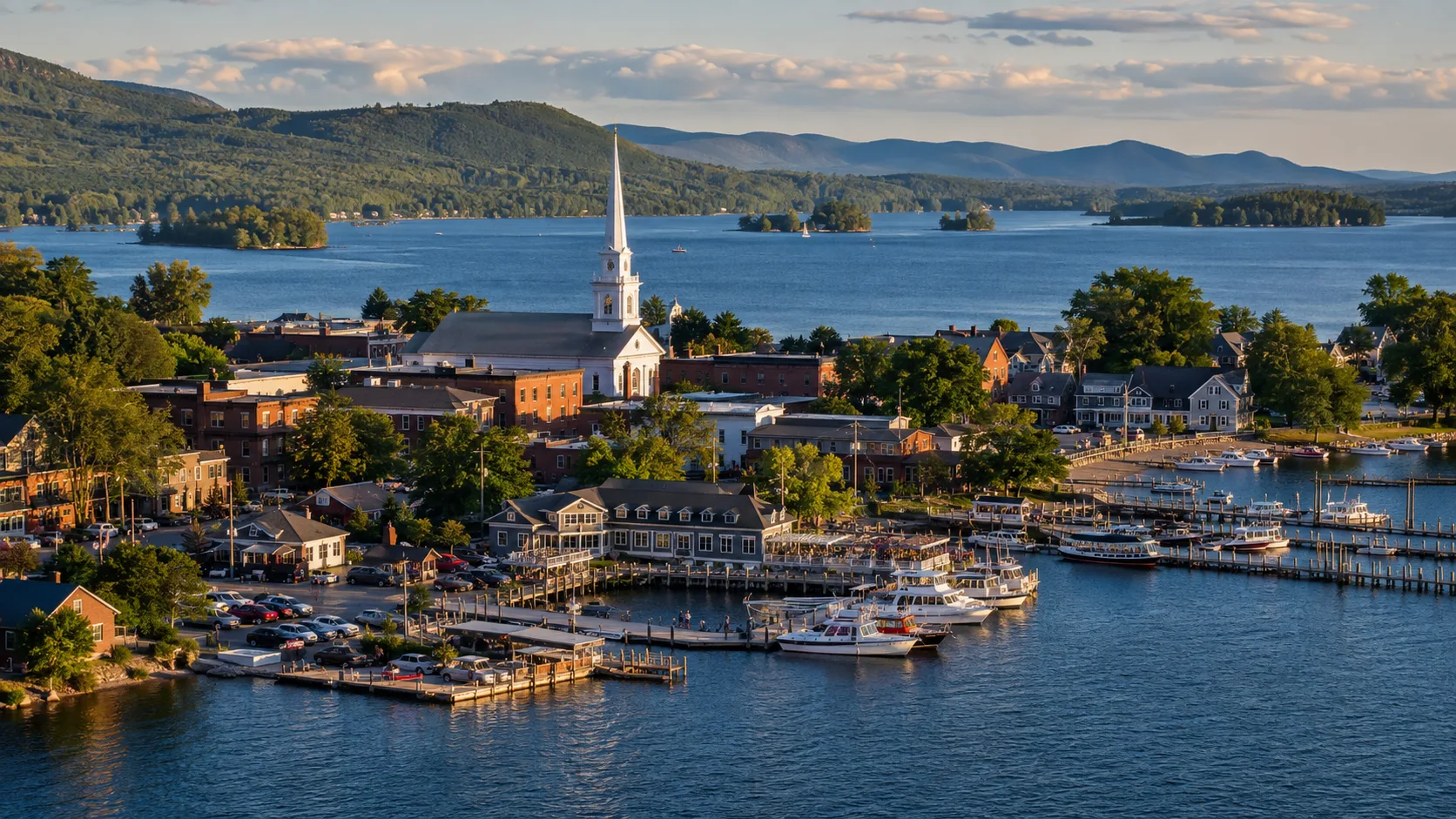

Meredith or Wolfeboro is the natural first fork in the road for anyone shopping Lake Winnipesaukee: the two towns everyone has heard of, the two with real downtowns on the water, the two that show up in every magazine roundup of New England lake towns. And when people go looking for a straight comparison, what they find is forum threads — summer people defending their side of the lake like it's a college rivalry.
So here's the professional version — from a brokerage that sells in both towns, has no side of the lake to defend, and pulled these numbers from the MLS in the summer of 2026 rather than repeating what things cost when the forum thread was written. The short answer up front, because nobody likes articles that bury it: Meredith is the convenient one and Wolfeboro is the complete one. Meredith wins on access — to the interstate, to skiing, to the rest of your life. Wolfeboro wins on immersion — it's the fullest expression of the classic New England lake town that exists anywhere, and it knows it. Neither is wrong. But they suit genuinely different buyers, and the rest of this article explains which one you are.
If you're still earlier in the process than this — still deciding whether Winnipesaukee is even your lake — start with the Lake Winnipesaukee home buying guide, which covers all eight shore towns, the waterfront rulebook, and how the market tiers actually work. This article assumes you've narrowed it to the two headliners.
Two towns, opposite corners
Geography first, because it drives everything else in this comparison.
Meredith sits at the lake's northwest corner, where Route 104 comes east from Interstate 93 and dead-ends into Route 3 at the head of Meredith Bay. That's the whole story of Meredith's convenience in one sentence: the interstate is about ten miles of good state highway away — call it fifteen minutes — and I-93 is the spine that connects you to everything. Boston in about two hours. Manchester airport in about an hour. The White Mountains, Loon, Waterville Valley, and my office in Campton, thirty-five to forty-five minutes north. Gunstock, the lake's own ski area over in Gilford, is roughly twenty minutes around the bay. When Meredith people say "it's easy to get here," they mean it literally.
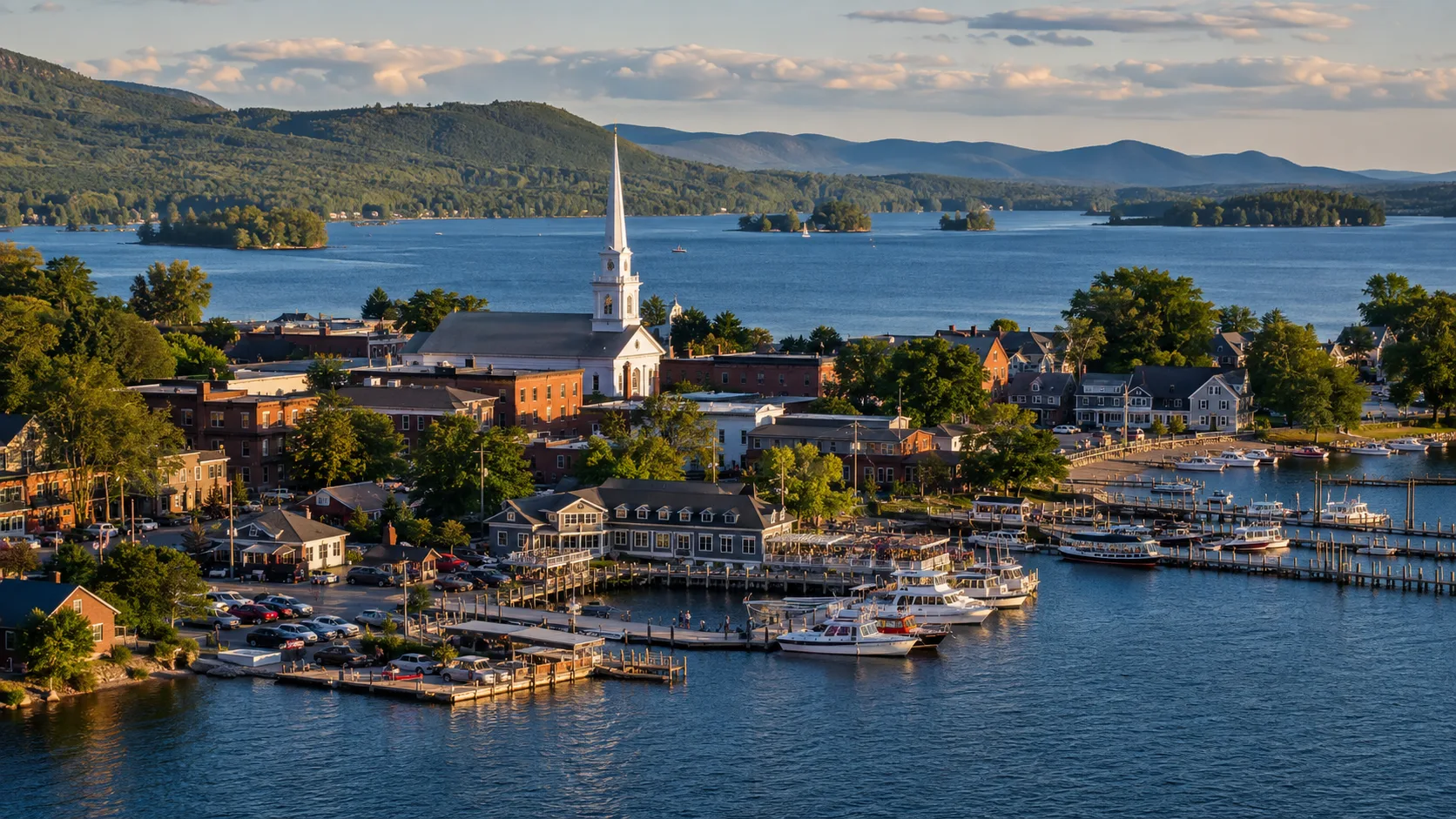
Wolfeboro sits diagonally opposite, tucked into the southeast shore between Winnipesaukee and Lake Wentworth. There is no interstate anywhere near it, and that is not an accident — it's the point. You come up Route 28 from Alton, or Route 109 down the east shore through Melvin Village, or up the Route 16 corridor from the seacoast side, and however you do it, the last half hour is two-lane road through woods and farm country. From I-93 it's a solid forty-five minutes. From Boston it's closer than the map suggests — about two hours up the Route 16 side, roughly the same as Meredith — but the character of the drive is completely different, and so is what waits at the end of it. Driving the lake between the two towns takes the better part of an hour, which is why almost nobody genuinely cross-shops them once they understand what each one is.
Same lake, twenty-eight miles apart, and they've spent 250 years becoming different answers to the same question.
The case for Meredith
Meredith is the lake's front porch — that's what I call it in the big Winnipesaukee guide and I'll stand by it here. The town wraps around Meredith Bay, and the center of gravity is the Mill Falls at the Lake complex: four inns, a marketplace of shops built into a converted 1800s mill, and Church Landing sitting right on the water with its timber-and-stone great-lodge architecture that shows up on half the wedding invitations in New Hampshire. Around it, a genuinely walkable little downtown: the town docks, Hesky Park along the bay, galleries, and a restaurant bench that runs deep for a town of about 6,600 — the Common Man family alone operates several places here, and Hart's Turkey Farm has been feeding families off Route 3 since 1954. The Winnipesaukee Playhouse gives it professional theater. This is a town with a year-round pulse.
That's the thing to understand about Meredith: it's a real town that happens to be a resort, not a resort pretending to be a town. People live here full-time, commute from here, raise kids here in the Inter-Lakes district. The winter doesn't empty it out — it changes gear. The New England Pond Hockey Classic builds its 26 rinks on Meredith Bay every winter — the bay is the event's home ice, though a soft winter has occasionally chased it to backup water, and the February 2027 edition is set for Meredith again — the restaurants stay open, and the fifteen-minute run to I-93 means a Meredith address works for a life that still involves the rest of the world. Of the two towns, Meredith is by far the easier primary residence, and it's the better base if your version of lake life includes a ski habit — Gunstock twenty minutes one way, the White Mountain resorts under an hour the other.
The market reflects all of it. As I write this, Meredith NH homes for sale run to about 59 active residential listings with a median asking price around $739,000 — and the surprise for most buyers is how attainable the middle of this market is. Nearly half of Meredith's actives ask under $750,000. There's a brand-new development of four-bedroom, 2,500-square-foot townhome-style homes asking in the $730s–$740s — new construction at a number that doesn't exist in Wolfeboro right now. The condo market is the deepest of the two towns, thirteen actives with a median around $650,000, running from the low $400s to about $1.6 million.
The top of the Meredith market is real but restrained by Wolfeboro standards: seven waterfront-flagged actives from a $549,000 one-bedroom 1920s camp up to a 2021-built four-bedroom asking about $5.6 million, with the waterfront median around $2.8 million. One listing tells you everything about what frontage is worth here: a 1932 cottage of 613 square feet — smaller than most primary bedrooms I show — asking $3.2 million. You're buying the shoreline; the house is a rounding error. And a caveat I flag in every Meredith search: the town also contains Lake Waukewan and a piece of Winnisquam, so a Meredith "waterfront" flag doesn't automatically mean Winnipesaukee. Read the listing; better yet, read the map.
The case for Wolfeboro
Wolfeboro's claim is on the town seal and on the signs coming into town: the oldest summer resort in America. It dates to 1769, when colonial governor John Wentworth built his summer estate out here, and the remarkable thing is that the 250 years since have deepened the identity instead of diluting it. Wolfeboro is what people picture when they picture a New England lake town — and unlike most postcard towns, the real thing exceeds the postcard.
Start downtown, because there's nothing else like it on this lake. Main Street runs right along Wolfeboro Bay: shops, restaurants, Bailey's Bubble scooping ice cream to a line that never shortens all summer, the Dockside crowd watching the boats, the M/S Mount Washington tying up at the town dock. You can arrive at dinner by boat, and people do, constantly — Back Bay tucks in behind downtown as one of the most protected pieces of water on the lake. Brewster Academy, the prep school whose roots reach back to 1820, holds a long stretch of shorefront just south of downtown and gives the town a campus-green elegance. The Wright Museum of World War II is a legitimately excellent small museum. The Cotton Valley Rail Trail runs miles into the woods from the old station. And the town owns Abenaki, a tiny ski hill dating to the 1930s that won't replace anyone's Gunstock pass but tells you what kind of town this is — one that keeps things because they're worth keeping.
Two practical points that punch above their weight. First, Huggins Hospital sits right in town — a full critical-access hospital with a 24-hour emergency department, which is not a small thing when the nearest interstate is forty-five minutes away and you're deciding where to spend your sixties and seventies. Second, Wolfeboro is a real year-round town too — about 6,400 people, the Governor Wentworth Regional school district, a working Main Street in February. It's smaller and quieter in winter than Meredith, and the summer population multiplies severalfold, but this is not a town that boards up in October.
The market is where Wolfeboro shows its old-money bones. About 64 active residential listings as I write this — the deepest inventory of any Winnipesaukee town except Laconia — with a median asking price around $759,000, nearly identical to Meredith's. But the average asking price is about $1.65 million against Meredith's $1.03 million, and that gap is the whole story: Wolfeboro's top end is in a different league. Twenty of its actives ask $1 million or more, eight of them ask $3 million or more, and the nine waterfront-flagged listings carry a median asking price around $5 million — running from a $725,000 waterfront condo to a 14,700-square-foot estate asking just under $11 million. My favorite illustration of Wolfeboro frontage math: an 1812 house of 1,400 square feet asking $9.8 million. Nobody is paying that for the house.
The middle market is honest, though, and underrated. A 2004-built four-bedroom recently came on under $630,000; an 1822 village antique with 2,600 square feet is asking $875,000; the small condo market — eight or nine actives, median around $700,000 — includes waterfront association units in the $700s that get you on the big lake for a fraction of the estate money. One buyer-beware from the current feed: there's an "active listing" in town at $500 that is actually a hotel timeshare week wearing a condo costume. Every market has these; Wolfeboro's listings, like its houses, reward a careful read.
The numbers, side by side
Pulling it together, from the MLS as I write this — and treat any article's numbers, including mine, as a snapshot with a shelf life. The live feed is on our Lake Winnipesaukee page.
- Inventory: Meredith about 59 active residential listings; Wolfeboro about 64.
- Median asking price: Meredith roughly $739,000; Wolfeboro roughly $759,000. Effectively a tie — the towns' middles are the same market.
- Average asking price: Meredith about $1.03 million; Wolfeboro about $1.65 million. Wolfeboro's estate tier drags its average 60 percent higher on a nearly identical median. Same middle, much heavier top.
- Waterfront: Meredith 7 flagged actives, median about $2.8 million, range $549,000 to $5.6 million. Wolfeboro 9 flagged actives, median about $5 million, range $725,000 to $10.95 million. If you want true big-water frontage under $1 million, in either town, you're shopping camps, condos, and compromises — and in Wolfeboro the entry rung is a condo, not a cottage.
- Condos: Meredith 13 actives, median about $650,000. Wolfeboro 8, median about $700,000. Meredith's condo bench is deeper; Wolfeboro's includes the waterfront-association sleepers.
- Entry points: both towns still have sub-$500,000 listings — about nine in Meredith, ten in Wolfeboro — mostly village homes, older capes, and manufactured housing. The floor hasn't vanished; it's just thin.
- Pace: typical time on market is six or seven weeks in both towns, with correctly priced mid-market homes going far faster and the eight-figure frontage taking as long as it takes.
The one-sentence read: you don't pick between Meredith and Wolfeboro on price. The medians are the same. You pick on geography, character, and what the top of your budget buys — in Meredith it buys convenience plus water; in Wolfeboro it buys the deepest version of lake-town life in New England.
The tax bill, honestly
New Hampshire funds towns through property taxes and the rates differ town to town, so this belongs in your math from day one. Here's the current comparison, and it surprises people: Meredith's 2025 rate is $10.62 per $1,000 of assessed value, and Wolfeboro's 2025 rate is $8.36 — the fancy old summer resort has the lower rate.
Before anyone lets that decide anything, the caveats I give every buyer. Wolfeboro ran a town-wide revaluation in 2025 — completed that October, with new values effective April 1, 2025 — so that $8.36 rides on freshly updated assessments — a lower rate on a higher valuation can be a wash or worse, which is why I compare actual tax bills on actual properties, never rates in the abstract. Rates also reset every fall when the state certifies them, so the number you underwrite today is not a promise. And both towns are moderate by lake standards anyway — the famous outlier is Moultonborough at $5.33, one town up the shore. If taxes are going to steer your shoreline, understand the machinery first: my NH property taxes guide walks through rates, ratios, and why the "view tax" folklore gets the mechanism wrong.
The fair summary: taxes are a mild point for Wolfeboro this year and a tiebreaker at most. Neither town is a tax play. If you want a tax play, you want Moultonborough, and that's a different article.
Your boat cares which town you pick
Buyers compare downtowns and price tags; almost nobody compares the water itself, and they should, because the boating experience differs more than the real estate does.
Meredith Bay opens off the lake's southwest quadrant, a couple of miles of protected water with the town docks at the head of it. The infrastructure is excellent — multiple marinas including full-service operations on the bay and out on Meredith Neck, easy fuel, easy service, slips and valet storage. The trade-off is the neighborhood: when you clear the mouth of the bay you're in the busiest water on the lake, sharing the southwest broads with everything funneling through the Weirs channel out of Paugus Bay. Summer Saturdays out there are a boat parade. It's fun if you like the scene; it's chop and traffic if you don't. Quiet water exists — you just cruise northeast to find it.
Wolfeboro Bay is the opposite proposition. The town dock is literally on Main Street, Back Bay behind it is glass-calm and no-wake, and the eastern side of the lake it opens onto — down toward Alton, up toward Tuftonboro's coves and Winter Harbor — is the quietest big water Winnipesaukee has. Boating to dinner isn't a novelty in Wolfeboro; it's how half the harbor arrives on a July evening. The trade-off is reach: you're a long cruise from the lake's western attractions, and the marine infrastructure, while good, is thinner than Meredith's cluster.
One more thing the brochures skip, because it's the single most common rude awakening I see: don't assume a slip comes with the lifestyle. Seasonal slips on Winnipesaukee are chronically sold out in both towns, waitlists at the established marinas run years, and what a new buyer can actually get — this season, not someday — is usually valet rack storage: the marina keeps the boat inside and splashes it when you call ahead. It works fine for most people, but it's not the same as walking down to your boat with a cooler at 7 a.m. This is exactly why a deeded dock, a boat-club membership, or a transferable slip buried in a listing's fine print is worth real money, and why I read that fine print before I let anyone fall in love with a house.
Rough rule: if your boating fantasy is social — restaurants by water, sandbar raft-ups, the full scene — Meredith positions you for it. If your fantasy is a quiet evening cruise that ends with ice cream at a town dock, that's just called Wednesday in Wolfeboro.
The trade-offs nobody puts in the brochure
I promised both sides, so here's what I tell buyers when they're leaning too hard one way.
Meredith's honest problems. Route 3 through downtown in summer is genuinely bad — the Route 3/25 corridor is the main artery between the interstate and everything east, all of it funnels through Meredith's traffic lights, and on a July weekend the backup can turn a five-minute errand into thirty. You will plan your life around it from Memorial Day to Columbus Day; every local does. The convenience that makes Meredith easy to reach makes it easy for everyone else to reach too, so the town center trades some of the away-from-it-all feeling that people move to a lake for. And the waterfront market is thin — seven active listings as I write this — so Winnipesaukee-frontage buyers with a Meredith-only search should expect to wait, and to move fast when something real appears.
Wolfeboro's honest problems. Distance, in every direction. Forty-five minutes to the interstate means forty-five minutes to everything the interstate means — commutes, airports, big-box errands, and, pointedly for second-home owners, the drive itself: a Boston-based owner heading up Friday night does the last stretch on dark two-lane roads in winter. There's no ski mountain of consequence within a half hour. Its own brand works against buyers: "oldest summer resort in America" is priced in, the waterfront entry point is the highest of any town on the lake, and the estate tier is thick with generational money that doesn't negotiate like it needs to sell. And the deeper the summer identity, the sharper the February contrast — Wolfeboro in deep winter is lovely and very quiet, which is either the point or a problem, depending entirely on you.
Both towns share the lake-wide realities: nearly all waterfront runs on private septic with the state's new pre-closing evaluation requirement, docks are permitted state structures whose files I pull on every deal, and the Shoreland Act governs what you can do within 250 feet of the water. All of that is covered properly in the Winnipesaukee guide — it applies identically on both sides of the lake.
So which one are you
After enough of these conversations, the patterns are reliable. Here's how I'd sort you.
Pick Meredith if the house needs to work for your whole life, not just your summers. Primary residents, hybrid workers who need the interstate weekly, families juggling school and sports, and — decisively — anyone whose winters revolve around skiing. Meredith is the four-season logistics answer: lake in July, Gunstock in January, Boston when you must, and a real town running underneath all of it. It's also the better answer for a first lake purchase at a middle-market budget, because the condo bench and the new construction give you more ways in. And if the ski half of the equation is doing most of the work in your head, read my ranking of New England ski towns for second homes before you commit to a lake at all.
Pick Wolfeboro if you're buying immersion. Second-home buyers who want maximum lake-town per minute of their summer, retirees and near-retirees who value a walkable Main Street and a hospital in town over interstate access they no longer need, boaters who prefer the quiet east side, and buyers with estate-tier budgets — because the top of this lake's market simply lives in Wolfeboro, and if you're shopping serious frontage you'll end up here whether you started here or not.
And if you're torn, ask yourself the one question that resolves it most often: when you picture the house, are you coming or going? Buyers who picture leaving — for the mountain, for the city, for the airport — are Meredith people. Buyers who picture arriving and staying put are Wolfeboro people. If neither quite fits, the answer might be neither town: Gilford splits the difference on the ski question, Laconia undercuts both on price, and I've walked through the whole shoreline town by town in the big guide and ranked the state's waters in best lakes in New Hampshire.
Questions buyers ask us
Is Meredith or Wolfeboro better
Neither, universally — that's an honest answer, not a dodge. Meredith is better for year-round logistics: fifteen minutes to I-93, skiing in every direction, deeper condo and new-construction inventory. Wolfeboro is better at being a lake town: the finest Main Street on the water in New England, a hospital in town, the quietest big water on the lake. If you commute, ski, or juggle kids' schedules, Meredith wins. If you're buying the fullest version of summer, Wolfeboro wins. The rest of this article is the long form of that sentence.
Is Meredith or Wolfeboro more expensive
The medians are nearly identical — mid-$700s asking in both as I write this. The difference is the top: Wolfeboro's average asking price runs about 60 percent higher because its waterfront market is an estate market, with a waterfront median around $5 million against Meredith's roughly $2.8 million. Mid-market buyers will find the towns priced alike; frontage buyers will find Wolfeboro's entry rung meaningfully higher.
Is Wolfeboro NH expensive
By New Hampshire standards, yes at the top and no in the middle. The estate tier is genuinely expensive — a waterfront median around $5 million, eight active listings asking $3 million or more — and the town's reputation prices some listings on brand rather than substance. But the median active listing asks in the mid-$700s, there are about ten listings under $500,000, and the 2025 tax rate of $8.36 is among the more moderate on the lake. Day-to-day costs are ordinary small-town New Hampshire — no sales or earned-income tax, which I break down in what it really costs to live in New Hampshire. Wolfeboro is expensive the way a good watch is expensive: at the top, and by choice.
Which Winnipesaukee town is the cheapest
Not these two — and if budget leads, that's useful to know early. Laconia is the value answer on the big lake, with the deepest inventory and medians well below Meredith and Wolfeboro; its Winnisquam shoreline stretches dollars even further if the specific lake is negotiable. Alton and parts of Gilford also undercut the two headliners. What Meredith and Wolfeboro sell isn't the cheapest way onto Winnipesaukee — it's the two best downtowns on it, and you pay the downtown premium.
Which town has lower property taxes
Wolfeboro, currently — $8.36 per $1,000 for 2025 against Meredith's $10.62. But Wolfeboro revalued in 2025, rates reset every fall, and bills depend on assessments as much as rates — compare real tax cards, not headline numbers. Neither town is the lake's tax play; that's Moultonborough at $5.33.
Which is better for a second home from Boston
Drive time is nearly a wash — about two hours to either, Meredith up I-93 and Wolfeboro up the Route 16 corridor. Wolfeboro is the purer summer-colony experience and the traditional answer; Meredith wins if your second home doubles as a ski base or you value interstate driving in winter weather. Plenty of my second-home buyers choose Meredith for the logistics and never regret it; nobody who chooses Wolfeboro regrets it in July. And if the second home is really a trial run for leaving Massachusetts altogether, that math is its own article: moving from Massachusetts to New Hampshire.
Which town is better for year-round living
Both work — these are two of the most genuinely year-round towns on the lake. Meredith is the easier daily-life answer: interstate access, more mid-market and new-construction housing, skiing close. Wolfeboro counters with a hospital in town and the better Main Street. If year-round means employed and commuting, lean Meredith. If year-round means retired and rooted, Wolfeboro is hard to beat. One honest test either way: visit in November or April, the two months when the lake is at its emptiest. If a quiet Main Street in mud season unsettles you, you'll learn it for the price of a weekend instead of a closing.
Can I get on the water for under a million in either town
Yes, with eyes open. Both towns have waterfront-flagged listings in the $500,000–$800,000 range as I write this — in Meredith that money buys a vintage camp, in Wolfeboro a waterfront-association condo. Both towns also contain smaller lakes (Waukewan and a slice of Winnisquam in Meredith; Lake Wentworth and Crescent Lake in Wolfeboro), so verify which water a "waterfront" listing actually touches. The Winnipesaukee guide explains the ownership tiers that make these price points possible — and if the budget is firm but the lake is flexible, you can browse lakefront homes across New Hampshire and let the water find you.
Come drive both with me
Here's what I actually do with buyers wrestling this choice: we spend a day. Morning coffee at Mill Falls, walk the Meredith docks, drive the bay. Then around the lake — Center Harbor, Moultonborough's quiet shore — and into Wolfeboro for lunch on Main Street and an afternoon on the town docks. By the ice cream at Bailey's Bubble, almost everyone knows. The towns make their own arguments; my job is pulling the tax cards, the dock permits, and the septic files on whichever side wins you over — and telling you plainly when a listing is priced on reputation instead of substance. Browse what's active in Meredith and Wolfeboro right now, set an alert on new listings so the thin waterfront inventory can't slip past you, or start wider with the whole Lakes Region. Or just call the office — I still answer my own phone, and this particular question is one of my favorites to talk through.