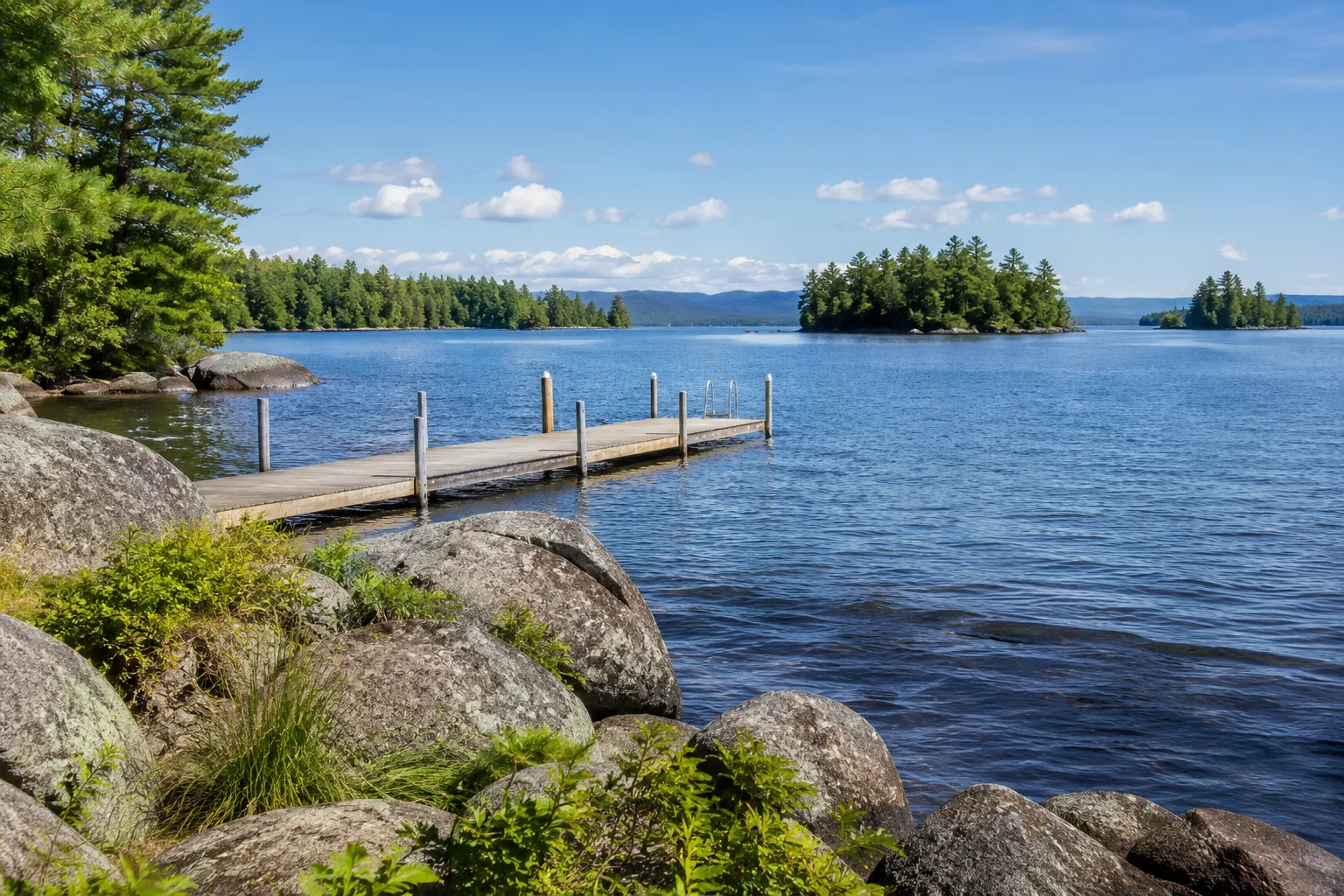

Buying Lakes Region waterfront property in New Hampshire comes down to four decisions: the right lake for how you'll use it, what the deed actually conveys at the shoreline, what the state's 250-foot shoreland zone and dock rules allow, and the true carrying cost. Prices are steep — Lake Winnipesaukee frontage closed at a $2.3 million median in the first half of 2026.
New Hampshire is not making any more lake frontage. Every buildable foot of shoreline on Winnipesaukee, Squam, Newfound, and the region's hundreds of smaller lakes and ponds was spoken for long ago, and the state's shoreland rules make sure what exists stays largely as it is. That fixed supply is why Lakes Region waterfront homes hold value the way few other property types in northern New England do — and why buying one well takes more homework than buying the same house a mile inland.
This guide covers the things that decide whether a waterfront purchase turns out to be the best money you ever spent or a string of expensive surprises: how the major lakes differ, what your deed actually gives you at the water's edge, the state rules that govern shorefront land, and the due diligence that is unique to property on the water. It's the same checklist our team runs on every waterfront showing — we work the lakes year-round from our offices on Route 49 in Campton and Main Street in Plymouth.
In this guide
- Lakes Region waterfront at a glance
- Which lake fits how you'll actually live?
- What does waterfront cost on each lake?
- Frontage, access, or a right-of-way? Read the deed first
- The Shoreland Act: what you can build and cut
- Docks: permits, grandfathering, and ice
- Waterfront due diligence: the inspection list is longer here
- The money: taxes, transfer costs, and why frontage holds value
- A year on the water (and what it means for buyers)
- Frequently asked questions
Key takeaways
- Each lake has a distinct personality — Winnipesaukee is lively big-boat water, Squam is conserved and deliberately quiet, Newfound is deep and famously clear, Winnisquam trades convenience for calm — and the right frontage on the wrong lake is still the wrong house.
- What the deed says at the water's edge matters enormously: owned frontage, deeded access, and association waterfront are different products, often worth six figures apart on the same street.
- The Shoreland Water Quality Protection Act (RSA 483-B) regulates all land within 250 feet of the water, including a 50-foot primary structure setback and limits on cutting and impervious surface.
- Since September 1, 2024, RSA 485-A:39 requires the buyer to have a licensed septic evaluation done before closing on developed waterfront whose septic system sits within 250 feet of the water, and a failed system must be replaced within 180 days of transfer.
- Town property tax rates vary sharply across the region — Moultonborough's 2025 rate was $5.33 per $1,000 — and the state transfer tax under RSA 78-B costs buyer and seller $0.75 per $100 each.
Lakes Region waterfront at a glance
| The big lakes | Winnipesaukee (44,586 acres — NH's largest), Squam (6,791 acres), Newfound (about 4,100 acres), Winnisquam (about 4,200 acres), plus hundreds of smaller lakes and ponds |
|---|---|
| Recent prices | Winnipesaukee waterfront: $2.75M median across 85 sales in 2025; $2.3M median across 29 sales in the first half of 2026 (details by lake) |
| Drive from Boston | Roughly 2 hours to Meredith or Wolfeboro via I-93 |
| Shoreland rules | RSA 483-B protects all land within 250 ft of the water; primary structures set back 50 ft, with vegetation and impervious-surface limits |
| Septic at transfer | State law (RSA 485-A:39) requires a licensed septic evaluation when developed waterfront property changes hands |
| Transfer tax | $0.75 per $100 of price, paid by buyer and seller alike (RSA 78-B) |
| Property taxes | Vary sharply by town — Moultonborough's 2025 rate of $5.33 per $1,000 was among the lowest in NH; Newfound's Bridgewater ($6.35) and Hebron ($9.55) are also low |
| Current inventory | Waterfront homes, luxury homes, and everything for sale in the Lakes Region |
Which lake fits how you'll actually live?
Buyers tend to shop the Lakes Region as one market. It isn't. Each lake has a personality, and the right frontage on the wrong lake is still the wrong house. The table below is the shorthand version; the profiles that follow fill in the character of each.
| Lake | Character | Pace on the water | Typical waterfront profile |
|---|---|---|---|
| Winnipesaukee | NH's largest lake (44,586 acres, roughly 260 islands) and the region's center of gravity — marinas, harbors, island picnics, the M/S Mount Washington | Lively, especially summer weekends; big-boat water with 45 mph day / 30 mph night limits (RSA 270-D) | The full spectrum, from vintage family camps to estate compounds; the region's deepest inventory, varying sharply by town and bay |
| Squam | The On Golden Pond lake — heavily conserved shoreline, loons, dark skies, strong stewardship culture | Deliberately quiet; limited public boat access keeps traffic low | Old-family compounds and understated camps that trade rarely, often privately, and at a premium |
| Newfound | Spring-fed, 183 ft at its deepest, and among the clearest large lakes in the state; old-camp New England feel | Calmer than Winnipesaukee; swimming and paddling water first, cruising second | Thinner inventory than the big lake — classic camps and rebuilt year-round homes on wooded frontage |
| Winnisquam | Big-lake boating minutes from I-93, between Laconia, Sanbornton, Belmont, Tilton, and Meredith | Active but less crowded than Winnipesaukee's busiest bays | A practical mix of camps, year-round homes, and condos; the convenience play among the big lakes |
| Smaller lakes & ponds | Hundreds of them, many barely known outside their own shorelines | Quietest of all; some restrict motor size or are paddle-only | Well-sited camps that often deliver more actual time-on-the-water per dollar than a trophy address |
Lake Winnipesaukee: the big water
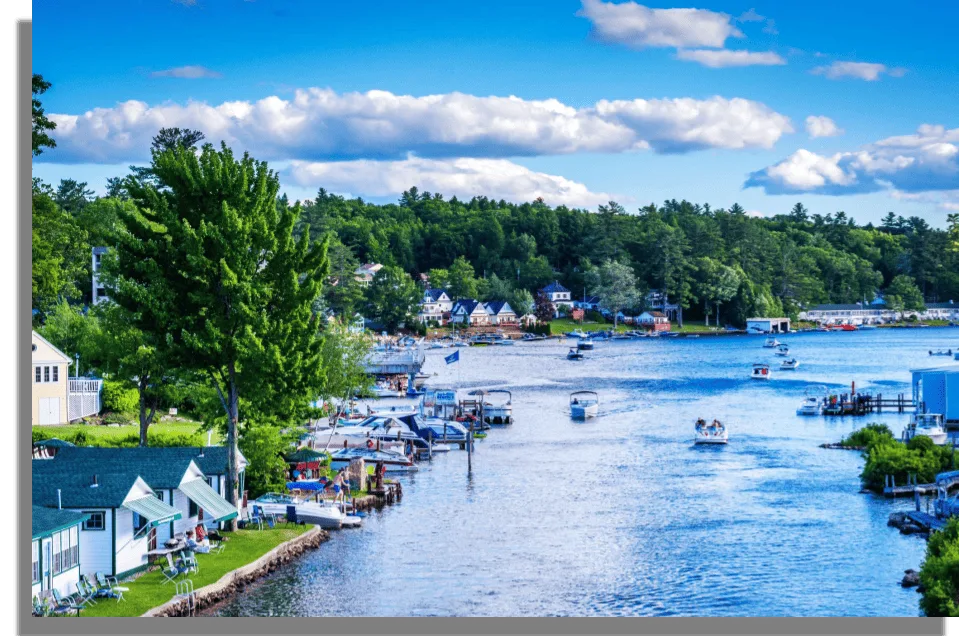
At 44,586 acres with roughly 260 islands and about 180 feet of water at its deepest, Winnipesaukee is New Hampshire's largest lake and the center of gravity for the whole region. It is big-boat water — the excursion ship M/S Mount Washington still runs a summer schedule out of Weirs Beach — with marinas, island picnics, and busy summer harbors. State law caps boat speeds at 45 mph by day and 30 mph at night (RSA 270-D:2), but summer weekends are lively, and that's the point: people who buy here want the action.
The shoreline towns each read differently. Meredith has a walkable lakefront village and one of the busiest bays on the lake. Wolfeboro — "the oldest summer resort in America" — anchors the quieter eastern shore. Laconia includes Weirs Beach and the lake's most accessible price points, Gilford pairs frontage with Gunstock's ski slopes, and Moultonborough claims the longest shoreline on the lake and the tax rate everyone talks about (more on that below). You can browse current Winnipesaukee waterfront listings town by town.
Squam Lake: On Golden Pond, deliberately quiet
Squam — 6,791 acres across Holderness, Center Harbor, Sandwich, and Moultonborough — is where cameras rolled for the 1981 film On Golden Pond, and the lake has spent the decades since making sure it stays recognizable. A remarkable share of its shoreline and watershed is conserved, thanks to the Squam Lakes Association and the Squam Lakes Conservation Society, and public boat access is deliberately limited. The result: loons, dark night skies, and waterfront that trades rarely, often privately, and at a premium — much of it old-family compounds, the kind of property covered in our guide to family compounds for sale in New Hampshire. Buyers here are buying quiet — and joining a community with strong stewardship expectations. At 99 feet at its deepest, Squam is shallower than Winnipesaukee or Newfound but still big water; our Squam Lake guide covers its towns, islands, and access in depth.
Newfound Lake: deep, clear, and spring-fed
Newfound, at about 4,100 acres in Bristol, Bridgewater, Hebron, and Alexandria, is the sleeper. Spring-fed and 183 feet at its deepest, it is rated oligotrophic — clear, cold, and low in nutrients — by NHDES, and Wellington State Park on its western shore has the largest freshwater beach in the New Hampshire state park system. Frontage inventory is thinner than Winnipesaukee's and the vibe is old-camp New England (our guide to camps and cabins for sale in NH covers that market). Its watershed association, the Newfound Lake Region Association, runs water testing and invasive-plant prevention; our Newfound Lake guide goes town by town.
Winnisquam and the smaller ponds
Lake Winnisquam — about 4,200 acres and 155 feet deep, southwest of Winnipesaukee between Laconia, Sanbornton, Belmont, Tilton, and Meredith — offers real big-lake boating minutes from I-93 at friendlier prices. And don't overlook the region's hundreds of smaller lakes and ponds: a well-sited camp on a quiet pond often delivers more actual time-on-the-water per dollar than a trophy address. Many of the best values in the region are on water most out-of-state buyers have never heard of.
What does waterfront cost on each lake?
Lakes Region waterfront sells in small numbers, so a single estate sale can swing a lake's median by a million dollars. Read the figures below as a sense of scale, not a price list. They come from Meredith-based Roche Realty Group's published tallies of MLS closings (single-family waterfront homes); the newest period available for each lake is shown.
| Lake | Size / max depth | Period | Waterfront sales | Median sale price |
|---|---|---|---|---|
| Winnipesaukee | 44,586 acres / ~180 ft | Jan–Jun 2026 | 29 | $2,300,000 |
| Winnipesaukee | 44,586 acres / ~180 ft | Full year 2025 | 85 | $2,750,000 |
| Squam | 6,791 acres / 99 ft | Full year 2025 | 5 | $5,900,000 |
| Winnisquam | ~4,200 acres / 155 ft | Jan–Oct 2024 | 14 | $1,412,500 |
| Newfound | ~4,100 acres / 183 ft | Jan–Oct 2024 | 5 | $1,400,000 |
Sources: Roche Realty Group, 2026 mid-year market report (published July 2026), 2026 outlook (2025 data), and waterfront sales on 10 area lakes (Jan–Oct 2024 data). Squam's five 2025 sales are too few to treat as a trend. For region-wide and statewide numbers, see our New Hampshire housing market 2026 report.
What moves price within a lake is consistent: feet of frontage, the slope and depth at the dock (a sandy, gradual entry suits swimmers; deep water off the end suits bigger boats and diving), sun exposure — west-facing frontage gets the evening sun — privacy from neighbors, and whether the house is a year-round build or a seasonal camp.
Frontage, access, or a right-of-way? Read the deed first
"Waterfront" gets used loosely in listings. The deed language is what you're paying for, and the differences are worth six figures or more on the same street:
- Owned frontage: your lot line runs to the water. This is true waterfront — the scarcest and most valuable category, and the only one where dock rights typically attach to your own land.
- Deeded access or right-of-way: your lot is set back, but the deed grants a path to the shore, sometimes with beach or dock rights. Verify exactly what the easement allows — foot access is not the same as a boat slip.
- Shared or association waterfront: a community beach or dock system owned by an association. Ask for the association documents, fees, and any waitlist rules for slips and moorings.
One more New Hampshire wrinkle: the beds of the state's "great ponds" — public waters of 10 acres or more — belong to the State, held in public trust. A dock permit is a permission to occupy public waters, not ownership of them, which is exactly why the paperwork below matters.
The Shoreland Act: what you can build and cut
The Shoreland Water Quality Protection Act (RSA 483-B) governs all land within 250 feet of the high-water reference line of public waters. If you buy waterfront, you are buying into these rules, and they shape everything from renovations to landscaping:
- 50-foot primary setback: new primary structures must sit at least 50 feet back from the reference line.
- The waterfront buffer: within the first 50 feet, trees and natural vegetation are protected under a point system — you can prune for a view corridor, but you cannot clear-cut your shorefront.
- Natural woodland buffer: between 50 and 150 feet, at least 25 percent of that area must be kept as unaltered natural woodland.
- Impervious limits: buildings, driveways, and patios can cover up to 20 percent of the lot within the 250-foot zone; above 20 percent requires a stormwater management system, and above 30 percent requires a stormwater plan certified by a licensed engineer.
- Permits: most construction, excavation, or filling within the protected shoreland requires a Shoreland Permit from NHDES before work begins.
Practical takeaway for buyers: that expansion or teardown-rebuild you're imagining may be possible — grandfathered structures can often be repaired or rebuilt within limits — but scope it against RSA 483-B before you waive contingencies, not after. We flag shoreland-rule implications on every waterfront showing we do.
Docks: permits, grandfathering, and ice
Docks on New Hampshire's public waters are regulated by the NHDES Wetlands Bureau under RSA 482-A. When you evaluate a waterfront property, treat the dock as its own small due-diligence project:
- Verify the permit. Ask for the state approval for any existing dock and confirm what's in the water matches what was permitted. Older structures may be legally grandfathered — but "it's always been there" is not a permit, and unpermitted structures can become the new owner's problem.
- Seasonal vs. permanent. Seasonal docks come out each fall, which is why they dominate here: lake ice moves, and it is astonishingly good at destroying anything left in its path. Permanent crib or piling docks exist, mostly as legacy structures; new ones are harder to permit.
- Size and expansion are regulated. The streamlined NHDES seasonal dock notification covers one seasonal dock on a lot with at least 75 feet of frontage, no more than 6 feet wide and 40 feet long on waterbodies of 1,000 acres or more (30 feet long on smaller ones), at least 20 feet from the abutter's line, and out of the water at least five months a year. Anything bigger — a second slip, a U-dock, a boathouse, a permanent crib — needs a full wetlands permit.
- Moorings are permitted separately through NH Marine Patrol and don't automatically convey with the house.
- Headway speed near shore. Statewide, boats must hold headway speed within 150 feet of shore, docks, moorings, swimmers, and other boats (RSA 270-D:2) — which shapes how a narrow cove or a busy channel actually feels from your deck.
Waterfront due diligence: the inspection list is longer here
Inland, a home inspection and a title search cover most of the risk. On the water, the list runs longer. Here is the checklist we work through with waterfront buyers — each row is its own small investigation, and the order matters less than making sure none get skipped.
| Checklist item | What to verify | Where to look |
|---|---|---|
| Deed & water rights | Owned frontage vs. deeded access vs. association waterfront; exact easement language; beach, slip, and mooring rights | The recorded deed and plan at the county registry; your closing attorney |
| Shoreland constraints | What RSA 483-B allows on this lot — setbacks, cutting limits, impervious coverage, and whether past work was permitted | NHDES Shoreland Program; town land-use office; any prior Shoreland Permits |
| Septic system | Age, siting, and condition; the RSA 485-A:39 evaluation at transfer; feasibility and setbacks (75–125 ft by soil type) for a future replacement | Licensed septic evaluator; NHDES approvals for the existing design |
| Well water | Flow and a full lab panel — arsenic, radon, and uranium occur naturally in NH bedrock wells | Accredited water-testing lab; NHDES private well guidance |
| Dock & moorings | State approval for the existing dock (RSA 482-A), whether the structure matches it, and separate mooring permits | NHDES Wetlands Bureau records; NH Marine Patrol for moorings |
| Flood zone | Whether any structure sits in a FEMA special flood hazard area and what coverage would cost | FEMA flood maps; an insurance quote before you commit, not at closing |
| Private road | Your share of plowing and grading, the association budget, and whether the maintenance agreement is recorded (lenders ask) | Road association documents; the registry of deeds |
| Water quality & invasives | Milfoil status, water clarity trends, and how the lake level is managed through the seasons | NHDES water-quality data; the lake association's newsletter and testing reports |
Septic: the state now checks at every sale
Most Lakes Region waterfront homes are on private septic, and this is the single most consequential system to understand. Since September 1, 2024, RSA 485-A:39 has required a septic system evaluation by a New Hampshire–licensed evaluator before any developed waterfront property changes hands when any part of its septic system lies within 250 feet of the water. The buyer pays for it (an evaluation the seller commissioned within the prior 180 days can be accepted instead); older or unapproved systems also need a permitted designer to check the leach field against the seasonal high water table; and a system found in failure must be replaced within 180 days of the transfer. Replacement near the water is constrained by soil-based setbacks (new leach fields must sit 75 to 125 feet back from the reference line depending on soils), which on a small lot can be a genuinely hard engineering problem. Price the septic's age and siting into your offer.
Water, flood, and ice
- Test the well. Naturally occurring arsenic, radon, and uranium show up in New Hampshire bedrock wells; a full lab panel is cheap insurance.
- Check the flood map. Some shorefront sits in FEMA special flood hazard areas, where lenders require flood insurance — get a quote before you commit, not at closing.
- Walk the shoreline. Look for erosion, undermined walls, and ice damage to steps, boathouses, and retaining structures. Ask how the lake level is managed and how much the water drops in winter.
Water quality and milfoil
Variable milfoil and other invasive plants are established in some regional waterbodies and absent from others, and the difference affects both daily swimming and long-term value. NHDES publishes water-quality data and tracks infested waterbodies, and nearly every lake here has an active lake association running water testing and courtesy boat inspections. Read the association's newsletter before you buy — it's the most honest disclosure document in the file.
Private roads
A large share of lake homes sit on private roads maintained by road associations. Ask for the association's budget, your share of plowing and grading, and whether the road agreement is recorded — lenders ask the same question.
The money: taxes, transfer costs, and why frontage holds value
New Hampshire has no tax on earned income and no general sales tax; towns fund themselves through property taxes, and the differences between neighboring towns are dramatic. Moultonborough — with miles of Winnipesaukee and Squam shoreline and nearly $7 billion in assessed value — set a 2025 rate of $5.33 per $1,000, one of the lowest in the state; Newfound's Bridgewater ($6.35) and Hebron ($9.55) are also low, while some neighboring towns run several times higher. Our guide to NH property taxes explains rates, assessments, and equalization. On a seven-figure waterfront purchase, the town line can matter as much as the house. Verify the current rate for any town you're considering; we run those numbers with every buyer.
Budget for the state transfer tax (RSA 78-B): $0.75 per $100 of the purchase price, paid by each side — $1.50 per $100 combined. On larger parcels, ask whether land is enrolled in current use (RSA 79-A): acreage taxed at its undeveloped value carries a 10 percent land use change tax when it's developed, and that liability effectively rides with the land. And remember New Hampshire taxes the transfer, not the gain — there is no state capital gains tax, though federal rules still apply when a lake house eventually sells; our guide to capital gains tax when selling a home in New Hampshire explains how second homes are treated.
As for value: waterfront is the textbook scarce asset. The supply of frontage is fixed, the Shoreland Act keeps it from being subdivided into oblivion, and demand compounds from Boston northward. Well-bought waterfront in this region has historically been forgiving of almost every mistake except overpaying for the wrong water. Current bands worth watching: Lakes Region homes under $750K (mostly water-access and small-pond frontage), $750K–$1.5M (entry big-lake frontage), and over $1.5M, where the prime Winnipesaukee and Squam shoreline lives.
Already own here? Everything in this guide cuts the other way when it's your dock, your septic, and your deed under the microscope — a prepared seller answers these questions before buyers ask them. Our guide to selling a lake house or second home in New Hampshire walks the owner's side of the transaction, our NH Seller Guide covers the process end to end — including our Ready-to-Sell Program, which pairs a pre-listing inspection with up to $2,500 in advanced preparation costs — and a professional home valuation is the place to start if you're curious what today's market says.
A year on the water (and what it means for buyers)
Lake life runs on a calendar of its own. "Ice-out" — declared each spring when the M/S Mount Washington can reach all five of her Winnipesaukee ports — usually lands in April and starts the season; docks go in, boats launch, and the summer crescendos through Labor Day. Fall brings foliage reflected on flat water and the best hiking weather of the year; winter brings ice fishing, snowmobiles, and the quiet the year-round residents prize. The buying market has a rhythm too: inventory peaks in late spring and summer when properties show best, while serious off-season buyers often face less competition for the listings that remain.
Many owners offset costs by renting during peak weeks — but town short-term-rental rules vary across the region and the numbers deserve real analysis, not optimism. If renting is part of your plan, our Short-Term Rental Property Analysis covers regulations and realistic operating assumptions for a specific property — our team operates vacation rentals in this region ourselves, so the assumptions come from real booking calendars — and our guide to second-home ownership covers the practical side of owning from a distance.
Frequently asked questions
How close to the water can I build in New Hampshire?
New primary structures must be set back at least 50 feet from the water's reference line, and all land within 250 feet is regulated under the Shoreland Water Quality Protection Act (RSA 483-B). Towns may impose stricter setbacks, so check local zoning too.
Do dock permits transfer when I buy a waterfront home?
Generally the state approval runs with the property, but verify the dock's permit status with the NHDES Wetlands Bureau and confirm the structure in the water matches what was approved — an unpermitted or enlarged dock becomes the new owner's problem. Legally grandfathered docks can usually stay if they aren't expanded. Moorings are permitted separately through NH Marine Patrol and may not convey.
Is a septic inspection required when buying waterfront property in NH?
Yes. Since September 1, 2024, RSA 485-A:39 requires an evaluation by a New Hampshire–licensed septic evaluator before developed waterfront property changes hands if any part of the septic system is within 250 feet of the water. The buyer pays, though a seller's evaluation from the prior 180 days can be accepted, and a failed system must be replaced within 180 days of transfer.
Which Lakes Region town has the lowest property taxes?
Moultonborough is famous for it: its 2025 rate was $5.33 per $1,000 of assessed value, among the very lowest in New Hampshire, thanks to a waterfront-heavy tax base. Bridgewater ($6.35) and Hebron ($9.55) on Newfound Lake are also low. Rates reset every fall, so confirm current figures for any town on your shortlist.
Can I cut down trees on my waterfront lot in New Hampshire?
Only within limits. In the first 50 feet from the water, RSA 483-B protects trees and natural vegetation under a point system — you can prune and open a view corridor, but you cannot clear-cut the shorefront — and at least 25 percent of the area between 50 and 150 feet must stay natural woodland. Significant cutting or construction within 250 feet of the water generally requires a Shoreland Permit from NHDES.
How much does waterfront cost on Lake Winnipesaukee?
Waterfront single-family homes on Winnipesaukee sold at a $2.75 million median across 85 sales in 2025 and a $2.3 million median across 29 sales in the first half of 2026, according to Roche Realty Group's tallies of MLS closings. Individual prices range far wider — dated camps on small lots at one end, estate compounds in Moultonborough, Gilford, and Wolfeboro at the other.
How big a dock can I put on a New Hampshire lake?
Under the NHDES seasonal dock notification, a lot with at least 75 feet of frontage can have one seasonal dock up to 6 feet wide and 40 feet long on lakes of 1,000 acres or more, or 30 feet long on smaller waters, set at least 20 feet from the abutter's line and removed at least five months a year. Larger or permanent docks need a full wetlands permit.
What is the difference between owned waterfront and deeded water access?
Owned frontage means your lot line runs to the water, and dock rights typically attach to your own land. Deeded access means your lot is set back but the deed grants a path to the shore — sometimes with beach or dock rights, sometimes foot access only. The two can differ in value by six figures on the same street, so read the actual easement language before you offer.
Find your stretch of shoreline
The right waterfront purchase is a matching problem: the lake that fits your pace, deed language that delivers what the listing promised, and a property whose shoreline systems survive scrutiny. That's local knowledge work, and it's what our team does every week, from the White Mountains to the big lake. Browse Lakes Region waterfront listings, run a broader property search, read our buyer's guide for the step-by-step process, or talk with our team about the lakes we'd steer you toward — and the ones we wouldn't — for how you actually plan to live.
Statutes, setbacks, prices, and tax figures above are general information, current as of September 2026; rules change and every lot is different. Confirm specifics with NHDES, the town, and your attorney or CPA before relying on them.
Sources and further reading
- RSA 483-B — Shoreland Water Quality Protection Act (full text)
- NHDES — Protected Shoreland FAQ
- RSA 485-A:39 — Waterfront Property Transfer; Septic System Evaluation
- NH Department of Revenue Administration — Real Estate Transfer Tax
- NHDES — Docks in Non-Tidal Areas FAQ and seasonal dock notification criteria
- Roche Realty Group — Lakes Region market 2026 (first-half waterfront sales)
- Town of Moultonborough — 2025 tax rate set
- Lakes Region Tourism Association — Our Lakes