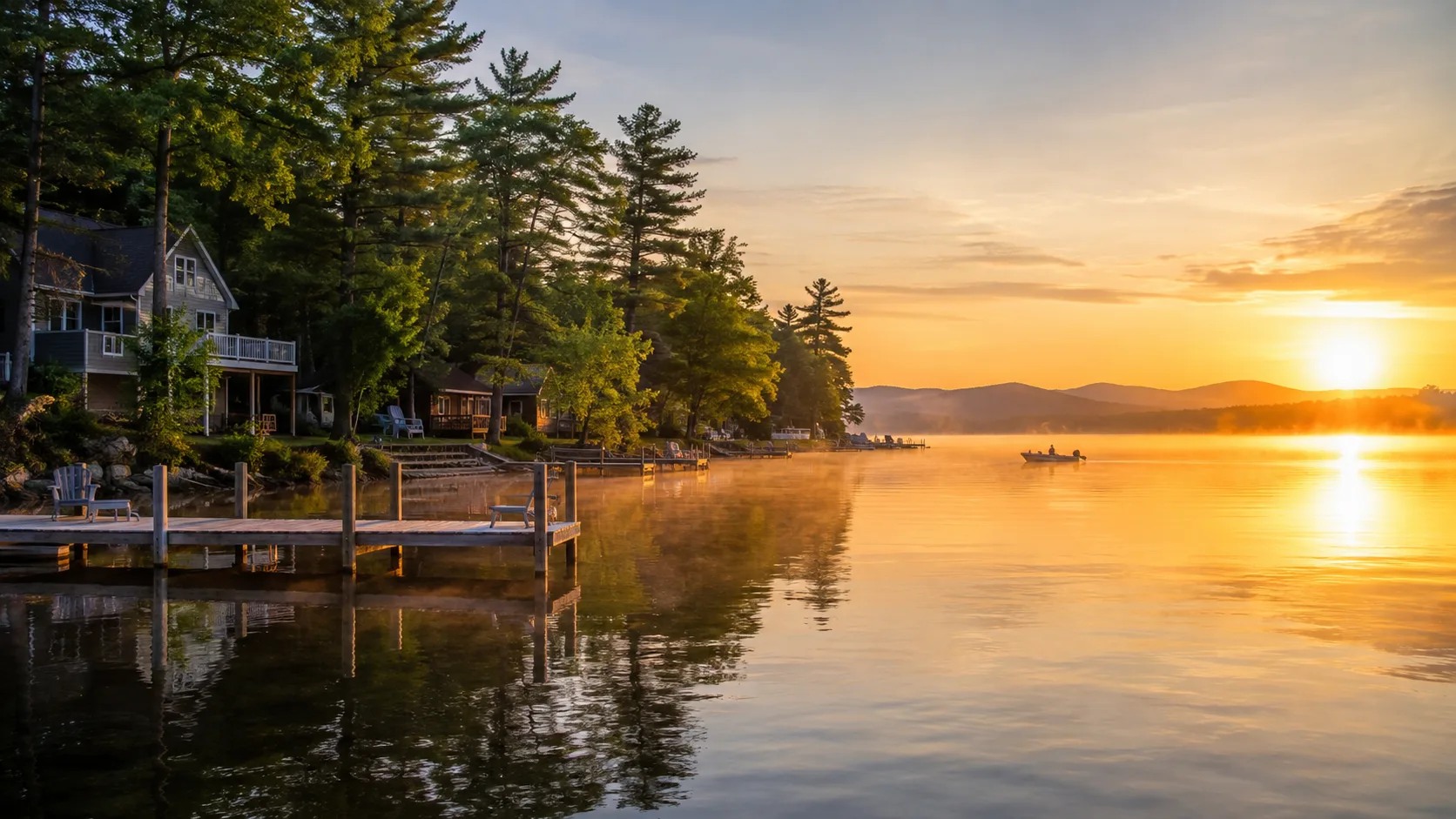

Lake Winnisquam is the lake local brokers recommend the most and get asked about the least — half an hour south of the White Mountains, straight down I-93 to exit 20 in Tilton, and visible before the coffee's finished. Buyers shop Winnipesaukee, Squam, and Newfound by name; Winnisquam they discover.
That's because Winnisquam has no marketing department. Winnipesaukee has Weirs Beach and the celebrity compounds. Squam has a movie. Newfound has the cleanest-water headlines. Winnisquam has 4,200-plus acres of genuinely big water, a shoreline shared by a small city and three towns you may never have heard of, and a price-per-foot that has historically run at a real discount to equivalent Winnipesaukee frontage ten minutes away. The buyers who figure this out tend to do it quietly and stop telling their friends.
So this is the guide I wish existed the first time a buyer asked me "what's the deal with Winnisquam?" Which shore belongs to which town — because that changes your tax bill more than most people believe. What the water is actually like, including the remarkable comeback story almost nobody outside the watershed knows. What's really for sale as I write this in August 2026, from a $275,000 association condo to a $3.5 million point. And the honest trade-offs, because there are some. If you just want the live inventory, the Lake Winnisquam area page has everything currently listed on and around the lake.
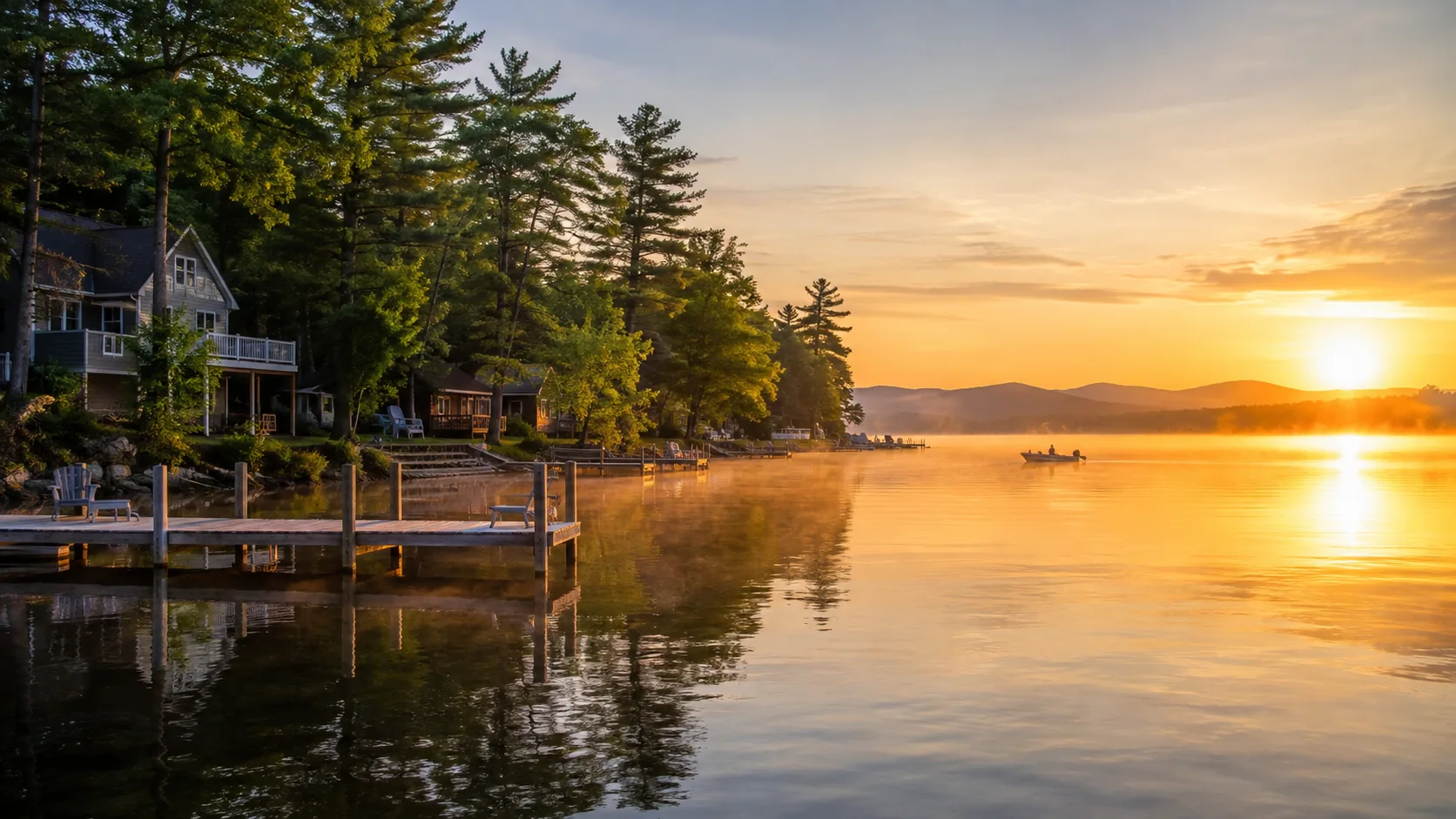
What Winnisquam actually is
Start with the map, because Winnisquam confuses people who think they know the Lakes Region.
The lake runs about ten and a half miles long and a mile and a half wide, covering roughly 4,214 acres — 4,237 by the watershed network's measure — with around 28 miles of shoreline and water that reaches about 170 feet deep. That makes it the fourth-largest lake in New Hampshire by the usual count, behind Winnipesaukee, Umbagog, and Squam — and since Umbagog splits itself with Maine, you'll hear locals call Winnisquam the third-largest lake entirely inside the state. Both are true. Either way, this is big water: deep enough for a coldwater fishery, long enough that the north end and the south end feel like different lakes.
Winnisquam is also plumbing, in the best sense. It sits in the middle of the Winnipesaukee River system: water leaves the big lake at Paugus Bay in Laconia, runs through Lake Opechee and the old mill district, enters Winnisquam on the Laconia shore, and exits at the southern tip in Tilton on its way to Franklin, where it joins the Pemigewasset to form the Merrimack. Practically, that means Winnisquam shares Winnipesaukee's neighborhood — the same hospital, the same marinas and restaurants and grocery runs, most of them ten or fifteen minutes from any point on the shore — without sharing its price structure. That's the entire pitch, and I made the same case when I ranked it fourth in my best lakes in New Hampshire rundown: Winnipesaukee's location without Winnipesaukee's premium.
Five municipalities touch the water: the city of Laconia along the busy eastern shore, Belmont on the southeast, Sanbornton holding essentially the entire quiet western shore, Tilton wrapping the southern end, and Meredith clipping the northern tip. At the narrows near the south end, Route 3 crosses the lake on what everyone here calls the Mosquito Bridge — the nickname goes back to a humped wooden bridge from the 1800s that locals thought looked like a mosquito's back — and the little village of Winnisquam around it manages to sit in three towns at once. Remember that image, because "which side of an invisible line is this house on" is about to become the most financially important question in this guide.
The comeback nobody talks about
Here's the piece of Winnisquam history I think every buyer should know, partly because it's a great story and partly because it explains what you're buying.
Fifty years ago, this lake was in trouble. Laconia's wastewater ran into the system for decades, and by the 1960s and 70s Winnisquam was the poster child for what nutrient pollution does to a lake — fish kills, algae blooms, odors, and beach closures were regular occurrences, and for years the blooms were controlled by dumping massive quantities of copper sulfate off boats and mixing it in with the propellers. That's not a detail from a pamphlet; older folks around the lake remember it.
Then the region did something almost no one does: it fixed the problem at the source. A citizens' group called the Lakes Region Clean Waters Association pushed the state into what became the Winnipesaukee River Basin Program — a regional sewer system, built out through the 1970s and 80s, that took wastewater from ten communities around Winnipesaukee and Winnisquam and piped it away to treatment in Franklin. The lake responded the way deep, well-flushed lakes do when you stop feeding them phosphorus: it recovered. Today the state's watershed plan describes Winnisquam as having better-than-average clarity and low phosphorus, and the salmon and trout fishery in that deep, cold water is one of the better ones in the state.
Two buyer-relevant consequences. First — and this is a genuine, underrated Winnisquam advantage — a meaningful share of the developed shoreline sits on municipal sewer because of that basin project. On most New Hampshire lakes, the scary line item on an old waterfront camp is the septic system; around Winnisquam, I regularly show waterfront homes where the answer is "town sewer," which removes a five-figure risk from the deal. Verify it property by property, but it's common here in a way it simply isn't on Newfound or Squam.
Second, honesty requires the current chapter: the lake's cleanup is a maintenance job, not a finished one. The Winnisquam Watershed Network — the lake's watchdog since 2019 — has documented cyanobacteria blooms four summers running, 2022 through 2025, driven by stormwater and runoff rather than sewage this time, and it's now executing the 2022 watershed plan's fixes site by site. The most recent event, a July 2025 bloom near the Belmont shoreline, stayed a localized single-spot report rather than a lakewide warning, and as I write this in mid-August 2026 the state hasn't posted a Winnisquam advisory this season. You can check the live status any day on NHDES's Healthy Swimming Mapper — a habit I'd build wherever you buy on any lake in this state. This is a lived-on, worked-on lake — good and stable rather than Newfound-pristine, as I put it in the best-lakes piece — and the people watching it are serious. As a broker I'd rather sell you a lake with an active watershed association and an honest data record than one running on reputation.
Four towns, four tax bills
Now the section that makes this guide worth your time, because no listing portal will lay it out for you: Winnisquam is one lake in four (and a bit) municipalities, and the town line your driveway sits on changes your carrying costs, your services, and the kind of property you'll find.
The 2025 tax rates, as set by the state Department of Revenue Administration and compiled town by town: Tilton at $11.29 per thousand of assessed value, Laconia at $12.98, Sanbornton at $13.21, and Belmont at $17.39 after a 10.5 percent jump that made local headlines. The statewide average is $17.10. Two caveats before you build a spreadsheet on those numbers: rates only mean anything against that specific town's assessments — a low rate on full-value assessments can cost more than a high rate on stale ones — and every one of these numbers resets each fall. I walk through how the whole system works in my New Hampshire property taxes guide. But the spread is real, and I see it in actual tax bills on actual waterfront listings every week: as I write this, a $1.2 million waterfront home on the Belmont shore carries a tax bill just under $21,000, while a $2 million waterfront condo across the lake in Tilton pays about $17,500. Same water. Read that again.
Here's how the four shores actually differ:
Laconia — the eastern shore
Laconia is a small city of about 17,000 wrapped around three lakes — Winnisquam, Opechee, and Winnipesaukee's Paugus Bay — and its Winnisquam shoreline runs along the eastern side, from the old state school lands down toward Belmont. This is where the services are: the hospital, the supermarkets, the year-round economy. It's also where the lake's most valuable frontage sits, on the west-facing roads off Eastman Shore and Shore Drive that get the long sunset light across the water. Laconia carries far more inventory than the other three towns combined — 158 active residential listings as I write this — and it's the only Winnisquam town with a real condo market. If you want to weigh Laconia's Winnisquam side against its Winnipesaukee side, my Lake Winnipesaukee buying guide covers the big lake town by town — and I wrote a full guide to living in Laconia that covers the city itself, schools to Motorcycle Week.
Sanbornton — the western shore
Sanbornton owns nearly the entire western shore, and it's the quiet side — no commercial strip, no through-traffic, just Lower Bay Road and Upper Bay Road winding along the water past a mix of old family camps and serious rebuilt year-round homes. The town itself is rural New Hampshire: about 3,000 people, a historic town square up in the hills, dirt roads, no downtown to speak of. You trade convenience for peace — most errands mean crossing the bridge into Tilton or driving up to Laconia — and Sanbornton buyers consider that the whole point. The western shore also faces east, which means sunrise over the water and softer afternoon light; some buyers care about that more than they expect to. This is where Winnisquam's family-camp inheritance stories live — as I write this, one of the listings on this shore is a camp held by the same family for more than sixty years, asking $1.2 million with about 100 feet of owned frontage.
Tilton — the southern end
Tilton holds the southern tip, where the lake narrows and empties into the river, and it's the convenience play. Exit 20 off I-93 lands here, the Tanger outlet mall and the Route 3 retail strip are minutes away, and Concord is about twenty-five minutes down the highway — which makes the Tilton end the closest big-lake waterfront to Boston-commutable New Hampshire that I can name. The trade-off is aesthetic and audible: the Route 3/Route 11 corridor near the lake's south end is a genuine commercial strip, and the waterfront here sits closer to road noise and traffic than anywhere else on the lake. In exchange, Tilton delivers the lake's most attainable water: its 2025 tax rate is the lowest of the four towns, and the current entry point to actual Winnisquam frontage — a $275,000 one-bedroom association condo with direct lake access — is on this shore.
Belmont — the southeastern shore
Belmont's piece runs along the southeast, roughly from the Laconia line to the Mosquito Bridge, and it's the most residential stretch of the lake — established waterfront neighborhoods like Mallards Landing, lake-access associations up the hillside, and the paved Lake Winnisquam Scenic Trail running along the shore (more on that below). Belmont town itself, away from the water, is working-class and unpretentious, with some of the region's most affordable housing stock — the town's median list price right now is $500,000, the second-lowest of the four. The honest asterisk is that 2025 tax rate: at $17.39 after a double-digit jump, Belmont currently carries the highest rate on the lake by a wide margin, and buyers comparing two similar waterfront homes across the Belmont–Laconia line need to run that math with open eyes.
And Meredith? It touches the lake's northern tip, and every few years something lists on that short stretch of shore — three Meredith listings mention Winnisquam as I write this, none of them waterfront — but Meredith's real estate story is a Winnipesaukee story. Treat it as a footnote here.
What's actually for sale
Numbers, dated, because undated lake-market numbers are worthless. Everything below is from the MLS as I write this in mid-August 2026.
Across the four core towns there are 236 active residential listings: 158 in Laconia, 44 in Belmont, 18 in Sanbornton, 16 in Tilton. Median asking prices tell the town story in one line each — Tilton $410,000, Belmont $500,000, Sanbornton $599,000, Laconia $600,000. About 38 of those listings carry a waterfront flag, but here's the diligence point that justifies working with someone local: most of Laconia's "waterfront" is on Winnipesaukee, Paugus Bay, or Opechee, and some of what's flagged in the other towns fronts rivers and brooks. Strip it down to true Lake Winnisquam frontage — your deed touching this lake, or a deeded dock on it — and the real count today is about a dozen listings. That's the actual market.
Here's the full spread of those dozen, because it's genuinely instructive. The floor is that $275,000 one-bedroom association condo in Tilton with shared frontage. From there: a $425,000 lake-view condo, a $600,000 one-level home in Belmont's Mallards Landing, and — the sweet spot of the whole lake, in my opinion — an $810,000 renovated 2013 ranch in Tilton with three bedrooms and about an acre of private waterfront. The million-to-$1.5 million band buys real frontage with real docks: the sixty-year family camp in Sanbornton at $1.2 million, a Belmont house with 106 feet of frontage and a 72-foot dock at $1.195 million, a Sanbornton contemporary on town sewer at $1.33 million. The top tier runs from a $2 million Tilton condo and a $2 million Belmont house with a 40-foot dock and permitted mooring, through a $2.4 million Laconia home with a private sandy beach and an L-shaped dock — three days on the market as I type this — up to the current ceiling: a former inn in Sanbornton with 250 feet of frontage at $3 million, and a $3.5 million west-facing sanctuary on the Laconia shore.
Read that spread against the trophy lakes and you see why I keep saying Winnisquam is the practical pick. On Winnipesaukee, $2.4 million is a mid-market waterfront ask; here it buys one of the two or three best properties on the lake. And the character of the stock is different — Winnisquam waterfront skews toward ranches, capes, and rebuilt camps with docks rather than gated compounds, and toward year-round homes rather than twelve-week estates. This is a lake people actually live on: the commute to Concord works, the I-93 run to Boston is about an hour and forty-five minutes, and the school-year population doesn't evaporate on Labor Day.
Below the waterfront tier sits the same structure I describe on every lake: water-access homes with deeded or association rights to shared frontage — Winnisquam has a healthy stock of these in Belmont and Tilton's lake associations, often in the $300,000s to $500,000s — and near-lake homes with no rights but five minutes to a public launch. The difference between waterfront and water-access is the most expensive vocabulary lesson in New Hampshire real estate, and I wrote the whole rulebook — deeds, docks, and the Shoreland Act — in my Lakes Region waterfront guide. Short version for Winnisquam: the state's shoreland rules govern the first 250 feet from the water here like everywhere else, docks need state permits, and the one local mercy is that municipal sewer takes the septic terror out of more deals here than on any other lake I work.
Getting on the water
For a lake with almost no commercial shoreline, Winnisquam's public access is better than people assume — different in kind from Winnipesaukee's, and worth understanding before you buy.
The headline is Ahern State Park, 128 acres of former state-school land on the Laconia shore with 3,500 feet of natural shoreline, small sandy beaches, and a network of wooded hiking and mountain-biking trails. It's unstaffed, free, and genuinely lovely — and it's also the honest ceiling on public swimming here. Winnisquam has no Ellacoya, no Wellington, no big staffed state beach with lifeguards and a snack bar. If a formal family beach day is central to your lake life, that's a real difference between this lake and its neighbors, and you should know it going in.
Boats are a different story — access is easy. There's a state ramp on the Belmont side, a public launch by the Mosquito Bridge at the south end, and Winnisquam Marine in Belmont runs a full-service marina and rental operation, so getting a boat wet is never the problem it is on Squam. The lake absorbs traffic well for its size, but I'll be straight about summer weekends: this is a motorboat lake in the middle of the Lakes Region in July — expect wake boats and jet skis off the sandbar areas on Saturday afternoons, and plan your kayaking for mornings. It's nothing like Winnipesaukee's weekend armada, and it's nothing like Squam's silence either. It's in between, which is what the price is too.
The fishery is one of the state's quiet standouts. All that deep, cold, recovered water holds lake trout, rainbow trout, and landlocked salmon — Fish and Game manages Winnisquam as one of its large-lake coldwater fisheries with annual stocking — plus smallmouth, largemouth, and white perch along the structure. Winter puts a bob-house village out over the deep holes, and the accessible fishing pier near the launch is busy from ice-out on.
And then there's the trail, which has become Winnisquam's signature amenity in the last decade: the paved Lake Winnisquam Scenic Trail hugs the Belmont shore and connects north into Laconia's WOW Trail, giving you about four and a half continuous paved miles of shoreline biking and walking. The grand plan is a connected regional trail running south through Tilton to meet the completed Winnipesaukee River Trail in Tilton and Franklin — but be clear-eyed about the state of it: the next Belmont segment south is still in the grants-and-design stage as I write this, and roughly five unbuilt miles separate the two finished sections. Buy the trail that exists, not the one on the planning maps. What exists is plenty: on a September morning it might be the best flat bike ride in the Lakes Region, and homes with direct trail access have started quietly trading on it.
Who Winnisquam suits
My honest sorting test, same as I'd give you across a desk.
Winnisquam is right for you if you want big, deep, usable water and a real life around it — a year-round house you can commute from, a grocery store ten minutes away, a dock with a boat that can run six miles before turning around — and you'd rather put the six-figure difference versus Winnipesaukee into the house instead of the address. It's the first lake I say out loud to first-time lake buyers with real-world budgets, and it's the lake I point to when someone asks where Lakes Region resale strength meets a sane entry price. It also suits the tax-sensitive buyer willing to do homework, because the four-town spread means the same lakefront lifestyle carries meaningfully different carrying costs depending on which shore you choose. And if your second-home math includes ski season, Gunstock is an easy half hour east — a lake-summer, ski-winter combination I priced out across the region in my ski towns for a second home piece.
It's wrong for you if you need pristine-wilderness water and silence — that's Newfound, twenty-five minutes northwest, and I'll happily make that case too. It's wrong if your lake life requires restaurants by boat and a social sandbar scene at scale — that's Winnipesaukee. And if the Route 3 corridor's commercial energy at the Tilton end would grate on you, shop the Sanbornton shore or don't shop this lake; I'd rather lose a sale than have you discover the outlet-mall traffic in your second August.
Questions I get about Winnisquam
The short versions of the conversations I have across the desk, for the people who scrolled here first.
How big is Lake Winnisquam?
About 4,200 acres — ten and a half miles long, a mile and a half across, up to 170 feet deep, with roughly 28 miles of shoreline. That makes it New Hampshire's fourth-largest lake by the usual count, and the third-largest sitting entirely inside the state. It is genuinely big water; a pontoon cruise from the Mosquito Bridge to the northern tip and back fills an afternoon.
Is Lake Winnisquam clean?
Cleaner than its history and cleaner than most people assume. The state's watershed plan rates the water better-than-average for clarity with low phosphorus, and the deep basin holds a cold-water trout and salmon fishery — a decent proxy for water quality all by itself. The honest footnote is the recent cyanobacteria record: documented blooms each summer from 2022 through 2025, mostly localized, none so far in 2026 as I write this. Check NHDES's Healthy Swimming Mapper on any given day, the same as you should on every lake in the state.
Can you swim in Lake Winnisquam?
Yes — people swim off their docks all summer, and Ahern State Park on the Laconia shore has small natural sandy beaches with 3,500 feet of shoreline. What Winnisquam doesn't have is a big staffed state beach with lifeguards; if that's the center of your lake life, Winnipesaukee's Ellacoya is the nearby answer. Same advisory habit applies: glance at the state's swimming mapper before a beach day.
What towns are on Lake Winnisquam?
Five municipalities touch the water: Laconia on the busy eastern shore, Sanbornton holding the quiet western shore, Belmont on the southeast, Tilton at the southern end, and a sliver of Meredith at the northern tip. The town line matters more here than on any lake I work — the 2025 tax-rate spread ran from $11.29 per thousand in Tilton to $17.39 in Belmont — so pick your shore before you pick your house.
How to buy here
The Winnisquam playbook is simpler than Squam's and faster than you'd like.
Pick your shore before you pick your house. East side for sunsets, services, and inventory; west side for quiet and sunrise; south for convenience and entry price; and check the tax rate the year you buy, not the year the blog post was written. The town line is worth real money here in both directions.
Move quickly on the good frontage. A dozen true waterfront listings is a thin market, and the well-priced ones do not wait around for second showings. Have financing fully underwritten, watch the current inventory closely, and set alerts so new listings in Laconia, Belmont, Sanbornton, and Tilton hit your inbox the day they land. Our property search covers all four towns, and I hear about Winnisquam properties before they list often enough that telling me exactly what you want is worth more than refreshing a portal.
Do the boring diligence anyway. Sewer or septic — confirm which, in writing, because the basin sewer line serves much of this shoreline but not all of it. Dock permits and mooring registrations. Deed language on anything sold as "lake access." Road noise at the south end, walked at 5 p.m. on a Friday, not noon on a Tuesday. None of it is complicated; all of it is decisive.
Winnisquam sits inside the broader Lakes Region market I work every week, and if you're still weighing it against the neighbors, that's a conversation I genuinely enjoy — it usually takes one afternoon and two shorelines to settle. The lake with no marketing department has been the right answer for more of my buyers than any trophy lake in the state. Come see it before everyone else finishes figuring that out. Call the office in Campton — I still answer my own phone.