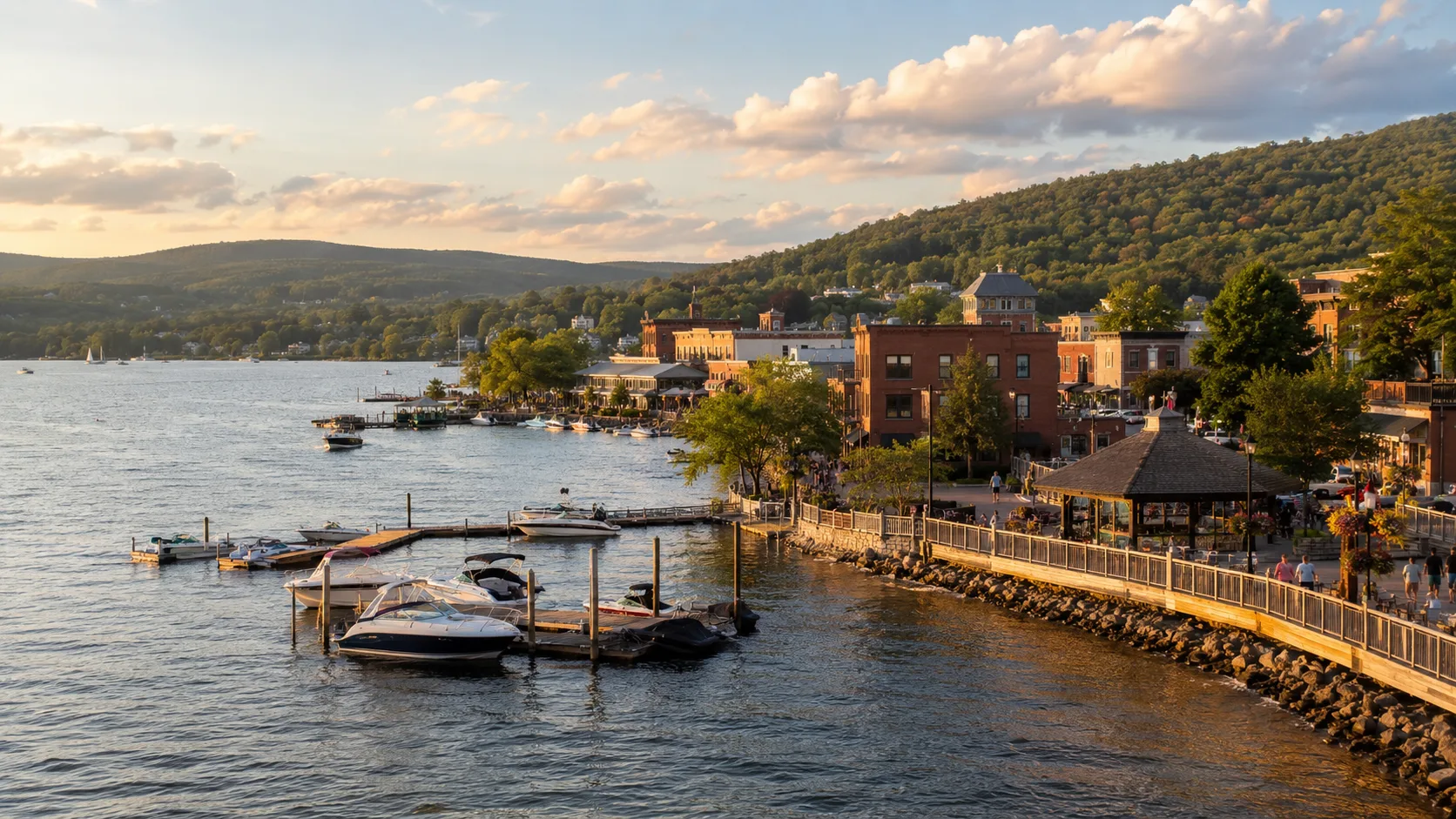

Living in Laconia NH is the question buyers reach after starting their search somewhere prettier and more expensive: they fall in love with the Lakes Region, price Meredith and Wolfeboro waterfront, do the arithmetic, and then ask — what about Laconia?
It's a fair question, because Laconia is the most misunderstood market in the region. It's the only actual city on Lake Winnipesaukee — about 17,000 people, the Belknap County seat, with a hospital, a downtown, a courthouse, and a school district, none of which the postcard towns can fully claim. It touches three lakes, not one. It contains both the rowdiest quarter-mile in New Hampshire (the Weirs boardwalk in June) and some of the quietest gated lake-access communities in the state. And it has, by a wide margin, the deepest and most varied inventory of homes for sale in the Winnipesaukee market — which is exactly why people searching Laconia homes for sale get more confused, not less, the longer they scroll.
So this is the conversation I'd have with you across a desk. Real prices from the market as I write this in August 2026, the neighborhoods one by one, the tax bill compared honestly to Gilford and Meredith, the biggest redevelopment story in the state happening right on North Main Street — and the trade-offs, because Laconia has real ones and pretending otherwise would waste your time and mine.
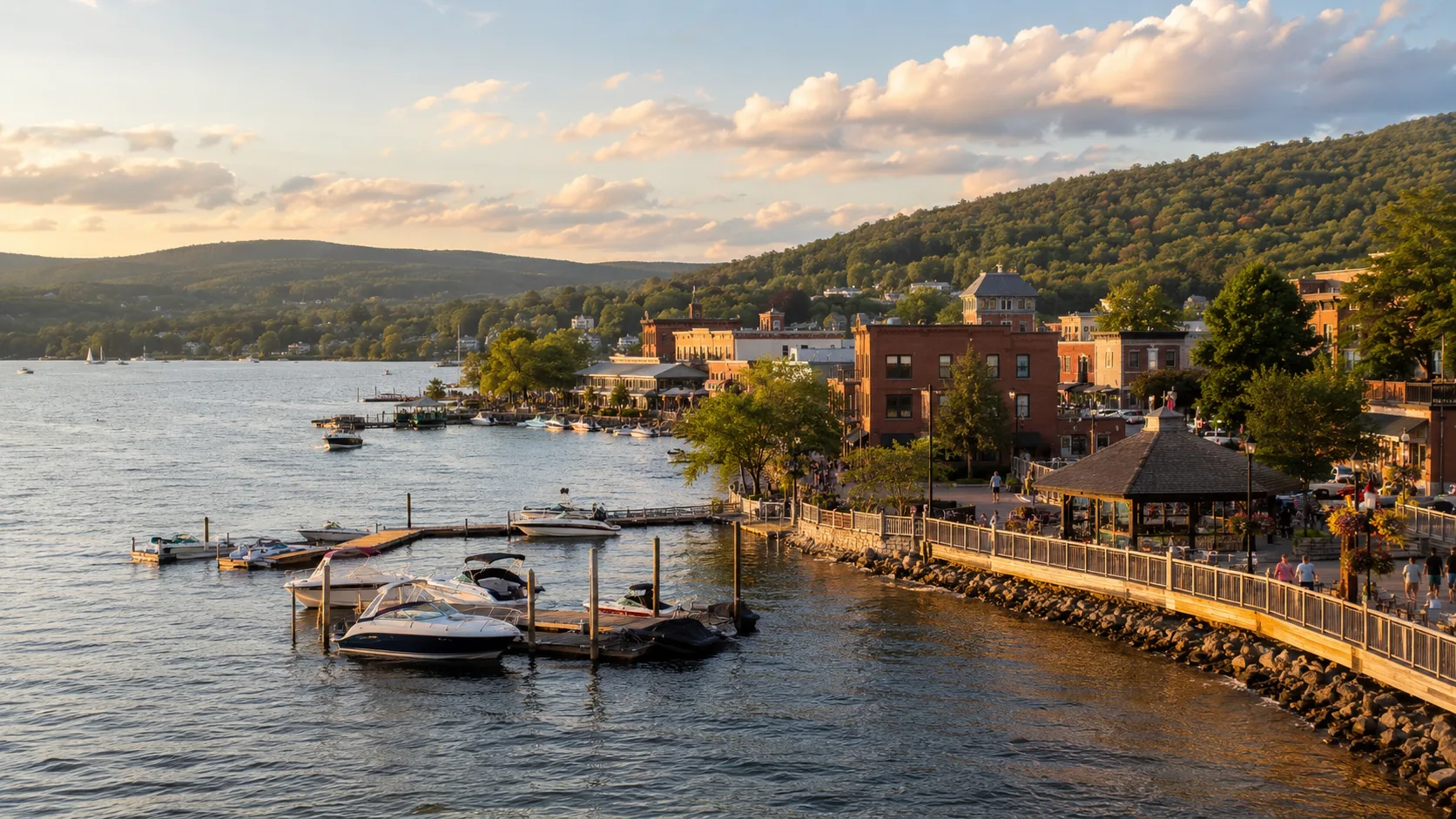
The city the Lakes Region actually runs on
Start with the geography, because it explains everything about the market. Laconia sits on the Winnipesaukee River between three bodies of water: Lake Winnipesaukee — via Paugus Bay and the Weirs Channel at the lake's southwestern corner — Lake Opechee in the middle of the city, and Lake Winnisquam along its western edge. The name itself is a nod to an old term for the "place of many lakes," and for once the branding is literal. You cannot drive across Laconia without crossing water.
That geography produced a city with distinct pieces rather than one continuous town. Downtown grew up around the mills on the river. Lakeport, at the bottom of Paugus Bay, was its own village and still feels like it. Weirs Beach, three miles north at the top of the bay, is a Victorian-era resort village with a boardwalk, arcades — including Funspot, which bills itself as the largest arcade in the world — the dock where the M/S Mount Washington ties up, and the greatest concentration of summer tourism anywhere on the lake. In between and around all of it: ordinary residential streets, mid-century neighborhoods, and, along the shorelines, everything from 1940s fishing camps to gated communities.
The practical upshot for a buyer is that "Laconia" on a listing tells you almost nothing by itself. A three-bedroom in Laconia can be a $250,000 walk-up condo in a converted building near downtown or a $1.4 million shingled house behind a gate on Paugus Bay. Same city, same tax rate, different planets. That's the thing this guide is really for.
What homes for sale in Laconia actually cost
I pulled these numbers from the MLS this week — August 2026 — and I'd encourage you to treat any article's price table, including mine, as a snapshot with a shelf life. For live data, run a property search filtered to Laconia.
As I write, there are just under 160 active residential listings in Laconia — by my count 158, roughly 86 single-family homes, 69 condos, and a few mobile homes. For scale, that's more inventory than Meredith and Moultonborough combined, and it's the deepest selection of any town on Winnipesaukee. The shape of it:
- The median asking price is right about $600,000. Single-family homes have a median around $669,000; condos around $549,000.
- The entry point is real. Thirty-eight listings — about a quarter of the market — are asking under $400,000, and sixteen are under $300,000. Nothing else on Winnipesaukee offers that. The floor is a pair of mobile homes off Weirs Boulevard in the $65,000–$79,000 range, and the cheapest conventional listing is a 1948 one-bedroom cottage of barely 200 square feet asking $199,000 — tiny, but it carries a waterfront flag, which tells you how compressed the low end of lake access has become.
- The top end is genuine luxury. Eighteen listings are at or above $1 million, topping out at a five-bedroom waterfront home asking just under $3.5 million. In between sits a 1960s three-bedroom of about 1,160 square feet asking $2.5 million — a number that makes no sense until you understand you're buying the frontage, not the house.
- The stock is older than the region's resort towns, but newer than you'd guess. Twenty-six active listings predate 1950 — that's the mill-city inheritance — but fifty-five were built in 2020 or later. A third of the current market is essentially new construction, which is not the Laconia most out-of-towners picture.
- Median days on market is 68. Correctly priced homes move in weeks; the lake premiums at the top end take longer to find their buyer.
One more data point worth calling out, because it captures where the city is heading: the single largest block of new inventory right now is a 16-unit condominium project in a 2023-built building at the edge of downtown, priced from about $360,000 for a one-bedroom up to about $810,000. Brand-new downtown condos at those numbers did not exist in Laconia ten years ago. Somebody is betting on this downtown, and they're not alone.
The neighborhoods, one by one
Downtown. The most changed part of the city. The restoration of the 1914 Colonial Theatre — a $15 million project that reopened in 2021 as a 750-seat venue — anchored a wave of reinvestment: restaurants, a brewery scene, new apartments and condos in old mill and Main Street buildings. It's still a working downtown, not a boutique one, and the housing stock immediately around it skews old — those 26 pre-1950 listings live disproportionately here — which means charm, and also knob-and-tube wiring, 100-year-old sills, and renovation budgets. Priced accordingly: this is where most of the sub-$300,000 market lives.
Lakeport. The old village at the foot of Paugus Bay, between Opechee and the big lake. It has its own square, its own identity, and a mix of vintage homes and newer infill — a 2022-built three-bedroom condo on the Opechee shore is asking $839,000 as I write. Lakeport is also a trailhead for the WOW Trail, the paved Winnipesaukee–Opechee–Winnisquam path that's slowly stitching the city's waterfronts together. Quietly one of my favorite pockets in the city.
Weirs Beach. The famous one. In July it's the busiest square mile in the Lakes Region — the boardwalk, the arcades, the cruise ships, the drive-in — and in January it's nearly silent. Housing here is a jumble: old cottage colonies (some converted to condos), a village condo association or two in the $550,000–$590,000 range, and small waterfront condos along Weirs Boulevard from the high $700,000s. Buyers either love the carnival energy or they don't; there's no faking it. If you're weighing a Weirs property as a rental play, keep reading — the zoning here actually works in your favor.
The Paugus Bay corridor. The west shore of Paugus Bay, between Lakeport and the Weirs, is where a lot of my buyer conversations end up, because it's the most affordable way to be near big-lake water. Right now that includes a three-bedroom, three-bath built in 2012 in a small community above the bay asking $659,000, its neighbor at $684,000, and a three-bedroom condo in a bayside association at $429,900. None of those are on the water — but the bay is at the end of the street, and marina slips are close.
South Down Shores and Long Bay. Laconia's quiet flex: two adjoining gated communities on roughly a mile of Paugus Bay shoreline — which is Winnipesaukee water — with private beaches, docks and association amenities. This is resort-style living with a Laconia address and a Laconia tax rate, and the market treats it as its own ecosystem. Today there are about fourteen active listings across the two: association condos from $359,000, single-family homes from $580,000, and the top of the range — newer construction and the Long Bay section — running $1.15 to $1.6 million. If your picture of Laconia was formed at a stoplight on Union Avenue, a drive through South Down recalibrates it fast.
Everywhere else. Rolling residential streets — mid-century capes and ranches, 1980s–2000s subdivisions, a 55+ manufactured-home community with listings around $319,000, and newer small developments in the $700,000–$900,000 range. This is the workhorse of the market, the part that functions like a normal city rather than a lake resort, and it's where most year-round families actually live.
Waterfront on three lakes
Here's the Laconia advantage nobody prices into their assumptions: three different lakes mean three different waterfront markets inside one town.
As I write there are 24 active waterfront listings in Laconia, ranging from that $199,000 micro-cottage to $3.5 million, with a median around $774,000. The spread is the story. Winnipesaukee frontage — Paugus Bay included — commands the premium it commands everywhere, and it's where the seven-figure listings cluster. But Lake Opechee and Lake Winnisquam offer genuine waterfront living at prices Winnipesaukee hasn't seen in a decade. Winnisquam is New Hampshire's fourth-largest lake in its own right — I'd argue it's one of the most underrated waters in the state, and I've made that case in our best lakes in New Hampshire rundown. Opechee is smaller and calmer, with Opechee Park and its town beach on the northern shore, and city convenience five minutes away. If you want to see how Laconia's waterfront pricing sits against the rest of the state, browse lakefront homes across New Hampshire side by side — the comparison is instructive.
If big-lake frontage is the goal, read our Lake Winnipesaukee home buying guide before you tour anything — and for the diligence that comes with any shorefront in this state (septic, docks, the Shoreland Act), our Lakes Region waterfront guide covers what I check on every waterfront deal. Laconia waterfront is subject to all the same state rules as the fancy towns; the water doesn't know what the tax rate is.
The tax bill, honestly
New Hampshire funds local government through property taxes, so the rate varies town by town and it belongs in your math from day one. Laconia's 2025 rate came in at $12.98 per $1,000 of assessed value. The neighbors people cross-shop: Gilford at $11.85 and Meredith at $10.62.
So yes — Laconia taxes are meaningfully higher than Gilford's and Meredith's, roughly 10 and 20 percent higher respectively on the rate, and on like-for-like waterfront the gap is real money every year. Two honest caveats, though. First, rates only mean anything alongside assessed values and each town's equalization ratio — a lower rate on higher assessments can wash out, so compare actual tax bills on actual properties, not rates in the abstract (the city posts current figures through its assessing office). Second, you're buying different things. Laconia's rate funds a city — full-time fire and police, a school district, water and sewer across most of the city, plowed sidewalks, a parks department with town beaches on all three lakes. Gilford and Meredith are wonderful towns; they are also towns, with town-scale services. Some buyers happily pay Laconia's extra point of tax to be five minutes from a hospital. I walk through how the whole New Hampshire system works — rates, ratios, the view-tax folklore — in my NH property taxes guide.
The trade-offs nobody puts in the brochure
I said I'd be straight about these, so here they are, in the order buyers actually raise them.
Motorcycle Week. Every June, Laconia hosts the country's oldest motorcycle rally — the 103rd running wrapped up this past June 13–21 — and for nine days the city, especially the Weirs, is loud, packed, and slow to drive through. Hundreds of thousands of riders pass through the region. Some locals love it, rent their driveways, and treat it like a holiday; others book their own vacations for that week and leave. If you're buying at or near the Weirs, there is no version of ownership that doesn't include Bike Week. Know thyself.
Summer at the Weirs generally. Even outside rally week, the Weirs and the Route 3 corridor congest from late June through Labor Day, and Bank of NH Pavilion concert nights (more on that venue below — it's in Gilford, just over the line) back traffic up along the lake roads. The rest of the city absorbs summer far more gracefully, but the tourist quarter is a tourist quarter.
The housing stock takes work. That deep sub-$400,000 market exists because a lot of Laconia housing is old mill-city fabric. Some of it has been beautifully redone; plenty hasn't. Budget for inspections like they matter, because here they do. On the flip side, this is precisely where the value lives — the same vintage house in Meredith costs more and the coffee is farther away.
The city has city problems. Laconia is a working community, and it carries the challenges that come with being the region's service hub — more visible poverty than the postcard towns, and the same substance-abuse struggles most of northern New England is working through, concentrated here because this is where the county's services are. It's also where the region's solutions live: Concord Hospital – Laconia and its behavioral-health programs are in this city because this city does the work. I won't pretend that reality away, and most Laconia residents wouldn't either — they'd just point out that their neighborhood block parties don't make the police log.
And the taxes, covered above. Higher than the neighbors. Priced into the market, but budget with your eyes open.
The State School site — the biggest wild card in the city
If you want a reason to believe Laconia's next decade looks different from its last one, drive past the former Laconia State School campus on North Main Street. It's a sprawling state-owned property — woods, fields, old institutional buildings — that the State of New Hampshire has been trying to redevelop for years. In 2024 the state selected Pillsbury Realty Development as the buyer at $10.5 million, and the master plan the developer has presented to the city is enormous: on the order of 2,050 housing units, a 125-room hotel, retail, recreation and civic space — effectively a new neighborhood grafted onto a city of 17,000.
I need to be careful here, because this story keeps moving. A suspicious fire destroyed one of the vacant buildings in June 2026, the developer asked the state to run an environmental assessment of the damage before closing, and the closing date has slid accordingly — first from midsummer, and now, per the latest reporting as I write in mid-August, to late October 2026, after Pillsbury exercised the first of its three 30-day extensions. The environmental report hadn't come back yet as of this writing, so treat any date you read — including that one — as penciled in. Nothing is built; the sale itself isn't done. Do not buy a house in Laconia because of this project. But do understand what it signals: the state's largest surplus property, a private developer's nine-figure vision, and a city that needs housing all pointing the same direction. If even half of the plan materializes over the next decade, it reshapes Laconia's housing supply, its school enrollment and its tax base. I know of no other Lakes Region town with anything comparable on the table.
What year-round life here is actually like
The buyers this city fits best are the ones who need the region to work, not just photograph well. The practical inventory:
Healthcare. Concord Hospital – Laconia (the former Lakes Region General) is a 137-bed hospital with a 24/7 emergency department, right in the city. In a region where some towns are 45 minutes from an ER, this is an underrated amenity — especially for retirees, who make up a growing share of my Laconia closings.
Schools. The Laconia School District runs three neighborhood elementary schools — Elm Street, Pleasant Street and Woodland Heights — plus Laconia Middle School and Laconia High School, which enrolls just under 600 students at a student–teacher ratio around 11 to 1. Small classes are the quiet upside of a city district this size. The genuine standout is the Huot Career and Technical Center on the high-school campus: it's the regional career-tech center, so students from the surrounding towns' districts travel to Laconia for its trades, health-science and culinary programs, not the other way around. I'll be straight with you the way I am about everything else: plenty of families cross-shop the Gilford and Inter-Lakes districts, and school reputation is one honest component of why Laconia is priced below its neighbors. Tour the schools yourself rather than outsourcing the verdict to a letter grade on a rankings site — I've had buyer families do exactly that and land on opposite conclusions, both correctly.
Getting to work. Concord is roughly 30–40 minutes down Route 106, Manchester about an hour, Boston a solid two hours-plus depending on the day. I'll be honest: there's no highway to Laconia — Route 106 and Route 3 are the arteries, and they're two-lane roads. Hybrid workers who go south two days a week find it very livable; daily Boston commuters mostly don't. If you're weighing a full relocation, my moving to New Hampshire guide covers the commuting math statewide.
Skiing. Gunstock Mountain — the county-owned ski area in Gilford with genuine Winnipesaukee views from the summit — is about 15 minutes from downtown. Season passes for a family, a real ski school, night skiing. It's the reason a Laconia address quietly works as a four-season base — and if skiing is the anchor of your search rather than the lakes, I've ranked the region's options in our best ski towns in New England guide.
Music. The Bank of NH Pavilion, just over the Gilford line, is a roughly 9,000-seat amphitheater that pulls genuinely national acts all summer. Locals develop strong logistical opinions about concert-night traffic and equally strong habits of sitting on their decks listening for free.
Daily life. The WOW Trail for morning runs, town beaches on Opechee and Winnisquam (Opechee Park and Bartlett Beach), Ahern State Park's shoreline trails, a downtown with a theater and enough restaurants that you're choosing rather than settling, and every errand — grocery, hardware, DMV, courthouse — inside city limits. The Lakes Region's ordinary infrastructure lives here, which is exactly why the extraordinary towns nearby can stay extraordinary.
Renting it out. Laconia is one of the more STR-practical towns on the lake — the city's ordinance permits short-term rentals outright in its Commercial Resort and Shorefront Residential zones (essentially the Weirs and the waterfront), with registration and parking/noise rules attached. But the rules just tightened, and you should know exactly how. In March 2026 the City Council adopted a zoning amendment — it passed 5–1 after months of planning-board back-and-forth — that removed short-term lodging from the Residential Single-Family zone entirely, roughly 20 percent of the city, while defining short-term lodging as stays under 28 consecutive days and adding performance standards and data-reporting requirements so the city can actually enforce what's on the books. Existing legal operators were protected, but if your plan depends on buying a non-waterfront neighborhood house and Airbnb-ing it, that door has largely closed — confirm how the current ordinance treats your specific address with the planning department before you write the offer, not after, because this fight isn't necessarily over. Buyers running the numbers on a Weirs Beach condo as a seasonal rental, on the other hand, still have one of the more defensible short-term-rental cases in the region — huge, reliable summer demand and zoning that anticipates it.
Questions I get about Laconia, answered straight
Is Laconia NH a good place to live?
For the right buyer, genuinely yes — and I say that as someone who sells in every town around it. You get lake access on three lakes, a hospital, a real downtown, a ski hill fifteen minutes out, and the lowest entry prices on Lake Winnipesaukee. The honest caveats are the ones covered above: higher taxes than Gilford or Meredith, older housing stock at the entry level, summer crowds at the Weirs, and the ordinary struggles of a working city. If you want the Lakes Region as a daily life rather than a view, Laconia is arguably the most livable town on the lake.
Why is Laconia cheaper than the rest of Lake Winnipesaukee?
Three reasons that compound. The housing stock skews older — it's a mill city, and a quarter of the market is asking under $400,000 partly because those homes need work. The tax rate is the highest of the Winnipesaukee towns, which gets capitalized into prices. And reputation lags reality — plenty of buyers still price Laconia off a memory from fifteen years ago, before the Colonial reopened and a third of today's inventory got built. The water, meanwhile, is the same water. That gap between perception and fact is exactly where value lives.
What does a house in Laconia cost right now?
As of August 2026, the median asking price across Laconia's 158 active residential listings is $599,900 — single-family homes around $669,000, condos around $549,000, with real inventory under $300,000 and a ceiling near $3.5 million on the waterfront. Those numbers age fast; the newest listings update daily if you want the live version.
Can I buy a house in Laconia and rent it short-term?
Depends entirely on the zone. Short-term rentals are permitted in the Commercial Resort and Shorefront Residential districts — the Weirs and most waterfront — which is where the defensible rental math lives anyway. As of the March 2026 ordinance change, short-term lodging is no longer permitted in the Residential Single-Family zone. Before you write an offer on a rental-dependent plan, have the planning department confirm the zoning on that specific parcel. I do this with clients as a matter of course.
Does Laconia have its own beaches?
Yes — city beaches on all three lakes: Weirs Beach on Winnipesaukee, Opechee Park on Opechee, and Bartlett Beach on Winnisquam. Residents don't need a lake house to live a lake life here, and that's a real budget strategy: buy the affordable inland house, use the town beaches, bank the difference. Our public beaches in New Hampshire guide covers the wider list.
Who Laconia fits
My honest sorting test. Laconia is right for you if you want the Lakes Region as a life rather than a photograph — lake access on three lakes, a real downtown, a hospital, a ski hill fifteen minutes away — and you'd rather put the money you save over Meredith or Gilford into the house, the boat, or your retirement. It's right for value buyers who understand that a market with a $199,000 entry point and a $3.5 million ceiling has more mispriced homes in it than any tidy resort town ever will. And it's right for anyone who finds the honest texture of a working New England city more appealing than a curated one.
It's wrong for you if silence is the whole point — buy in Sandwich or Moultonborough and I'll help you do it. It's wrong if Bike Week would ruin your June, and you're set on the Weirs. And it's wrong if you need pristine turnkey housing at the entry price point, because in Laconia the entry price point comes with a to-do list.
If you've been searching homes for sale in Laconia NH and trying to square the $250,000 listings with the $2.5 million ones, that's not a data error — that's the city. Call the office. I'll tell you which neighborhoods match your number, which streets I'd want a second inspection on, and which of the three lakes you should actually be looking at. The drive from my desk to Lakeport is thirty-five minutes, and I make it all the time.