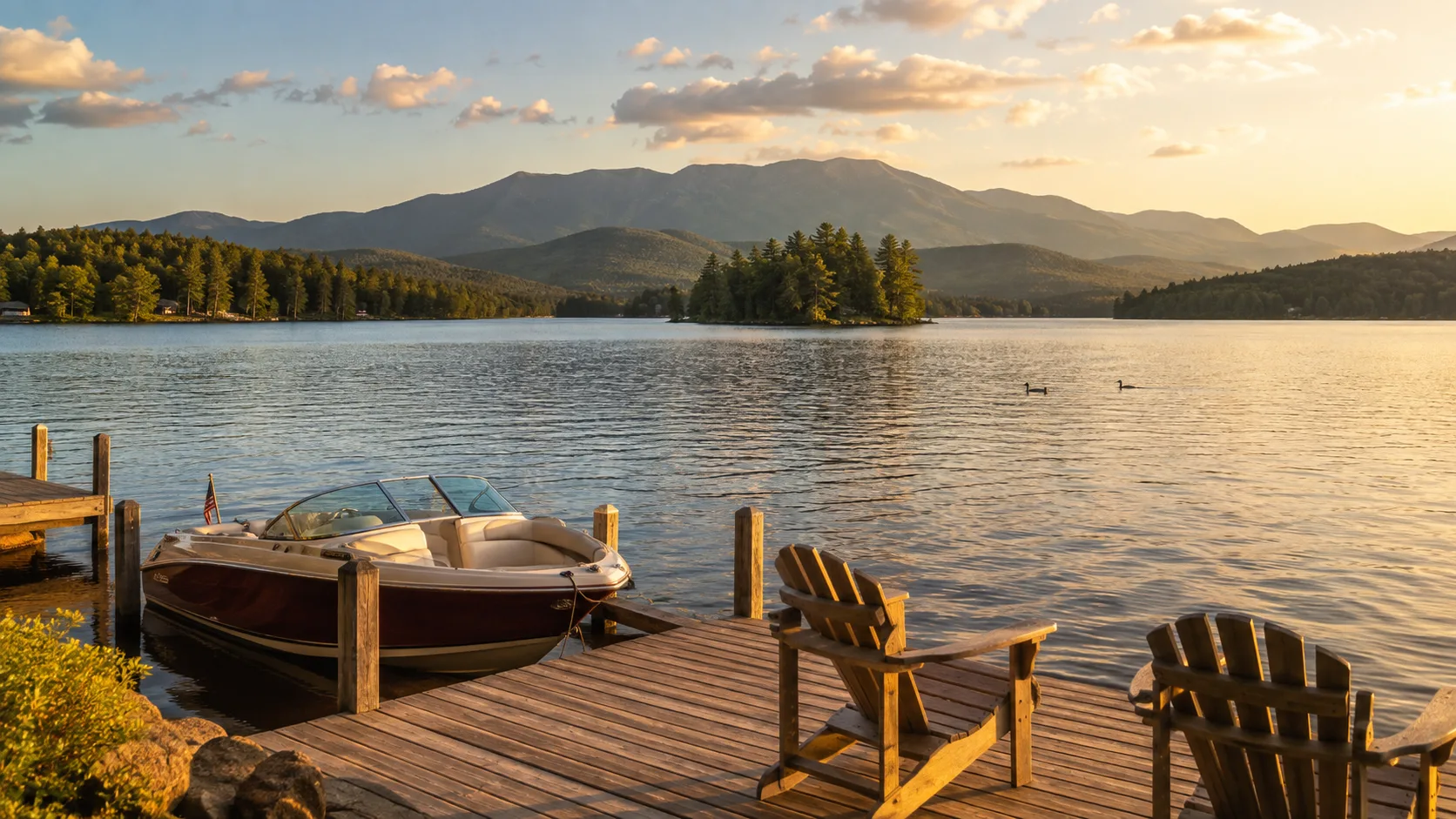

Houses for sale on Lake Winnipesaukee aren't one market — they're eight town markets, an island market, a condo market, and a dock market stacked on top of each other, and any guide that pretends otherwise is really a listing feed with an introduction. The lake sits thirty-five minutes from the White Mountains — down I-93 to exit 23, east on Route 104, into Meredith, where the bay opens up behind the mill buildings and the whole region's name suddenly makes sense. The companion guides to Squam and Newfound cover the quieter lakes; this one takes on the big water.
So this is the conversation worth having before spending a day driving the shore. Most people who search homes for sale on Lake Winnipesaukee are actually three decisions away from a useful search: which side of the lake, which tier of ownership, and which trade-offs they can live with. Get those right and the lake is generous — there is more inventory here, at more price points, than any other lake in New Hampshire — arguably more than the rest of them combined. Get them wrong and you'll spend a summer touring houses that were never really candidates.
If you just want to see what's on the water today, our Lake Winnipesaukee page has the live inventory, and the broader NH lake homes page covers every lake we work. For everyone else, here's the whole picture.
What Winnipesaukee actually is
The numbers first, because on this lake the numbers are the point. Winnipesaukee is the largest lake in New Hampshire at 72 square miles — roughly 21 miles long, 1 to 9 miles wide, with a maximum depth of 180 feet and more than 250 islands scattered across the water. Squam, the state's second-largest lake, would fit inside it seven times. Eight towns share the shore, plus a scatter of named villages — Weirs Beach, Alton Bay, Melvin Village — inside them.
That scale changes the character completely. Winnipesaukee has everything the small lakes deliberately don't: marinas, yacht clubs, restaurants you can reach by boat, the honky-tonk boardwalk at Weirs Beach, the M/S Mount Washington steaming between ports all summer, and a weekend boating scene that ranges from kayaks in a quiet Tuftonboro cove to a raft-up of cruisers off Braun Bay. It is a big, social, fully-serviced lake — and it's also, in its northeastern reaches, as quiet as anywhere in the state. Both things are true, sometimes within the same mile of shoreline, which is exactly why the town you choose matters more here than on any other lake I sell.
The other thing scale buys you is a real market. On Squam, a handful of waterfront sales is a normal year. On Winnipesaukee, as I write this, there are roughly 480 active residential listings across the eight shore towns I track, about 80 of them carrying a waterfront flag — and that's before you count the condos, the island camps, and the deeded boat slips that trade as real estate in their own right. Inventory exists here. The work is choosing well.
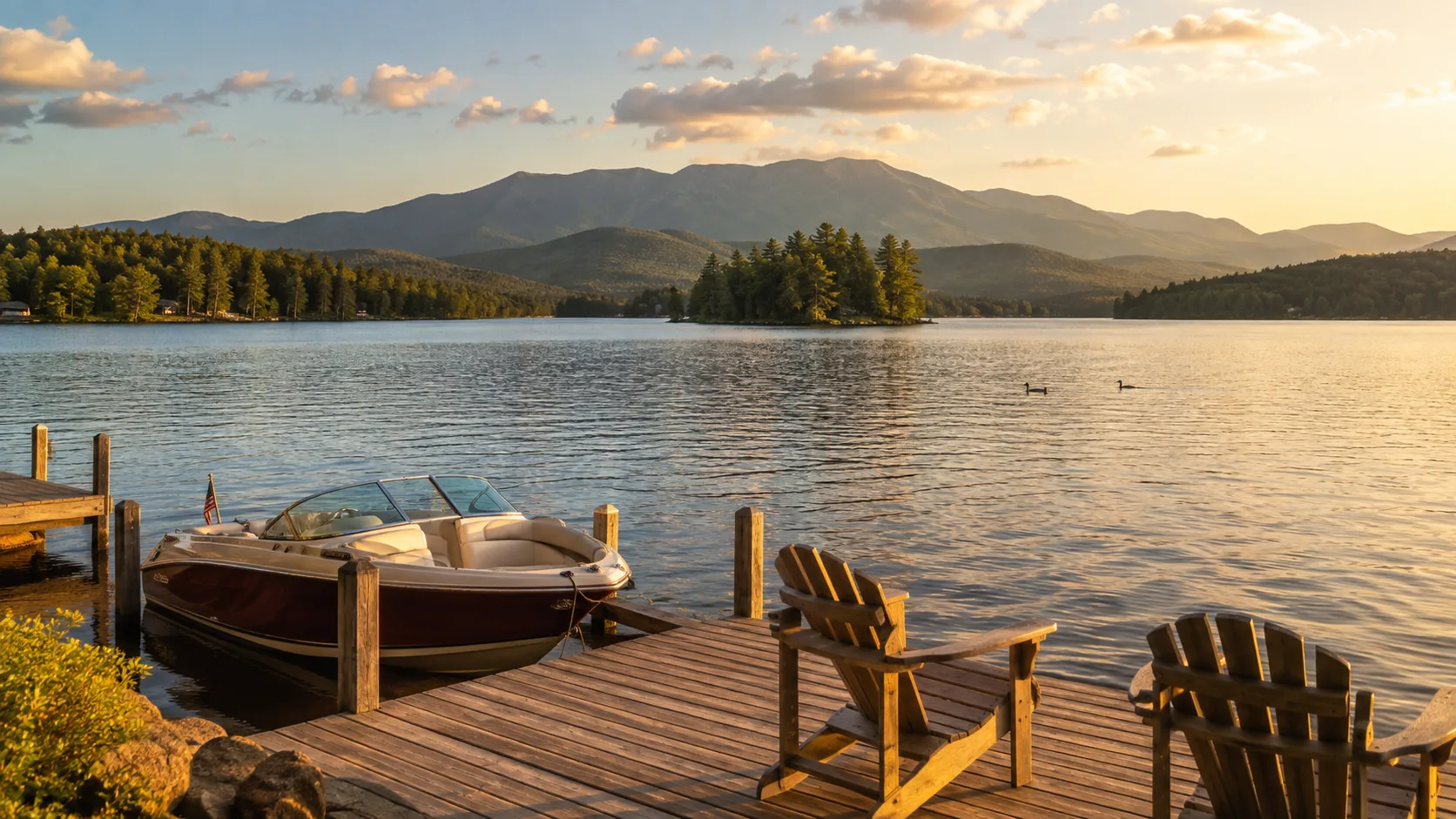
The eight towns around the lake
Going clockwise from the northwest corner. These are genuinely different markets — different tax rates, different services, different buyers — and "which town" is the first question I ask anyone who calls about homes for sale on Lake Winnipesaukee NH.
Meredith
The lake's front porch, and where most out-of-state buyers start. Meredith has a real walkable downtown wrapped around Meredith Bay — the Mill Falls complex, restaurants, a town docks scene in summer — plus year-round services and quick highway access, about two hours from Boston. The waterfront stock runs from village-adjacent condos to serious bay-front homes, and the town also holds Lake Waukewan and a piece of Winnisquam, so read listings carefully: "waterfront" in Meredith doesn't automatically mean Winnipesaukee. Inventory is steady but competitive; Meredith trades on convenience and charm, and it's priced like it.
Center Harbor
The smallest market on the lake by a wide margin — a village at the head of the bay between Winnipesaukee and Squam, with a general-store-and-town-docks kind of center. As I write this there are seven active residential listings in the whole town. When something good comes up in Center Harbor, it tends to be gone before the casual shopper notices, which makes it a town for alert-driven buyers, not browsers.
Moultonborough
The one everyone asks about, for one famous reason I'll cover properly in the tax section below. Beyond the tax rate, Moultonborough holds an enormous share of the lake's best frontage — long, quiet, rural shoreline with almost no commercial strip — plus bridged Long Island and a big slice of the island market. It's a second-home town at heart: fewer services, more shoreline. In my current data it has one of the highest waterfront shares of any shore town — roughly a third of its active residential listings carry a waterfront flag, against about one in six across the lake as a whole.
Tuftonboro
The quiet-money northeast corner — Melvin Village, low-key coves, no downtown to speak of, and some of the most beautiful protected water on the lake. Tuftonboro's property tax rate has also historically been among the lowest in the state, though rates reset every fall, so confirm the current number with the town before you build it into your math. This is where the lake's discreet high end lives: as I write this, the most expensive active listing in all eight shore towns is a Tuftonboro waterfront asking just under $13 million.
Wolfeboro
America's oldest summer resort — the claim dates to 1769, when colonial governor John Wentworth built his summer estate here — and the only town on the lake with a genuine, thriving, year-round downtown right on the water. Wolfeboro is the east side's anchor: shops, restaurants, a town beach, Brewster Academy on the shore, and a deep bench of both classic waterfront estates and in-town homes. If your ideal lake life includes walking to dinner and a bookstore, Wolfeboro is probably your town, and you'll pay the premium that implies.
Alton
The southern tip, where Alton Bay runs a long narrow arm down to a little seasonal boardwalk community. Alton is the value-conscious buyer's side of the lake — generally more house for the money than the north shore — and it's also the mainland gateway to Rattlesnake Island, the lake's famous boat-access camp colony. One caveat on search results: Alton also contains Merrymeeting Lake, a lovely small lake in its own right, so an Alton "waterfront" listing needs a second look at which water it's on.
Gilford
The southwest shore under the Belknap range — Gunstock ski area is in town, which makes Gilford the best genuine four-season play on the lake. It holds Governors Island, the lake's premier bridged-island address, plus town beach rights that residents genuinely use, and a broad mix of association developments and standalone waterfront. Gilford is where I send buyers who want the boat in July and the chairlift in January without two separate properties.
Laconia
The only city on the lake, and by far the deepest inventory pool — as I write this, Laconia alone holds about a third of the active residential listings in the eight shore towns. It's also the most complicated town to search: Laconia touches Winnipesaukee at Weirs Beach and Paugus Bay, but it also fronts Lake Opechee and Lake Winnisquam, and the big gated communities like South Down Shores and Long Bay sit on association land with their own beaches, docks, and fee structures. Laconia is where the lake's attainable end lives — condos, association homes, and the occasional true-waterfront value — and where reading the listing carefully matters most. Motorcycle Week every June is either a feature or a bug; decide which before you buy near the Weirs.
Houses on Lake Winnipesaukee: waterfront, water-access, condo, or island
Strip away the town differences and Winnipesaukee ownership comes in four tiers. Listings blur them constantly; prices don't.
True waterfront. Your deed runs to the water, you control your frontage, and you have — or can pursue — your own dock. This is the headline product — Lake Winnipesaukee waterfront homes for sale span an astonishing range: as I write this, waterfront-flagged residential listings across the shore towns run from under $200,000 (a flag that usually means association frontage, a seasonal camp, or one of the towns' smaller lakes) to that $12.9 million Tuftonboro estate, with the median asking price sitting right around $1.1 million. Roughly half the waterfront-flagged listings ask under $1 million; about a quarter ask $3 million or more. Two markets, one flag — which is why the flag alone is never enough.
Water-access. A home near the lake whose deed or association carries legal rights to shared frontage — a community beach, a day dock, sometimes a slip or mooring field. This is the workhorse tier on Winnipesaukee, far more developed than on the small lakes, and quality varies enormously. A South Down Shores home with a deeded slip is a fundamentally different asset from a cottage with a fifty-foot right-of-way to a shared strip of shore. I read the association documents and the actual deed language on every one of these before a buyer of mine writes an offer, because the difference between "beach rights" and "boat rights" can be several hundred thousand dollars of value.
Condos. Winnipesaukee has a real condo market — the only NH lake that does at scale. As I write this there are well over a hundred active condo listings in the shore towns, with a median asking price just under $600,000, running from modest Laconia units to luxury waterfront townhomes with deeded docks. For buyers who want the lake without the septic system, the plow contract, and the dock maintenance, this tier is honestly underrated — and it's the natural rental-friendly tier too, subject to each association's rules.
Island. Covered properly below, because it's a different purchase entirely.
The Moultonborough tax question
Every Winnipesaukee buyer hears about it eventually, so here it is straight. New Hampshire funds local government through property taxes, rates vary town by town, and Moultonborough's is famously low — the 2025 rate is $5.33 per $1,000 of assessed value, down from $5.65 the year before, against a town tax base now valued at nearly $6.9 billion. The mechanism is no mystery: an enormous base of high-value waterfront paired with a small-town budget and no city services to fund. On a $1.5 million lake house, the difference between Moultonborough's rate and a rate in the high teens elsewhere in the state is real money every single year, and plenty of buyers let it steer them to the north shore.
My advice is to treat the tax rate as a tiebreaker, not a strategy. Three reasons. First, rates reset every fall when the state sets them, so the number you underwrite today is not a promise. Second, low-rate towns are low-service towns — that's the trade — and whether that suits you depends on how you'll actually use the house. Third, assessments do the other half of the work: a low rate on a high assessment can cost more than a middling rate on a modest one, waterfront is assessed as waterfront, and the view is part of the market value your assessment reflects. And if you're looking at a property with significant acreage, ask the town's assessing office whether any of the land is enrolled in current use taxation before you plan to build on it — taking enrolled land out of the program triggers a change-of-use tax bill, and it lands on the buyer who changes the use. I walk through how all of this works statewide in my NH property taxes guide.
The rules that come with the water
New Hampshire wraps every big lake in the same regulatory framework, and Winnipesaukee buyers need the short course before they fall in love with anything. The controlling law is the Shoreland Water Quality Protection Act, RSA 483-B, and the numbers that matter are these. The protected shoreland extends 250 feet back from the water. Primary structures must sit at least 50 feet back — towns can and do require more. The first 50 feet is a waterfront buffer where tree removal is governed by a 50-by-50-foot grid and point system rather than your preferences, ground cover must stay intact, and your path to the water can't exceed six feet wide. From 50 to 150 feet, at least a quarter of the area must stay in an unaltered natural state. Fertilizer within 25 feet of the water is limited to limestone, and only low-phosphorus, slow-release nitrogen products beyond that. Exceed 20 percent impervious coverage in the protected shoreland and you need a stormwater plan; exceed 30 percent and it takes an engineer-designed system. Most new construction, excavation, or filling in that zone needs a state shoreland permit before anything happens.
The practical translation: that sweeping lawn to the water's edge on the estate you toured is grandfathered, not reproducible. Renovation and expansion plans on tight waterfront lots need to be tested against these rules — and the town's own zoning — before you write the offer, not after.
Septic deserves its own paragraph. Nearly all Winnipesaukee waterfront outside the sewered stretches runs on private septic, new leach fields are set back 75 to 125 feet from the water depending on soils, and systems are sized by bedroom count — which quietly caps what an old camp on a small lot can ever become. One rule that surprises even experienced buyers: since September 2024, RSA 485-A requires the buyer of developed waterfront property to hire a licensed septic system evaluator before closing whenever any part of the septic system sits within 250 feet of the reference line — at the buyer's expense, before transfer. I treat the septic file — design, approval, age, and a real pumped inspection — as non-negotiable diligence on every waterfront candidate, no matter how good the sunset was.
Docks, slips, and moorings
On a boating lake, the dock is often half the value and most of the risk, so here's how the water side actually works.
Docks are permitted by NHDES under the state wetlands law — the docking structures program covers the details, and NH LAKES publishes a plain-English summary. A simple seasonal dock that meets the criteria — on a lake Winnipesaukee's size, no more than six feet wide and forty feet long — can qualify for a streamlined permit by notification instead of a full individual permit. Anything bigger, permanent, or multi-slip goes through full permitting. For a buyer, the questions are always the same: is the existing dock permitted, what exactly does the permit cover, and does it transfer cleanly? A gorgeous unpermitted dock is a liability with cleats on it. I pull the dock file on every waterfront deal.
Moorings on Winnipesaukee require a permit from the NH Marine Patrol's mooring program — this is one of the specific lakes where permits are mandatory. You have to show a registered boat, legal access over land to the mooring, and that no reasonable alternative exists; a new permit runs $125 the first year and $25 a year after. The operative word is waitlist-adjacent: don't assume a mooring is available just because the water in front of the house is empty.
Slips trade as real estate. This is the Winnipesaukee wrinkle that surprises small-lake buyers: deeded boat slips and dock spaces are bought and sold here on their own, through the MLS, like tiny waterfront condos. As I write this there are a handful of them on the market across the shore towns, asking anywhere from around $55,000 to nearly $300,000 depending on location and boat size. For a water-access or near-lake buyer, pairing a village house with a purchased slip is a legitimate strategy — sometimes a better one than stretching for marginal frontage.
The islands
With 244 islands, Winnipesaukee has something no other New Hampshire lake really offers: an island housing market. It splits cleanly in two.
Bridged islands — a handful of islands, most famously Governors Island in Gilford and Long Island in Moultonborough, connect to the mainland by bridge — give you island geography with mainland logistics: year-round road access, power, plowing, normal financing. Governors Island in particular is one of the premier addresses on the entire lake. These properties buy and sell like any high-end waterfront, just with better views in every direction.
Boat-access islands are the real adventure — Bear Island, Cow Island, Rattlesnake Island, and dozens of smaller ones, reached by your own boat from a mainland dock. As I write this, there are around a dozen active island-address listings on the lake, from sub-$700,000 camps on Rattlesnake to a Wolfeboro island estate asking $9.5 million. The lifestyle is genuinely magical and the diligence list is genuinely longer: where's the deeded or rented mainland slip that serves the property (and does it convey?), how do materials and trades reach the island (there are barge services on the lake — budget for them), what's the power and water situation, how does the septic get pumped, what does insurance look like, and what's your realistic season, since most island camps close when the boating does. Lenders are also choosier about boat-access property, so the financing conversation happens first, not last. I love selling island camps and I refuse to sell them casually.
How to actually buy here
Winnipesaukee rewards a different strategy than the scarce little lakes. On Squam, the game is patience and relationships. Here, the game is focus and speed — there's enough inventory that unfocused buyers drown in it, and enough competition that slow ones lose the good ones.
Pick your towns before your houses. Two or three, based on the honest questions: downtown or quiet? Four-season or summer? Tax rate or services? Every town section above is really a filter — use it, and you'll cut the lake down to a searchable size.
Decide your tier and underwrite it. True waterfront, water-access, condo, or island — the budgets, diligence lists, and carrying costs are different products. The most expensive mistake I see on this lake is a water-access budget chasing true-waterfront listings for a summer, then settling in frustration.
Watch continuously, not casually. Good waterfront moves fast here in season. Set up alerts on our newest listings page for your target towns so new inventory hits your inbox the day it lands, and browse the Lake Winnipesaukee page to calibrate your expectations against what's actually asking what.
Bring the diligence team early. Septic inspector, shoreland-literate contractor, the dock and mooring files, association documents on anything with shared frontage. Speed on this lake comes from preparation; every item above is fast if you're ready and fatal to a deal if it surfaces late.
And tour in the off-season if you can. Anyone can love Winnipesaukee from a boat in July. Drive the road in November, stand on the dock in the wind, and ask whether the house — not the summer — is the thing you're buying.
Questions buyers ask us
Which town on Lake Winnipesaukee has the lowest property taxes
Moultonborough, famously — $5.33 per $1,000 for 2025, one of the lowest rates in New Hampshire, with Tuftonboro historically close behind. But rates reset every fall and assessments matter as much as rates, so verify current numbers with the town before you let taxes pick your shoreline.
Can you still buy on Winnipesaukee for under a million dollars
Yes — genuinely. As I write this, about half the waterfront-flagged residential listings across the shore towns ask under $1 million, and the condo market's median sits below $600,000. The honest caveats: at the entry end, "waterfront" often means association frontage, a seasonal camp, or one of the towns' smaller lakes, so the deed and the map deserve a close read.
How is Winnipesaukee different from Squam or Newfound
Scale and services. Winnipesaukee is the big, social, fully-serviced lake — restaurants by boat, marinas, a real condo market, actual inventory. Squam is the scarce, conserved, quiet one where a few waterfront sales make a year. Newfound is the small, spring-fed, spectacularly clear one. I sell on all three, and the right answer is a personality question, not a ranking.
Do island homes make sense as a first lake house
Sometimes, but go in clear-eyed: boat-access island camps need a mainland slip, barge logistics for any real work, and often cash or specialty financing. If the romance survives that paragraph, an island camp delivers a version of the lake nothing on the mainland matches. A bridged-island home on Governors or Long Island is the have-it-both-ways answer, priced accordingly.
What does a dock permit have to do with my offer
Everything, if the dock isn't permitted. Docks here are state-permitted structures, and an unpermitted or over-built dock can mean removal or expensive after-the-fact permitting. Make the dock file — and the mooring permit, if there is one — part of diligence on every waterfront offer.
Come see the lake with me
I've helped buyers land everything from a Laconia condo with a deeded slip to quiet north-shore frontage, and the pattern never changes: the happy ones picked their towns and their tier first, and the frustrated ones tried to shop all 178 miles of shoreline at once. If Winnipesaukee is your lake — or if you're still weighing it against the quieter water in the rest of the Lakes Region — call the office. I'll tell you which towns fit, pull the dock and septic files before you're emotionally committed, and say so plainly when a listing is priced on sunset photos instead of substance. Browse the current inventory, set up an alert on new listings, or just call — I still answer my own phone.