
Buying a log cabin in New Hampshire comes down to four checks a standard purchase skips: a log-specific inspection for rot, upward checks, settling and insects; a realistic stain-and-chinking budget; a lender and insurer who have handled log construction; and, on seasonal camps, proof the septic, water and road support how you will use it.
This guide is the buyer's homework — inspection, maintenance costs, financing, insurance and the shoreland rules that apply to a log building on the water. For what is on the market today, the log homes for sale in NH page pulls live log and log-style listings from the MLS. For where seasonal camps are and what they cost region by region, see our companion guide to camps and cabins for sale in New Hampshire.
Log cabin, log home or camp: what are you actually buying?
The MLS does not police the vocabulary, so settle it before the shortlist:
- Log cabin usually means smaller and often seasonal — one or two bedrooms, sometimes on piers, sometimes on a camp road.
- Log home means a full-size, four-season house of log construction, very often a milled kit. The White Mountain towns — Campton, Thornton, Lincoln, Woodstock and the Conway side — hold the deepest stock, much of it built from the 1970s on as ski-country second homes (our guide to owning a White Mountains second home covers the carrying costs). Plenty were cut in-state: Coventry Log Homes has milled kiln-dried pine log packages in Woodsville since 1993.
- Camp is the New Hampshire word for a seasonal place of any construction. Many lakefront "log cabins" are actually framed camps with pine paneling, which photographs like logs and is not.
Why it matters: a log home in ski country is usually a real four-season house — drilled well, engineered septic, central heat — because it was built for January weekends. A seasonal log camp is a different asset even when the photos match, and its septic, water and road questions are covered in the camps guide. Browse the White Mountains area for the year-round stock; the Great North Woods around Pittsburg is where the cheapest seasonal log camps are.
How to inspect a log home before you buy
This is the section to read twice. A standard home inspection does not cover half of what can go wrong with log construction. New Hampshire licenses home inspectors through the OPLC Board of Home Inspectors, but the license is generalist — ask specifically how many log homes the inspector has done, and consider adding a log-restoration contractor's walkthrough on anything older or neglected. Here is the checklist, roughly in order of expense.
Rot
Water is the number one enemy of a log structure, and rot concentrates where water concentrates: the bottom two or three courses, log ends at the corners, under window sills, behind shrubs and stacked firewood, and anywhere a deck or roof valley splashes back against the wall. The test is humble — probe suspect logs with something pointed and listen for soft spots and hollow sounds; sound wood resists, rotted wood gives. Look hard at the south and west faces where sun cooks the finish, and at any wall with short roof overhangs — roughly two feet is the usual minimum, and a house without them will fight water forever. Logs should also sit well clear of the ground, not in mulch. Fresh stain on one wall only, or new caulk in odd patches, deserves a closer look at what it is covering.
Checks and upward-facing cracks
All logs check — that is the wood relieving stress as it dries, and vertical or downward checks are cosmetic. What matters is a large upward-facing check on an exposed wall, because it catches rain and funnels it into the heart of the log. Those need to be sealed, and if they have been open for years, probe around them.
Settling
Log walls compress and settle for years after construction — which is why properly built log homes have slip joints over windows and doors and screw jacks under posts. On an older home the settling is mostly done; what needs checking is whether the builder allowed for it. Doors and windows that stick or show stress cracks at the corners, porch posts with no adjustment hardware, and drywall cracks where framed interior walls meet log walls say the house has been fighting itself. Most of it is fixable; all of it belongs in the negotiation.
Chinking, caulking and finish
Missing or torn chinking and failed caulk lines mean air and water infiltration; from inside on a bright day, look for daylight at the joints. Then test the finish: spray the logs and watch whether water beads or soaks in. Soaking, or stain that is peeling, blackened or chalky, means the UV and water protection is gone and the logs are weathering bare — budget a full prep-and-refinish in year one.
Insects
Carpenter ants leave piles of sawdust-like frass and favor wood that is already damp — find ants and you have usually found a moisture problem too. Powderpost beetles leave tiny pinholes with fine powder below; carpenter bees drill neat round holes under fascia and rail ends. None of these is automatically a deal-killer — treatment, including borate applications, is routine — but active infestation plus soft wood means the damage assessment has to happen before the inspection contingency expires, not after closing.
A cabin that has been stained on schedule and kept clear of vegetation is a genuinely durable building. The point of the checklist is that condition is nearly invisible in photographs, and in this market people buy from photographs.
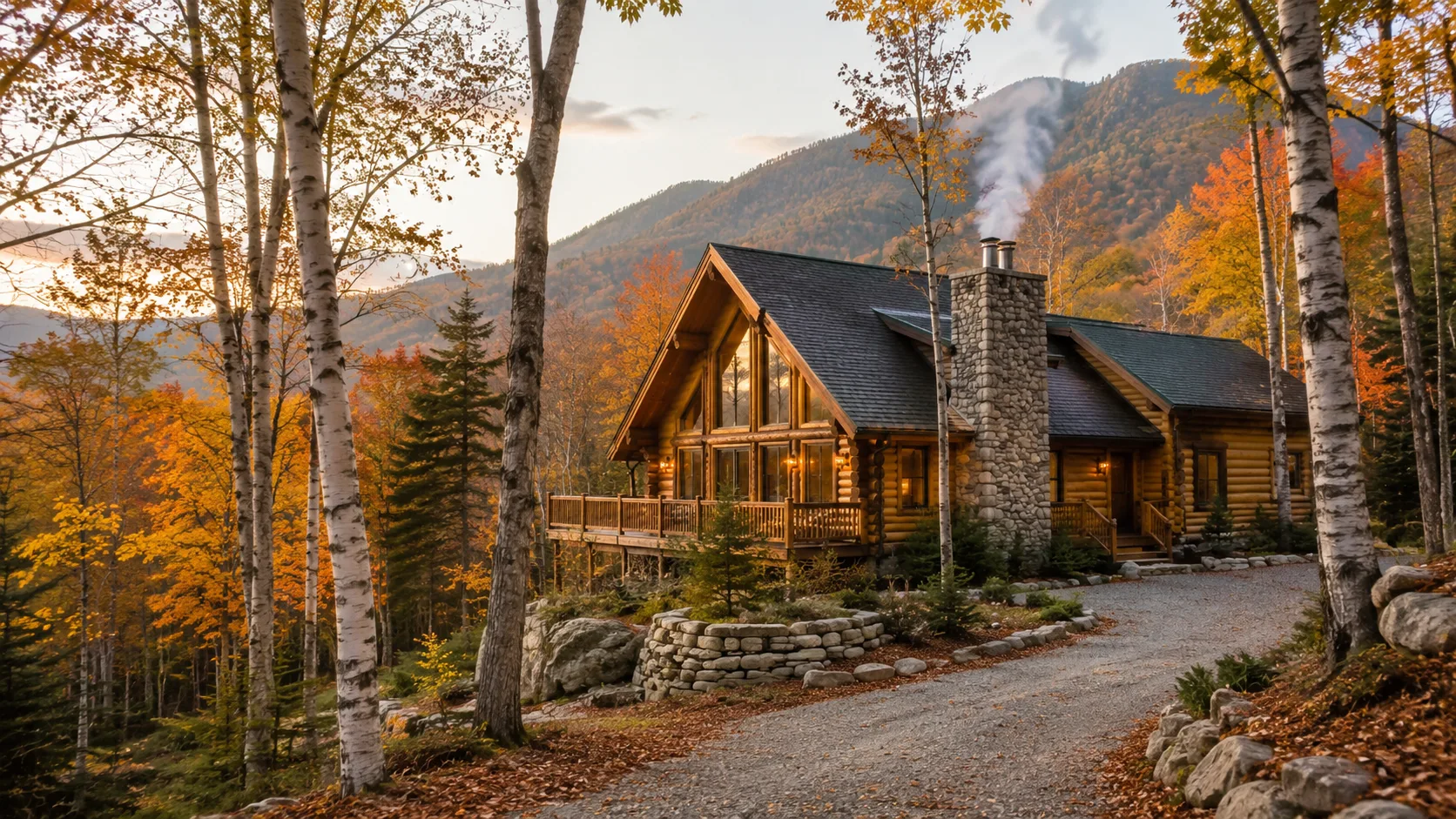
What log home maintenance costs
Log upkeep is predictable if it is done on evidence rather than neglected. These are published contractor rates, not New Hampshire quotes — local pricing, access (a two-story gable end needs staging) and the house's condition move them a lot, so get bids during the contingency.
| Work | Published range | How often |
|---|---|---|
| Log home inspection | $300–$600 | At purchase; owner walk-around every spring |
| Stain / recoat | $4–$8 per sq ft of wall | Every 3–5 years on sunny faces; shaded walls last longer |
| Chinking and caulking repair | $8–$15 per linear foot | As needed; check yearly |
| Media blasting (strip old finish) | $1.50–$4 per sq ft | Only before a full refinish |
| Full restoration (strip, repair, refinish) | $18–$20+ per sq ft | When maintenance has been skipped |
| Rot repair / log replacement | $100–$400 per linear foot | As found |
Sources: Log Home Finishing LLC rate calculator (inspection, stain, chinking, blasting, restoration); Weatherall buyer's field guide (rot repair). Ranges as published in 2026.
Refinish walls individually rather than the whole house at once: south- and west-facing walls take the most sun and come due first, often years ahead of the shaded elevations. The practical rule for a buyer is to price the house as if the next refinish is due, because on a listing with faded south walls it is.
What drives the price of a log cabin
No price table here, because log stock is thin and any specific number goes stale within a season — look at what's actually listed right now instead. What holds year to year is what moves the number:
- Water. The same log cabin is worth several times more on Winnipesaukee frontage than on a wooded acre in Coos County. Deeded water access, shared beach rights or river frontage each add a step.
- Year-round systems. A drilled well, a state-approved septic sized to the bedroom count, a real heating plant and a town-maintained road separate a four-season log home from a summer camp that looks identical in photos.
- Condition of the logs. A cabin that needs its bottom two courses replaced can be a fine buy if the price reflects it. It often does not, because sellers stain over problems and out-of-state buyers bid on photographs.
- Access and acreage. A plowed town road means normal life and normal financing; an unmaintained Class VI road can mean no winter access and lenders who say no. Acreage adds value and brings the current-use question below.
Financing and insuring a log home
Lenders write mortgages on log homes, but the appraisal is the choke point: appraisers need comparable sales, and log homes are scarce enough in most areas that recent log comps are hard to find. Around Waterville Valley and the Pemi corridor there is usually enough log stock to make this workable; in thinner markets the appraiser may reach farther afield, and some lenders simply have less appetite for unique construction. Get pre-approved with a lender who has closed log homes, disclose log construction on day one, and expect the appraisal to take longer. Seasonal camps are a separate problem — a use question, not a log question — and usually need cash, home equity or a local portfolio loan.
Insurance is the same story. Fewer carriers write log homes, and premiums often run higher because a rebuild needs specialized materials and labor that standard replacement-cost software models poorly. An independent agent who works with log-friendly carriers solves this — but get the quote during the contingency period, especially on anything remote, wood-heated or far from a hydrant, because those factors stack.
Log cabins on the water: shoreland rules
A log cabin on the water is a different purchase from a log cabin in the woods. True log construction is a minority of New Hampshire's waterfront inventory; the genuine ones are mostly pre-war handcrafted camps and milled log homes put up on redeveloped lots since the 1980s — around Winnipesaukee's quieter bays, Newfound Lake, Squam and Little Squam, Winnisquam, Ossipee, Stinson Lake above Rumney, and Back Lake and the Connecticut Lakes in Pittsburg. The lake homes page and the lakefront homes list are the statewide views; the ranked rundown of the best lakes in New Hampshire helps choose a shoreline. Frontage carries most of the price, so a lakefront log cabin in poor condition still costs lakefront money — on the water, condition is a negotiation item, not a price bracket.
What you can change on a log camp near the water
The Shoreland Water Quality Protection Act, RSA 483-B, governs the land within 250 feet of lakes and ponds over ten acres, fourth-order and larger rivers, designated rivers and tidal waters. NHDES administers it. The numbers that shape a project: primary structures set back at least 50 feet; a waterfront buffer inside that 50 feet where tree removal is scored on a 50-by-50-foot grid that must keep at least 50 points of vegetation; a woodland buffer out to 150 feet where at least a quarter of the ground stays unaltered; and impervious coverage capped at 30 percent, with a stormwater plan required above 20 percent.
Nearly every old lakefront camp sits inside the 50-foot setback, which makes it a legal nonconforming structure. NHDES's protected shoreland FAQ spells out what RSA 483-B:11 allows: repair, modification and even vertical expansion need no shoreland permit if the impervious footprint and the footprint of interior living space do not grow and the work needs no excavation or fill. A new or expanded deck may extend no more than 12 feet toward the water from the wall it attaches to, and enclosing an open porch or deck between a nonconforming structure and the water is prohibited. Towns often layer stricter rules on top.
The log-specific wrinkle: the expansion the state most readily allows — upward, inside the existing footprint — is the one log construction makes hardest, because the settled wall below is already carrying the roof. Adding a floor on a log wall is a structural question for a builder who works in logs, not a permitting formality. Ask before writing an offer on the strength of "we can always go up."
Rot on the water-facing wall
The lake side of a camp is where the deck, steps, lawn and shade are — the wall that stays damp longest. Morning shade and lake humidity keep the bottom courses wet, splash off a low deck drives water into the logs, and overhangs on view-facing camps are often short. The usual fix, clearing vegetation off the wall, is regulated inside the waterfront buffer; NHDES allows trimming and pruning to maintain clearance around structures, but not wholesale clearing. On any waterfront log cabin, probe the water-facing bottom courses first and look under the deck ledger.
Docks, shoreline and septic
A dock is not covered by the shoreland permit: under RSA 482-A, new docking structures, including seasonal docks and lifts, need an NHDES wetlands permit, and a retaining wall cannot be built for stabilization if planting would do the job. Ask for the dock's permit or registration during diligence. And since September 1, 2024, a buyer of waterfront property with a septic system in the protected shoreland must have it evaluated by a state-licensed evaluator before the sale, with a failed system replaced — the camps guide explains that law and the leach-field setbacks.
Converting a seasonal log camp to year-round
In brief: NHDES requires septic approval before a structure converts from seasonal to year-round use, and on a small lot near water there may be no compliant place for a bigger system. Old camps often run on shallow dug wells or lake water with lines above frost; year-round living usually means a drilled well, and because arsenic and radon occur naturally in New Hampshire groundwater, test for both, not just bacteria. Post-and-pier camps need a real foundation, and the road has to be plowed and legally usable in winter. The camps and cabins guide prices each step. The trap is paying camp prices plus assuming a conversion the lot, the septic rules or the road will never allow.
Current use and taxes on a log cabin with land
Cabin buyers here often end up owning more land than they expected. Under current use (RSA 79-A), a parcel with at least 10 acres of qualifying open or forest land can be assessed at its productive value instead of market value — a dramatic cut in the annual bill, with an extra 20 percent reduction for land kept open to public recreation. The enrollment stays with the land. Building on or otherwise taking enrolled land out triggers a one-time land use change tax of 10 percent of its full market value at that time — so get the enrollment map before an offer, and plan any future building envelope outside the enrolled acreage. If you plan to build a new log home on raw land instead, our guides to buying land in New Hampshire and building a new home in New Hampshire cover lot diligence and construction.
New Hampshire has no general sales or income tax and relies on property taxes, and town rates vary widely — compare actual tax cards, not towns' reputations. Our NH property taxes guide explains the math. At closing, the state real estate transfer tax is $0.75 per $100 of price, charged to both buyer and seller.
Renting out a log cabin
A genuine log cabin with a woodstove, a porch and a hot tub near skiing or water is among the strongest short-term rental listings in the region; guests scroll past interchangeable condos and stop on logs. The obligations are the same as any New Hampshire rental: the 8.5 percent Meals and Rooms (Rentals) Tax on stays under 185 days, a state license before the first guest, and town rules that range from nothing to real permitting — call the town office before buying on a rental thesis. A "sleeps ten" listing on a two-bedroom seasonal system is how leach fields fail.
Rental wear accelerates log maintenance, and guests will not report the failed caulk line or the carpenter ants. A rented log cabin needs a spring and fall walk-around by someone who knows what to look for — a management program handles it. The guide to whether Campton is a good place for an Airbnb walks through the economics and town rules.
How to buy a log cabin in New Hampshire, step by step
- Decide what the cabin is for — year-round living, a family base, a rental or a snowmobile camp. That decides the region, and the region decides the budget.
- Get pre-approved with a lender who has closed log construction, and ask an independent insurance agent for a log-home quote now, not later.
- Do the paper diligence before falling in love: septic design and approvals, well records, road status and maintenance agreements, current-use enrollment, and shoreland constraints near water.
- Inspect with someone who knows logs, and attend. Walk the walls, watch where the probe goes in, spray-test the finish.
- Price what was found. Every soft log, failed caulk line and "conversion required" is a number from the maintenance table above; a seller who will not recognize those numbers has told you something useful.
Our New Hampshire home buyer guide covers offers, contingencies and closing. And before any of it, look at real inventory: the newest listings update daily, and the log homes for sale in NH page filters the market to log construction.
Frequently asked questions
What should you look for when buying a log cabin?
Rot in the bottom courses, corners and under windows; large upward-facing checks that catch rain; settling damage around doors and windows; failed chinking or caulk; finish that soaks up water instead of beading; and carpenter ants or powderpost beetles. Then the systems: septic approval, well, heat and a plowed road. Use an inspector with real log-home experience.
How much does it cost to maintain a log home?
Published contractor rates run about $4 to $8 per square foot of wall for a stain recoat every three to five years on the sunny faces, $8 to $15 per linear foot for chinking and caulking repair, and $18 to $20 or more per square foot for a full restoration when maintenance was skipped. New Hampshire quotes vary with access and condition, so get bids during the contingency.
Can you get a mortgage on a log cabin in NH?
Yes. Lenders write mortgages on year-round log homes routinely; the choke point is the appraisal, because recent log comparable sales are thin outside corridors like the White Mountains. Disclose log construction on day one and use a lender who has closed log homes. Seasonal camps are the separate problem and often need cash, home equity or a local portfolio loan.
Are log homes hard to insure?
Harder than a conventional house, not hard in an absolute sense. Fewer carriers write log construction and premiums often run higher, because a rebuild needs materials and trades that standard replacement-cost models handle poorly. Use an independent agent who already places log homes, and get the quote during the inspection contingency — remoteness, wood heat and distance from a hydrant each narrow the list further.
How often do you have to stain a log home?
On evidence more than on a calendar. Inspect and wash each spring, then spray-test: if water soaks in rather than beading, the finish is spent. South- and west-facing walls usually come due first, often every three to five years, while shaded walls last longer — so refinish wall by wall. A lake-facing wall that stays damp may need attention sooner.
Can you live in a log cabin year-round in New Hampshire?
Yes — a properly built or properly converted log home is warm, tight and durable in a New Hampshire winter. The qualifier is properly converted: NHDES septic approval for year-round use, a frost-protected water supply, a real foundation and heat source, and plowed legal access. If a listing says "seasonal," assume none of that until the paperwork proves otherwise.
Do log homes hold their value?
Well-maintained ones do, and scarcity helps — buyers who want logs cannot substitute a colonial, so a sound one in the White Mountains draws a crowd. Neglected ones are punished harder than neglected conventional homes, because every buyer's inspector finds the problems. The land and location do most of the work; the stain schedule protects the rest.
The best log cabin purchases are boring: dry logs, documented septic, plowed road, fair price. If you are watching the market for one — in the Whites, on the lakes, or up in Pittsburg — Owl's Nest Real Estate will tell you which ones are worth the drive, bring the screwdriver to the showing, and say "not this one" before the contract, not after.