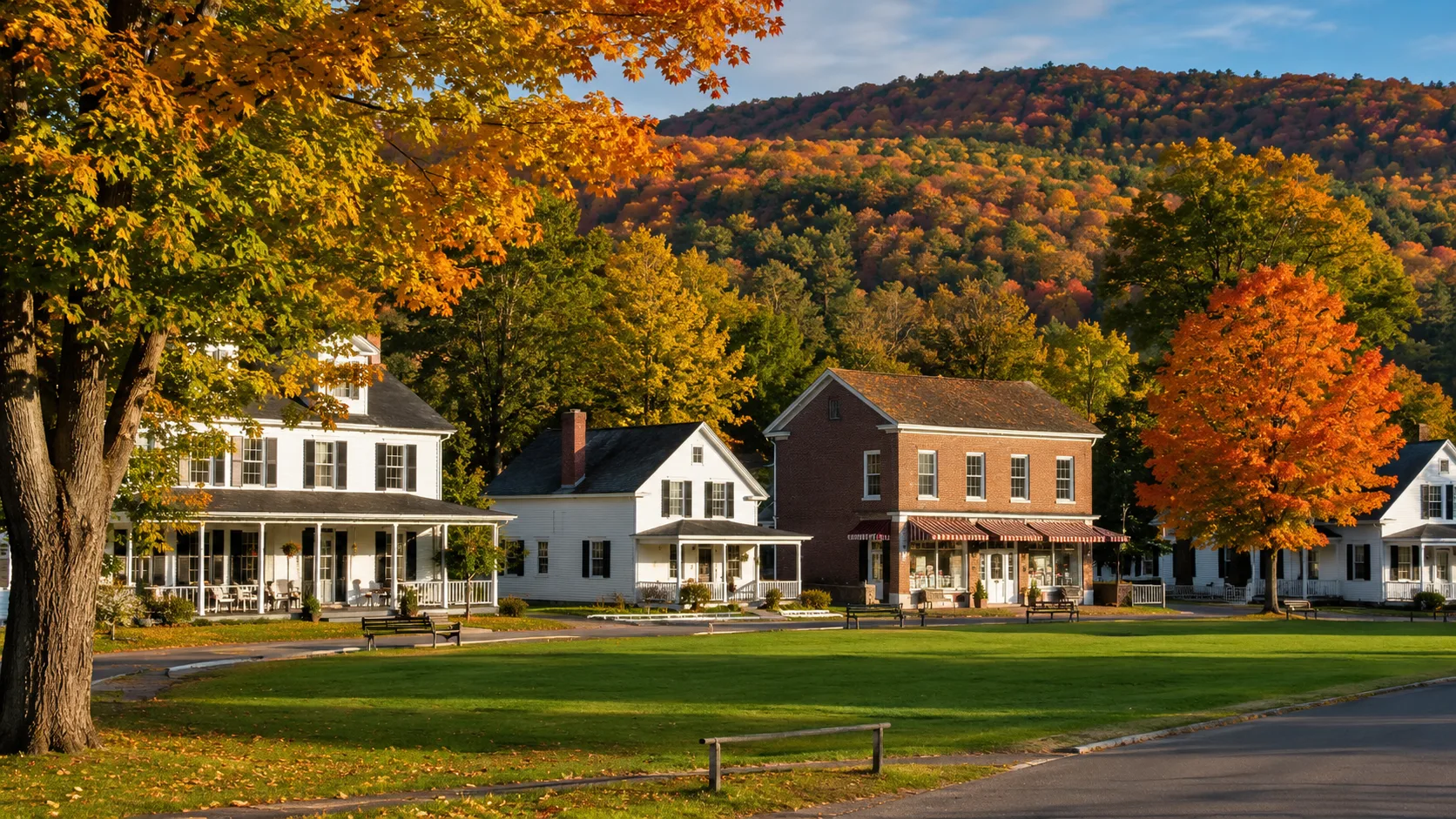

The real cost of living in New Hampshire has no single number — it depends on which line items dominate your life, and the calculator websites that average the whole state into one figure miss exactly that. Somewhere between "we're thinking about it" and "we're calling a mover," everyone sits down with a spreadsheet; this article is what belongs on it.
The problem with those calculators: nobody has ever sold a house to an average. A retiree drawing down a portfolio, a family with two kids in daycare, and a remote worker heating a drafty 1970s chalet with oil are living in three different states, economically speaking. So this article is the version that gets walked through on the phone with real buyers — every major category, real 2025–2026 numbers, what's genuinely cheaper here, what's genuinely more expensive, and where the calculators get it wrong.
One framing note before the numbers: the honest headline is that New Hampshire is not a cheap state. Overall living costs run roughly 13 to 15 percent above the national average by most indexes — Salary.com puts the state's cost of living well above the U.S. baseline, driven mostly by housing and energy. What New Hampshire is, is a state with an unusual cost structure — dramatically cheaper than the rest of New England in some categories, more expensive in others — and if your life happens to fit that structure, the total comes out remarkably well. If it doesn't, it won't. Let's find out which one you are.
The scorecard, before the story
The calculator sites do get one thing right: sometimes you just want the whole picture on one screen. So here's mine — every line gets unpacked, with sources, in the sections below.
| Line item | New Hampshire | Against the national average |
|---|---|---|
| State income tax | None — not on wages, investments, or retirement | Most states tax at least one |
| Sales tax | None | Most states take 5–10% at the register |
| Property taxes | ~$17.10 per $1,000 statewide; $8,174 average bill | Among the highest in the country |
| Median single-family price | $580,000 (July 2026, a record) | Well above the U.S. median |
| Residential electricity | ~27¢ per kWh | ~18¢ — we pay close to 50% more |
| Home heating | Mostly oil and propane; $4,000–6,000 real-winter fuel bills happen | Most of the country has cheaper gas or milder winters |
| Homeowners insurance | ~$1,150–1,200 a year | ~$2,900 — one of the cheapest states |
| Car insurance | ~$1,000 a year for full coverage | Hundreds below the U.S. norm |
| Health insurance | $401/month benchmark premium for 2026 | Lowest in the nation |
| Groceries | ~10% above the U.S. average | The standard New England surcharge |
| Infant childcare | ~$16,500 a year, waitlists included | Well above the national average |
One more thing the statewide scorecard hides: where in the state you land changes the whole answer. The New Hampshire Fiscal Policy Institute's county-level estimates put the annual cost for a family of four anywhere from about $87,500 in Coos County up north to over $131,000 in Rockingham County down on the Seacoast and the Massachusetts border. The North Country discount is real, and so is the southern-tier premium. Keep that spread in mind through everything that follows.
The taxes you will never pay here
Start with the famous part, because it's the foundation everything else sits on.
New Hampshire has no tax on wages. Your paycheck clears the state untouched, and always has. There is no sales tax — not on the car, the furniture, the groceries, the restaurant bill at the register. And since the Interest and Dividends Tax was fully repealed effective January 1, 2025, there is no state tax on investment income, capital gains, pensions, Social Security, or retirement account withdrawals either. That repeal made us the only state in the country with neither a personal income tax of any kind nor a state or local sales tax.
What that's worth depends entirely on your income. A household earning $150,000 in wages pays Massachusetts about $7,500 a year in income tax before it buys a single taxable item; the same household pays New Hampshire zero. A retired couple pulling $90,000 a year from IRAs and dividends keeps all of it. The Tax Foundation ranks New Hampshire's overall state and local tax burden among the lowest in the nation — not because our taxes are low across the board, but because the ones we skip are the big ones.
I covered this in more depth in my full relocation guide, but the one-line version for your spreadsheet: the income side of your budget gets an immediate, permanent raise the day you become a resident. Now for the other side of the ledger.
The tax you will absolutely pay
New Hampshire funds its towns, schools, and counties almost entirely through property taxes, and the bills are genuinely high. The average single-family property tax bill here was $8,174 in 2025, among the highest in the country, and the statewide average rate ran about $17.10 per $1,000 of assessed value in 2025.
Here's what the averages hide, and it's the single most important thing in this whole article: the rate depends radically on the town. Around the Lakes Region, where we do a lot of our business, the 2025 rates tell the story. Meredith was $10.62 per thousand. Gilford was $11.85. Tilton was $11.29. Laconia — the region's real city, with real city services — was $12.98. Cross into Belmont and it jumps to $17.39. Up my way, Thornton was $11.74 while Campton, one town over, was $17.46, and Plymouth ran $23.77. Same lakes, same mountains, same commute, tax bills that differ by thousands of dollars a year on the same assessment.
So when someone asks me what property taxes in New Hampshire cost, my answer is: on which street? A $500,000 assessment in Meredith is about $5,310 a year. The same assessment in Plymouth is about $11,885. That spread is bigger than most people's entire income-tax savings, which is why I put the town rate into every buyer's spreadsheet on day one, right next to the list price. The mechanics — how rates are built, why assessed value isn't market value, village districts, abatements, the December bill that's always bigger than the July one — get a full article of their own in my property tax guide. Read it before you compare towns, because raw rates lie without the context.
One more real-estate-specific line for your moving budget: New Hampshire charges a real estate transfer tax of $0.75 per $100 of the sale price to each side — 1.5 percent combined. On a $500,000 purchase, that's $3,750 out of your pocket at the registry, and buyers from states where the seller customarily pays it are surprised every time.
What houses actually cost right now
Housing is the biggest line in anyone's budget, so let me give you live numbers instead of last year's.
The statewide market just set a record: the median sale price for a New Hampshire single-family home hit $580,000 in July 2026, per the New Hampshire Association of Realtors — a new high, even as prices cooled nationally. Our own MLS feed says the same thing from the supply side: as I write this, there are about 4,400 active residential listings statewide, and the median asking price is right around $574,000.
The medians hide a spread you can actually use. Pulling town-level asking prices from our feed this week: Manchester's median list is about $445,000 and Plymouth's about $435,000. Laconia — nearly 160 active listings, the deepest inventory in the Lakes Region — sits around $600,000, pulled upward by waterfront. Gilford is about $615,000 and Meredith about $739,000, which is what proximity to Winnipesaukee does to a market. Meanwhile Campton's median list is around $360,000, Lincoln's condo-heavy market medians near $300,000, and up in Berlin you can still see a median under $200,000. Same state, four-fold spread. Where you land matters more than when you buy.
And the entry level genuinely still exists, which surprises people who've only read headlines: roughly 30 percent of the active residential listings in the state right now — about 1,300 properties — are asking under $400,000, and over 800 are under $300,000. They're condos, they're smaller ranches, they're houses that need weekend labor, and they're north of the commuter belt. But they're real.
If lake life is the goal, budget separately and read our Lake Winnipesaukee home buying guide — true waterfront is its own market with its own math, and you can calibrate against the live lakefront inventory statewide before you fall in love with a number. If Winnipesaukee's numbers sting, Lake Winnisquam ten minutes away delivers the same water life at a genuine discount. For the best value-per-dollar city in the Lakes Region, I've made the case for Laconia at length in our living in Laconia guide: the region's lowest big-town tax rate at $12.98, a real downtown, and two lakes. And whatever you do, don't budget off an article — including this one. Run a live property search the week you're actually shopping, because these numbers move.
Renters, a candid word: New Hampshire is harder on you than on buyers. Vacancy rates have been scraping historic lows for years — New Hampshire Housing's annual rental survey has tracked vacancy at a fraction of the 5 percent that makes a balanced market — and in my clients' experience a decent two-bedroom in the Manchester–Nashua corridor runs $1,800 to $2,400 depending on age, parking, and utilities. Zumper's summer 2026 averages land square in the middle of that range, with Manchester around $2,100 and Nashua a bit above it. If your plan is "rent for a year while we look," start that search early and expect competition.
Keeping the lights on and the house warm
Here's the category where New Hampshire genuinely costs more than almost anywhere, and where the calculator sites underweight reality: energy.
Electricity. New England sits at the end of the natural gas pipeline network, and we pay for it. New Hampshire residential electric rates have been running in the mid-to-high 20s of cents per kilowatt-hour — EIA data puts us around 27 cents against a national average of about 18.4, close to 50 percent above the U.S. norm. For a typical home using 600 kWh a month, that's a bill in the $155–170 range before you've done anything interesting. Homes with electric heat or big hot tubs feel it much harder.
Heat. This is the line item transplants from gas-served suburbs consistently miss. Natural gas only reaches the more built-up corridors here; statewide, about 59 percent of New Hampshire households heat with fuel oil or propane — the second-largest share of any state. Heating oil was averaging in the high $4s per gallon this summer per the NH Department of Energy's price surveys, and a typical oil-heated New Hampshire home burns on the order of 900 to 1,400 gallons a season. Do that multiplication and sit with it: a real winter in a real house can mean $4,000 to $6,000 in fuel. A tight, newer, modestly sized home does far better; a rambling antique does worse. Propane users face the same shape of bill, and many of us split the load with a wood stove — a cord of wood is the most honest hedge in the state.
My broker's advice, and I give it during showings, not after closings: in New Hampshire, the heating system and the insulation are part of the price of the house. A $420,000 home with a 30-year-old oil boiler and 1978 insulation can cost more per month than a $460,000 home with cold-climate heat pumps and new windows. Ask for a year of fuel bills before you offer — sellers have them, and the good ones expect the question. Add the winter miscellany while you're at it: plowing ($400–800 a season for a normal driveway), snow tires, and a generator if you're rural. Call it a season budget of a few thousand dollars beyond the fuel itself, same as I tell every buyer in the relocation guide.
The bills that are quietly cheaper here
Now the good news column, which the scare headlines never total up.
Homeowners insurance. New Hampshire is one of the cheapest states in the country to insure a house — about $1,150 to $1,200 a year on average against a national average approaching $2,900. No hurricanes making regular landfall, no wildfire zones, no hail alley. In an era when Florida and California premiums are wrecking budgets, this line is worth real money every single year.
Car insurance. Same story. New Hampshire perennially ranks among the four or five cheapest states for auto coverage — the state insurance department cheerfully publicizes it — with full coverage commonly running around $1,000 a year against a national average hundreds higher. The offsetting reality: this is a car state. Outside the Manchester–Nashua corridor there is no meaningful transit, most households need two vehicles, and rural mileage adds up. Cheaper per car, more cars, more miles.
Health insurance. This one surprises people. For 2026, New Hampshire's benchmark marketplace premium is $401 a month — the lowest in the entire country, per the state insurance department. A competitive hospital market and a healthy risk pool actually deliver here. The honest asterisk: like everywhere, 2026 brought steep rate increases and the expiration of enhanced federal subsidies, so self-employed buyers above the subsidy cliff are paying meaningfully more than last year — just less more than they would be in most other states. The care itself is genuinely good in the southern tier and the Upper Valley; north of the lakes you're on small critical-access hospitals for everyday needs, with the serious cases referred an hour-plus away. If monthly specialist visits are part of your life, that geography belongs in your cost calculation as drive time and missed work, not just premiums.
Groceries, childcare, and the everyday stuff
Groceries run modestly above the national average — most indexes put New Hampshire food costs roughly 10 percent over the U.S. baseline, which is the general New England surcharge for being far from where food is grown. The partial offset nobody counts: there's no sales tax on anything else in the cart, and the state-run liquor outlets on the highways price low enough that half of Massachusetts shops there on purpose. Gas has historically run cheaper than over the border, too — lower state gas tax.
Childcare is the ugliest number in this article, and if you have young kids I'd rather you hear it from me now. Center-based infant care in New Hampshire averaged about $16,500 a year in 2025, per the New Hampshire Fiscal Policy Institute — and for a family with an infant and a four-year-old, the combined center price is around $30,000 a year. Worse, supply is shrinking: in much of the state the real problem isn't the price, it's the waitlist. Families moving here with two kids under five should treat childcare like housing — research specific providers in specific towns before you commit to a location, not after. The consolation is that the ramp ends well: New Hampshire's public schools rank among the best in the country, and they're already paid for in that property tax bill we discussed.
The costs that don't show up in any index: most of what people move here to do is free or close to it. Hiking the Whites costs a parking pass. A day at a town beach on Winnipesaukee or Newfound costs residents almost nothing — I keep a running argument about which lake wins in our best lakes in New Hampshire roundup. The genuinely expensive hobbies are the motorized ones: boat ownership and ski passes cost what they cost everywhere — and if a ski-country second home is the actual plan, that's a different budget conversation entirely, and I've written that one too. But a family that hikes, swims, paddles, and sleds spends less on recreation here than a family in a city spends on a month of weekends.
The Massachusetts math
Nearly half my relocation clients are doing one specific comparison, so let's do it properly. Massachusetts takes 5 percent of wages (9 percent above the millionaire threshold), 6.25 percent at the register, and — despite the reputation — lower property tax bills in many towns than ours, on much higher home values. Overall, Massachusetts' cost of living runs far above New Hampshire's — the index gap is on the order of 20-plus points, concentrated in housing.
The honest version of the trade: move from Greater Boston to New Hampshire and your housing dollar buys noticeably more, your income taxes go to zero (if your job comes with you — commute physically to a Massachusetts employer and Massachusetts still taxes that income), your insurance bills drop, and your property tax bill likely rises. For most households the net is comfortably positive, sometimes five figures a year. For a high-earning remote household, it's dramatic. The households for whom it doesn't pencil are the ones who buy in a $25-per-thousand town on a fixed income without running the property tax number first — which is precisely the number a local broker will run for you in twenty minutes.
So is New Hampshire a good place to live
If you've read this far you can see why I refuse to answer that question with a slogan. Is New Hampshire a good place to live? Financially, it comes down to whether your life fits the state's cost structure, so here are the living in New Hampshire pros and cons strictly through the budget lens.
You come out ahead here if: your income is wages, investments, or retirement draws (all untaxed); you're arriving with equity from a more expensive market; your recreation is the outdoor kind; you'll own rather than rent; and you pick your town with the tax rate in the spreadsheet.
The state fights your budget if: you have two kids in daycare and no family nearby; you're renting long-term in the southern tier; you're heating a big, leaky house with oil and nobody warned you; or you're on a tight fixed income in a high-rate town. None of those are unsolvable — but they're the four honest cons, and every one of them is addressable by choosing the right town and the right house, which is the whole game here.
To make it concrete, here's a real composite — roughly the median case I see: a family buys a $500,000 home in a Lakes Region town at a $12 rate with 20 percent down. That's a $400,000 note, and with the 30-year averaging about 6.7 percent this August, per Freddie Mac, call it roughly $2,600 a month for principal and interest. Add $500 for property taxes, $100 for insurance, about $160 for electricity, and $250 a month averaging out a $3,000 oil-and-plowing winter across the year. Roughly $3,600 a month to own and operate the house — before groceries, cars, and childcare, and before subtracting the income tax they stopped paying. Whether that's a bargain or a stretch depends on what they left. Coming from Winchester, Massachusetts, it's a windfall. Coming from Tennessee, it isn't.
Questions I get every week
Is it expensive to live in New Hampshire?
Moderately, yes — the honest number is 13 to 15 percent above the national average, driven almost entirely by housing and energy. But New Hampshire punishes and rewards very specific situations rather than everyone equally. A retiree who owns a home outright in a $11-per-thousand town lives remarkably cheaply here; a renting family with two kids in daycare pays New England prices with none of the offsets. The average tells you almost nothing — your line items tell you everything.
Is New Hampshire cheaper than Massachusetts?
Overall, yes, by a wide margin — the cost-of-living index gap runs twenty-plus points, most of it housing — and the tax swing compounds it: Massachusetts takes 5 percent of wages and 6.25 percent at the register, and we take neither. The two catches worth knowing: if you physically commute to a Massachusetts employer, Massachusetts still taxes those wages, and your New Hampshire property tax bill will very likely be higher than the one you left. The full arithmetic is in the Massachusetts section above.
What salary do you need to live in New Hampshire?
For a single person, statewide living costs run around $2,800 to $2,900 a month, so a salary in the $50,000s covers the state comfortably outside the priciest towns — helped by the fact that none of it goes to a state income tax. For a family of four, the county-level estimates run from roughly $87,500 a year in the North Country to over $131,000 near the Massachusetts border, and my worked example above — about $3,600 a month to own and operate a median-ish Lakes Region house — squares with that: a household income somewhere north of $100,000 makes the middle of this state comfortable, and meaningfully less does the job the farther north you go.
Where is New Hampshire cheapest to live?
North of the notches, no contest — Coos County has the lowest living costs in the state, and Berlin still posts median asking prices under $200,000. The trade is distance: from jobs, from big hospitals, from the airport. The better question for most buyers is where the value is, and my answer for years has been the western Lakes Region and the I-93 corridor towns — the places where a modest tax rate, a real median price, and an hour-fifty to Boston all coexist. That math is exactly what the Laconia guide is about.
Run your actual numbers with me
The cost of living in New Hampshire is a real question with a real answer — but it's your answer, not a statewide average, and it swings on three choices: which town's tax rate, which house's heating system, and which side of the childcare years you're on. Those are knowable things. I price them out for relocating buyers every week on a legal pad, and it takes less time than you've spent reading forum threads about it.
So here's the offer I make everyone: tell me your income picture, your kids' ages, and what your Tuesday looks like, and I'll tell you honestly which towns make your budget sing and which would quietly eat it. Start with the full relocation guide if you're early, browse the current listings if you're ready, and call the office either way. I still answer my own phone, and the math is free.