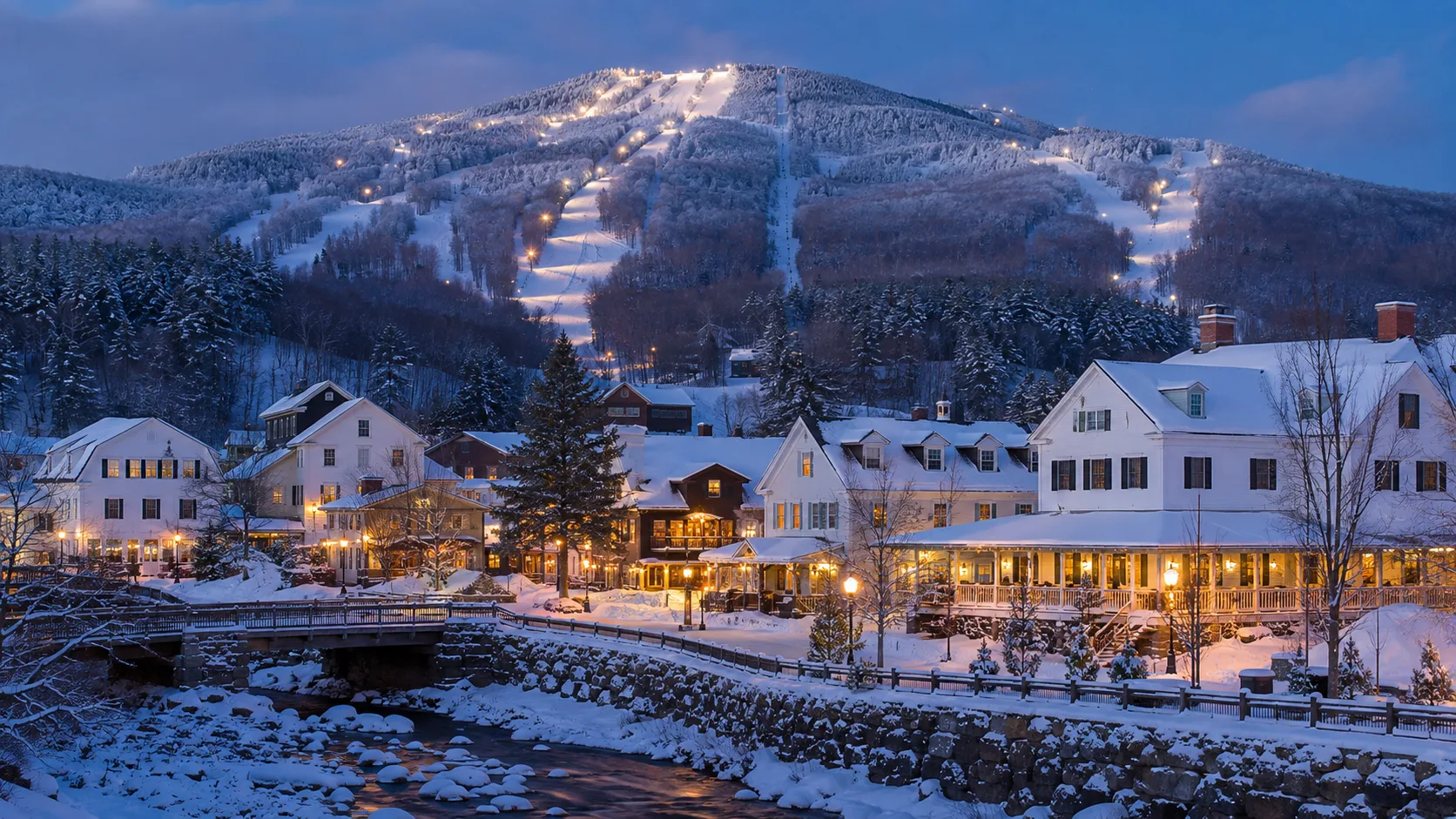

The best ski towns in New England for a second home are a different list from the best ski mountains — and the difference costs real money. Every fall the same call comes down from Boston: "We've been renting ski houses for years. Where should we actually buy?"
It's a better question than most of the internet gives it credit for. Search "best ski resorts in New England" and you'll get a dozen listicles ranking mountains by vertical drop, written by people who have never seen a property tax card. But you're not buying a mountain — you're buying a town, with a tax rate, a drive time, a rental ordinance, and a housing stock that behaves in ways trail maps don't mention. So this is that article: the honest tour of New England's ski towns, Vermont and Maine included, with real numbers from the MLS as of August 2026 — and then the case, made openly by a New Hampshire brokerage, for why the I-93 corridor keeps winning on value.
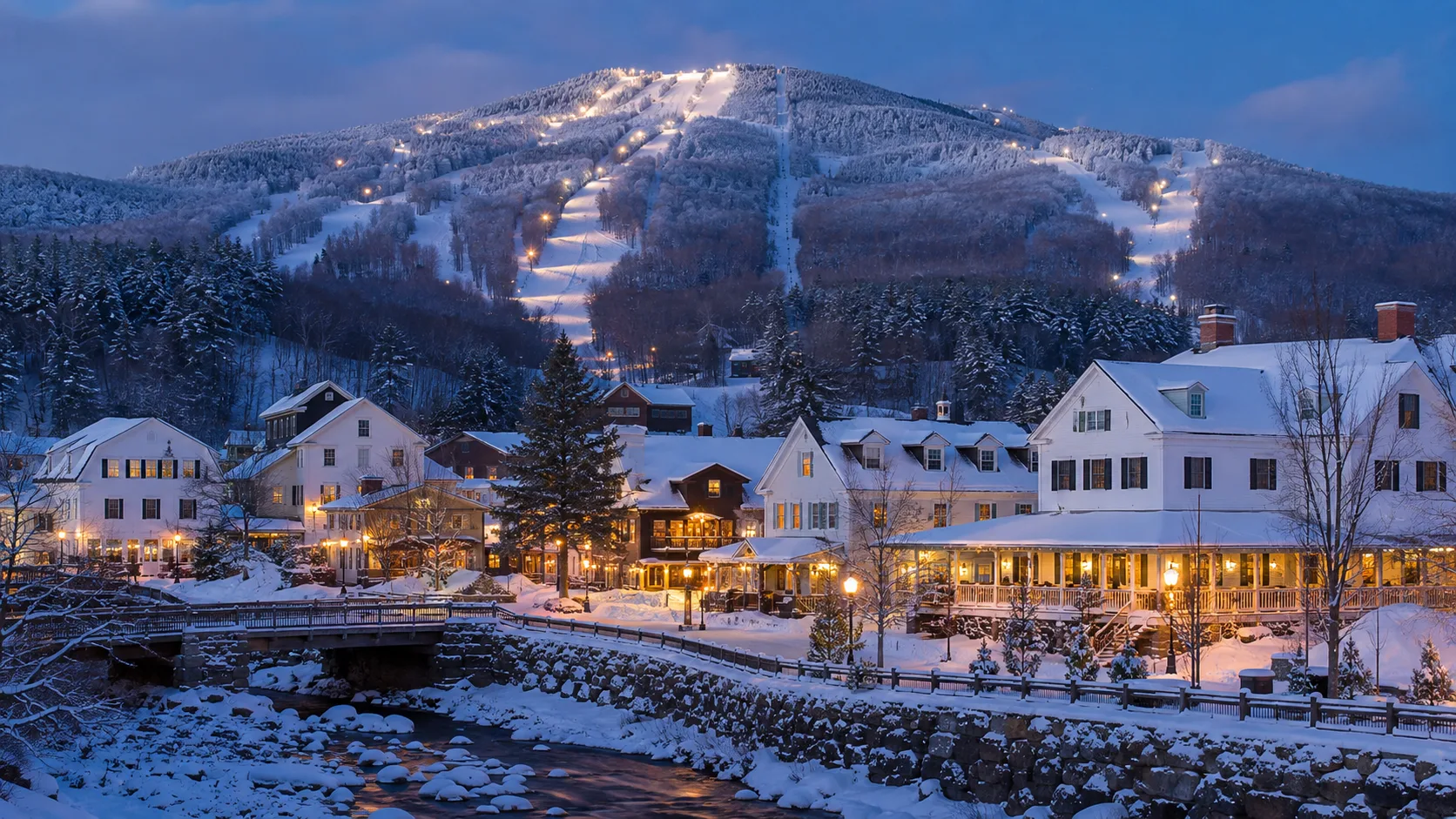
The three questions that actually decide this
Before any town names, the framework. After years of these conversations, almost every buyer's decision comes down to three things, in this order:
Drive time, honestly measured. Not the Saturday-morning-in-July number — the Friday-at-5pm-in-January number. A second home you can reach in two hours gets used forty-plus days a year; one that takes four hours becomes a vacation-week house you feel guilty about. This is the single biggest reason the best skiing in New England and the best ski town to own in are not the same list. Sugarloaf is arguably the best mountain in the East. It is also four-plus hours from Boston, and that fact will shape your ownership more than anything on its trail map.
The full cost of carrying it. Purchase price is the headline, but the spread between states on taxes is now wide enough to change decisions. Vermont raised its property transfer tax on second homes to 3.4% — 3.62% with the clean water surcharge — effective August 2024. On an $800,000 Stowe condo, that's about $29,000 at closing, before you've bought a single lift ticket. New Hampshire's transfer tax is 1.5% total, customarily split between buyer and seller. Add New Hampshire's zero income tax and zero sales tax, and the ownership math starts diverging fast — I walk through how our town-by-town property tax system really works in my property tax guide.
Whether the town works when it isn't snowing. A ski condo that sits dark from April to November is half an asset. The towns that hold value — and rent well — are the ones with a real summer: lakes, golf, hiking, a downtown. Keep that lens on as we go; it separates the towns more than the skiing does.
The big names, given their honest due
Credibility first: if I pretended New Hampshire had the only answer, you should stop reading. So here's the fair version of the marquee towns.
Stowe, Vermont is the most complete ski town in New England, full stop. A genuinely beautiful village, a serious mountain (2,360 feet of vertical, 468 acres, 116 trails, on the Epic Pass since Vail bought it in 2017), and a four-season economy that most resort towns would kill for. You pay for every bit of it. Coldwell Banker Carlson's market report puts Stowe's median single-family sale at $1.59 million for the second quarter of 2026, with condos trading at a median around $686,000 — and a quarterly median in a market that small swings hard, so read those as the neighborhood of the truth rather than gospel — and then Vermont takes its 3.62% second-home transfer tax on top. It's also three hours and change from Boston on a good night. Stowe is a wonderful place to be rich. As a value proposition for a family that will actually use the house forty weekends a year, it's a hard case to make.
Killington, Vermont is the volume play — the biggest vertical drop in New England at just over 3,000 feet, a famously long season, and Ikon Pass access. Real estate is genuinely cheaper than Stowe; the portals put the median in the mid-$400,000s to high-$500,000s depending on how much condo stock is in the mix, and that market has softened over the past year. The honest trade: Killington the town is a strip along an access road, not a village, and the same Vermont transfer tax and non-homestead education property tax rates apply. It's a skier's mountain more than an owner's town.
Okemo and Ludlow, Vermont is the one Boston buyers ask me about most after Stowe, and it deserves the airtime: Okemo is southern Vermont's Epic Pass anchor — 2,200 feet of vertical, 667 acres, 98% snowmaking, and grooming so reliable it's a running joke — attached to Ludlow, a genuine small town rather than an access road. It's also the shortest Vermont drive on this list, though "shortest" still means roughly two and three-quarter hours from Boston with the last stretch on state highways, not interstate. The market is a classic second-home market: the portals put Ludlow's median anywhere from the mid-$500,000s to the high-$600,000s depending on the month, because a town that closes a few dozen sales a year swings with every ski-condo batch that trades. And the same Vermont tax stack applies here as in Stowe — the 3.62% second-home transfer tax and the non-homestead education property tax rate. Okemo is the best answer for a family already committed to Epic; it's not an escape from the Vermont math.
Sugarloaf and Sunday River, Maine. Sugarloaf has a legitimate claim to the best skiing in New England — 2,820 feet of vertical and the East's only lift-served terrain above the treeline — and Sunday River spreads 870 acres across eight peaks. Both are on the Ikon Pass and Boyne's New England Pass. Both are also a very long way from everywhere: figure four-plus hours from Boston to Sugarloaf, three to Sunday River. Maine owners tend to be devoted, and prices reflect the distance discount. If your life allows week-long stays instead of weekends, Maine is the honest dark-horse answer. For the every-weekend family, the drive kills it.
That's the fair reading of the big names. Now the case for my side of the border — and note what all three paragraphs above had in common: the drive, and the taxes.
Why the smart money keeps landing on the I-93 corridor
The best ski resorts near Boston aren't a matter of opinion — they're a matter of the interstate. I-93 runs from downtown Boston straight into Franconia Notch, and two exits on it — 28 and 32 — put you at the access roads of two legitimate mountains, Waterville Valley and Loon, in almost exactly two hours from Route 128. No mountain passes, no two-lane crawls behind a snowplow for the last forty miles. That's the whole trick. The New England ski towns that make sense as second homes rather than vacations are the ones where the Friday-night math works, and nothing in northern New England beats the I-93 corridor on that math.
Then the tax layer: New Hampshire has no income tax, no sales tax, no Vermont-style second-home transfer surcharge. Property taxes vary wildly by town — that's the catch, and it's why I wrote a whole guide to NH property taxes — but the total cost of owning here, all-in, is structurally lower than the equivalent across the river. If you're weighing a bigger move than a second home, the moving to New Hampshire guide covers the full picture.
So here are the towns, with real numbers from our MLS as of this writing.
Waterville Valley, the valley that's all one town
Waterville Valley is New Hampshire's original planned resort village — a bowl entirely surrounded by White Mountain National Forest, with the ski area (2,020 vertical feet, 265 acres, 62 trails on Mount Tecumseh), a golf course, a lake, tennis, and a walkable Town Square all inside one tiny town. Because the national forest surrounds it, supply is permanently capped; nobody will ever build the competing development next door. The resort skis bigger than its acreage suggests, it's on the Indy Pass, and the multi-mountain White Mountain Superpass pairs it with Cannon, Bretton Woods, and Cranmore if variety matters to you.
The market: this is a condo town, and the portals will lie to you about it. As I write this there are 27 condos listed in Waterville Valley, but more than half are quartershares — deeded quarter-interests, mostly at Mountain Sun, listed at $40,000 to $60,000 — which is why any "median condo price" you see quoted online is meaningless. The real whole-ownership market is a dozen condos running from $175,000 for a one-bedroom to $665,000 for the largest four-bedroom townhouses, most built in the 1970s and 80s, with association dues typically $200 to $500 a month. Single-family homes are genuinely scarce — three on the market right now, all between $1.55 million and $2 million. I wrote the full breakdown, associations compared and the quartershare trap explained, in the Waterville Valley condo guide, and the summer side of the ledger — the lake, golf, tubing, the events calendar — in things to do in Waterville Valley.
Who it fits: families who want the whole vacation inside walking distance, and buyers who want capped supply working for them over decades. Who it doesn't: anyone who needs nightlife, or a single-family house under seven figures.
Lincoln and North Woodstock, the corridor's commercial heart
Lincoln is the biggest ski economy in the corridor, built around Loon Mountain — three peaks, 2,190 feet of vertical, 403 skiable acres including the recent eleven-trail Timbertown expansion, and full Ikon Pass access, which matters enormously for resale: Ikon affiliation keeps a national buyer pool interested in the town. Main Street has real restaurants, a brewery scene, and year-round tourist traffic from the Kancamagus Highway — this is the corridor town that works hardest in summer, which I've catalogued in things to do in Lincoln.
The market, with the same portal warning: 74 condos show as listed in Lincoln right now, but three dozen of them are fractional intervals — mostly at the Mountain Club on Loon — priced from $10,000 to $50,000. Read every listing for the word "interval" before you get excited. The genuine whole-ownership condo market is 48 listings from $165,000 to $3 million, with a median around $489,000. That top end is real and new: South Peak's 2025–2026 construction is trading between $2.5 million and $3 million, the most expensive condo product in New Hampshire ski country. Single-family homes are scarce and priced accordingly — thirteen active, median around $1.97 million, topping out at $3.6 million. Next-door North Woodstock is the relief valve: its seven single-family listings run $300,000 to $1.05 million, with a median near $500,000, five minutes from the lifts with a walkable little downtown of its own.
Who it fits: buyers who want the Ikon Pass, rental income (Lincoln has the deepest short-term rental demand in the corridor), and restaurants they can walk to. Who it doesn't: buyers allergic to bustle — February Saturdays here are genuinely busy — and anyone who wants acreage at Campton prices.
Campton and Thornton, the between-the-mountains value play
Now my home turf, so weigh the salesmanship accordingly — but the logic here isn't mine, it's geography. Campton and Thornton sit at I-93's Exit 28, fifteen minutes from Waterville Valley's lifts and about twenty-five from Loon's. You're not in a resort town, which is exactly the point: you skip resort-town pricing and resort-town crowds while keeping two mountains inside a half-hour, and you shave ten minutes off everyone else's drive home to Boston on Sunday.
The numbers make the case better than I can. Setting aside a handful of sub-$200,000 camps and mobile homes, Campton's single-family market is 31 listings from about $210,000 to $1.2 million with a median of $625,000 — against Lincoln's $1.97 million single-family median for the same snow. Campton condos, mostly in the Waterville Estates community up in the hills, run $170,000 to $360,000. Thornton skews newer and pricier — median around $800,000 — because so much of its inventory is recent construction at Owl's Nest Resort, where condos currently list from roughly $699,000 to $815,000 and new single-family homes run to $1.2 million. Owl's Nest is also the reason I call this corridor a four-season buy with a straight face: the resort now operates two 18-hole golf courses, having added the Vineyard Course in Ashland for 2026, alongside its lake, pickleball complex and restaurants — the full picture is in my guide to living at Owl's Nest Resort.
Who it fits: buyers optimizing for value per dollar and flexibility — two mountains, shortest drive, single-family homes at half the resort-town price. Who it doesn't: anyone who wants to walk to the chairlift or the bar. Here, you drive to everything, ten pleasant minutes at a time.
Franconia and Sugar Hill, the corridor's quiet north end
One more corridor stop, two exits past Loon, because serious skiers will notice if I skip it: Cannon Mountain at Exit 34B is state-run inside Franconia Notch State Park, and at 2,330 feet it has the most vertical of any ski area in New Hampshire — old-school, wind-blasted, cheap by big-resort standards, and the mountain that produced Bode Miller. Because it sits in a state park, there is no slopeside real estate and never will be; you buy in Franconia, Sugar Hill, or Bethlehem, quiet villages with country prices, and drive ten minutes to the tram. That's the appeal and the limitation in one sentence: no resort amenities, no rental machine, no Town Square — just a legitimate mountain, a beautiful notch, and a much smaller crowd. The White Mountain Superpass ties Cannon to Waterville Valley, Bretton Woods, and Cranmore, which is how a lot of corridor families end up skiing it anyway. It's the right answer for buyers who want the skiing without the resort — and the wrong one for anyone counting on short-term rental income to carry the mortgage.
Gilford, where the lake carries the winter
Here's the corridor's oddest and maybe smartest play. Gunstock Mountain in Gilford is county-owned — one of the last county-run ski areas in America — with 1,340 feet of vertical and 227 acres of trails and glades, and summit views straight down onto Lake Winnipesaukee. As pure skiing it's a tier below Loon or Waterville. As a town, Gilford might have the strongest hand of any of them, because it sits on the big lake: this is the only entry on this list where the summer asset is bigger than the winter one. It's also the shortest drive here — well under two hours from Boston.
The market is a real town's market, not a resort's: 81 active residential listings as I write this, single-family homes with a median around $725,000 running up to $4.15 million on the water, and condos from $189,000 to $1.1 million with a median in the mid-$400,000s. Waterfront inventory is chronically tight — five active waterfront listings right now — which tells you what carries value here. Buy in Gilford and you're really buying a Winnipesaukee home that happens to come with a ski hill ten minutes away — and buying on the big lake is its own discipline, which is why I wrote a separate Lake Winnipesaukee home buying guide, and for a family with one skier and one boater, that's not a compromise. That's the whole answer.
North Conway, the one I'll send you to a colleague for
Honesty requires including it: North Conway is a genuine contender — a real downtown, tax-free outlet shopping, and a ring of mountains (Cranmore in town, Epic-affiliated Attitash and Wildcat up the road, Bretton Woods beyond). Our MLS shows 161 active listings in Conway, with single-family homes at a median around $575,000 and whole-ownership condos around $385,000 — Waterville-like prices with more town attached. The trade-offs: it's a solid two-and-a-half to three hours from Boston on Routes 16, not the interstate, and weekend traffic through the strip is famous for a reason. It's also outside our service area, so this is the one town in this article where I'm not the right broker to call — which is perhaps the strongest evidence I'm playing this straight.
If you're choosing for the kids
A quick word on the family lens, because "best ski resorts for families in New England" is its own question with a different answer than the expert-terrain rankings. What actually matters with kids under twelve: a contained base area you can see from the lodge, a real ski school, night activities, and — this is the one everyone underweights — a short enough drive that Sunday night isn't misery. On that scorecard, Waterville Valley is the corridor's standout (the village is essentially a car-free playground once you've parked, and the resort's season pass deal currently throws in a free junior pass, ages 6 to 12, with each adult Plus Pass for 2026–27), Gunstock is the budget pick with the easiest drive, and Loon brings the most on-mountain variety as the kids get older. Stowe is wonderful with children too — it just costs Stowe prices to find out.
The costs nobody puts in the listing
Whatever town wins, budget past the mortgage before you offer. The recurring lines that surprise second-home buyers most:
- Property taxes that vary town by town. New Hampshire funds government through property tax, and the spread between neighboring towns is real — a low-tax town like Waterville-adjacent Thornton and a resort town maintaining its own infrastructure are different bills on the same home value. Pull the actual tax card; my property tax guide explains the system.
- Association dues. Nearly all resort-town condo stock carries them — $200 to $500 a month is the normal Waterville Valley range — and a suspiciously cheap fee usually signals a thin reserve fund with a special assessment hiding behind it.
- Rental rules and taxes, if you'll rent. New Hampshire's 8.5% Meals and Rooms (Rentals) Tax applies statewide, and some towns — Waterville Valley among them — run their own short-term rental registration on top. Verify the specific town's ordinance and the specific association's rental rules before you underwrite a single night of income.
- The pass line. A family of four on Epic or Ikon products is a four-figure annual line item; towns whose mountains sit on the pass your family already holds are effectively discounted. It's a small factor with a way of deciding ties.
Questions buyers actually ask
The same handful of questions comes up in nearly every one of these phone calls, so here are the answers I give on the phone.
What's the closest real ski area to Boston worth buying near?
Gunstock, at about an hour and fifty minutes from Route 128 — and because it comes attached to Lake Winnipesaukee, it's a defensible purchase even before the skiing. If you want a bigger mountain, Waterville Valley and Loon are both almost exactly two hours up I-93. Everything else in this article is a longer drive than those three, and most of the famous names are much longer.
Is a ski condo a good investment?
As a pure financial instrument? Usually no — after dues, taxes, insurance, and management, short-term rental income on most ski condos covers the carrying costs, not the mortgage. As a place your family actually uses forty days a year that also appreciates and offsets its own expenses, it's one of the better purchases I know. The math improves where supply is capped — Waterville Valley can never sprawl, because the national forest owns every acre around it — and it collapses where you've overpaid for rental projections. Run it as a lifestyle purchase with an income offset, never the reverse.
Can I rent it out when I'm not using it?
Usually, but verify twice before you underwrite a dollar: once with the town (Waterville Valley, among others, runs a short-term rental registration) and once with the condo association, because association rules trump your business plan. Then collect and remit the state's 8.5% Meals and Rooms tax on every night. Lincoln is the corridor's deepest rental market by a wide margin; Franconia and Campton are the shallowest.
Should I buy in New Hampshire or Vermont?
If the question is purely financial, New Hampshire — a 1.5% transfer tax customarily split with the seller versus Vermont's 3.62% on second homes, no income tax, no sales tax, and no non-homestead education rate. On an $800,000 purchase, the transfer-tax difference alone is roughly $17,000 — closer to $23,000 once the seller splits New Hampshire's, as is customary. If the question is "but I've loved Stowe since college," then buy in Stowe with clear eyes — a second home you don't love is the worst deal of all. Just make the choice knowing the number.
When's the best time of year to buy?
Spring and early summer, when ski-town sellers who've decided they're done list after the lifts close and the buyer pool is thinking about beaches. By late September, every Boston family that rented last winter is shopping at once. If you're serious, set up a search in April and be ready to move in May — you'll have more inventory and less company.
How I'd actually decide
Strip away the trail maps and it comes down to a sorting question. If money is genuinely no object and the drive doesn't scare you, Stowe is the complete package — I'd be lying to say otherwise. If you want the biggest mountain for the fewest dollars and don't care about town charm, Killington. If your family is already welded to the Epic Pass, Okemo is the honest Vermont pick. If you can take weeks instead of weekends, Maine will reward you.
But if you're what most of my callers are — a Boston-area family that will drive up forty Fridays a year, wants the skiing and the summer, and would rather not donate an extra 2% of the purchase price to Montpelier at closing — the answer has been sitting on I-93 the whole time. Waterville Valley if you want the village. Lincoln if you want the Ikon Pass and the restaurants. Campton or Thornton if you want the most house for the money with both mountains in reach. Gilford if the lake matters as much as the snow.
I sell real estate in four of those five towns, so you know where my bread is buttered. But the numbers in this article came straight out of the MLS, and they'll say the same thing whoever quotes them. If you want to test any of this against the live market, the newest listings update daily — or call the office, tell me how your family would actually use the place, and I'll tell you honestly which town fits and which listings to skip. That conversation is free, and it's the part of this job I like best.