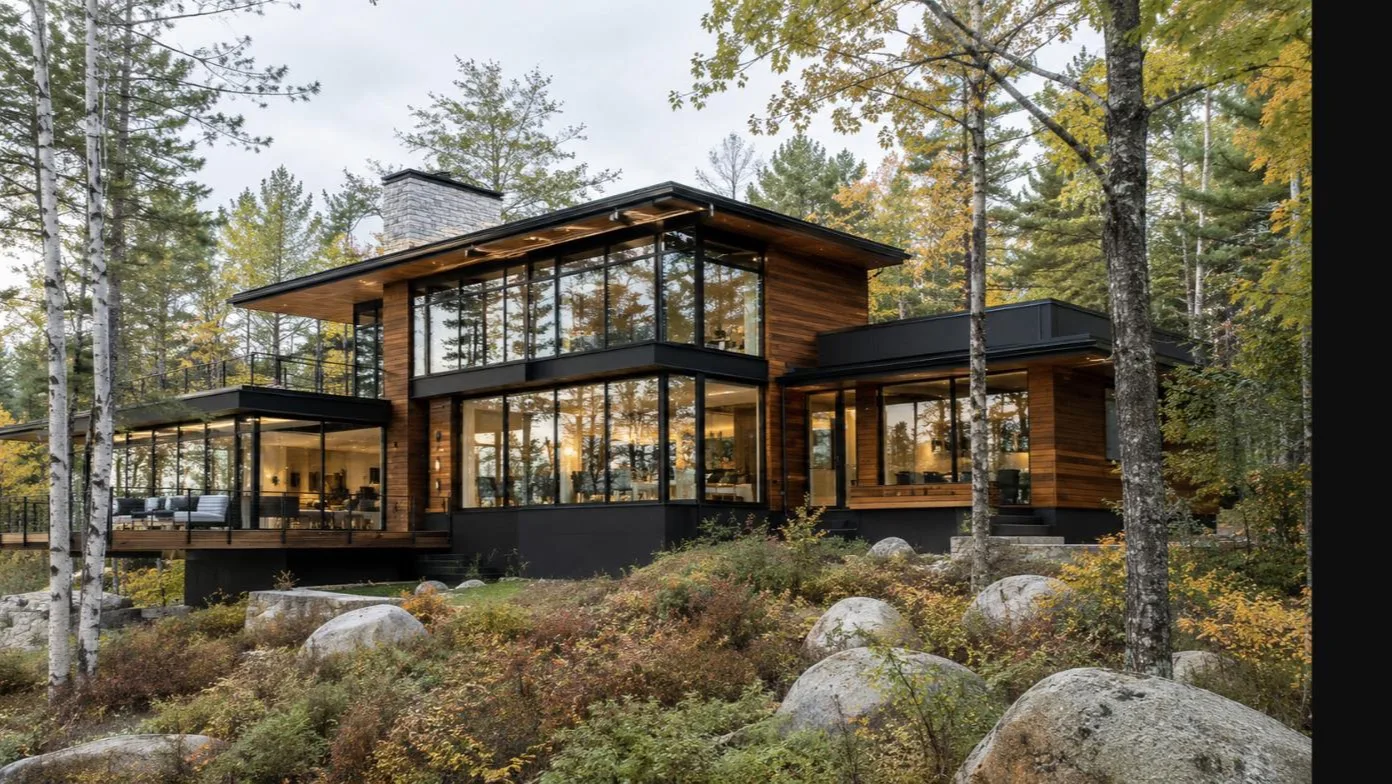

Modern homes for sale in New Hampshire are genuinely scarce — and knowing why is the first step to actually finding one. This is a state whose housing stock was shaped by capes, colonials, and farmhouses, whose builders overwhelmingly build what appraises easily and sells fast, and whose buyers, until recently, mostly wanted exactly that. The result: search any listing portal for "modern" or "contemporary" in New Hampshire and you'll wade through vinyl-sided colonials tagged "modern kitchen" before you find a single house with clean lines, big glass, and an open plan designed that way on purpose. The houses exist — they just cluster in findable pockets (ski-country contemporaries, one-off architect-built lake and view houses, scattered mid-century stock, and new construction with modern character) and hide behind inconsistent labels. Here's where they are, what the style labels actually mean, and how to search for them effectively.
Why true modern architecture is rare here
New England's building culture is conservative in the literal sense: it conserves. Towns write zoning and historic-district rules with the traditional streetscape in mind, local builders carry crews and subcontractors trained on conventional framing and trim, and the resale market has long rewarded the safe silhouette. Building a flat-roofed, glass-walled house in a state of gable roofs takes a committed owner, an architect, and usually a custom budget — which is why most genuinely modern homes in New Hampshire are one-off, architect-involved builds rather than anything a subdivision produced. Scarcity cuts both ways: modern homes are harder to find, but the good ones rarely linger, because the buyer pool that wants them has almost nothing else to choose from.
Modern vs. contemporary vs. mid-century: what the labels mean
The words get used interchangeably in listings, but they point at different things — and knowing the vocabulary makes every search sharper:
- Modern properly refers to the design movement: flat or low-slope roofs, glass walls, minimal ornament, open plans, honest materials. In practice, buyers use it to mean "clean-lined and current."
- Contemporary means "of the current era" — in New Hampshire MLS entries it's a style tag that can cover anything from a 1975 shed-roofed ski house to a 2024 glass box, and often just means "built after 1990."
- Mid-century modern (MCM) is the 1945–1975 generation: low-slung rooflines, post-and-beam structure, walls of glass, integration with the site. New Hampshire has real but thin MCM stock, mostly scattered through postwar professional neighborhoods in the cities and college towns, plus lake cabins of the era — it surfaces rarely and sells fast.
- Deck houses and A-frames are the region's vernacular modernism: kit-built post-and-beam houses and steep-gabled ski cabins from the 1960s–70s, common around the mountains and lakes. Many are the best renovation candidates in the state, because their frames take open plans naturally.
- Mountain modern and modern farmhouse are today's builder styles — dark exteriors, black window frames, gable forms, vaulted interiors — traditional envelopes with contemporary light and flow inside.
Where modern homes cluster in New Hampshire
Four pockets produce most of the state's modern and contemporary inventory.
Ski country contemporaries. The mountains are where New Hampshire gave itself permission to break from the colonial. From the 1960s onward, ski towns filled with chalets, A-frames, and shed-roofed contemporaries — big windows aimed at the view, open living floors, dramatic rooflines — and that tradition continues in today's mountain-modern builds around Waterville Valley, Lincoln, Campton, and Thornton. If a modern aesthetic and a mountain lifestyle both matter, ski country is the deepest pool in the state; our guide to the best ski towns in New England for a second home covers how those towns compare as places to own.
Architect-built lake and view houses. Scattered around the Lakes Region and the hill towns are the one-offs: architect-designed houses built to capture a specific piece of water or a specific mountain view, where the glass wall faces the lake and the road side stays private. These are the hardest modern homes to find precisely because each is unique — they surface one at a time, often marketed on the land and the view as much as the architecture. They're also a natural fit for buyers already shopping the upper tiers; our guides to luxury homes in central New Hampshire and NH luxury lake homes map that territory.
Mid-century and deck-house stock. The thinnest pocket but a real one: postwar modern houses in the older city neighborhoods and college towns, 1960s–70s deck houses and post-and-beam contemporaries in the hill and lake towns, and mid-century lake cabins in the Monadnock region and elsewhere. Almost none of it is labeled correctly in the MLS — this is the pocket where remark-keyword searching and a human screener earn their keep.
New construction with modern character. The newest and fastest-growing pocket. Much of New Hampshire's current new construction splits the difference — modern-farmhouse and mountain-modern designs with board-and-batten siding, black window frames, open plans, and vaulted great rooms that read contemporary inside a traditional envelope. Resort communities and new developments in the I-93 corridor are producing most of it. For buyers who want modern light and flow without a flat roof, this is the practical middle path, and it's the one part of the modern market where you can sometimes choose finishes rather than inherit them.
There's an energy dimension to the newest of these, too: high-performance and net-zero construction — superinsulated envelopes, heat pumps, solar sized to offset consumption — is a small but growing niche that buyers increasingly ask about, including in the towns around Concord such as Dunbarton, Hopkinton, and Bow where custom builds on rural lots are common. Modern design and building science tend to travel together, so a search for one often surfaces the other.
How to actually search for a modern home
Because the MLS has no reliable "modern" filter, finding these houses is a technique problem. What works:
Search the style field and the remarks, not just the photos. Agents tag architectural style inconsistently — the same house might be entered as Contemporary, Chalet, Post and Beam, or simply "Other." A thorough search sweeps keyword variants through listing remarks: contemporary, architect-designed, mid-century, A-frame, deck house, mountain modern, floor-to-ceiling windows, open concept done as architecture rather than as a renovation buzzword. Expect false positives; the word "contemporary" in New Hampshire listings often means "built after 1990."
Let a person do the screening. This is one of the few searches where an agent materially outperforms a portal. A saved search casts the net; a person who knows what you mean by "modern" — and knows the local stock well enough to recognize the 1970s deck house behind bad listing photos — filters it. Tell us the aesthetic in pictures, not keywords, and the screening gets sharp fast. The wide net starts at our property search; the filtering is a conversation.
Watch the land listings too. Some of the best "modern homes" in New Hampshire don't exist yet — they're view lots waiting for the right build. If nothing standing fits, the ground-up path is real here (see below), and the lot search runs in parallel with the house search.
Move quickly when one appears. Scarcity discipline applies: a well-executed modern house in a good location has a small but intense buyer pool waiting for it. Have financing settled before the right one lists.
The renovation path: buying bones instead of a finished aesthetic
When the standing inventory disappoints, the alternative is buying a house with the right bones and taking it modern. Some structures convert well — mid-century ranches, post-and-beam capes, deck houses, and barns take open plans and big glazing naturally, because their frames don't depend on the interior walls you'd want to remove. Others fight you: a center-chimney colonial resists an open plan by design, and chopped-up two-story floor plans can cost more to open than they're worth.
Two honest cautions. First, renovation-to-modern is usually a custom project wearing a renovation budget — window walls, flush details, and minimalist finishes are less forgiving and more expensive than traditional trim, and contractors comfortable with them are booked ahead in most of the state. Second, buy the site, not just the structure: orientation, light, and view determine whether the finished house feels modern or just renovated. The same logic extends to adding modern space rather than converting it — a detached studio or guest structure is often the cheapest way to get a genuinely contemporary building on a traditional property, and New Hampshire law now requires most towns to allow accessory dwelling units alongside single-family homes; our NH accessory dwelling unit guide covers what's allowed and how the approval process runs.
Building a modern home from the ground up
For buyers with time and a clear vision, a custom build is often the most direct route to a truly modern house in New Hampshire — and the mountains and lake towns are full of proof that it works. The sequence matters:
- Buy the site for the architecture. Southern exposure, view axis, privacy, and a buildable envelope determine the design before the architect draws a line. Our guide to buying land in New Hampshire walks through due diligence — perc tests, wetlands, access, current-use taxes.
- Check the town's rules early. Most NH towns will permit a modern house, but historic districts, ridgeline and shoreland rules, and subdivision covenants (some prescribe "mountain style" or minimum rooflines) can constrain the design.
- Choose the delivery model. Architect-led custom builds, design-build firms, and panelized/prefab systems with modern lines all operate in the state; prefab can shorten the mountain building season problem, but site work and foundations remain local, seasonal work.
- Budget for performance, not just looks. Big glass in a cold climate is an engineering problem; triple glazing, careful orientation, and a tight envelope are what make the January version of the house as good as the July one.
The energy performance angle
One under-appreciated reason to shop modern: the newest generation of contemporary construction is often the best-performing housing in the state. Tight envelopes, triple-glazed windows, cold-climate heat pumps, and solar-ready roofs show up disproportionately in architect-involved and high-performance builds — which matters in a place with real winters and no shortage of drafty antique stock. When comparing a modern new build against a charming 1840s farmhouse at a similar price, ask for heating costs and fuel history on both. The aesthetic difference is a matter of taste; the February operating costs are not.
Frequently asked questions
Are there modern homes in New Hampshire?
Yes, but they're scarce relative to the state's colonial-and-cape stock. Most cluster in four pockets: ski-country contemporaries around towns like Waterville Valley, Lincoln, Campton, and Thornton; one-off architect-designed lake and view houses in the Lakes Region and hill towns; scattered mid-century and deck-house stock; and newer construction with modern-farmhouse or mountain-modern character. Because inventory is thin, well-executed modern homes tend to sell quickly.
Are there mid-century modern homes for sale in NH?
A thin but real supply: postwar modern houses in older city neighborhoods and college towns, 1960s–70s deck houses and post-and-beam contemporaries near the mountains and lakes, and mid-century cabins on Monadnock-region and other lakes. Almost none are tagged "mid-century" in the MLS, so they're found by searching listing remarks and by agents who recognize the stock — and they rarely sit long once surfaced.
Who builds modern homes in NH?
Mostly architect-led custom projects and small custom builders taking on one house at a time — New Hampshire has no large subdivisions of genuinely modern homes. Design-build firms and panelized/prefab systems with modern lines also operate in the state, and newer resort and I-93-corridor construction leans modern-farmhouse rather than fully contemporary. Expect a custom process, and a custom timeline, if you're building rather than buying.
Can I build a modern home in New Hampshire?
Yes — on the right lot, a ground-up custom build is often the most direct route to a truly modern house here. The site does much of the work (orientation, light, view), and zoning, historic-district rules, or subdivision covenants in some towns can constrain what you build, so vet the land first; our guide to buying land in New Hampshire covers that process.
What does "contemporary" mean in NH listings?
Less than you'd hope. Agents tag architectural style inconsistently, and "contemporary" in New Hampshire listings often just means built after 1990 — the same genuinely modern house might be entered as Contemporary, Chalet, Post and Beam, or "Other." Search listing remarks for terms like architect-designed, mid-century, A-frame, and mountain modern, and expect to screen out false positives.
Do modern homes hold their value in New Hampshire?
The well-executed ones tend to, for a structural reason: the buyer pool that wants modern has very little inventory to choose from, so a good modern house in a good location competes in a market of one. The caveat is execution and site — a dated or badly detailed "contemporary" without a view or land behind it competes on price like anything else. As with any thin market, local comparable sales matter more than portal estimates.
The bottom line
Modern homes for sale in New Hampshire reward the prepared and the patient: know the pockets — ski-country contemporaries, one-off lake and view houses, mid-century survivors, and new construction with modern character — search on technique rather than a single keyword, and treat renovation and ground-up building as real second paths when the standing stock runs dry. Start the wide net at our property search, and when a search needs a human filter for "actually modern," that's what we're here for.