
Homes for sale near Plymouth State University attract two buyers who rarely meet: the investor looking for a two- to four-unit building that rents by the bedroom, and the parent doing the arithmetic on four years of room and board. Both should read one sentence of Plymouth's zoning ordinance before they read a listing, because it defines an unrelated "family" as a group of three persons or less. A four-bedroom unit near campus cannot lawfully be leased to four unrelated students. Every four-beds-times-a-per-bedroom-rent spreadsheet circulating in this market is pricing something the town does not permit.
That is the number that decides most of these deals, and almost nobody arrives knowing it. What makes the deals worth doing anyway is the demand underneath. Plymouth is the only year-round rental market in the Pemi-Baker region: every other town within thirty minutes rents seasonally, to skiers and lake people, on a calendar set by snowfall, while Plymouth rents to a university, a hospital, a courthouse and a school district, on a calendar set in August.
So a Plymouth rental is not a Waterville Valley condo with tenants instead of guests. It is a small, old, heavily regulated building in a town that has thought carefully about student housing and written its conclusions down. The occupancy cap is defined. The parking spaces required per bedroom are defined. Which streets allow a three-unit building at all is defined, block by block, in the ordinance text. And nobody may park on any street in Plymouth overnight between September 1 and June 1 — the whole academic year. What we tell buyers from our office in Campton and Plymouth, before they offer on a converted Victorian three blocks from campus, is that the building is the easy part.
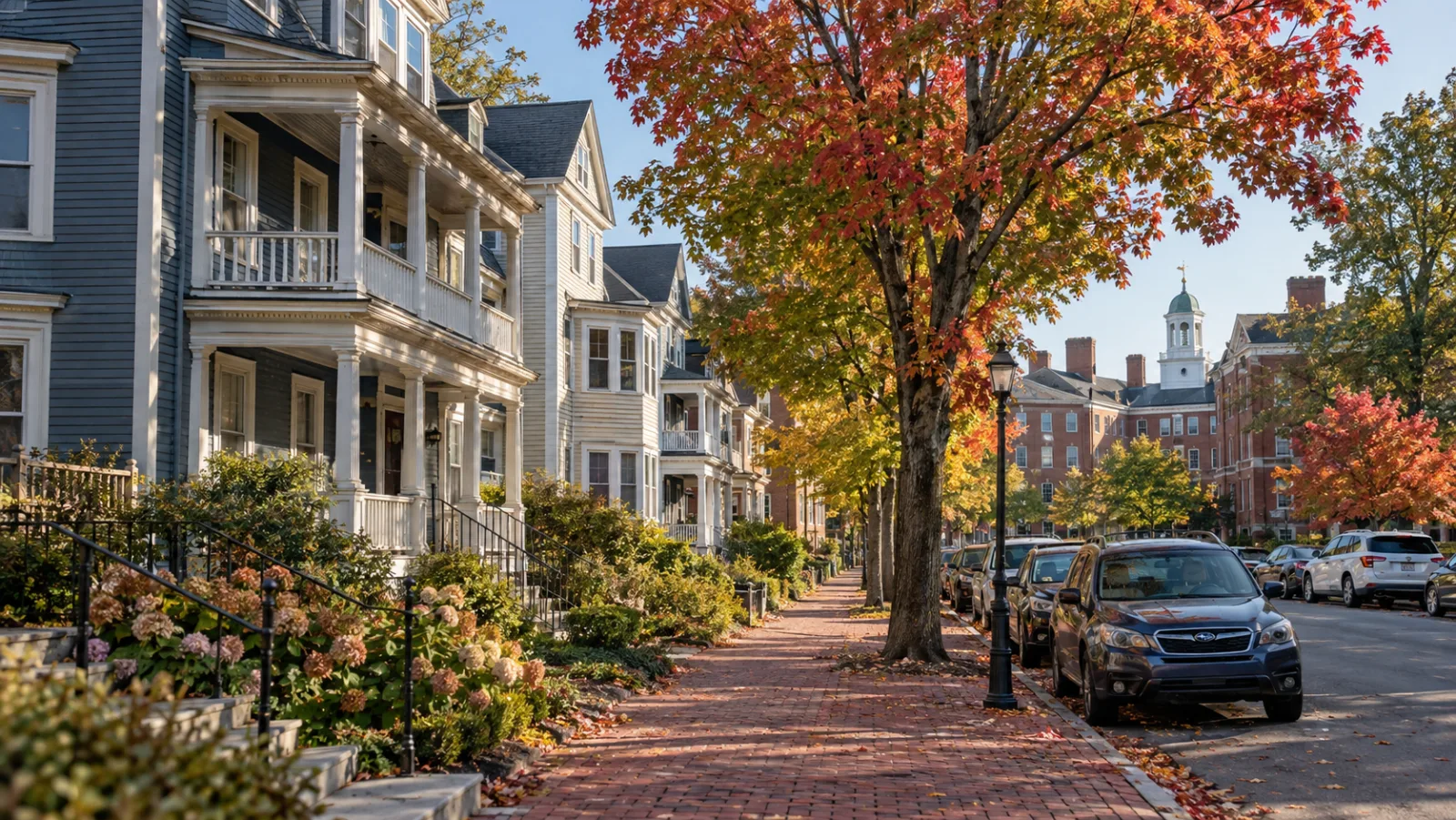
Why Plymouth has a year-round rental market
Plymouth State has educated students on the hill at the south end of Main Street since 1871, on a campus the university puts at 170 acres. Enrollment is the number people get wrong most often, and PSU's own website is part of the reason. Checked in September 2026, the university's About page carries a Fast Facts panel reading 3,182 undergraduate students a few hundred words below prose describing "approximately 4,100 undergraduate and approximately 3,000 graduate students." Federal IPEDS reporting for 2024-25 put total headcount at 3,707. The sources differ and we are not going to pretend otherwise: underwrite against the smaller published figure, roughly 3,200 undergraduates, and recheck it annually, because enrollment is the single input your rent roll depends on.
Around that sits the rest of the payroll: Speare Memorial Hospital, the Grafton County courthouse complex, SAU 48, and the retail, restaurants and things to do that a dozen surrounding towns drive here to use. The town is small — about 6,618 residents in the 2023 Census ACS five-year estimates, median age 26.8, which tells you who lives here. The Plymouth NH town page and the moving to Plymouth guide cover that side of the picture.
For a landlord, the consequence is two overlapping tenant pools rather than one. Students fill the walk-to-campus stock on a nine- or twelve-month cycle. Nurses, faculty, county employees, teachers and tradespeople fill the rest on conventional twelve-month leases, in every season. A building that can serve either pool is worth more than one that can only serve students, and that flexibility is a function of location and parking rather than finish.
The university rule that decides who your tenants can be
This is the fact most out-of-area investors miss, and it is published on Plymouth State's own Residential Life pages. PSU requires full-time matriculated students to live on campus if space is available. For 2026-27, a student is released if they turn 21 on or before September 1, 2026, or have earned 64 or more Plymouth State credits by the end of Winterim on January 31, 2026. Every first-year student lives in a traditional residence hall as part of the First-Year Residential Experience — Blair, Belknap, Grafton, Pemigewasset, Geneva Smith, or select rooms in Mary Lyon. A separate release covers students commuting from a home owned by, or shared with, a parent or guardian within a thirty-mile commute, with written approval from Residential Life.
That defines your market:
- Your tenants are juniors, seniors and graduate students. Sixty-four credits is the end of sophomore year on a normal load. First-years and most sophomores are not available to you.
- The parent-owned-home exception is a door held open for one kind of buyer. A parent housing their own student is operating inside a written policy, not around one. Get the approval in writing before you rely on it.
- The policy is reviewed annually. PSU says so in the same document. A tighter credit threshold shrinks the off-campus pool; a looser one expands it. That is a risk in your model with nothing to do with the housing market.
- "If space is available" cuts both ways. In a year when the halls are full, more students are released; when they are not, fewer are.
- A signed lease is not a release. PSU tells students not to sign an off-campus lease for the coming year unless they already meet the release criteria, and states that a signed lease alone is not justification for release. A lease signed by a student who is still hoping for one is not a lease you can bank.
If your plan depends on renting four bedrooms to four first-years, there is no plan. A three-bedroom leased to rising juniors with a parental guaranty behind it is the actual market.
The calendar your lease has to match
Plymouth State's published term dates set the leasing year. Fall 2026 runs August 31 to December 18. Spring 2026 ended May 8; summer session ran May 11 to August 7. So the academic-year occupancy window is roughly the third week of August through the second week of May, and the lease decision follows from that.
| Nine-month lease | Twelve-month lease | |
|---|---|---|
| Term | Late August to mid-May | Late August to late August |
| Per-bedroom rent | Higher — nine months of use | Lower per month, more in total |
| Summer risk | Yours. You carry June to August | Theirs. They pay through the gap |
| Tenant appeal | Strong — no paying for an empty room | Weaker, unless they can sublet |
| Turnover | Every May, every year | Every August, but often renewed |
| Best for | Buildings with summer demand from staff or travel nurses | Walk-to-campus units students renew |
Most experienced Plymouth landlords write twelve-month leases at a rent the student market will bear and allow approved summer sublets, because a nine-month lease priced to cover twelve months of carry loses to the landlord down the street who did the twelve-month version. If you do write nine months, price the vacancy honestly rather than assuming a summer tenant.
Three more calendar-driven mechanics belong in the lease. Sign early, and know why early is early. Units for an August start are commonly committed by March or April because the university's calendar sets the pace: returning-student housing selection at PSU begins in mid-February, and release requests for 2026-27 were due March 2, 2026, with decisions shared before selection opened. The off-campus leasing season is the few weeks either side of that. A building you buy in June has already had its next academic year decided for it. Joint and several liability makes every tenant liable for the full rent rather than a share, which is what keeps one roommate leaving in October from becoming your problem. And a parental guaranty, drafted by your attorney as a guaranty of the whole obligation rather than a co-signature on one bedroom, is what makes a lease to three twenty-year-olds bankable.
Which streets are actually walkable to campus
The campus occupies the hill on the south side of downtown, and Highland Street is effectively its northern edge. Walkability falls off fast here, and the streets that genuinely work are a short list — these are the ones named in the town's own zoning district boundaries, so the geography is verifiable rather than local hearsay.
A genuine walk. Highland Street, Merrill Street, Langdon Street, Langdon Park Road, Russell Street, Pleasant Street, Winter Street, Warren Street, School Street, Emerson Street, Cooper Street, Hawthorne Street, Avery Street, Cummings Street, Bayley Avenue, Batchelder Street, Broadway, Court Street, Weeks Street, and the Main Street blocks between Merrill and Warren. This tight grid between Main Street, the Baker River and the campus holds nearly all of the converted multi-family stock.
A longer walk students will still do. Tobey Road and Armory Road at the north end, and the blocks west toward Old Ward Bridge Road. Add ten minutes and a hill.
A drive, whatever the listing photo suggests. Fairgrounds Road and the Route 3 corridor north toward Campton. Smith Bridge Road and everything off Tenney Mountain Highway to the west. Texas Hill Road, Binks Hill Road, Reservoir Road and the hill roads. Cummings Hill Road and the south end past Crystal Springs. These are fine places to own a house — the Plymouth neighborhoods guide covers what each is good for — but a student rental out here needs a parking space per tenant and a tenant with a car, which changes the economics entirely.
The whole 03264 ZIP is one town, but the walkable core is perhaps a dozen blocks of it. Inventory across the ZIP is on the 03264 real estate page; the walk-to-campus subset is a much smaller thing, which is why a fairly priced duplex on Merrill Street draws multiple offers in days while a comparable building three miles out sits.
What the zoning map allows, street by street
Plymouth's zoning ordinance is unusually specific about multi-family housing, and reading it before you offer will save you from the most expensive mistake available in this market. The figures below are from the ordinance as revised at the March 11, 2025 town meeting. Plymouth amends it most years — the town now posts an edition revised March 10, 2026 — so confirm anything you are relying on against the current text.
| District | Two-family | Multifamily (3–6 units) | Minimum lot on municipal water and sewer |
|---|---|---|---|
| SFR — Single-Family Residential | Special exception only | Not permitted | 10,000 sq ft, plus 5,000 per extra unit |
| MFR — Multi-Family Residential | Permitted | Permitted | 7,500 sq ft, plus 2,500 per extra unit |
| VC — Village Commercial | Permitted, above or below street level only | Permitted, above or below street level only | No minimum lot size |
| CI — Civic/Institutional | Permitted | Special exception | 20,000 sq ft, plus 2,500 per extra unit |
Four things follow.
A multifamily dwelling in Plymouth means three to six units. The ordinance defines it that way and the use table permits "multifamily dwelling, not exceeding 6 units per building." Anything larger is not a listed residential use, which is why the stock tops out at small buildings. Scale here means several buildings, or mixed-use — see the New Hampshire commercial property guide for that end.
The MFR district is small and specific. The ordinance describes it in three pieces: a southern block bounded roughly by Warren, Main, Highland and Russell Streets; a central block around Highland, Langdon, School and Merrill Streets out toward Bayley Avenue and Langdon Park Road; and a northeast piece between Tobey Road, Armory Road and Main Street. That is the legal home of walk-to-campus multi-family. Most of the rest of the grid is SFR or CI.
Do the lot-area math before you assume a fourth unit. In MFR on municipal services, a four-unit building needs 7,500 square feet plus 2,500 for each unit above the first — 15,000 in total. Plenty of village lots in this grid are smaller than that.
A nonconforming three-unit is a wasting asset if you let it sit. Many multi-family buildings near campus are lawful nonconforming uses that predate the ordinance in districts that would not allow them today. The ordinance protects them with one hard condition: if a nonconforming use is discontinued for one year, it cannot be resumed. A three-unit in the SFR district left empty through a long renovation can come back as a single-family house. Get the legal unit count confirmed in writing by the code enforcement officer before closing, and do not let a building go dark.
Rooming houses — rented by the room — are a special exception use in most districts, with their own rules: at least 1,000 square feet of lot per occupant and never less than 11,000 total, a cap of 16 residents, and a requirement that the owner or an on-site manager actually live there. That last one rules the model out for most absentee investors. Adding a unit to a single-family house is a different path: Plymouth allows accessory dwelling units, capped at two adults each and approved by conditional use permit, and our New Hampshire ADU guide covers how that works statewide.
Parking is the constraint that decides the deal
Everything here eventually comes down to parking, and the ordinance says so out loud — Section 411 states its purpose as keeping traffic moving, letting fire apparatus through, and facilitating snow removal. The minimums:
- Multifamily dwelling: one space per one-bedroom unit; two spaces per unit for units with two or more bedrooms.
- Multifamily in a development of ten or more units: 1.5 spaces per unit.
- Two-family and single-family dwellings: two spaces per dwelling unit.
- Rooming house: one space per resident. Student residence: one per sleeping room, or one per two beds, whichever is greater.
- Residential units in the Village Commercial zone occupied by an unrelated family: one parking space per bedroom.
That last line is the student-rental rule, and it connects to the definition that governs occupancy everywhere else in the ordinance — the one this article opened with. Plymouth defines an "unrelated family" as any group of three persons or less not related by blood, marriage or adoption living together as a single housekeeping unit. Three. A four-bedroom unit near campus cannot legally house four unrelated students as one household, so the fourth bedroom is a study, not a revenue line. Confirm the interpretation with Plymouth's code enforcement officer for the specific building — before the inspection contingency runs, not after.
The rest of the parking reality: spaces must be paved or gravelled on any residential property other than a single-family dwelling, and no vehicle may be parked on grass or dirt outside a designated space, so the informal side-yard overflow student tenants create is a violation rather than a grey area. Each required space must be at least 9 by 19 feet exclusive of aisles and manoeuvring space, so measure the driveway — village lots here frequently cannot fit what the unit count requires. Off-site parking is available only by special exception and only within 300 feet. And Plymouth has adopted the state's alternative-parking framework under RSA 674:16-a, which lets the Planning Board approve shared off-site spaces within a quarter mile, transit or walkability arrangements in place of strict minimums — a real tool for a downtown project, and one that goes through the Planning Board rather than around it.
And on-street parking is not the fallback, because for the entire academic year there is no on-street parking. Plymouth's traffic and parking ordinance bans overnight parking on every street in town between 12:00 midnight and 6:00 a.m. from September 1 to June 1 — not a winter snow rule, the whole school year — and the Police Department lists the fine at $50. Parking is separately prohibited on all streets, sidewalks and public ways during a declared snow ban so the Highway Department can clear them. Daytime downtown parking is metered at $1.00 per hour, Monday to Thursday 8 a.m. to 6 p.m. and Friday and Saturday 8 a.m. to 9 p.m., free Sundays and holidays; Langdon, Merrill, Russell and High Streets and the Green Street overnight lot are pay-by-app through Parkmobile, and select Green Street spaces are permit only. That paid overnight lot on Green Street is the only public overnight option the Police Department lists, and it is a nightly cost somebody has to absorb.
So every tenant's car has to fit on your property, every night, for nine months. If the driveway holds two cars and the unit has three bedrooms, you do not have a three-bedroom student rental — you have a two-car building, and the third tenant will park on the grass, which is separately prohibited. Count the spaces before you count the bedrooms. On the walk-to-campus grid, where lots are village-sized and driveways run one car deep, that arithmetic fails more often than it works.
The buildings themselves
The walk-to-campus stock sorts into four kinds, and they behave differently.
- The converted village house. An 1880s–1920s Victorian, foursquare or cape, cut into two to four units between roughly 1965 and 1995. Most of what trades, and the conversions range from careful to alarming: original framing, added kitchens, stacked bathrooms over original joists, and a basement full of decades of decisions.
- The purpose-built small multi-family. A handful of 1960s–1980s buildings put up as apartments, with parking laid out from the start. They carry a premium and deserve one, largely because the parking already works.
- The duplex. Often the cleanest entry point: two units, four to six bedrooms, financeable as owner-occupied, simple enough to self-manage. The "duplex for sale Plymouth NH" search is the most competitive in town for a reason.
- The condo. Mostly in-town conversions and small associations near campus and the hospital, plus riverside clusters. Easiest to own at a distance and hardest to fill with students, because most association documents restrict leasing, occupancy or both. Read them before assuming you can rent by the bedroom.
The newer product is not in the walkable grid. It is on the village edge and across the rivers — better buildings, bigger lots, more parking, and a tenant pool of hospital and university staff and families rather than students. A legitimate and often better strategy, simply a different one, and it shades into the neighbouring towns: how Plymouth compares with Campton and Thornton matters if the thesis is staff housing rather than students.
The numbers, per bedroom rather than per unit
Student housing prices by the bed, not the apartment. Any pro forma that starts with "a three-bedroom rents for X" is already out of step with how this market quotes: landlords near campus advertise a per-bedroom rate, usually with utilities included or split, and total the building from there.
With one correction that reorders the whole calculation. Price by the bed, but cap the beds at three per unit, because that is where Plymouth's unrelated-family definition leaves you. A four-bedroom unit is a three-tenant unit with a spare room. A six-bedroom duplex is two three-tenant units, not six beds. Build the model as units times three, not bedrooms times rent, and treat any bedroom beyond the third as a reason the unit leases quickly rather than as income.
What follows is our market read from working this town, not a published statistic. Plymouth's MLS multi-family sample in any given month is small enough that a town median is close to meaningless, and we will not dress up a thin sample as data.
- Duplexes in and near the walkable grid have generally traded in the mid-$300,000s to the high-$400,000s, depending on condition, unit mix and whether the parking works.
- Three-unit buildings in the same area generally run from the low $400,000s into the $600,000s.
- Four-unit buildings are genuinely scarce — there are not many legal ones — and when they trade they tend to clear above the three-unit band, with the premium driven by the lot and the parking as much as the building.
- For context, the 2023 ACS median home value for Plymouth was $277,300 and mid-2026 single-family list-price medians have run near $419,000. Multi-family trades above the single-family median here because the buyer pool for it is larger.
On the income side, ask four questions rather than reaching for a gross rent multiplier: what does a bedroom rent for on this street, how many of those bedrooms the three-person occupancy cap actually lets you fill, who pays heat, and how many months are covered. Then take 25% off gross rents before you get excited — roughly the discount a lender will apply for vacancy and maintenance, and a more honest starting point than a spreadsheet at 100% occupancy.
Current inventory in this segment is on the Plymouth NH investment properties page, and the framework for evaluating any New Hampshire rental purchase is in our NH investment property guide.
What it costs to run a Plymouth rental
Property taxes. New Hampshire has no income tax and no sales tax, so property tax carries the municipal load, and Plymouth carries an added structural burden: a large share of its land area — the university, the hospital, the courthouse complex — is tax-exempt, which shifts the bill onto the taxable grand list. The arithmetic, the current rate and the abatement process belong to our Plymouth NH property taxes guide. Do not underwrite on the seller's current bill without reading it.
Heat, and who pays it. The line that separates a good year from a bad one. Most walk-to-campus stock is pre-1950 construction on oil or propane, often with one boiler and a single zone serving units carved out later. If there is one heating system and no unit-level metering, you are paying for heat, and your tenants are nineteen to twenty-two years old in a New Hampshire January. Separate the systems, install controls you manage, or price heat into the rent with a realistic number and a cap. Budget a replacement on any boiler over twenty years old, and check whether the oil tank is buried.
Water, sewer, snow and turnover. The in-town grid is on municipal water and sewer, which removes the well-and-septic diligence that dominates the rest of Grafton County and means quarterly bills that usually land on the owner — confirm how the building is metered. Plowing and roof-and-walkway clearing are not optional, and a landlord with one small lot, three tenants' cars on it and no legal street to move them to is buying a contract, not a snowblower. And budget a full make-ready every May: paint, floor repair, an appliance or two, and a cleaning that costs more than you think. Student wear is volume, not malice.
Management. The difference between self-managing and not is the three-hour drive from Boston at 11 p.m. in February. Our property management team handles year-round rentals here, including the parts that matter most in a student building — screening, lease enforcement and the turnover.
And the thing Plymouth is not is a short-term rental market. Nightly demand in this valley sits in the resort towns, not on Highland Street; a nightly strategy belongs in Campton, Thornton or Lincoln, and our vacation rental management page covers how that is run. The renter-side view of this market is in the Plymouth NH rentals guide.
Egress, and the inspection that kills these deals
The most common structural problem in this housing stock is bedrooms in converted attics and basements without compliant egress.
The pattern is always the same. A 1900 house was cut into units in 1978. At some point the attic became "the fourth bedroom" with a knee-wall, a small gable window and one stair down. Or the basement got a partition, a dropped ceiling, a hopper window near grade and a bulkhead padlocked from the outside. Both rent. Neither is a legal sleeping room, and both are how a landlord ends up in front of the fire department after an incident.
What compliant actually means, in inches. New Hampshire's state building code adopts the 2021 International Residential Code by reference under RSA 155-A:1, IV, together with the amendments approved by the state building code review board as of April 11, 2025. Under IRC Section R310 every sleeping room, and every basement, needs at least one operable emergency escape and rescue opening, and the requirements are numeric rather than a matter of opinion:
- A net clear opening of at least 5.7 square feet — 5.0 square feet is allowed for a grade-floor opening.
- At least 24 inches of net clear height and at least 20 inches of net clear width, measured on the opening as it actually operates. Both minimums must be satisfied inside that 5.7 square feet, which is why a wide, short basement hopper window almost never qualifies however large it looks.
- The bottom of the clear opening no more than 44 inches above the floor. This is what disqualifies most basement bedrooms in this stock: the window sits up near the joists.
- Operable from inside without keys, tools or special knowledge.
- Where the opening is below grade, an area well of at least 9 square feet with a horizontal projection and width of at least 36 inches, plus a permanently affixed ladder or steps if the well is deeper than 44 inches.
Two more numbers settle most attic arguments. Habitable space needs a 7-foot ceiling; where the ceiling slopes, at least half the required floor area must be at 7 feet, and floor area under 5 feet does not count toward the requirement at all. And IRC R310.7 is explicit that a new sleeping room created in an existing basement must be given a compliant escape opening — conversion is the trigger, so "it was like that when I bought it" is not the defence people assume it is. A room that predates the code and has never been altered is judged under the state fire code the chief enforces rather than under the IRC; that distinction is worth asking about rather than assuming in your favour.
Enforcement here is local and personal. RSA 155-A:1, III makes the municipal fire chief the local enforcement agency for the state fire code in buildings the state does not own. Plymouth's zoning ordinance defers to the fire department explicitly on life-safety minimums for setbacks, access and circulation, and directs the building inspector to act in cooperation with it and to order repair, vacancy or demolition of unsafe structures. Plymouth has gone further still: the town moved building permitting from Planning and Development to the Fire Department in February 2023, and the building inspector and code enforcement officer works out of the fire station at 42 Highland Street. One number, (603) 536-1253, reaches both of the people who can tell you what your building is approved for. The position is part time, so call early in your diligence rather than late.
So: count the legal bedrooms rather than the advertised ones, and get the approved count in writing from the fire department and the code enforcement officer. Walk every sleeping room and find the second way out — a compliant means of escape means a door to a protected exit path plus a window or second route a person can get through and a ladder can reach, not one interior stair through a common kitchen. Look for the tells: a bedroom with no interconnected smoke detector, a basement bedroom whose only window sits above the boiler, an attic stair you have to duck under, interior doors that do not latch, a bulkhead that will not open from inside. Then price the fix during diligence — an egress window and window well, or a second stair, is a real number a local contractor can give you before you close, not after.
What Plymouth does not require. There is no rental registration ordinance in Plymouth and no published periodic rental-inspection schedule. As of September 2026 the town's published ordinances are the zoning ordinance plus a traffic and parking ordinance, a disorderly actions ordinance, a refuse container ordinance and a rights-based ordinance; none of them creates a landlord registry, a rental permit or a recurring inspection cycle, and the Fire Department's published permits cover oil and LP gas installations, blasting, hot works and fireworks, not rentals. What does exist is Plymouth Fire-Rescue's fire prevention programme, which lists existing residential fire inspections and pre-planning among its functions, and a fire safety and health complaint form on the town website that a tenant or a neighbour can file. So the absence of a registry is not an absence of oversight. It means the first inspection of your building may well be one that somebody else requested. An absence is harder to verify than a rule, so confirm it for your address with the code enforcement officer.
Assume lead paint too. Almost all of this stock predates 1978. Federal law requires a seller or landlord of pre-1978 housing to disclose known lead-based paint and hazards and provide the EPA pamphlet, and work disturbing painted surfaces must be done by a certified renovator under EPA's RRP rule. New Hampshire's own lead law, RSA 130-A, is worth knowing in specifics rather than by name:
- A lead exposure hazard is mostly just deteriorated paint. RSA 130-A:1, XVI includes lead base substances that are peeling, chipping, chalking or cracking, or any damaged or deteriorated painted surface likely to become accessible to a child, and lead paint on surfaces subject to friction or repeated impact — which describes every window sash and door jamb in a hundred-year-old house. The dust thresholds in the statute are 40 micrograms per square foot on floors, 250 on windowsills and 400 in window wells, with the federal standard prevailing where it is stricter.
- What triggers an order. The department investigates when a child's blood lead level reaches 5 micrograms per deciliter of whole venous blood (RSA 130-A:5, I). Between 3 and 9.9 micrograms it notifies the owner in writing, and that notice is explicitly neither a finding of a hazard nor an order (RSA 130-A:6-a, I). If an inspection then finds a hazard, the commissioner shall issue a written lead hazard reduction order, and may inspect other units in the same building occupied by a child or a pregnant woman (RSA 130-A:6, I).
- Ninety days, and it follows the property. An order on an occupied dwelling allows no more than 90 days for the work unless the commissioner extends it (RSA 130-A:7, II(c)). It binds anyone who later acquires the property, and it is recorded at the registry of deeds and runs with the land (RSA 130-A:7, IV and VI). That makes it a title question on any pre-1978 Plymouth rental, not just a maintenance one.
- Interim controls are not a permanent answer. They substitute for abatement only with the commissioner's prior written approval, and they require a certificate of compliance from a licensed risk assessor every year (RSA 130-A:7, V).
- Creating a new rental unit triggers certification. Since July 1, 2024, RSA 130-A:5-d has required certification of lead safety before a newly created rental unit in a building erected before January 1, 1978 may be used as residential rental housing — and "newly-constructed" there means a unit converted from some other use. Cutting a new apartment into a pre-1978 Plymouth house is precisely that.
- It also changes what you can do about a tenant. Evicting a tenant because a child has tested positive for lead is unlawful, with a rebuttable presumption against any eviction begun within six months of notice (RSA 130-A:6-a, II). Conversely, a tenant who refuses access for a lead inspection gives good cause for eviction under RSA 540:2, II(e), provided you give at least 48 hours' written notice (RSA 130-A:6-a, IV).
If you are renovating a Plymouth student rental you are working in a lead environment. Budget and staff for it, and confirm current requirements with NH DHHS.
A building with three legal bedrooms rented as five is not a bargain. It is a rent roll you cannot keep.
The landlord-tenant law you are signing up for
New Hampshire's residential rules live in RSA 540 (actions against tenants) and RSA 540-A (prohibited practices and security deposits), and the thresholds in both turn on how much rental property you own and whether you live in the building. Get them right before you structure the purchase — they can change the answer to "should I buy the three-unit or the four-unit."
Security deposits. RSA 540-A:5 excludes from the definition of "landlord" a person who rents a single-family residence and owns no other rental property, and a person renting units in an owner-occupied building of five units or fewer — except any unit in that building occupied by a person 60 or older. Outside those exclusions the rules apply in full: the deposit is capped at one month's rent or $100, whichever is greater; it remains the tenant's money and must be held in trust rather than mingled with yours; you must give a signed receipt stating the amount and where it is held; you owe interest if you hold it a year or longer; and you must return it, with interest, within 30 days of the end of the tenancy, with a written itemised list of any damages claimed and evidence the repairs have been or will be done.
Evictions. RSA 540:1-a distinguishes restricted from nonrestricted property. Nonrestricted includes single-family houses where the owner owns no more than three at a time, and units in an owner-occupied building of four dwelling units or fewer. For restricted property — most investor-owned multi-family — a landlord may terminate only for an enumerated good cause under RSA 540:2, II: nonpayment, substantial damage, a material lease violation, behaviour affecting health or safety, other good cause, and a short list of others. Notice is seven days for nonpayment and thirty days for most other grounds, and a nonpayment notice must tell the tenant how to avoid eviction by paying the arrearage and liquidated damages under RSA 540:9. The case is filed in the Circuit Court, District Division, on the state's own landlord-tenant forms.
An uncontested New Hampshire eviction takes weeks from notice to writ of possession; a contested one takes longer, and a student tenant with a parent paying for counsel is entirely capable of contesting. Plan on carrying an empty unit through it, and note the trap the calendar sets: an eviction started in February may not conclude before the May turnover anyway. Screening and a real parental guaranty are worth more than any remedy the statute gives you afterwards.
Two more items for the file. New Hampshire's seller disclosure obligations apply when you buy and again when you sell. And rental activity is a business here, so know where the state's business tax thresholds actually sit rather than assuming they are far away. According to the Department of Revenue Administration, for taxable periods beginning on or after January 1, 2025 a business organization must file a Business Profits Tax return if gross business income from all business activities exceeds $109,000, with the tax charged at 7.5% of taxable business profits; a business enterprise must file a Business Enterprise Tax return if gross receipts from all activities, or its enterprise value tax base, exceeds $298,000, at 0.55%. Both thresholds are adjusted biennially, and BET paid is creditable against BPT.
The BPT threshold is the one that catches Plymouth landlords, because it is measured on gross income rather than profit. Two multi-family buildings renting by the bedroom can clear $109,000 of gross rent while producing nothing like that in cash. Whether your particular ownership structure counts as a business organization for these purposes is a question for your accountant; the thresholds themselves are not.
This is general information, not tax or legal advice; your attorney and the town assessor have the current answers for a specific property.
Financing a Plymouth multi-family
What you can borrow depends almost entirely on whether you will live in the building.
Owner-occupied, two to four units is the best money available to a small investor here. FHA finances one- to four-unit owner-occupied property with a low down payment, conventional owner-occupied financing for two- to four-unit property has been available at 5% down since Fannie Mae's 2023 change, and VA is zero down for eligible buyers. The catch on FHA three- and four-unit purchases is the self-sufficiency test: net rental income must cover the mortgage payment, which a marginal Plymouth three-unit may or may not pass. You must occupy a unit, generally for at least a year.
Investor terms mean a larger down payment, a rate premium and reserve requirements. Local and regional banks that know Plymouth will portfolio these; a national lender underwriting from a call centre often will not understand a nonconforming three-unit at all. DSCR loans qualify the property rather than the borrower, comparing rental income to debt service and skipping personal income documentation — how a lot of small multi-family gets bought now, at a larger down payment, a higher rate than owner-occupied terms, and a conservative view of creditable rent.
How lenders count student rent is where Plymouth deals get repriced late. Underwriters want executed leases and typically discount gross rents by around 25% for vacancy and maintenance. Nine-month leases get scrutinised and are sometimes annualised down for the summer gap. Per-bedroom rents in a unit whose legal occupancy is capped at three unrelated persons will not be credited for four beds. Bring executed leases, a rent roll, two years of the seller's operating statements and the tax bill to the first conversation, and make sure the appraiser gets a genuinely local rent schedule. Talk to a lender before you shop: in this price band, a pre-approval that already contemplates the unit count and the lease structure is what separates an accepted offer from a retrade.
The parent buyer's arithmetic
Buying a house for a student is a real strategy here, and it deserves an honest number. Start from the alternative. Plymouth State's published 2026-27 direct-billed costs put room and meals at an estimated $14,008 for a double room with an unlimited meal plan, on top of tuition and mandatory fees of $15,444 for a New Hampshire resident and $26,872 out of state. Over four years, room and board alone is roughly $56,000 — and the first two of those are years the university requires the student to live on campus anyway.
So the honest version is that buy-versus-dorm is really a two-year comparison, junior and senior year, against roughly $28,000 of room and board — unless the student qualifies for the parent-owned-home commuting exception from the start, in which case it is four.
| Dorm and meal plan | Buying a house or condo | |
|---|---|---|
| Cash out | About $14,008 a year, billed | Down payment, closing costs, then the monthly carry |
| Covered years | All four, if the student stays on campus | Realistically two, unless you use the commuter exception |
| Offsetting income | None | Rent from roommates — capped at three unrelated occupants per unit |
| Ongoing costs | None | Taxes, insurance, heat, water and sewer, snow, repairs |
| Tax treatment | Personal expense | Rental, if rented — depreciation over 27.5 years, expenses deductible |
| At the end | Nothing | An asset to sell or keep renting, minus selling costs |
Three things parents consistently get wrong. The primary residence exclusion will not apply to you — Section 121 requires the property to have been your principal residence for two of the five years before sale, and your student living there does not make it yours, so plan on a taxable gain plus depreciation recapture on anything you depreciated. Charging your own child rent does not by itself make it a rental; if you want depreciation and expense deductions the arrangement has to be a real rental at fair market rent, documented, and that is a conversation to have with your accountant before rather than after. And the exit is not automatic — graduation is in May and the market for a Plymouth multi-family is strongest in spring, which can line up nicely, but if your student graduates into a soft month you are a landlord for another year. Decide now whether that is acceptable; if you would rather keep it, everything else in this article applies to you.
Under-$500,000 inventory, where most parent buyers end up, is on the Plymouth homes under $500K page, and the neighbourhood-by-neighbourhood picture of what that money buys is in the Plymouth homes for sale guide.
What actually goes wrong
Enrollment. The pool of high school graduates across northern New England is shrinking and regional public universities have felt it. Plymouth State has a strong regional draw and programs that fill, but no student-rental investment is insulated from its enrollment. Underwrite a building that also works at a rent the staff-and-faculty market will pay.
Wear. A student building depreciates faster than a family building — floors, walls, appliances and the yard take three people's use for nine months and then a summer of nothing. Owners who run these well replace on a schedule instead of reacting.
The May turnover. Every year, all at once: four units means four make-readies compressed into three weeks, in a town where every other landlord is calling the same painter and the same cleaner. Book your trades in February.
Neighbours, and the noise ordinance. The most underestimated item on the list. Tolerance for student rentals varies street by street in Plymouth: the blocks closest to campus have lived with it for decades and accept it, while the quieter edges of the grid, where owner-occupants have stayed, do not. What makes that the owner's problem rather than the tenant's is how the department says it enforces. Plymouth Police publish a presumptive policy on noise complaints — once a founded complaint comes in, the officer issues a summons rather than a warning — with fines of $372 for a first offence and $744 for a second, and tenants are held responsible for activity on the property regardless of who made the noise. In all instances the police send a letter to the property owner or landlord describing the incident, and cases are referred to the Plymouth State Dean of Students. Separately, more than fifty people inside a dwelling makes it an assembly occupancy requiring a permit, and RSA 644:18 makes hosting a gathering of five or more people under 21 where one of them is drinking a Class A misdemeanour. Town and university police hold the same authority on and off campus under a cooperative agreement. Drive the street on a Saturday night in October before you buy. Then knock on a door and ask.
The retrade. The most common way a Plymouth multi-family deal dies is that the legal unit count, bedroom count or parking count turns out lower than the listing said — a diligence problem, entirely preventable by making the calls before your contingency runs.
Who this works for and who it does not
It works for an owner-occupant buying a duplex or three-unit and living in one side: the best financing, the lowest risk, and the version that builds real equity. It works for a regional investor within a reasonable drive who will answer the phone, or who pairs the purchase with local management. It works for a parent whose student will be here four years and who has decided in advance that they are willing to be a landlord afterwards. And it works for anyone buying on numbers a staff-and-faculty tenant will support, with the student premium as upside rather than as the thesis.
It does not work for a distant investor with no local contractor, no manager and no intention of visiting. It does not work as a hands-off yield play — this is an operating business in old buildings in a cold climate. And it does not work at all if the legal unit count, bedroom count or parking does not support the rent roll, which is why every recommendation here points at the same short list of calls: the code enforcement officer and the fire department, who share a number at 42 Highland Street; Planning and Development on the zoning district and the lot-area maths; and a lender who has financed in Plymouth before. Owners already holding a Plymouth rental and weighing a sale into this demand can start with our Plymouth seller page.
Frequently asked questions
Where do Plymouth State students live off campus?
Almost entirely in the converted multi-family houses and small apartment buildings in the grid between Main Street, the Baker River and the campus — Highland, Merrill, Langdon, Russell, Pleasant, School and the surrounding streets, plus units above the Main Street storefronts. Plymouth State requires full-time students to live on campus unless they have earned 64 or more PSU credits or reach 21 by the start of the year, so the off-campus population is mostly juniors, seniors and graduate students.
Is a multi-family in Plymouth NH a good investment?
It can be, for an operator rather than a passive owner. Plymouth has year-round rental demand from a university, a hospital and a county seat, which almost no other town in this valley does. The risks are enrollment, the age and condition of the buildings, the May turnover, and zoning limits on unit count, occupancy and parking that can make a listing's advertised rent roll unachievable. Verify all three counts — units, legal bedrooms, parking spaces — before you offer.
How many unrelated people can live in a rental unit in Plymouth NH?
Plymouth's zoning ordinance defines an "unrelated family" as a group of three persons or less not related by blood, marriage or adoption living together as a single housekeeping unit. That is the figure to plan against, and it means a four-bedroom unit cannot simply be leased to four unrelated students. Confirm how the town applies it to your building with Plymouth's code enforcement officer.
Can students park on the street overnight in Plymouth NH?
No. Plymouth's traffic and parking ordinance bans overnight parking on every street in town between 12:00 midnight and 6:00 a.m. from September 1 to June 1 — the whole academic year, not only the snow season — and the Police Department lists the fine at $50. Parking is also prohibited on all streets, sidewalks and public ways during a declared snow ban. The only legal overnight alternative to your own lot is the paid overnight lot on Green Street, which runs through the Parkmobile app. In practice, every tenant with a car needs a space on the property.
How much parking does a Plymouth rental need?
Under the zoning ordinance a multifamily building needs one space per one-bedroom unit and two spaces per unit for units with two or more bedrooms; a two-family needs two per unit; and residential units in the Village Commercial zone occupied by an unrelated family need one space per bedroom. Spaces must be paved or gravelled and at least 9 by 19 feet, and parking on grass or dirt is not permitted.
Does Plymouth NH require landlords to register or inspect a rental property?
As of September 2026 there is no rental registration ordinance in Plymouth and no published periodic rental-inspection schedule. The town's published ordinances are the zoning ordinance, a traffic and parking ordinance, a disorderly actions ordinance, a refuse container ordinance and a rights-based ordinance, and the Fire Department's permits cover oil and LP gas installations, blasting, hot works and fireworks rather than rentals. That is not the same as no oversight: Plymouth Fire-Rescue lists existing residential fire inspections among its fire-prevention functions and the town publishes a fire safety and health complaint form, so an inspection can be prompted by a tenant or a neighbour at any time. Confirm for your own address with the code enforcement officer, who works out of the fire station at 42 Highland Street.
What makes a bedroom legal in a New Hampshire rental?
New Hampshire's state building code adopts the 2021 International Residential Code under RSA 155-A:1, IV. Section R310 requires every sleeping room to have an operable emergency escape and rescue opening with a net clear opening of at least 5.7 square feet (5.0 at a grade floor), at least 24 inches of clear height and 20 inches of clear width, and the bottom of the opening no more than 44 inches above the floor, openable from inside without keys or tools. Below-grade openings need an area well of at least 9 square feet with a 36-inch projection, and a ladder if the well is deeper than 44 inches. Habitable space needs a 7-foot ceiling, with at least half the required floor area at that height where the ceiling slopes. A new sleeping room created in an existing basement has to meet the escape-opening requirement, so converting a space is exactly the moment the rule bites.
Do I owe New Hampshire business taxes on rental income?
Possibly, and sooner than most owners expect. Per the Department of Revenue Administration, for taxable periods beginning on or after January 1, 2025 a Business Profits Tax return is required where gross business income from all business activities exceeds $109,000, taxed at 7.5% of taxable business profits, and a Business Enterprise Tax return is required where gross receipts or the enterprise value tax base exceed $298,000, taxed at 0.55%. The BPT threshold is measured on gross income, not profit, so a small portfolio of per-bedroom rentals can reach it. Both thresholds are adjusted biennially; your accountant should confirm how your ownership structure is treated.
Should I write a nine-month or a twelve-month student lease?
Most Plymouth landlords write twelve months and allow approved summer sublets, because a nine-month lease priced to cover twelve months of carrying cost loses to the building next door that did the twelve-month version. If you do write nine months, price the summer vacancy honestly instead of assuming a summer tenant appears.
What are the security deposit rules for a New Hampshire landlord?
Under RSA 540-A a landlord may not take more than one month's rent or $100, whichever is greater; the deposit stays the tenant's money and must be held in trust with a signed receipt; interest is owed if it is held a year or more; and it must be returned with an itemised statement of any damages within 30 days of the end of the tenancy. The rules do not apply to someone renting a single-family residence who owns no other rental property, or to units in an owner-occupied building of five units or fewer — except any unit occupied by a person 60 or older.
Can I buy a house in Plymouth for my college student to live in?
Yes, and it is common here. Plymouth State allows a student to live off campus while commuting from a home owned by a parent or guardian within a thirty-mile commute, with written approval from Residential Life — get that approval before you rely on it. Run the numbers against the university's published room and meals estimate of about $14,008 a year for 2026-27, remember the first two years are on-campus years anyway, and know that the primary-residence capital gains exclusion will not be available to you when you sell.
What is the most common problem in Plymouth student rental buildings?
Sleeping rooms in converted attics and basements without compliant egress. Most of this stock predates 1978 and was divided into units decades ago, and the extra bedroom that makes the rent roll work is frequently the one that is not legal. Ask the fire department and the code enforcement officer what the building is approved for, in writing, during diligence.
Owl's Nest Real Estate works both sides of this market from our office in Campton and Plymouth — the multi-families near campus and the buyers and sellers who own them. If you are weighing a Plymouth investment property or a house for a student, talk to us; we will make the zoning and fire department calls with you before you write the offer.