

The best things to do in Plymouth NH are a show at the Flying Monkey, a walk around the historic common and Main Street, free river swimming at Langdon Park, the hike to Pike's Peak on Plymouth Mountain, and day trips within half an hour — Rumney Rocks, Polar Caves, Newfound and Squam lakes, Tenney Mountain, Waterville Valley and Loon.
Plymouth, New Hampshire is not a resort town, and that is the point. It is a working hub at the confluence of the Pemigewasset and Baker rivers in Grafton County (ZIP 03264, I-93 Exits 25–26): 6,682 residents at the 2020 census, roughly 3,700 Plymouth State students for eight months of the year, a hospital, and the supermarkets and hardware stores the surrounding towns drive to. It sits where the Lakes Region stops and the White Mountains start.
| Plymouth at a glance | Pick | Cost |
|---|---|---|
| Night out | Flying Monkey Movie House & Performance Center, 39 Main St | Ticketed |
| Culture | Museum of the White Mountains, 34 Highland St | Free |
| Swim in town | Langdon Park river beach on the Baker | Free |
| Easy hike | Rainbow Falls, Walter/Newton Natural Area | Free |
| Real hike | Plymouth Mountain via the Sutherland Trail to Pike's Peak | Free |
| Family day | Polar Caves Park, Rumney (15 min) | $29 adult at the gate, 2026 |
| Lake beach | Wellington State Park, Newfound Lake (25 min) | $5 ages 12+ |
| Skiing close to town | Tenney Mountain (15 min) | 2026/27 adult season pass $359–$559 |
Getting your bearings
Two exits off I-93 serve Plymouth, which is unusual for a town under 7,000 people and tells you something about its role.
Exit 25 is the one for downtown, Plymouth State and Speare Memorial Hospital. The ramp is technically over the line in Holderness, and the exit is signed for Plymouth State University; Speare's own directions send you right at the stop sign, past the PSU Field House, over the bridge, and around the roundabout onto Main Street. It is the exit locals mean when they say "exit 25" — Biederman's names a sandwich after it.
Exit 26 puts you on Tenney Mountain Highway, Route 25 running west, where the supermarket, the big-box store, the urgent care and most of Plymouth's commercial growth of the last forty years ended up. The hospital campus is reachable from either exit.
The village is compact. Main Street runs a few blocks between the common and the bridge, Green Street drops to the river below it, the campus climbs the hill behind on Highland Street, and the Pemigewasset is at the bottom of town. Nothing downtown is more than a ten-minute walk from anything else downtown.
Plymouth is the gate. North on I-93: Campton, Thornton, Waterville Valley, Lincoln, Franconia Notch. West on Route 25: the Baker River valley, Rumney, Wentworth, Warren. South on Route 3A: Bristol and Newfound Lake. East on Route 25: Holderness and Squam. Boston is about two hours. For the rest of the state, our guide to things to do in New Hampshire sorts it by season and region.
Downtown Plymouth and Main Street
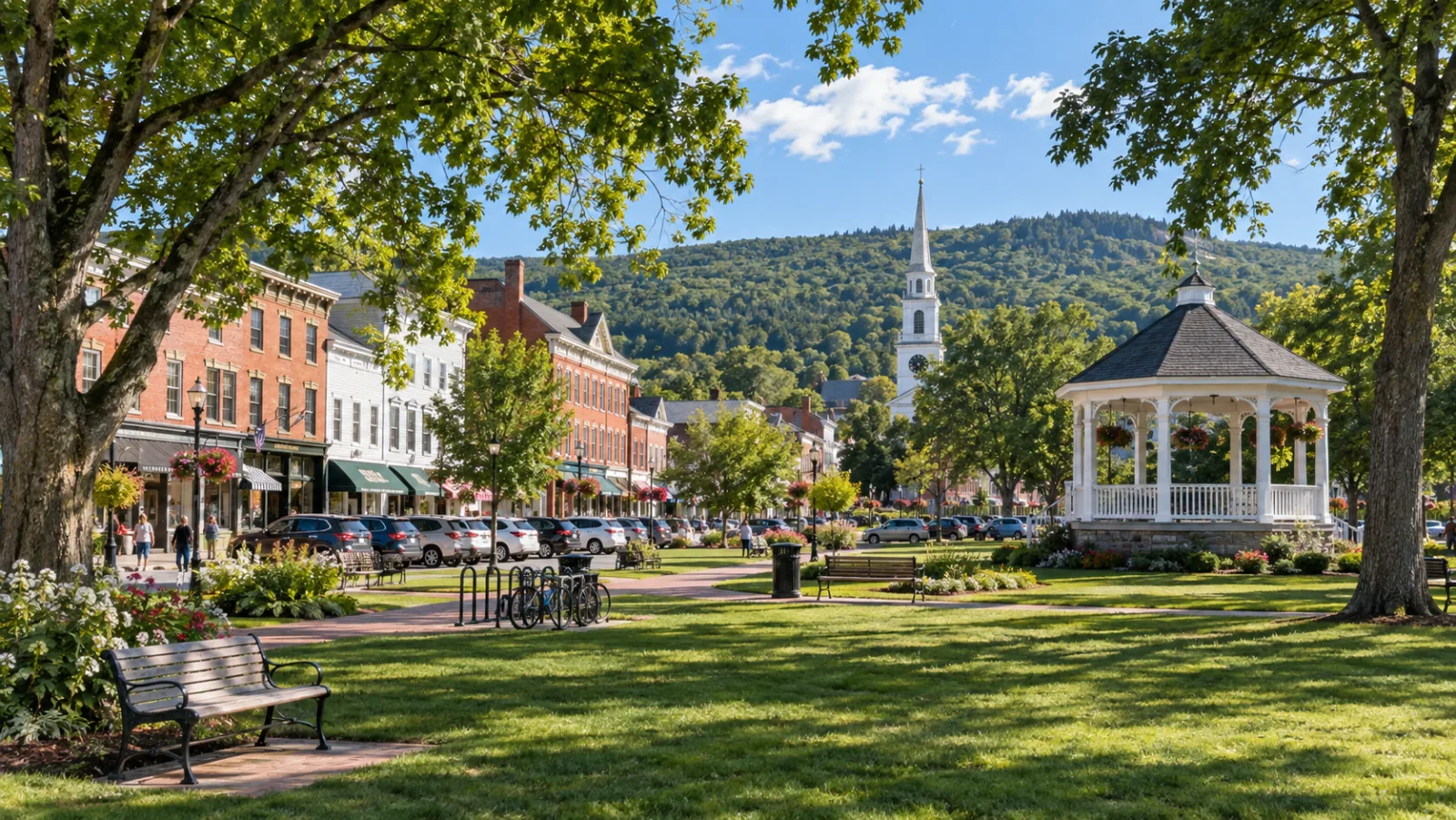
The common is the anchor, and the five civic buildings on its west side were listed on the National Register of Historic Places in 1986 as the Plymouth Historic District. The common was laid out not long after the town's settlement in 1763, and there is a bandstand in the middle of it. Walking it takes ten minutes and is worth doing.
- The Old Grafton County Courthouse (1774), 1 Court Street. One of the oldest civic buildings in New Hampshire. Courthouse, then school, paint shop, wheelwright shop and town library; now the Plymouth Historical Museum. Daniel Webster lost his first criminal case here in 1806, which the town mentions more often than Webster probably would have.
- Plymouth Town Hall (1890). Romanesque, designed by C. Willis Damon, built to serve as both town hall and county courthouse. It still hosts community events.
- Pease Public Library, 1 Russell Street. Opened in 1991 at the foot of the common, with real programming and a reasonable place to sit out a rainy hour.
- Chase St. Market, 83 Main Street. A specialty grocer, deli and bottle shop across from the common, locally owned since 1999, with Café Monte Alto inside it. If you want one stop that tells you who lives here, this is it — students, contractors, faculty and retirees in the same line.
Main Street is a genuine retail street rather than a museum of one. In 2026 that means Rand's Hardware, the Artistic Roots artists' cooperative, Plymouth Soapworks, a couple of clothing and gift shops, outdoor gear, a bike shop, the bank in the 1885 Pemigewasset National Bank building and the 1936 post office at the south end. Storefronts turn over — a college town's always do — so treat any list of shops, this one included, as a snapshot.
Green Street is the block most visitors miss. It drops off the south end of Main toward the Pemigewasset and ends at Riverside Park and the Rotary Amphitheater, which is where the town's outdoor summer programming and Plymouth Pride happen. The Grafton County circuit court sits at 26 Green Street and the police substation lot is here too, so the street reads as municipal until you get to the water.
The Flying Monkey
The Flying Monkey Movie House & Performance Center at 39 Main Street is the best reason to be downtown on a weeknight. The building opened in the 1920s as the New Plymouth Theater, went dark, and was bought and restored by the Common Man's founder Alex Ray in 2010. It now runs national touring music, comedy, tribute shows, community productions, a silent film series with live accompaniment and regular movie nights.
The scale is the point. The room holds 492 people — 357 theatre-style seats on the inclined main floor, 69 table seats in the dining area and 66 balcony table seats with their own bar and table-side service. (The 700-seat figure you will find repeated online is the 1930s house, before the restoration.) A room that size means you see an artist from twelve rows back for a fraction of what the same act costs in a Boston shed, and walk to dinner beforehand. The box office is open Wednesday to Friday, noon to 5 p.m., and an hour before doors on show days. Check the calendar before planning a weekend here — a Flying Monkey show is usually what anchors it.
Plymouth State University as a visitor destination
Plymouth State is not a gated campus. It is woven into the town, and most of what it runs is open to the public.
The Silver Center for the Arts is the region's performing arts venue, with a main theater and Smith Recital Hall. Its most reliable draw is the New Hampshire Music Festival, which has put professional orchestra and chamber concerts into the Silver Center each July for decades; the 2026 season, the festival's 74th, ran July 7 to July 30 under the title "A Musical Traverse," chamber on Tuesdays and orchestra on Thursdays, with free community performances around the Lakes Region. The rest of the year it carries university theater and dance, touring acts and student ensembles.
The Museum of the White Mountains, 34 Highland Street, is the serious cultural asset most visitors do not know about — the art, photography, maps, guidebooks and material culture of the White Mountains, including the region's tourism history and its conservation fights. Admission is free. Hours track the academic calendar rather than the tourist one, and some exhibitions are mounted at the Silver Center rather than at the Highland Street gallery, so check the museum's page before you drive over.
The PSU Ice Arena and Hanaway Rink opened in 2010, seats 860 and is a full NHL-sized sheet. It is home to Panthers men's and women's hockey and also runs public skating, youth hockey, broomball and curling. In a town where winter is five months long, a public sheet of ice matters.
Athletics. Plymouth State competes in NCAA Division III, mostly in the Little East Conference, with football in the MASCAC and hockey in the New England Hockey Conference. That means free or cheap admission, small crowds and genuinely good football, soccer and hockey within walking distance of Main Street. Fall Saturdays are the easy entry point. Lamson Library, the largest publicly accessible library in central and northern New Hampshire, is useful if you are here for a week and working.
Outdoors right in town
Plymouth's best outdoor assets are inside the town line and free, and almost nobody outside the valley knows about them.
Langdon Park runs along the Baker River, with parking north of the Plymouth Armory off Route 3 and access from Merrill Street, Langdon Park Road and the high school. There is a sandy river beach that swims well at low water, a playground, wooded walking paths, mountain bike trails, cross-country ski trails the high school maintains, and a flooded ice rink in winter when the weather cooperates. It is the closest thing Plymouth has to a town beach.
Fox Park, off Prince Haven Road from Langdon Street, is a roughly two-and-a-half-mile hand-built mountain bike network maintained by the town's Conservation Commission with Pemi Valley NEMBA — long switchbacking climbs, bermed descents, boardwalk over the wet sections, and a jump and skills area for beginner and intermediate riders. Hiking and snowshoeing on designated segments, dogs on leash, no fee.
Riverside Park, 20 Green Street, sits on the Pemigewasset below downtown. It has a canoe and kayak launch, a paved multi-use path along the water, and the Rotary Amphitheater the Plymouth Rotary Club built, which is where most of the town's summer programming lands. If you have seen a "Pemi River Trail" mentioned somewhere, this is what people mean — there is no separately named long-distance river trail through Plymouth, and the riverside walking in town is the Riverside Park path plus the wooded paths at Langdon Park.
The rivers. Two of them meet here. The Pemigewasset is bigger and faster — a classic summer float from the Campton and Thornton put-ins down toward Plymouth and Ashland, and good smallmouth and trout water. The Baker is smaller, warmer and gentler, which makes it the better one for kids and a canoe. Both drop and clear through July and August; both are cold and pushy in April and May, when you should stay out of them.
Pemi Valley NEMBA maintains two more networks within fifteen minutes: Whitten Woods Community Forest in Ashland, flowy and intermediate, and the Gyroscope Trails at Holderness Riverside Park, unusual in New Hampshire for having almost no rock and the right place to put a kid on a mountain bike for the first time.
Hikes and waterfalls within fifteen minutes
Plymouth Mountain is the town's own summit at 2,193 feet, the highest point in Plymouth. The Sutherland Trail leaves a small lot on Old Hebron Road, reached via Texas Hill Road out of downtown, and climbs about 2.2 miles through hardwoods and along streams to rocky outcrops. The true summit is wooded; the view is at Pike's Peak, a short spur below the top looking out over town, the Lakes Region and, on a clear day, the Whites to the north. Blazes get thin in places. Call it three hours round trip.
The Walter/Newton Natural Area off Cummings Hill Road is the easy one: a little over a mile of gentle trail, gifted to the town by the Walter and Newton families, with Rainbow Falls on Glove Hollow Brook as the payoff. It is the hike for small children, elderly parents, or forty-five minutes.
Two more flat walks within fifteen minutes, both worth knowing about on a day when nobody wants to climb: Quincy Bog in Rumney, a nature area with easy trails through some of the most biodiverse ground in central New Hampshire, and the Chamberlain-Reynolds Memorial Forest in Holderness, which runs through woods and bog to the Squam Lake shoreline.
Livermore Falls is on the Pemigewasset where Campton, Holderness and Plymouth converge, ten minutes north. The state recreation area parks at 86 Livermore Road in Holderness, charges $5 per car and gives you a gorge, a waterfall, the ruins of an 1877 salmon hatchery and a 1900 pulp mill, and the 1886 lenticular truss bridge locals call the Pumpkin Seed. It is beautiful, dangerous in high water, and no pets are allowed. Our Campton things-to-do guide covers Livermore Falls, the Campton swimming holes and the covered bridges properly. For the big White Mountain peaks — Welch-Dickey, the Tripyramids, the Sandwich Range — start with the hiking near Waterville Valley guide.
The day-trip radius
This is the real argument for Plymouth. Almost nowhere else in New Hampshire puts this much within forty minutes of a hospital and a supermarket.
| Destination | Route from downtown Plymouth | Roughly |
|---|---|---|
| Livermore Falls | US 3 north | 10 minutes |
| Squam Lakes Natural Science Center, Holderness | NH 25 / US 3 east | 10 minutes |
| Rumney Rocks | NH 25 west, then Buffalo Road | 15 minutes |
| Polar Caves Park, Rumney | NH 25 west | 15 minutes |
| Tenney Mountain | Tenney Mountain Highway and Mayhew Turnpike | 15 minutes |
| Wellington State Park, Newfound Lake | NH 3A south through Bristol | 25 minutes |
| Stinson Lake, Rumney | NH 25 west to Stinson Lake Road | 25 minutes |
| Waterville Valley Town Square | I-93 to exit 28, then NH 49 | 30 minutes |
| Loon Mountain, Lincoln | I-93 north to exit 32 | 30 minutes |
| Kancamagus Highway, west end | I-93 to Lincoln, then NH 112 | 35 minutes |
| Franconia Notch State Park | I-93 north | 40 minutes |
Rumney Rocks and Stinson Lake
Rumney Rocks is the most internationally significant thing within twenty minutes of Plymouth. The cliffs sit on the flank of Rattlesnake Mountain off Buffalo Road, about a mile west of Rumney village, inside the White Mountain National Forest. The Forest Service describes hundreds of rock and ice climbs on schist; the climbing databases count well over a thousand routes from 5.3 to 5.15a, mostly faces in the 40- to 90-foot range with a few over 300 feet. Either way, the concentration of hard sport climbing has made it a destination for climbers from across the country and abroad.
The Forest Service runs the Rumney Rocks Day Use Area with three parking lots and a fee of $5 per vehicle per day, $30 for an annual pass or $50 for an annual household pass. The lots fill to capacity on summer and fall weekends, and parking on the road is not the answer.
You do not have to climb to enjoy it. The approach trails are short, the Main Cliff on a busy Saturday is a spectacle, and the American Alpine Club's Rumney Rattlesnake Campground at the base ran an April-to-November season in 2026 and is the cheapest bed in the valley.
Stinson Lake, further up Stinson Lake Road, is the quiet counterweight — clear, cold, mostly undeveloped, ringed by national forest, with a state boat ramp by the dam at the southwest corner (more ramps are in our guide to public boat launches in NH). Ski craft have been banned since 1989, which is why it still feels like 1975. It is a cold- and warmwater fishery holding rainbow and lake trout, smallmouth and pickerel, and it fishes well through the ice, with Stinson Mountain rising behind it on a short trail to a ledgy view. The paved approach from Rumney village is open year round; the gravel connections from Ellsworth and Campton are a late-spring-to-early-fall proposition. If the lake does what it does to most people, our Stinson Lake area page and the Rumney town page show what is for sale up there.
Polar Caves
Polar Caves Park, 705 Route 25 in Rumney about five miles west of I-93, has run since 1922, the year a high school student named Bernard Campbell found the caves. They are glacial talus caves — granite blocks cleaved from Hawk's Cliff by the last ice age and stacked — and the coldest holds snow into summer, which is where the name comes from. Nine caves are connected by lit, well-marked boardwalks and stairs, with a boulder maze, a fallow deer and duck park, a mining sluice, nature trails, a gift shop and, for rainy days, the Maple Lodge Interactive Center. The park runs rain or shine.
Practicalities, from the park's own booking system as of the 2026 season:
- Admission at the gate is $29 for adults and $24 for youth ages 4 to 17; children 3 and under are free but still need to be on the ticket. Online prices are lower than walk-in prices, and there are reduced online rates for military, first responders and seniors 70 and over. A trails-only ticket that skips the cave boardwalks is also sold.
- Book ahead. Online reservations take priority and walk-ins are not guaranteed. Check in within 30 minutes of your booking time.
- Season and days. The 2026 season runs through Sunday, October 18, on a Wednesday-through-Sunday schedule at the shoulders and seven days a week in high summer.
- The caves are not for everyone. Strollers and baby backpacks are not allowed, there are a lot of stairs, the Lemon Squeeze narrows to fourteen inches, and every cave has a bypass for the tight bits. Wheeled mobility devices cannot manage the cave paths. No pets.
- Time it. The cave circuit takes 45 to 60 minutes; the whole park takes about two hours.
It is the classic New England roadside attraction and unapologetically that. With children roughly four to twelve it is a guaranteed afternoon.
Newfound Lake and Squam Lake
Twenty-five minutes south, Newfound Lake is one of the clearest and deepest lakes in New Hampshire, and Wellington State Park in Bristol has the largest freshwater swimming beach in the state park system. Day-use admission for the 2026 season was $5 for ages 12 and up, $2 for ages 6 to 11, free for children five and under and free for New Hampshire residents 65 and over with a valid license. There is a boat launch, a peninsula nature trail, kayak rentals, picnic pavilions, a snack bar and trail access toward Goose Pond, the Sugarloafs, Bear Mountain, Welton Falls and Mount Cardigan. The season runs weekends from early May, daily through summer and unstaffed weekends into October. Our Newfound Lake guide goes deeper, and the public beaches in New Hampshire guide compares it with the rest of the state's swimming.
Ten minutes east, Squam Lake is the quieter and more protected of the big lakes, with a largely conserved shoreline and nesting loons. The Squam Lakes Natural Science Center at 23 Science Center Road in Holderness is the best family stop in the region: a live animal exhibit trail of native New Hampshire species, hiking trails, and guided 90-minute pontoon cruises looking for bald eagles and loons. 2026 was its 60th anniversary season; the trail system first opened in 1970. The trail season runs May 1 through November 1, daily 9:30 a.m. to 5:00 p.m., with last trail admission at 3:30. Trail admission for the 2026 season is $30 for adults, $28 for seniors 65 and over and $24 for youth ages 3 to 15, free for children two and under and for members. Cruises are ticketed separately and need advance reservations, and there are reduced-rate options including library passes and a Museums for All rate with SNAP/EBT. Note that low ticket prices still float around on the review sites; the figures above are the current ones. The Squam Lake guide and the Holderness town page cover the lake and its shoreline.
Golf courses near Plymouth NH
The closest eighteen holes are about ten minutes south at the Owl's Nest Vineyard Course in Ashland, the former White Mountain Country Club, which Owl's Nest Resort now runs as its second course. About twenty minutes north, on the Campton–Thornton line off Route 49, Owl's Nest Resort & Golf Club has an 18-hole, par-72 championship course with White Mountain views. Both run roughly May through October, weather permitting.
The mountains north of town
Thirty minutes north, Waterville Valley is a self-contained resort town at the end of Route 49 with a pedestrian Town Square, an ice arena, a town beach on Corcoran Pond, an indoor athletic club and a road that goes nowhere else — which is exactly why families like it. See things to do in Waterville Valley.
Also thirty minutes north, Lincoln and Loon Mountain are the commercial heart of the White Mountains: the biggest ski area in the immediate region, a gondola that runs in summer and fall, the Kancamagus Highway starting at the edge of town, Franconia Notch fifteen minutes further, and more restaurants and shops than the rest of the valley combined. Our things to do in Lincoln guide has the detail.
And in Plymouth itself, Tenney Mountain is running on the west side of town — a small independent hill with 1,500 feet of vertical at 151 Tenney Mountain Road, fifteen minutes from Main Street, with skiing, snowboarding, tubing and lessons in winter. As of September 28, 2026 it is selling 2026/27 season passes, running fall foliage chairlift rides from September 26 and hosting an Oktoberfest on October 10 (skitenney.com). It is genuinely useful for a family that wants ski afternoons without an hour in the car, and it has a complicated operating history anyone buying near it should understand — the whole story is in the Tenney Mountain guide. For how it stacks up against the rest of the state's hills, see the New Hampshire ski resorts guide.
What Plymouth is like season by season
Plymouth runs two calendars at once — the weather and the academic year — and the second is the surprise for most visitors.
Late August to mid-December. The town is full. Main Street traffic doubles, restaurants are busy, there are events most weeknights, and foliage lands in the first two weeks of October on top of parents' weekend and peak leaf traffic on I-93. Plymouth at its liveliest and its most crowded. Book a table.
Mid-December to mid-January. The students leave and the town exhales. Downtown is quiet, some places cut hours, and the ski traffic goes straight past on the interstate.
Mid-January to March. Winter proper: Tenney, Waterville and Loon; ice fishing on Stinson and Newfound; the Hanaway Rink; cross-country at Langdon Park and on the Walter ski trails. Cold, dark and genuinely pleasant if you are equipped for it.
Mud season, late March into April. The worst month here, honestly. Dirt roads soften and post, trails above 2,000 feet are slush and ice, the rivers run high and cold, most attractions have not opened and the landscape is brown. It is also the cheapest time to visit and the easiest time to get a contractor on the phone.
May and June. Green, quiet, cheap. Students go home in mid-May and summer tourism does not start until late June, so there are six weeks when you have the place mostly to yourself. Black flies run roughly Mother's Day to the Fourth of July in the woods, and are a non-issue in the village.
July and August. Rivers warm and drop, Wellington and Livermore Falls fill, the New Hampshire Music Festival is in town, and the Pemi valley runs at full tourism speed. Weekends are busy; Tuesdays are not.
Where to eat and drink in Plymouth
Restaurants in a college town turn over, and Plymouth proved it this year: Six Burner Bistro, the town's sit-down dinner restaurant for twenty years, closed in 2026 when Pam and Vince Donnelly retired. Its building at 13 Main Street reopened in August 2026 as Cuba Libre, a Cuban restaurant from Leo and Alexa Vazquez. That is the right frame for everything below — categories hold, specific names do not, and it is worth a look at a menu before you drive.
The long-standing places, all confirmed open as of September 2026:
- The Main Street Station, 105 Main Street. The breakfast-and-lunch diner and where half the town's business actually gets done. Mornings into the early afternoon only — the kitchen is done by mid-afternoon.
- Biederman's, 1 Chase Street on the corner of Main. Sandwiches and beer since 1973, when it opened as The Cellar Pub; Scott and Patti Biederman bought it in 1976 and it reopened under their name after a renovation in 1986, and two former employees bought it in 2022. Open 11 a.m. to 8 p.m. Sunday through Thursday and to 9 p.m. Friday and Saturday, with live music Fridays at 6 and cribbage on Thursdays.
- Chase St. Market, 83 Main Street. Deli counter, beer and wine, and Café Monte Alto inside for coffee and the morning bagel.
- Foster's Boiler Room, 231 Main Street, inside The Common Man Inn & Spa at the corner of Foster and Main. The inn is a converted paper mill and the private wine room was the building's boiler room. Open 4 to 9 p.m. Monday through Thursday and from 11:30 a.m. on the weekend. The spa attached to it has a sauna and a rock waterfall hot tub, which beats most rainy-afternoon options in towns this size.
- Peppercorn Natural Foods, 43 Main Street. Open since 1976 and run since 2014 by a mother-and-daughter pair, in a small former train station, with bulk spices, bulk coffee, refill bottles and local produce, meat and dairy.
- The Lucky Dog Tavern & Grill, 53 South Main Street. Family restaurant upstairs, tavern downstairs, and a Plymouth staple for decades.
- The Last Chair Brewery, 5 Route 25. Craft beer, a full menu, live music and a patio with a mountain view. Open seven days: 4–9 p.m. Monday to Thursday, from 11:30 a.m. Friday to Sunday.
Beyond those, Plymouth carries what a university and a regional trade area support: Thai, Chinese and Japanese, Italian, seafood and barbecue, a noodle shop, national fast food out on Tenney Mountain Highway, and pizza calibrated to student demand.
The farmers market question has a Plymouth-specific answer. Local Foods Plymouth, now in its twentieth year and run as a program of the Plymouth Area Renewable Energy Initiative, is an online farmers market rather than a tented one: the store opens Friday at noon, you order from area farms through the week, and orders are picked up the following Thursday at 14 Fairgrounds Road — staffed 3:30 to 5:30 p.m., self-service until 8, with limited local delivery available. The Central New Hampshire Chamber's Plymouth page also advertises a Local Foods Plymouth summer outdoor market, which does not appear on the organisation's own site; check before you plan around one. What you should not do is drive to Plymouth on a Saturday expecting a market on the common.
Plymouth with kids
A workable rainy-and-sunny mix, all within half an hour:
- Polar Caves in Rumney — caves, boulder maze, deer, mining sluice, and an indoor interactive center for the day it pours. The most reliable hit for ages four to twelve. Book ahead.
- Squam Lakes Natural Science Center — native animals along an easy trail, plus the lake cruise in good weather.
- Langdon Park — playground, river beach, easy paths, and a place to let a dog and a child both get wet.
- The Gyroscope Trails at Holderness Riverside Park — the rock-free beginner mountain bike network, where a first-time rider should start.
- The PSU Ice Arena — public skating, and Division III hockey that is fast and cheap to watch.
- Wellington State Park — the biggest state beach in New Hampshire, shallow near shore, with a snack bar.
- The Flying Monkey — movie nights in an actual theater rather than a multiplex.
- Rainbow Falls in the Walter/Newton Natural Area — a mile of flat trail to a waterfall, about the right ambition for short legs.
Plymouth at a slower pace
Plymouth draws retirees out of the surrounding hill towns for one unglamorous reason: it is the town in this valley where you can stop driving so much.
The part that matters most is Speare Memorial Hospital, a 25-bed critical access hospital at 16 Hospital Road with an emergency department, primary care, specialty clinics and a Dartmouth Hitchcock affiliation. After that, everything is within a few blocks of everything else and on flat ground: the common, Main Street, the library, the post office, the deli, two or three restaurants. Two real performance venues are a ten-minute drive home, the Museum of the White Mountains is free, and the Recreation Department runs adult pickleball, tennis, swim lessons, walking groups and day trips.
The scenic drives are as good as the hikes and require nobody to leave the car: Route 25 west up the Baker valley toward Rumney, Wentworth and Warren; Route 3A down the west shore of Newfound; Route 175 north through Campton and Thornton on the old road; Route 49 to Waterville Valley; and the Kancamagus, thirty-five minutes away.
Events worth planning around
Plymouth's calendar runs on three engines — the university, the Flying Monkey and the town — and one date is worth building a trip around in each season.
Summer belongs to the New Hampshire Music Festival at the Silver Center: professional orchestra and chamber concerts across roughly four weeks of July, plus free community performances around the Lakes Region. Late September brings Plymouth Pride, a free festival with performances, artists and food at Riverside Park on Green Street; in 2026 it ran Saturday, September 26, from 11 a.m. to 4 p.m. October is foliage — not an event, but the busiest stretch of the year in the Pemi valley — plus the downtown Halloween tradition the Flying Monkey has been feeding with free horror movies since the 1930s. Late August through May is Plymouth State's own calendar: home football Saturdays in fall, hockey from October, theater and dance, nearly all of it open to the public. Mid-December to late March is ski season at Tenney, Waterville and Loon, with dates that move with the snow. And the Flying Monkey runs year round, with the busiest calendar in town.
For everything else — summer programming at the Rotary Amphitheater, holiday events on the common, church suppers, craft fairs — the calendar that actually gets updated is the Central New Hampshire Chamber of Commerce at centralnh.org, which covers Plymouth, the Baker valley, Newfound, Squam and the Pemi-Waterville corridor, alongside the town's own calendar at plymouthnh.gov.
One warning, because search engines get this wrong constantly: the Plymouth Waterfront Festival and Arts & Crafts on the Green are events in Plymouth, Massachusetts. So is most of what comes back for "Plymouth chamber of commerce." Check the state before you book a room.
Practical logistics
Exits. Exit 25 for downtown, the university and the hospital; Exit 26 for Tenney Mountain Highway and the big stores. Exit 24 is Ashland and Holderness, Exit 27 Blair Road in Campton, Exit 28 Campton and the Waterville Valley road.
Parking. Downtown parking is on-street and in municipal lots off Main Street — the Flying Monkey's own directions describe it as metered — and it is finite. On a football Saturday, a foliage weekend or a sold-out show, park a block off Main and walk. During the academic year, do not park in a campus lot without reading the signs.
Groceries and supplies. Hannaford at 389 Tenney Mountain Highway and the Walmart Supercenter at 683 Tenney Mountain Highway are the two full grocery stops, both with pharmacies; downtown covers specialty, natural foods and the deli counter. Hardware, gear and building supply are all in town, which is the main reason people in Campton, Thornton, Rumney, Ellsworth and Wentworth drive here.
Cell and gas. Coverage is solid in the village and along I-93 and Route 25 and degrades fast up Stinson Lake Road, in the national forest and on the back roads of Ellsworth and Groton — download your maps. Fill up in Plymouth rather than assuming you will find something on Route 25 west or Route 118.
What we would tell you to skip
Do not build a hot Saturday around Livermore Falls or the popular Pemi swimming holes — go on a weekday, go early, or go to Wellington, which has a real beach and a lot built for the crowd.
And do not come expecting a resort village. There is no pedestrian mall, no ski-in lodging, no cluster of boutiques. Plymouth is a working town that happens to sit in the middle of extraordinary country. If you want the resort experience, base yourself in Waterville Valley or Lincoln and come to Plymouth for the hospital, the hardware store and the Flying Monkey. If you want a town that is alive in March, Plymouth is the one.
When the visit turns into a house search
A lot of people arrive for a weekend and start doing arithmetic on the drive home. It usually works out better than they expect: Plymouth is one of the more affordable places to own in the Pemi-Baker region, it has services the resort towns do not, and it is the only town in the valley where you can live without a long drive to a supermarket, a hospital or an interstate.
- In-town village housing. Older homes on the campus grid and the streets around the common, walkable to Main Street, popular with faculty, staff and buyers who want to stop driving.
- Hillside and rural Plymouth. Texas Hill Road and the roads climbing west and south, where the acreage and the views are — and where most land for sale in Plymouth turns up.
- The rental angle. A university of roughly 3,700 students in a town under 7,000 creates a rental market that does not exist in Campton or Thornton — the homes near Plymouth State University guide covers how that actually works, and our guide to rentals in Plymouth NH covers renting here first while you learn the town.
- Access. Two interstate exits, and twenty to forty minutes to three ski areas and two major lakes.
Current homes for sale in Plymouth NH are on our town page. Our guide to buying a home in Plymouth NH covers prices and what the market actually does, the guide to Plymouth NH neighborhoods breaks the town down street by street, the Plymouth NH property tax guide explains the bill, the Plymouth, Campton and Thornton comparison weighs the three against each other, and the guide to moving to Plymouth NH handles schools, commutes and the relocation math.
Frequently asked questions
What is there to do in Plymouth NH?
In town: Main Street and the historic common, shows at the Flying Monkey, the Silver Center for the Arts and the free Museum of the White Mountains at Plymouth State, public skating at the PSU Ice Arena, river swimming at Langdon Park, mountain biking at Fox Park and the hike to Pike's Peak. Within thirty minutes: Rumney Rocks, Polar Caves, Livermore Falls, Newfound and Squam lakes, Tenney Mountain, Waterville Valley and Loon.
Is Plymouth NH worth visiting?
Yes, if you understand what it is. Plymouth is a hub town rather than a resort, worth visiting for a real downtown, a restored 492-seat theater, a university arts calendar and a position within forty minutes of most of the White Mountains and two of the state's best lakes. If you want a pedestrian resort village with ski-in lodging, base yourself in Waterville Valley or Lincoln and come to Plymouth for the day.
What is Plymouth NH known for?
Plymouth State University, its position where the Pemigewasset and Baker rivers meet and the Lakes Region gives way to the White Mountains, and its role as the service hub for the Pemi-Baker region — the hospital, the supermarkets and two I-93 exits. Historically, it is known for the 1774 Grafton County Courthouse on the common, where Daniel Webster lost his first criminal case in 1806.
Can you visit Plymouth State University?
Yes. The campus is woven into the town. The Museum of the White Mountains at 34 Highland Street is free, the Silver Center for the Arts sells tickets to the public, the Ice Arena runs public skating, Lamson Library is publicly accessible, and Division III games are open and inexpensive. The museum and arts calendar follow the academic year, so check hours around holidays and breaks.
What are the best restaurants in Plymouth NH?
As of September 2026: The Main Street Station for breakfast and lunch, Biederman's on Chase Street for sandwiches, beer and Friday live music, Chase St. Market for the deli and coffee, Foster's Boiler Room at The Common Man Inn for dinner, The Lucky Dog Tavern & Grill, and The Last Chair Brewery on Route 25. Six Burner Bistro closed in 2026, and Cuba Libre opened in its Main Street building that August.
How much does Polar Caves cost and when is it open?
Walk-in admission for 2026 is $29 for adults and $24 for youth ages 4 to 17, with children 3 and under free; online prices are lower and online bookings take priority over walk-ins. The 2026 season runs through October 18, seven days a week in high summer and Wednesday through Sunday at the shoulders. Allow about two hours, and note that strollers and baby backpacks are not allowed on the cave route.
Where can you swim near Plymouth NH?
In town, the sandy river beach at Langdon Park on the Baker River swims well at low water and is free. Twenty-five minutes south, Wellington State Park on Newfound Lake has the largest freshwater beach in the state park system, with a $5 day-use fee for ages 12 and up. Livermore Falls and the Pemigewasset swimming holes are beautiful but dangerous after rain, and both rivers run cold and high in April and May.
What is there to do in Plymouth NH in winter?
Ski at Tenney Mountain fifteen minutes away, or Waterville Valley and Loon at about thirty. Skate at the PSU Ice Arena, cross-country ski at Langdon Park, ice fish on Stinson or Newfound, and catch a show at the Flying Monkey or the Silver Center. Mid-December to mid-January is quiet because the students are gone; late January through March is the town at its most wintry.
Owl's Nest Real Estate works out of Campton and Plymouth, and the Pemi-Baker valley is the market we know best — which town has the trails, which road gets plowed first, and what a house near the common actually trades for. If a weekend here turned into a search, talk to us.