

Yes — Tenney Mountain in Plymouth NH is open and heading into the 2026/27 ski season. As of September 28, 2026, the resort's own site is selling 2026/27 season passes ($359–$559 adult, prices rising after October 15), running fall foliage chairlift rides since September 26, and hosting its fourth annual Oktoberfest on October 10.
| Tenney status check (September 28, 2026) | |
|---|---|
| Ski seasons since reopening | Every winter since February 2023, including a full 2025/26 season |
| 2026/27 passes | On sale: adult $359–$559, college $129, rope-tow park pass $239 |
| Indy Pass | On the 2026/27 roster — up to 2 days, plus a third at 25% off |
| Fall operations | Foliage chairlift rides from September 26; Oktoberfest October 10 |
| Zoning | Tenney Mountain Overlay District approved at town meeting, March 10, 2026 (530–160) |
| Opening day 2026/27 | Not yet announced — snow and snowmaking dependent |
That answer needs a date on it, because Tenney has a record back to 1960 of opening, closing, changing hands and opening again — dark at least six separate times. A buyer needs not a prediction but a way to price a property whose value is partly tied to a business that has failed before and is now being rebuilt. This is that framework. For the wider town first, see the Plymouth neighborhoods guide.
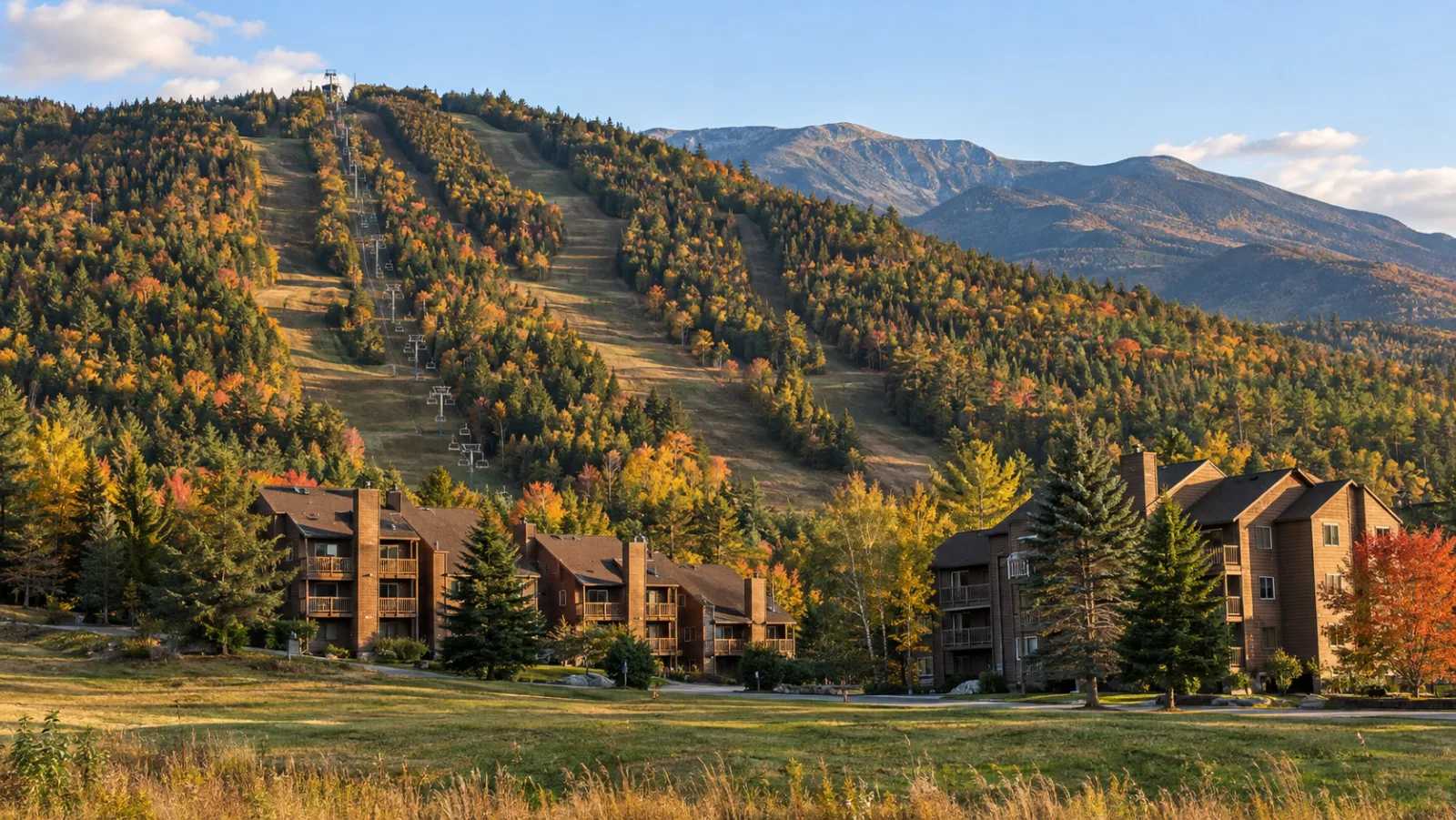
Where Tenney Mountain actually is
Tenney sits on the west side of Plymouth (Grafton County, ZIP 03264), above the Baker River valley, with the summit ridge on the Plymouth–Groton line. The base is at 151 Tenney Mountain Road. From I-93 Exit 26, the resort's directions are 3.7 miles west on Tenney Mountain Highway (NH 25) to the roundabout, second exit onto Mayhew Turnpike (NH 3A), then 1.8 miles to the entrance — about five and a half miles of plowed state highway, under fifteen minutes. The trade-off is that three of those miles are a commercial strip, not a notch.
Plymouth village and Plymouth State University are about fifteen minutes east, across the interstate; current inventory is on the homes for sale in Plymouth NH page, and the campus side of town has its own guide to homes for sale near Plymouth State University.
What the mountain is by the numbers
Published figures for Tenney disagree, which is normal for a ski area that has been re-measured by several owners. The three sources a buyer is most likely to hit still do not agree in September 2026, so here they are side by side with the date each was last updated.
| Figure | Tenney Mountain Resort, own site (checked Sept 28, 2026) | Indy Pass partner page (updated July 10, 2026) | Ski NH member listing (updated April 14, 2026) |
|---|---|---|---|
| Vertical drop | 1,500 ft | 1,500 ft | 1,500 ft |
| Summit elevation | 2,100 ft | 2,149 ft | — |
| Base elevation | not published | 649 ft | — |
| Skiable terrain | 130 acres | 130 acres | 130 acres |
| Named trails | 53 | 53 | 49 |
| Lifts | 4 | 4 | 4 |
| Snowmaking | full-mountain system installed | — | 62% |
| Terrain parks | PLN Park | yes | 1 |
| Average annual snowfall | — | 140 in (high 170 in) | — |
| Terrain split | — | 23% beginner, 50% intermediate, 27% advanced | — |
No definitive 2026/27 figure has been published that resolves the trail count: the resort's own snow report header still counts to 53, Ski NH still says 49, and older third-party databases carry lower numbers again — 1,400 feet of vertical, 45 trails, 110 acres — from an earlier era. The elevations do not fully reconcile either; the resort's own "2,100-foot summit, 1,500-foot vertical" implies a 600-foot base, and Indy Pass publishes 2,149 and 649. Treat the vertical drop as the one number all three agree on. That vertical puts Tenney in the same class as several far better-known New England areas, on a footprint roughly a tenth the size of Loon's.
Four lifts serve the mountain: a Platter Pull on the tubing and beginner hill, a TowPro rope tow serving the PLN terrain park, and two chairlifts — the Eclipse Triple and the Hornet Double, which the resort describes as New Hampshire's oldest operating chairlift. Lifts run 9:00 a.m. to 4:00 p.m. on operating days, with the rope tow lit into the evening on Thursdays, Fridays, Saturdays and holidays. The Hornet has been turning since 1964, and replacing it with a modern high-speed detachable chair is the first big-ticket item on the current owner's list.
The operating history, told straight
The romantic version of Tenney is a plucky local hill that keeps coming back. The useful version is a business that has been undercapitalized for most of its life and has been rescued, roughly, once a decade.
| Period | What happened |
|---|---|
| 1953–1958 | Sam Hall, a 10th Mountain Division veteran, and partner John French buy 400-plus acres for logging and form the Tenney Mountain Corporation |
| December 26, 1960 | Opens with a rope tow and a T-bar |
| 1964–65 | Upper-mountain chairlift installed, 1,285 vertical feet, making Tenney one of the region's larger areas |
| 1968 | Hall buys out French; Tenney Mountain Highway opens |
| 1979–80 | Hall, a famous holdout against machine-made snow, is forced to sell after a poor winter |
| 1982–83 | The area does not open at all for lack of natural snow |
| 1983–84 | Tenney Village Company buys it and installs the first snowmaking |
| 1986–89 | Expansion era: a new triple chair, an enlarged base lodge, and the Tenney Village condominiums |
| June 1989 | Tenney Village Company files Chapter 11 with 48 condominiums standing empty |
| 1989–90 | The lender forecloses mid-season; early closure |
| January 1991 | Reopens under new ownership |
| 1992–93 | Rebranded "Lookout"; equipment repossessed mid-season; Chapter 7 filed in May; dark for several seasons |
| December 6, 1996 | Reopens under Wilkinson ownership on a deep-discount pricing model |
| 2001–02 | Does not open |
| October 2002 | Bought by SnowMagic, which installs a year-round snowmaking technology and even runs summer skiing in 2003 |
| December 27, 2003 | Founder Sam Hall dies |
| 2006–07 | Does not open |
| 2007–08 | Reopens |
| December 15, 2010 | Sold at auction after closing with unpaid taxes; dark for eight years |
| November 21, 2014 | Tenney Mountain Development Group buys the area for $1.25 million |
| February–March 2018 | Lift-served skiing resumes after the eight-year hiatus |
| 2018–19 | First full winter in nearly a decade |
| March 2020 | Closes with the pandemic; dark through 2022 |
| 2022 | Bought by Steve Kelly, a Massachusetts businessman, through North Country Development Group |
| February 2023 | Reopens; has run ski seasons every winter since |
| March 2025 | The Hornet double goes down with a gearbox failure over the February vacation weeks; repaired by mid-March |
| December 2025 – March 2026 | Full 2025/26 season, on the Indy Pass |
| March 10, 2026 | Plymouth town meeting approves the Tenney Mountain Overlay District, 530–160 |
| September 2026 | 2026/27 passes on sale; foliage chairlift rides from September 26; fourth annual Oktoberfest October 10 |
Read that table twice. The pattern is not random. Tenney fails in exactly two ways: a bad natural-snow winter against thin snowmaking, and a lift breaking when there is no capital reserve to fix it fast. The 1982–83 non-opening and the March 2025 gearbox failure are the same story forty-two years apart. Everything the current owner is spending money on — snowmaking with retention ponds, a replacement for the Hornet — is aimed at those two failure modes.
Why a small independent ski area is a hard business
Each Tenney closure looks like bad luck until you see the structure underneath it:
- Snowmaking is the business. Without deep snowmaking a New England ski area is a weather bet, and full coverage costs millions in pumps, pipe, power and water storage.
- Lifts are the other half. A 1960s fixed-grip double is cheap to own until a gearbox fails in February vacation week and takes the year's best revenue days with it.
- The season is short. A small area earns most of its money in about eight weekends.
- Big mountains own the passholder. Loon, Waterville Valley, Cannon and Bretton Woods are all within an hour. Indy Pass membership is the small-area answer, and for a base-area owner it is a meaningful share of the traffic.
- Staffing is a housing problem, which is why workforce housing keeps appearing in Tenney's plans.
That is why the region has fewer ski areas than in 1970 — and why 1,500 feet of vertical five miles from an interstate exit, with a college town at the bottom, keeps attracting owners who think they can make the arithmetic work.
What that history did to values at the base
The base condominiums were built in the late 1980s as the amenity package for an expansion that went into Chapter 11 within about two years, with forty-eight units standing empty when the developer filed. That original event — not the current operation — set the long-run pricing personality of the base area: housing stock older than its peers at Waterville Valley or Loon, associations that have spent decades being conservative, and a resale record with stretches when the mountain was simply not running.
The consequence is a persistent discount. A base-area condominium at Tenney trades well below a comparable-vintage unit at a ski area that has never closed, and the gap widens every time the mountain has a bad news cycle. Some of that discount is a real opportunity and some is the market correctly pricing risk. Separating the two is the whole job, and it is done with documents rather than opinions.
Tenney Mountain Village and the condominiums at the base
The residential fabric around the base is a mix rather than a single resort village:
- The base-area condominiums. Built in the late 1980s in a wooded setting off the base-area roads, with the association organized in 1988. A naming warning before you search: people call the whole thing "Tenney Mountain Village," but the clusters are recorded and registered under Tenney Brook names — Tenney Brook Village I and Tenney Brook II — off Tenney Brook Road. Searching only the colloquial name is why buyers conclude the inventory is smaller than it is. Typical construction is wood-frame, multi-unit buildings of the period — vinyl or wood siding, asphalt roofs, baseboard or forced hot air, and floor plans that run from studios and one-bedrooms up to three-bedroom townhouse layouts. Some units sit close enough to the tubing side of the hill to be described as slope-side. Whatever is on the market at the base shows up on our Tenney Mountain Village condos page.
- Detached homes on the access roads. Mayhew Turnpike, Tenney Mountain Road and the side roads off them carry conventional single-family houses of every era, from 1970s ranches and chalets to newer colonials on acreage. These are ordinary Plymouth houses that happen to be near a ski area, and they price like Plymouth houses.
- Land. The overlay district approved in March 2026 has changed the conversation about undeveloped acreage on the west side of Route 3A, which is now the subject of a long-dated master plan rather than a straightforward house lot question. For ordinary building lots elsewhere in town, our guide to Plymouth NH land for sale covers frontage, septic and current use.
What the association fee typically covers at a base-area condominium here is the usual New England ski-condo bundle: building exterior maintenance, master insurance on the structures, landscaping, common-area upkeep, snow removal and trash. What it typically does not cover is anything inside your walls, your own contents insurance, or in many cases your utilities.
The base-area condos are not on town water
This is the single most expensive thing most buyers here get wrong, and it is answerable from the public record before you ever call anyone.
Plymouth Village Water & Sewer District is real, it is municipally owned, and the federal drinking-water register lists it with 1,180 service connections serving about 6,700 people. That is the village core and the campus side of the interstate — not the whole town, and not the Tenney base.
The same register lists two separate, privately owned community groundwater systems on the Tenney side, both active: one registered to the Tenney Brook Village I condominium association, with 36 service connections serving about 90 people, and Tenney Brook II, with 91 connections serving about 228. Tenney Brook Road runs off the base-area roads a few hundred yards from the resort's parking lots. Read the 127 combined connections as a measure of scale rather than a unit count, since one connection can serve a whole building. The ski area's own separate water system was deactivated in April 1989. (Source: EPA Safe Drinking Water Information System, New Hampshire primacy data, queried September 13, 2026.)
What that means in practice. A base-area condominium here is most likely on a well the association owns, operates and is legally the public water supplier for — with the state sampling schedule, treatment obligations, operator certification and eventual pump, well and treatment replacement costs that come with being a public water system. Those costs land in your monthly fee or in a special assessment. Sewer is the other half and is not in this register: confirm in writing whether the unit is on a community septic system owned by the association, on its own septic, or on a district sewer connection, and if it is a community system, when it was last pumped and inspected and what its NHDES approval permits for daily flow. Two buildings on the same road can have different answers.
Nobody publishes the fees, the unit count or the rules — so demand them
Unit counts, current monthly fees, pet policies and rental restrictions for the Tenney base associations are not published anywhere authoritative. There is no association website, no town-hosted roster, and the figures that circulate on listing portals and aggregator sites are stale, inconsistent and unattributed. Do not buy on them.
You do not have to negotiate for the real numbers. New Hampshire's Condominium Act, RSA 356-B:58, gives a prospective buyer of a resale unit the right to obtain them from the owners' association before the contract date, and the association's principal officer must furnish them within ten days of a written request. The statute names what you get:
- the condominium declaration, the by-laws and any formal rules of the association — this is where the pet limits and the short-term rental rules actually live, and the association's rules and Plymouth's zoning both have to allow a nightly rental before you can run one;
- the amount of the monthly and annual fees, and any special assessment made in the last three years;
- a statement of capital and major maintenance expenditures anticipated in the current or next two fiscal years;
- the status and amount of the reserve or replacement fund, and any part of it earmarked for a specific project;
- the association's income statement and balance sheet for the last completed fiscal year;
- the status of any pending suit or judgment against the association;
- what the association's insurance covers and what each owner is expected to carry;
- a statement that the prior owner's alterations are not known to violate the condominium instruments.
Put the request in writing, date it, and start the ten-day clock the day you go under agreement rather than the week before closing. If an association cannot produce these, that is itself the finding.
The rest of the due-diligence list for a condo tied to a ski area
Beyond the statutory packet, four things are worth asking for by name, because RSA 356-B:58 does not compel them.
- A current reserve study, not just the reserve balance. The statute gets you the fund's size; it does not tell you whether the fund is adequate. Ask what the study says the roofs, siding, paving, the community well and the septic will cost and when. A low monthly fee with no funded reserve is a future special assessment with a friendly face.
- Whether any amenity is owned or licensed. Pool, tennis, trail access, shuttle, ski privileges — does the association own it, or does it come from the resort by agreement? A licensed amenity can end when the licensor's business changes hands. Get the agreement and its expiry date in writing.
- Who maintains the road. Town-maintained, association-maintained, or a private road with a maintenance agreement among abutters. On this side of Plymouth that is a real annual number, and a private gravel road climbing off Route 3A is a different number from a town-plowed one.
- How many units are owner-occupied and how many owners are delinquent. Neither is in the statutory list, both drive financing, which is the next section's problem.
The Tenney Mountain Highway corridor
The name confuses people. Tenney Mountain Highway is NH Route 25 running west out of Plymouth from exit 26, and it is where essentially all of Plymouth's commercial growth of the last forty years has gone. It opened in 1968, the same era the mountain was expanding, and the highway is named for the mountain rather than the other way round.
What is on it: a Walmart Supercenter, Plymouth Commerce Park with roughly 30,000 square feet of retail, medical and office space, a mix of auto dealers, restaurants, banks and trade businesses, a MedCheck urgent care at 389 Tenney Mountain Highway, and Speare Memorial Hospital's Boulder Point campus about 3.1 miles west of the interstate. The hospital's main campus remains near the village.
For a buyer, the corridor is the practical reason to like the west side of Plymouth. Groceries, urgent care, hardware, fuel and a pharmacy are all within a few minutes of the base area, which is not remotely true of Waterville Valley or of the hill towns north of here. It is also, aesthetically, a commercial strip. People who want a mountain road and no headlights will not love it; people who have spent a winter forty minutes from a grocery store will.
Plymouth's zoning puts most of this frontage in commercial and industrial districts, and the new overlay layered on the Tenney side is explicitly intended to encourage a planned mix of recreational, commercial, industrial and residential uses consistent with the town master plan. If you are buying land or a house on this corridor, pull the zoning map and the overlay boundary before you assume what can be built next door.
What the March 2026 overlay vote actually did
On March 10, 2026, Plymouth voters adopted the Tenney Mountain Overlay District by 530 to 160 — not a close call. As Article 3 described it, the district covers land west of Route 3A and Route 25 plus everything within 500 feet of the east side of those roads, and it modifies what uses are permitted without redrawing the underlying zoning. That 500-foot figure is the one to check against a specific parcel: it is a narrow band, and a house on the east side of the highway may sit just inside or just outside it.
Owner Steve Kelly's stated program, reported by the Laconia Daily Sun on April 3, 2026 and again in the Boston Business Journal that April, includes residential development at several scales — workforce apartments for snowmakers, lift crew and food-service staff, single-family homes and luxury condominiums — plus hotel development, commercial buildings, an industrial park, a possible village core, road improvements to a network he calls in serious disrepair, an additional retention pond for expanded snowmaking, and replacement of the Hornet, a fixed-grip double running since 1964, with a high-speed lift. He describes it as multiple phases twenty to twenty-five years out, residential first. He also told the Sun there is no true timetable, because he is still seeking investors and planning approvals.
Hold two things at once. This is the most credible development posture Tenney has had in decades — a zoning approval actually in hand, a stated phase order, several seasons of operation behind it. And twenty-five-year master plans at this mountain have been announced before: a hotel, a golf course, a water park and a retirement community were all announced around 2005 and none were built. Approval is not construction, and construction is not completion. Price the property you are buying today and treat the master plan as an option, not an asset.
Living at the base year round
The distances and times below were routed on the OpenStreetMap road network from the Tenney base parking lot on September 13, 2026, using one routing engine for every row so the figures are internally consistent. They are free-flow driving times with no traffic or weather adjustment — treat them as a floor, not a promise, and add for a February Friday on I-93 north.
| From the Tenney base area to | Route | Distance | Free-flow drive |
|---|---|---|---|
| Boulder Point, Speare Memorial's west campus | Mayhew Turnpike (3A) and Route 25 | 3.9 miles | 10 min |
| Walmart Supercenter, Tenney Mountain Highway | Route 3A and Route 25 | 4.0 miles | 11 min |
| Speare Memorial Hospital, main campus | Route 25 east | 6.2 miles | 15 min |
| Plymouth Regional High School | Route 25 east to Old Ward Bridge Road | 6.0 miles | 15 min |
| Plymouth State University | Route 25 east through exit 26 | 7.5 miles | 16 min |
| Waterville Valley Resort | I-93 to exit 28, then Route 49 | 26.3 miles | 52 min |
| Loon Mountain, Lincoln | I-93 to exit 32 | 30.0 miles | 46 min |
| Cannon Mountain, Franconia Notch | I-93 north past Lincoln | 37.7 miles | 52 min |
| Concord | I-93 south | 49.4 miles | 62 min |
| Manchester-Boston Regional Airport | I-93 south | 72.4 miles | 95 min |
Base to I-93 Exit 26 is about 5.5 miles by the resort's published directions (online routers disagree because of the divided highway at the interchange). Exit 26 to Exit 28, the Waterville Valley turn, is 9.7 miles of interstate.
Schools are SAU 48. Plymouth Elementary School serves kindergarten through eighth grade with a little over 400 students, and Plymouth Regional High School, on Old Ward Bridge Road, serves grades 9–12 with an enrollment of 660 in 2024–25, drawing from Plymouth, Ashland, Holderness, Campton, Rumney, Wentworth, Warren, Ellsworth, Waterville Valley and Thornton. For families relocating, the moving to Plymouth NH guide covers registration, the school calendar and the rest of the settling-in list.
Winter reality: Route 25 and Route 3A are state highways and get plowed early and often, which is the single biggest quality-of-life difference between the Tenney side and a house up a class-V town road. Above the highway, conditions change fast — the base sits somewhere around 650 feet and the access roads climb from there, so you will have snow on your driveway when the village has rain. Four-wheel drive is not optional here, and neither is a plan for a plow contractor before your first November.
Summer reality has changed. The base now runs a nine-hole disc golf course in the offseason, foliage chairlift rides from late September, an Oktoberfest and a function business; Ski NH's member listing has carried Tenney's status as "open for events/activities" through the warm months. That is a small but real diversification away from the eight-weekend problem, and it is why a property here is less purely seasonal than it was a decade ago. For what a summer week looks like from this address, see things to do in Plymouth NH and, forty minutes north, hiking near Waterville Valley.
Who buys around Tenney and why
Four buyer types, and they want different things:
- The priced-out skier. Someone who looked at Waterville Valley or Lincoln, found what a two-bedroom costs there, and came down the interstate looking for the same winter at a lower number. This is the largest group, and the best ski towns in New England for a second home comparison is usually where the search started.
- The year-round local buyer. A Plymouth State employee, a Speare Memorial nurse, a tradesperson, a family that wants a house with land and a five-minute drive to a grocery store. This buyer mostly does not care whether the lifts run; they care about the commute and the plowing. They are the floor under the market, and they are why west Plymouth values never collapsed even during the dark years.
- The value hunter with a rental spreadsheet. Buying a condo priced for a closed mountain and modeling income from an open one. Sometimes right, frequently early — check what year-round rentals in Plymouth NH actually lease for before you count on ski-season income.
- The speculative buyer. Buying a stake in the overlay district's twenty-five-year story. Legitimate, as long as it is named as speculation and sized accordingly.
If you are in the first group, run the numbers on total cost rather than purchase price; our guide to buying a home in Plymouth NH sets out the town's price bands. A Plymouth-side property with a modest association fee and Plymouth's tax structure often lands in a very different place from an apparently similar unit at a full-service resort with a large fee and an amenity assessment. Our Plymouth property tax guide has the tax side; the Plymouth homes under $500,000 page shows what is actually available in the band most of these buyers are shopping.
The honest part — buying near a ski area that might not be running
Assume that at some point during your ownership the mountain has a season it does not operate. It has happened repeatedly. What breaks?
Resale. The big one. A ski-adjacent condominium in a year when the lifts are not turning does not just sell for less; it sells to a smaller pool, more slowly, and often only to a local year-round buyer rather than a second-home buyer. Days on market stretch. If your exit plan requires selling inside a fixed window, that window has weather in it.
Rentability. Winter nightly rates at a base-area condo are underwritten by lift access. Without it you are renting a house in Plymouth — which is a real market, with Plymouth State families, traveling healthcare staff and White Mountains visitors in it, but at different rates and a different seasonal shape. Any pro forma that only works with ski-season nightly rates is a pro forma with a single point of failure.
Appraisal. Appraisers use closed comparable sales, and in a market this thin the comparable set is often stale or unrepresentative, so a low appraisal at a base-area condominium is common. Build appraisal-gap language into your offer strategy rather than discovering it at underwriting.
Financing. The one buyers underestimate. Conventional lenders apply project-level standards to condominiums: owner-occupancy ratios, the share of units owned by a single entity, delinquency rates, litigation, adequacy of reserves, and whether the project is dominated by commercial or resort-style use. An association that fails those tests is a non-warrantable project, and the loan goes from a straightforward conforming mortgage to a portfolio product with a bigger down payment and a higher rate — or no loan at all. Ask your lender to review the condo questionnaire and the budget before you remove your financing contingency, not after. Ask specifically about short-term rental character, because heavy nightly-rental use can itself push a project out of conventional eligibility.
Insurance. Master policy adequacy and wind, ice-dam and water-damage loss history all feed your fee and your own HO-6 premium.
And then the line that should be written on every listing in a ski town: "It's cheap because the mountain is closed" is a description, not an investment thesis. Cheapness is the market's price for uncertainty. It becomes a bargain only if you have a reason to believe the uncertainty will resolve in your favor — and a balance sheet that survives if it does not. Buy a Tenney-area property because the price works for you as a place to ski, live or rent under conditions that exist today. Treat anything the overlay district delivers as upside you did not pay for.
This is general information, not tax or legal advice; your attorney and the town assessor have the current answers for a specific property.
How to value a Tenney property under each scenario
Rather than guessing which future arrives, price the same unit three ways and see whether you are still comfortable.
| Scenario | What it looks like | How to value the property |
|---|---|---|
| Operating as now | Full ski seasons, Indy Pass, incremental lift and snowmaking improvements | Value on current ski-adjacent comparable sales plus a realistic winter rental yield. This is the base case as of September 28, 2026. |
| Build-out proceeds | Overlay district phases actually get funded — new lift, hotel, new residential, more year-round traffic | Do not pay for this today. Model it as an option on future value, and accept that construction next door is also years of noise, traffic and change. |
| Operations pause again | A bad snow year, a capital failure, or a change of ownership takes a season or more out | Value as a Plymouth property with a view and a trailhead. Ask whether the number still works when the word "ski" is deleted from the listing. |
If the answer under the third scenario is still yes — the payment is affordable, the fee is funded, the year-round rental or personal use stands on its own — then you are buying a house, with a ski area as upside. If the answer is only yes under the first two, you are taking a position on a business, and you should size it like one.
How Tenney compares with what you are probably also looking at
| Tenney / west Plymouth | Waterville Valley | Lincoln and Loon | Campton and Thornton | |
|---|---|---|---|---|
| Entry price for a base-area condo | Lowest of the four | Highest | High | Not applicable; mostly houses |
| Operating certainty of the ski area | The open question | Long, continuous record | Long, continuous record | N/A |
| Year-round services | Full commercial corridor at the bottom of the hill | Small village; groceries 11 miles down Route 49 | Full services in Lincoln | Limited; most errands run to Plymouth |
| Short-term rental market | Thin and seasonal, plus a real year-round Plymouth demand base | Established, resort-managed | Deepest in the region | Established, mostly single-family |
| Association fees | Generally modest, but most base associations own their own well and are the water utility | Generally high, plus resort amenity structures | Varies widely by project | Usually none |
| Who it suits | Value buyer, year-round local, patient speculator | Buyer who wants a finished resort village | Buyer who wants nightlife, dining and rental depth | Buyer who wants land and a house |
The head-to-head that most Tenney shoppers eventually run is Loon versus Waterville Valley, and it is worth reading before you decide the discount is the deciding factor. If Waterville's certainty is what you actually want, start at the Waterville Valley town page; if it is Lincoln's rental depth, compare the condos near Loon Mountain in Lincoln and the Lincoln and Woodstock area page. If the fourth column is the one you keep coming back to, Plymouth versus Campton versus Thornton runs that comparison properly. For the statewide picture of which mountains are where, our roundup of ski resorts in New Hampshire covers all of them.
What to verify before you make an offer
Every item here is answerable in a week.
- Current operating status, from a dated source. The resort's own site and social channels, and Ski NH's member listing — checking both, because they disagree and Ski NH's page can sit unchanged for months. Look for pass sales, published opening dates and lift status, not a review site's cached summary.
- The RSA 356-B:58 packet, requested in writing. Declaration, by-laws, rules, fee amounts, three years of special assessments, reserve balance, financials, litigation and insurance statements. Ten days from the request.
- A reserve study and two to three years of meeting minutes, which the statute does not compel. Minutes tell you what the owners are actually arguing about.
- Water and sewer, in writing, for that specific unit — which community system, who operates it, its last inspection and its state approval.
- Who maintains and plows the road, and what it costs per year.
- Any amenity license or shared-use agreement with the resort, and its term.
- Your lender's project review of the condominium, before the financing contingency expires.
- The Plymouth zoning map, the overlay boundary and its 500-foot east-side line, and the planning board agenda for anything filed near the property.
- A standard inspection plus a look at building envelope and roof age on a late-1980s multi-unit building.
Frequently asked questions
Is Tenney Mountain open?
Yes. As of September 28, 2026, Tenney Mountain Resort is selling 2026/27 season passes, running fall foliage chairlift rides from September 26 and hosting an Oktoberfest on October 10. It ran a full 2025/26 ski season and has operated every winter since reopening in February 2023. Opening day for 2026/27 depends on snow and snowmaking; because Tenney's status has changed many times, confirm it on the resort's site before relying on it.
Where is Tenney Mountain in New Hampshire?
On the west side of Plymouth, in Grafton County, with the summit ridge on the Plymouth–Groton line. It is the only ski area in Plymouth NH. From I-93 Exit 26 it is about 3.7 miles west on Tenney Mountain Highway (Route 25) to the roundabout, then 1.8 miles on Mayhew Turnpike (Route 3A) to the entrance at 151 Tenney Mountain Road — roughly fifteen minutes.
How big is Tenney Mountain ski area?
The resort, the Indy Pass and Ski NH all publish 1,500 feet of vertical drop, 130 skiable acres and four lifts. They differ on the rest: the resort lists a 2,100-foot summit and 53 trails, Indy Pass a 2,149-foot summit, and Ski NH 49 trails. The lifts are the Eclipse Triple, the Hornet Double — running since 1964 and described by the resort as New Hampshire's oldest operating chairlift — a rope tow and a platter pull.
Is Tenney Mountain on the Indy Pass?
Yes. Tenney is on the Indy Pass 2026/27 roster. An Indy Pass gets up to two lift-access days at Tenney plus a third day at 25% off, redeemed in person at the ticketing desk with no online reservation, and a $6 RFID card. As of September 28, 2026 Tenney said its 2026/27 blackout dates would be announced soon, so check before planning a holiday-week visit.
How much is a Tenney Mountain season pass?
For 2026/27 the resort lists adult season passes from $359 to $559, a rope-tow-only park pass at $239 and a college pass for undergraduates at $129, all with no blackout dates. Prices rise after October 15, and passes stay on sale until mid-February 2027. Children five and under and adults eighty and over ski free with a $6 RFID card.
Do the Tenney Mountain condos have town water and sewer?
Generally not. The EPA's drinking-water register lists two active, privately owned community well systems on the Tenney side — Tenney Brook Village I (36 connections) and Tenney Brook II (91) — while the Plymouth Village Water & Sewer District serves the village and campus side of the interstate. The association is effectively the water utility, with testing, treatment and replacement costs in the fees. Confirm sewer arrangements for the specific unit in writing.
Are there condos for sale near Tenney ski area?
Usually a handful. The base-area condominiums date mostly from the late 1980s and are the most affordable ski-adjacent condos in the Pemi-Baker region. Search the recorded names — Tenney Brook Village I and Tenney Brook II, off Tenney Brook Road — as well as "Tenney Mountain Village," and watch the Plymouth 03264 listings, because inventory is thin and turns over slowly.
Is it risky to buy a condo near a ski area that has closed before?
It carries specific, identifiable risks rather than being a bad idea: resale liquidity, winter rental income and condominium financing eligibility. The mitigation is documentary — a funded reserve, no pending special assessment, clear water, sewer and road responsibility, a lender who has reviewed the project, and a price that still makes sense if the lifts sit idle for a season.
The bottom line
Tenney Mountain is running as of September 28, 2026, has run four consecutive winters, is on the Indy Pass, and just won a decisive zoning vote for a long-term build-out. That is the best position it has been in since the 1960s. It is also a mountain that has gone dark six times, and a well-run brokerage will tell you both halves.
Buy here because west Plymouth works for you on a Tuesday in April — the highway, the hospital, the schools, the price per square foot, the ten minutes to a college town — and let the chairlift be the part that makes it better rather than the part that makes it worth it. If you are on the other side of the transaction and wondering what the overlay district did to what your place is worth, the Plymouth seller page is the place to start, and our guide to selling a home in Plymouth NH walks through the process.
Owl's Nest Real Estate works out of Campton and Plymouth, and Tenney is the mountain we get asked about more than any other because the answer keeps changing. If you want someone to read the association's reserve study with you before you write an offer — or to tell you plainly when a unit is not worth what it is priced at — talk to us.