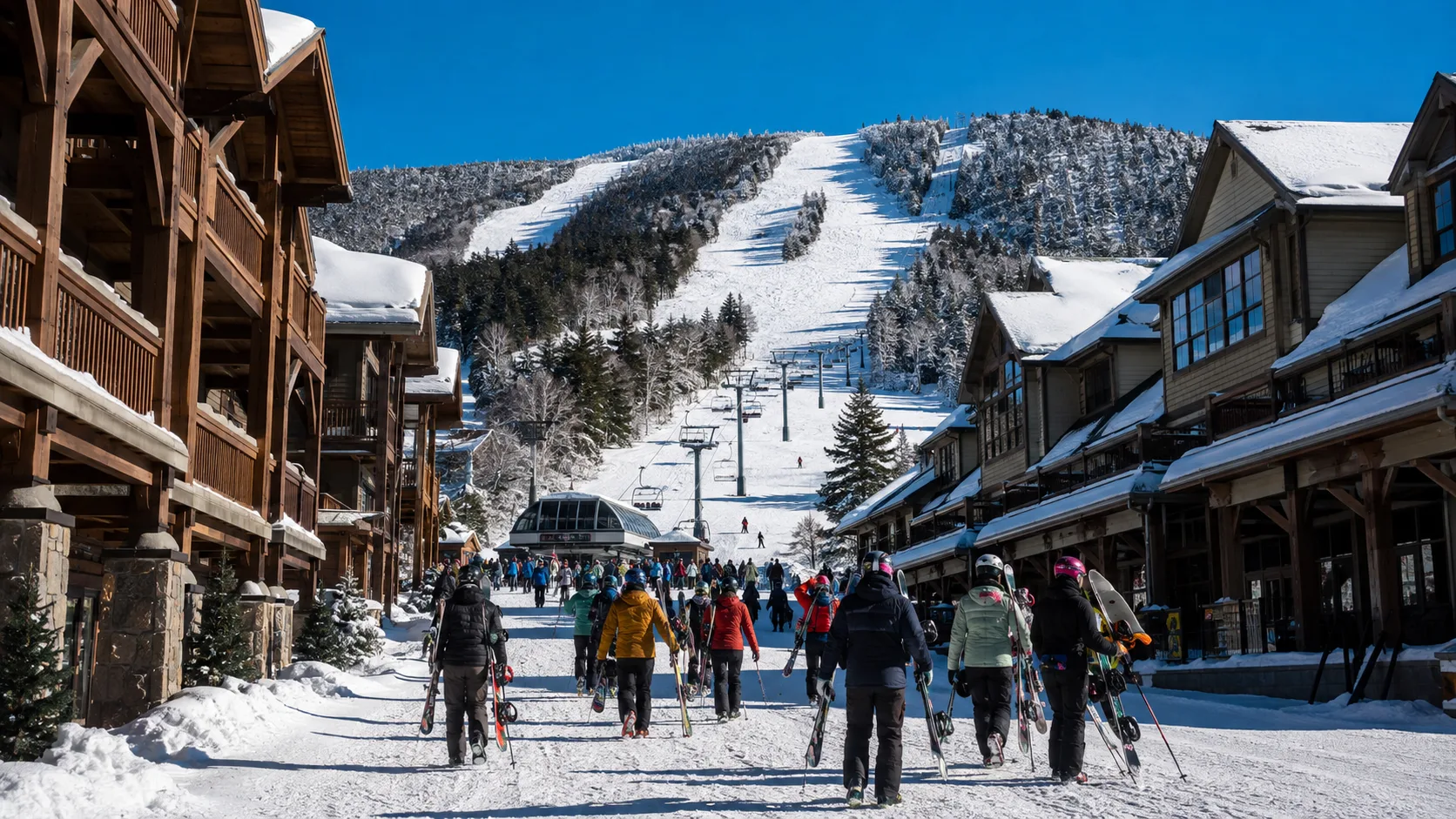

Loon or Waterville Valley is the several-hundred-thousand-dollar version of a question skiers usually argue about in lift lines. Search the comparison and you'll find a decade of forum threads — lift lines, ski school, terrain — and almost nothing about the decision second-home buyers actually face: where to put the money, in a corridor that sits fifteen minutes from one mountain's lifts and about twenty-five from the other's.
So here's the version of this comparison the forums can't write — from a brokerage that sells homes at both mountains. Every price in this article came out of the MLS in August 2026, with notes on where each number flatters and where it doesn't, and at the end the honest sorting rule — because the truth underneath this whole rivalry is that these are two genuinely different products wearing the same "NH ski town two hours from Boston" label, and most buyers are a much better fit for one than the other. In practice this decision resolves in about twenty minutes of honest conversation. This article is those twenty minutes.
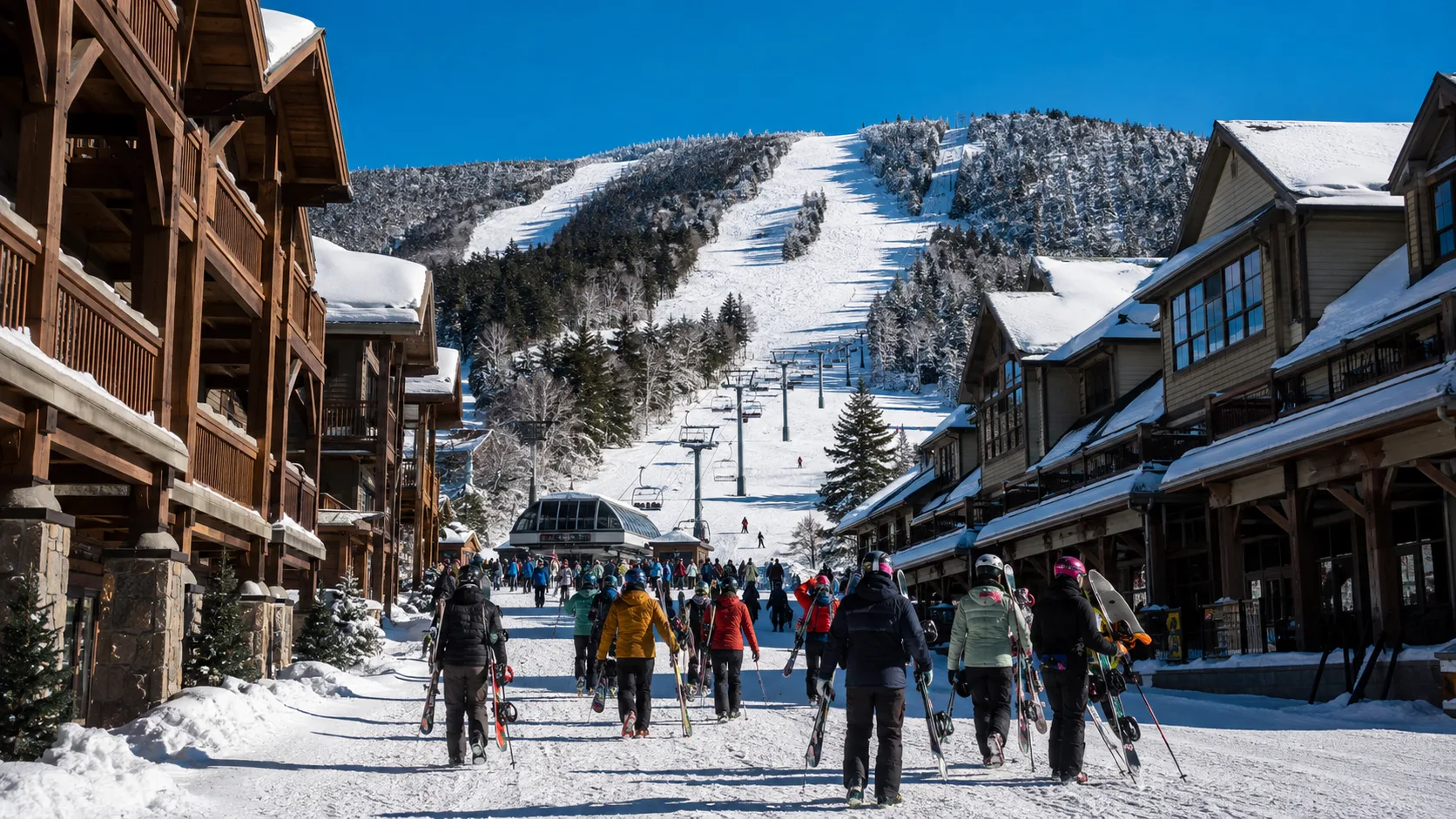
Two mountains ten miles apart, as the crow flies
Start with the skiing, because that's what the forums fight about, and because the honest answer sets up everything else.
Loon Mountain is the bigger operation: three peaks, 2,190 feet of vertical, and 403 skiable acres spread across 73 trails, topping out at 3,050 feet on North Peak. The recent Timbertown expansion added eleven trails on the South Peak side, more than half of them greens, purpose-built for beginners — a smart move for a mountain whose learning terrain used to be its weak spot. The lift fleet is the most modern in New Hampshire, headlined by the Kancamagus 8, an eight-passenger bubble lift with heated seats that moves 3,500 skiers an hour, plus a gondola out of the main base. Loon is owned by Boyne Resorts, and it skis like a flagship: groomed to a corduroy shine, big terrain parks, big infrastructure, big weekends.
Waterville Valley is the smaller mountain: 2,020 feet of vertical — only eighty feet less than Loon, which surprises everyone — on 265 acres and 62 trails on Mount Tecumseh. It skis bigger than its acreage suggests because the vertical is real and the fall lines are honest; the front-side blues off the bubble-equipped Tecumseh Express six-pack are some of the best cruising in the state, and the resort keeps investing — the newest addition is a T-bar that opened for the 2025–26 season, built for race and training programs but a genuine capacity add on busy mornings. What Waterville doesn't have is Loon's breadth. On a powder week, an expert will run out of new lines at Waterville a day or two before they would at Loon.
Three more arguments the forum threads recycle every winter, settled while we're here. Terrain parks: Loon's park scene is the destination one — the multi-park progression draws kids from all over New England — but Waterville is no shutout. It's the birthplace of freestyle skiing, it opened New Hampshire's first terrain park back in 1994, and the revived Exhibition park runs right under the lift where everyone can watch. Night skiing: exactly one of these mountains has it, and it's not the one people guess — Waterville runs lights on Exhibition and the lower mountain on Friday and Saturday nights, included with a weekend full-day ticket, while Loon has none. Kids' programs: both run full ski schools and season-long junior programs, so the honest difference is logistics — Waterville's single contained base area makes drop-off, lunch, and pickup dramatically simpler with kids under twelve, which is half of why parents defend it so fiercely online.
Here's the part the trail-map arguments miss: the crowd difference is bigger than the terrain difference. Loon is the closest major mountain to Boston with an Ikon logo on it, and February Saturdays there are genuinely busy — the Kancamagus 8 exists precisely because the line it replaced was famous. And it isn't just broker anecdote: for 2026–27, Loon is one of only five Ikon destinations in the entire country — a list that's otherwise Jackson Hole, Deer Valley, and Washington's Snoqualmie — where passholders still have to reserve their day in advance. Parking is free at both mountains, no reservation systems, but Loon's lots genuinely fill on peak-Saturday mornings while Waterville's village lots mostly don't. Waterville, with no national mega-pass and a village at the end of its own dead-end valley, is the quiet one: midweek you'll ski onto nearly every lift, and even Saturdays feel like a different sport. Skiers argue about which trade is better. As a broker I'll just tell you: you will feel this difference more often than you'll feel the extra 138 acres.
The pass question, which is really a resale question
Ski passes seem like a lifestyle detail until you're selling, so take this section seriously.
Loon is an Ikon Pass destination — seven days on the full Ikon, and new for 2026–27, the cheaper Base Pass finally picks up Loon too, at five days with holiday blackouts, after years of excluding it entirely. Two fine-print items before you count those days: Ikon visits to Loon now require an advance day reservation (check the current access chart before you buy — this stuff moves every spring), and Loon regulars still tend to skip the day-count math altogether for Boyne's New England Pass, which pairs Loon with Sunday River and Sugarloaf for unlimited skiing. What Ikon affiliation does for a homeowner is keep a national buyer pool interested in Lincoln: when a family from New Jersey or Chicago who already holds Ikon goes shopping for an Eastern base, Loon is on their list automatically. I see it in my buyer calls every fall, and I said the same thing in my ranking of New England ski towns — the pass ecosystem is quietly one of Lincoln's strongest resale arguments.
Waterville plays the value side of the same game. It's on the Indy Pass, and its own season pass lineup is the corridor's family bargain — the White Mountain Superpass pairs Waterville with Cannon, Bretton Woods, and Cranmore, and the resort currently throws in a free junior season pass (ages 6–12) with each adult Plus Pass, which for a family of four changes the annual math by four figures. A Waterville family skis cheaper than a Loon family, full stop. What Waterville's pass situation doesn't do is market the town to strangers. Waterville buyers tend to already know Waterville — they honeymooned there, or skied there as kids, or rented for a decade. That keeps the buyer pool loyal but local, and it's part of why the price histories of the two towns look so different.
Two towns that could not be less alike
Now the part that actually decides most purchases, because you'll spend far more hours in the town than on the hill.
Lincoln is a real commercial town. Loon sits just off I-93's Exit 32, and Main Street runs from the interstate to the mountain lined with restaurants, breweries, gear shops, and family attractions — and it's the western gateway to the Kancamagus Highway, which pumps tourist traffic through town in every season, most famously during foliage. Ice castles in winter, a water park and scenic railroad in summer; I've catalogued the full menu in things to do in Lincoln. The honest flip side: Main Street is a strip, not a village green. It's lively, it's convenient, and on a February Saturday or a peak foliage weekend it's traffic. Next-door North Woodstock is the charming one — a walkable little downtown of its own, five minutes from the lifts.
Waterville Valley is a planned resort village in a bowl. The entire town sits at the end of an eleven-mile road off Exit 28, surrounded on all sides by White Mountain National Forest — there is no strip because there is no through-road and no land to build one on. Life centers on the pedestrian Town Square: coffee, restaurants, the skating rink, boats on Corcoran Pond in summer, with the golf course, tennis center, and trailheads all a few minutes away. Park the car Friday night and you genuinely don't need it again until Sunday, which is why I call it the corridor's standout for families with young kids in my summer guide to the valley. The flip side is the same fact wearing its other face: it's quiet. Two grocery aisles, no nightlife to speak of, and midweek in shoulder season the valley is close to silent. Buyers who wanted a scene feel stranded; buyers who wanted the silence can't believe their luck.
The national forest boundary also does something economic that Lincoln's geography doesn't: it caps supply forever. Nobody will ever build the competing condo development on the edge of Waterville Valley, because there is no edge. Lincoln, by contrast, is still building — which brings us to the money.
What the MLS actually says
Everything below is from our MLS the week I wrote this: active residential listings, both towns, with the fractional-ownership listings separated out — because in both of these markets, the listing portals will mislead you within the first three clicks.
Lincoln. There are 68 condos listed in Lincoln right now, and 22 of them — a third — are fractional intervals, almost all quarter-shares at the Mountain Club on Loon, priced from $15,000 to $37,500. Those aren't condos; they're a deeded quarter (or single week) of one, and I've excluded them from every number that follows. The genuine whole-ownership market is 46 condos from $165,000 to $2.6 million, with a median of $487,000. That top end is new and real: South Peak's newest slopeside construction is listed between $2.3 million and $2.6 million, the most expensive condo product in New Hampshire ski country. Single-family homes are scarce and expensive — eleven active from $450,000 to $2.9 million with a median of $1.85 million. North Woodstock is Lincoln's relief valve: seven single-family listings from $300,000 to $1.05 million, median right around $500,000, plus a handful of whole-ownership condos from $215,000 to $640,000.
Waterville Valley. There are 27 condos listed, and 15 of them are fractional — from single deeded weeks listed at a few hundred dollars up to quartershares at $40,000 to $60,000, mostly at Mountain Sun. Same warning, same exclusion. The real whole-ownership market is 12 condos from $175,000 to $665,000, with a median of $461,500. Exactly one single-family home is on the market, at $2 million — that's not a typo, that's the national forest cap doing its work. I wrote the full breakdown of the valley's associations, fees, and the quartershare trap in the Waterville Valley condo guide.
Put the two side by side and the shape of the choice appears:
- Entry points are nearly identical. A whole-ownership one-bedroom starts at $165,000 in Lincoln and $175,000 in Waterville. Medians are within $26,000 of each other. Price per square foot is a near tie — about $391 in Lincoln, $379 in Waterville, on today's whole-ownership listings.
- The ceilings are wildly different. Waterville's most expensive condo is $665,000. Lincoln's is $2.6 million. Lincoln has a luxury market; Waterville essentially doesn't, because nobody has built new product there in decades.
- What that means for owners. In Lincoln, new construction keeps resetting the top of the market upward — good for comps, and it means supply keeps arriving to compete with your resale. In Waterville, the housing stock is finite and mostly 1970s–80s vintage; you're betting on capped supply and steady demand rather than a rising luxury tide. Both bets have paid over the last decade. They are different bets.
Renting it out, compared honestly
Most of my second-home buyers at both mountains plan to rent at least some weeks, and this is a category with a clear winner and an important asterisk.
Lincoln has the deeper short-term rental market, and it isn't close. The same things that make Main Street busy — Ikon traffic, the Kancamagus, the attractions, foliage season — mean Lincoln rentals book in all four seasons to guests who've never heard of your condo association. The town runs a straightforward STR registration — an online portal and a $100 annual fee per parcel — with zoning that's permissive in most residential districts, which is what you'd expect from a town whose economy is tourism. If your underwriting depends on gross rental revenue, Lincoln is the answer, and the newest South Peak product rents at nightly rates Waterville simply doesn't command.
Waterville rents well but differently. Demand is steady and loyal — the same families come back every February and every July for the lake, the golf, and the Town Square — but the total pool of guests is smaller and the peak rates are lower. Two cautions from the property-management side of my desk: Waterville Valley runs its own short-term-rental registration under the town zoning ordinance, so file with the town before your first guest; and the associations differ meaningfully on rental rules — minimum stays, caps, and in a few cases whether short-term renting is allowed at all. Verify in the condo documents, not from a listing agent's memory. New Hampshire's Meals and Rooms (Rentals) Tax applies to every rental in both towns.
The asterisk on Lincoln's win: a third of Lincoln's condo inventory is fractional or condo-hotel product precisely because it rents so well, and those categories finance hard and resell slowly. The rentable and the ownable are not always the same unit. That's a conversation to have before you offer, not after.
The carrying costs nobody puts in the brochure
Two lines on the monthly statement separate these towns more than the purchase price does.
Association dues. Across today's whole-ownership listings, Waterville Valley fees run about $208 to $487 a month, median around $356 — garden-variety resort-condo dues covering plowing, exteriors, and the usual. Lincoln's median is higher at roughly $460, and the range is enormous: from about $110 a month at simple associations to over $2,000 a month at amenity-loaded slopeside and condo-hotel buildings where the fee bundles pools, shuttles, and front-desk services. Neither number is "bad" — but a $2,000 fee changes what a $700,000 condo actually costs, and in both towns a suspiciously low fee usually means a thin reserve fund with a special assessment hiding behind it.
Property taxes. Here's one the forums get backwards. On today's listed whole-ownership condos, the median annual tax bill in Lincoln is about $2,960 against Waterville Valley's roughly $3,990 — Lincoln is meaningfully cheaper to hold, tax-wise, because its large commercial and resort tax base subsidizes residential rates, while Waterville is a tiny year-round town maintaining resort-grade roads and services on a few hundred taxpayers. New Hampshire's town-by-town spread is a whole subject of its own — my property tax guide explains the system, and my cost-of-living breakdown puts taxes next to every other line on the ledger — but pull the actual tax card on any unit you're serious about.
On the getting-there ledger, call it even: both towns hang off I-93 — Loon at Exit 32, Waterville up Route 49 from Exit 28 — and both are almost exactly two hours from Route 128 on a clean night. Waterville adds eleven pretty minutes up its valley road; Lincoln adds a stoplight-and-traffic variable on Main Street in peak weeks. No decision should hinge on this.
Buy Loon if, buy Waterville if
I sell in both towns, so I have no reason to shade this. Here's the sorting rule I use in the first twenty minutes with every buyer.
Buy at Loon (Lincoln/Woodstock) if:
- You hold, or want, an Ikon Pass — the mountain and the resale market both reward you for it.
- Rental income is load-bearing in your math. Lincoln's four-season tourist economy is the strongest STR demand in the corridor.
- You want restaurants, breweries, and things to do at 9pm within a five-minute drive.
- Your skiers are advanced, or will be — the extra acreage, terrain parks, and lift network matter more every year the kids get better.
- You want a modern or luxury product — new construction at South Peak simply has no Waterville equivalent.
- You can make peace with company: February Saturdays and foliage weekends here are genuinely busy.
Buy at Waterville Valley if:
- Your ski life is family weekends, especially with kids under twelve — the car-free village, contained base area, and the free-junior-pass deal are the best family package in the state.
- You value short lift lines over long trail lists. Eighty fewer vertical feet, several hundred fewer people.
- You want capped supply working for you over decades — the national forest boundary is the strongest structural moat of any ski town in New England.
- Your budget for a three- or four-bedroom is under $700,000 — that buys the top of Waterville's market and the middle of Lincoln's.
- Rental income should subsidize, not justify, the purchase — steady and loyal beats deep and seasonal in your ledger.
- Quiet is a feature. If you read "two grocery aisles and no nightlife" earlier and felt relief, you're a Waterville buyer.
And a third answer I give more often than you'd think: buyers who genuinely can't choose sometimes split the difference in Campton or Thornton at Exit 28, where both mountains sit inside a half-hour and the money goes further — that's the corridor around Owl's Nest Resort, which now runs two 18-hole golf courses (the Vineyard Course in Ashland is new for 2026) and where dinner at Panorama Six82 has ended more than one of these debates in a draw. Campton itself is a quieter, cheaper base than either ski town, which is exactly why I live there.
The short answers, for the people who skimmed
Is Loon or Waterville Valley better for families?
For families with kids under twelve, Waterville Valley, and it's not especially close: the car-free Town Square village, one contained base area for drop-offs and meet-ups, night skiing on weekends, and a free junior season pass (ages 6–12) with each adult Plus Pass. Loon pulls ahead as the kids turn into teenagers who want more terrain, bigger parks, and a town with something happening after dinner.
Which is closer to Boston, Loon or Waterville Valley?
It's a functional tie — both are almost exactly two hours from Route 128 up I-93. Waterville's Exit 28 comes up a few minutes sooner, but the eleven-mile valley road gives those minutes back; Loon's Exit 32 is farther north but the lifts sit minutes from the interstate. I sell in both towns and I have never once seen this decide a purchase.
Is Waterville Valley cheaper than Loon?
To buy, barely: on today's whole-ownership condo listings the medians are $461,500 in Waterville Valley versus $487,000 in Lincoln, and entry points are nearly identical. To operate, it splits — Waterville's association dues run lower on average and its family ski passes are much cheaper, while Lincoln's property taxes are meaningfully lower and its ceiling is far higher, with new South Peak construction to $2.6 million that Waterville simply has no equivalent of.
Does Loon or Waterville Valley have night skiing?
Waterville Valley does; Loon doesn't. Waterville runs lights on Exhibition and the lower mountain on Friday and Saturday nights, included with a weekend full-day ticket — a genuinely underrated perk for second-home owners arriving Friday evening with kids who want to ski now.
The conversation is free
Strip everything above down to one sentence each: Loon is the bigger mountain in the busier town with the stronger rental market and the higher ceiling; Waterville is the quieter village with the capped supply, the cheaper family skiing, and the gentler pace. Neither is the wrong answer. Buying the one that fits the other family's life is the wrong answer, and I've watched it happen — usually to buyers who decided from a trail map and a Zillow session instead of a weekend in each town.
So do the weekend in each town. Then call me. I'll pull the live inventory in both — the newest listings update daily — tell you which associations to look at and which to skip, and if the honest answer is that you're a Loon family or a Waterville family, you'll hear it plainly either way. I get paid the same in both towns, which is the closest thing to objectivity this argument has ever had.