
What is there to actually do in Waterville Valley? Not the brochure answer — the real one, season by season. Waterville Valley is a strange and wonderful piece of geography: a resort town of a few hundred year-round residents sitting in a bowl of national forest at the end of a dead-end road, eleven miles up Route 49 from I-93 — and once you understand how it's laid out, the whole place clicks.
So here it is, written down once — the honest version from people who drive up that road in every month of the year. The layout is where to start.
Getting your bearings
Look at a map of Waterville Valley and the first thing you notice is that the road stops. Route 49 leaves I-93 at exit 28 in Campton, follows the Mad River east for about eleven miles, and ends in the valley. There's no through-traffic, because there's nowhere to go through to — the town is surrounded on every side by the White Mountain National Forest. People who write about the valley like to call it an inland island, and for once the phrase is earned. Mount Tecumseh and its ski trails rise on the west side, Mount Osceola's ridge walls off the north, and the Sandwich Range closes the east. The peaks around the bowl include five of the White Mountains' 4,000-footers.
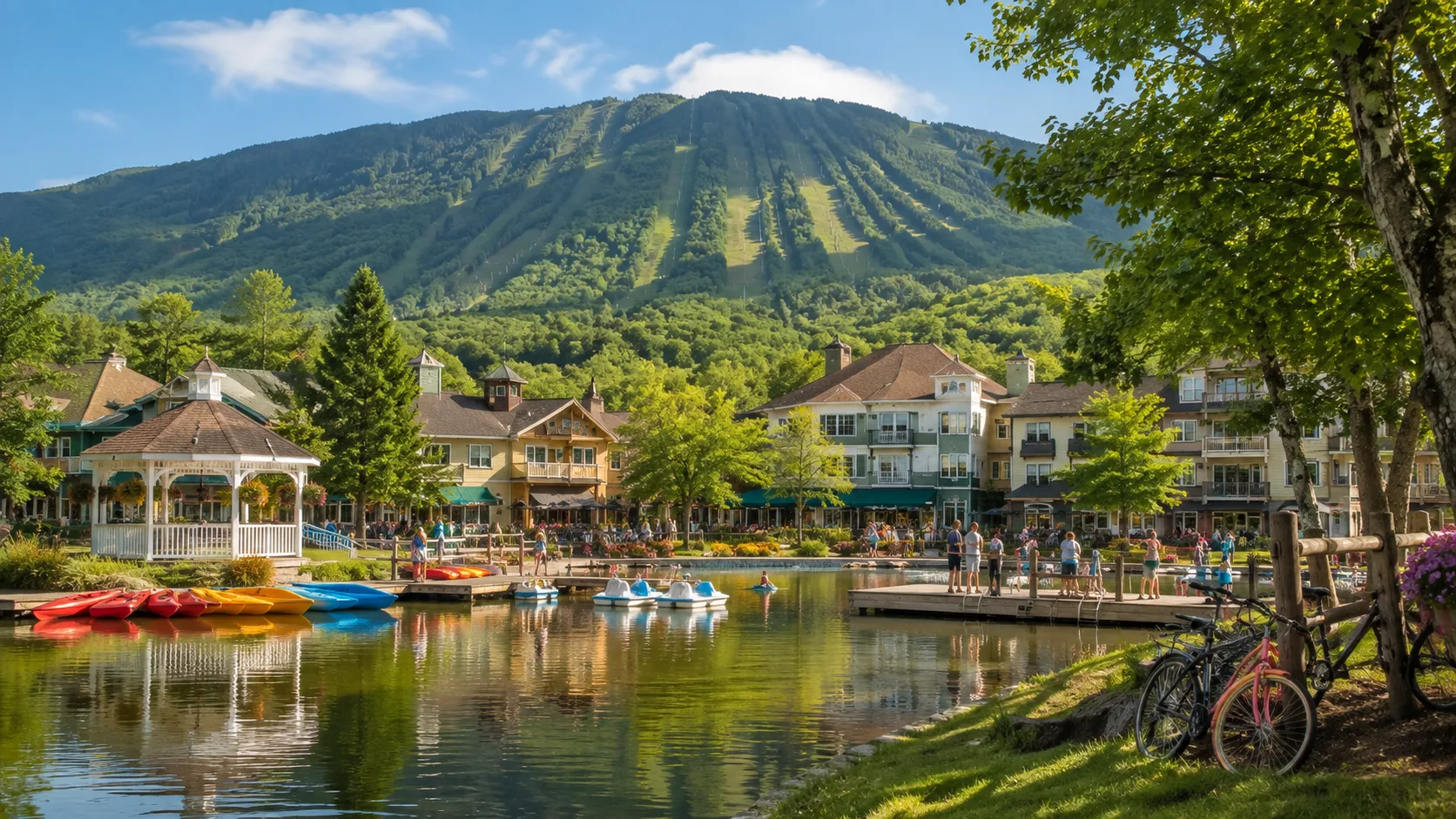
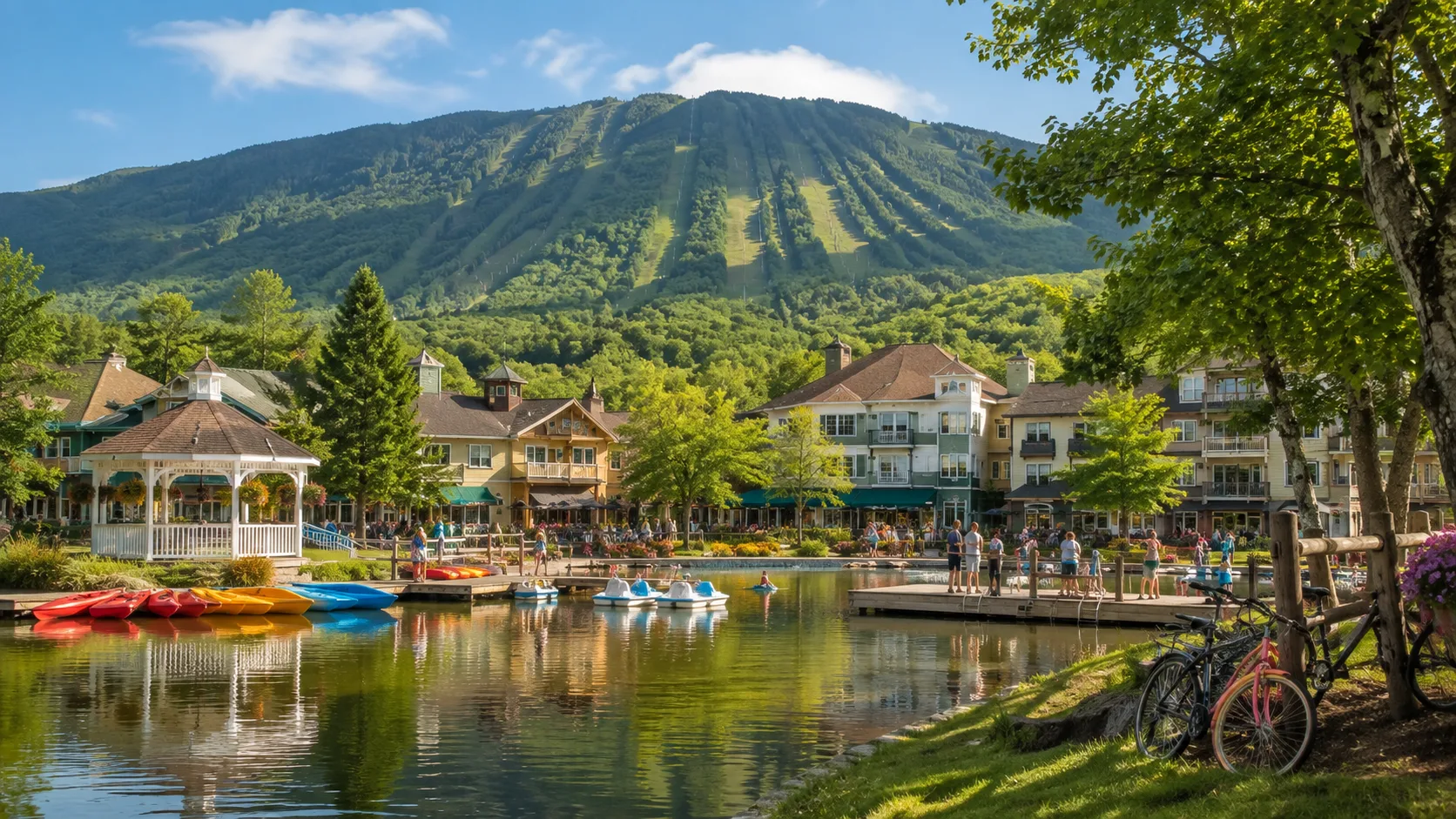
Inside the bowl, everything human is within about a mile of everything else. Town Square is the center — shops, restaurants, a gazebo, the ice arena beside it — sitting on the shore of Corcoran's Pond, a small swimming and boating pond fed by the Mad River. The ski area base is a couple minutes' drive up the hill. The golf course, tennis courts, and athletic club fill in the valley floor. That compactness is the town's whole character: you park once, and a kid who can ride a bike can get to all of it alone. There aren't many places left in New England where that sentence is true.
One more map note, because it matters seasonally. Tripoli Road, a rough seasonal forest road, climbs out of the valley's northwest corner and comes out at I-93 exit 31 in Woodstock, just south of Lincoln — a beautiful backwoods shortcut in summer and fall, gated shut all winter. The town's business association posts trail maps and current information at visitwatervillevalley.com if you want more than my map-in-words.
Winter
Winter is the season the valley was rebuilt around, and it's still the season that fills our rental calendar first.
The ski area. Waterville Valley Resort skis on Mount Tecumseh — 2,020 feet of vertical off a summit the resort lists at 4,004 feet, 62 trails across 265 acres, with 100 percent snowmaking coverage and a high-speed six-pack bubble lift doing the main work out of the base. My honest read, as someone who has skied everything in this corridor: it's a mid-size mountain that skis bigger than its acreage, the terrain skews friendly — roughly three-quarters of it is novice or intermediate — and the bubble lift is a genuine gift on a windy January day. Families and improving intermediates are the mountain's sweet spot. Experts will find a handful of legitimately steep shots and some glades, then find themselves lapping them. That's not a knock; it's how you should plan. This is the mountain where your kids learn to ski well, not where you chase 100-day seasons of expert terrain.
Tubing. This one earns its own paragraph because so many people search for it and the details matter. Waterville Valley's snow tubing runs on dedicated lanes at the Clubhouse, and it's walk-up rather than lift-served — you carry your tube back up. That makes it cheaper and more flexible than the big lift-served tubing parks, and it makes it exactly the right ninety minutes for kids with energy to burn on a non-ski afternoon. Two practical notes from many chaperoned trips: no ski boots or hard-shell boots on the hill, and the Clubhouse has warming space and food, so one parent can supervise from indoors with coffee. Nobody needs to be a hero.
Skating and the Nordic side. The ice arena beside Town Square runs public skating and stick-and-puck sessions through the year, with rental skates on site — it's the reliable indoor answer on a bitter day. And the Nordic Center grooms a big cross-country network across the valley floor and lower slopes, with snowshoe and fat-bike terrain besides. I know downhill families who came for Tecumseh and, three winters in, spend more days on the Nordic trails than the lifts. The valley floor is sheltered, the grooming is consistent, and gliding along the Mad River in falling snow is the best free-feeling afternoon in town, even if it isn't technically free.
The storm-day truth. The unglamorous winter fact about Waterville Valley is that it's an eleven-mile dead-end road, and on a big storm day that's a feature. No pass traffic, no highway crawl — people who stayed in the valley are on the lifts while the day-trippers are still on I-93. It's the single best argument for sleeping in the valley instead of driving up, and it's the argument that eventually turns renters into owners.
Summer
Here's the thing the ski-town label hides: Waterville Valley summer is the better-kept secret, and it's when the valley makes the most sense as a family base. Everything sits within that one walkable mile, and the resort's summer operation layers a full program on top of the geography.
Corcoran's Pond. The center of a summer day. There's a fleet of kayaks, stand-up paddleboards, canoes, and pedal boats for rent at the Town Square dock, a swim area with a floating dock, and the pond is stocked with fish. It is small, warm-ish by mountain standards, and completely surrounded by the view — a kid-friendly beach day in the middle of the mountains with no ocean drive.
The trails. The valley's hiking network is the deepest single reason to be here, and the resort bills it as the oldest trail network in the country — people have been walking these paths since the 1800s. There are around 125 miles of trails radiating from town. My short list for visitors: the Cascades for a waterfall walk close to the village (the resort runs guided versions in summer, which tells you how doable it is), Greeley Ponds through the notch north of town for a moderate out-and-back to two mountain ponds holding brook trout, and for the ambitious, the 4,000-footers ringing the bowl — Tecumseh and Osceola being the classics. On your way in or out, the Welch-Dickey Loop off Route 49 in Thornton is the best open-ledge hike this side of Franconia Notch; I covered it properly in my Campton guide. Start early on summer weekends. That advice never expires.
Golf and tennis. The valley's nine-hole golf course has been in play since 1898, which makes it one of the older courses in the state — short, scenic, and exactly right for a family round or a warm-up. (The serious eighteen is down the road at Owl's Nest Resort in Campton — yes, my brokerage shares the name, and yes, I'm biased, but the Nicklaus Design course is the best round in the region.) The tennis center runs eighteen outdoor clay courts plus two indoor — clay courts in this quantity are rare in northern New England, and the tennis culture here is real, not decorative.
Biking, the chairlift, and the rest. Mountain and valley bike trails thread the whole bowl, with rentals in town. The Snow's Mountain chairlift runs scenic rides in summer, with a disc golf course up top. The White Mountain Athletic Club covers the rainy-morning gap with indoor and outdoor pools. And the Mad River itself fishes well for rainbow trout — NH Fish and Game manages this water, and the anglers you see at dusk near the covered bridge know exactly what they're doing.
The Curious George thing. This is my favorite piece of valley trivia and it's completely true. Margret and H.A. Rey, the authors of Curious George, summered in Waterville Valley for two decades starting in the 1950s — Hans revised his stargazing classic here because the valley's forest-ringed darkness was perfect for it — and several Curious George stories were written in town. Their cottage now operates as the Rey Cultural Center, running art, science, and nature programs for kids and families. If you have a child of picture-book age, the fairy-house building sessions and nature programs are the gentlest, best hour on the calendar.
Events and Town Square
The events question comes up constantly with rental guests, so let me describe the rhythm rather than pin dates that shift year to year.
In summer, Town Square runs on a weekly pulse: live music at the gazebo on weekend evenings, family movie nights, s'mores and campfire nights, craft workshops, guided waterfall hikes, tie-dye afternoons. You don't plan a trip around any single one; you show up in July or August and the programming is simply there, most days of the week. The resort's event calendar has the current lineup.
Across the year, the town's annual traditions rotate through — a chocolate festival, a chili challenge, a car show, an artisan fair, a fall harvest festival, trail races in late summer — the kind of small-town calendar Visit White Mountains keeps better track of than I do. Check dates before you book around one. The honest note I'll add as the guy managing rental turnovers: event weekends fill the valley, but they never overwhelm it the way a Lincoln holiday weekend does. The dead-end road keeps the crowds proportional to the beds.
Fall
Fall in Waterville Valley is short, spectacular, and quieter than it deserves to be. The Route 49 drive up the Mad River is eleven miles of maple over moving water — I've called it the best free itinerary in this corridor before, and the valley end of it is the crescendo. Foliage typically peaks here from late September into mid-October.
What I actually recommend: hike the Cascades or Greeley Ponds under peak color, ride the chairlift if your knees vote no, then take Tripoli Road out of the valley toward Lincoln while it's still open — a slow dirt-road hour through the national forest that beats sitting in Kancamagus traffic, which in foliage season resembles a very scenic parking lot. If you want the full Lincoln-side menu afterward, my Lincoln guide covers it honestly, traffic warnings included.
Fall is also when I tell buyers to tour. The summer programming has wound down, the winter crowds haven't arrived, and you see the town at its quietest — which is exactly the town you're buying for forty weekends a year.
Spring
I owe you the same honesty I gave Campton and Lincoln: April here is mud season. The lifts stop, the trails up high are rotten snow, Tripoli Road is still gated, and Town Square runs at a murmur. If you come in early April expecting a postcard, you'll get brown grass and closed signs.
But spring has two real uses. The first is late May, when the trails dry out, the guided programming warms up, and you get the valley's whole summer infrastructure with none of its (already modest) crowds. The second is house-hunting. Spring is when inventory builds and when the valley is at its most honest — no snow flattering the buildings, no concerts flattering the square. A condo you love in mud season is a condo you'll love all year.
Rainy days and small kids
The valley's wet-weather bench is deeper than most mountain towns because so much of it was built for après-ski anyway. The athletic club's indoor pool, the ice arena's public skating, the arcade and bowling alley, the Rey Center's programs, and Town Square's shops and restaurants cover a full washout day without a car. With small kids in decent weather, the resort's self-guided Bigfoot scavenger hunt — five silhouettes hidden along the pond loop, a prize at the end — is precisely calibrated to the under-ten attention span. And Plymouth's movie theater and college-town restaurants sit thirty minutes down the hill when cabin fever wins.
What I'd skip
Nothing in the valley is a trap — it's too small and too honest a town to support one. But manage expectations on three counts.
First, don't come for nightlife. Town Square has good dinners and a couple of easygoing bars, and by ten o'clock the valley is asleep. The people who buy here consider that the amenity.
Second, if you're an expert skier building a trip around steeps, be realistic about Tecumseh's trail mix and consider splitting your days with a bigger mountain — plenty of our guests ski Waterville midweek and Loon or Cannon on the weekend from the same base.
Third, skip the idea of using Waterville Valley as a touring hub for the whole White Mountains. The dead-end road that makes it peaceful also makes every excursion start with eleven miles of Route 49. If your trip is mostly Flume Gorge, the Kanc, and North Conway outlets, base in Lincoln and day-trip here instead. If your trip is unpack once, walk everywhere, let the kids roam — that's the valley, and nothing else in the Whites does it as well.
What all this does to the real estate market
Here's the broker's postscript, because everything above shapes what's for sale. Waterville Valley is a condo town — the resort era built it that way, and the market still reflects it. As I write this, there are about twenty-eight active residential listings in the valley, and exactly one of them is a single-family house. Everything else is condos, from studios near the lifts to townhouses on the golf course.
The entry points surprise people in both directions. Quartershare condos — you own a deeded quarter of a unit and use it on a rotation — list in the mid five figures as I write this, which is the cheapest legitimate foothold in any New Hampshire resort town. Whole-ownership condos run from under two hundred thousand into the six-sixes for the newer and better-located stock. That spread is why I always start buyers with a conversation about how they'll actually use the place before we look at a single unit — the quartershare that's perfect for six ski weekends a year is the wrong answer for a family planning full summers. I unpacked the whole condo market, quartershares included, in my Waterville Valley condo guide.
If the valley has its hooks in you — and it tends to do that quietly, somewhere around the second summer — start with our Waterville Valley neighborhood page, where every current listing updates from the MLS. The four-seasons overview is the companion piece to this one from the ownership side. If the budget argues for the hills just down Route 49, the Waterville Estates guide covers the community in Campton where a lot of valley-priced-out buyers land happily, and the new listings page shows what's fresh across the whole corridor.
Or call the office. It's eleven miles down the road, I've got the trail map in the truck, and showing someone the valley for the first time is still the easiest sale I never have to make.