
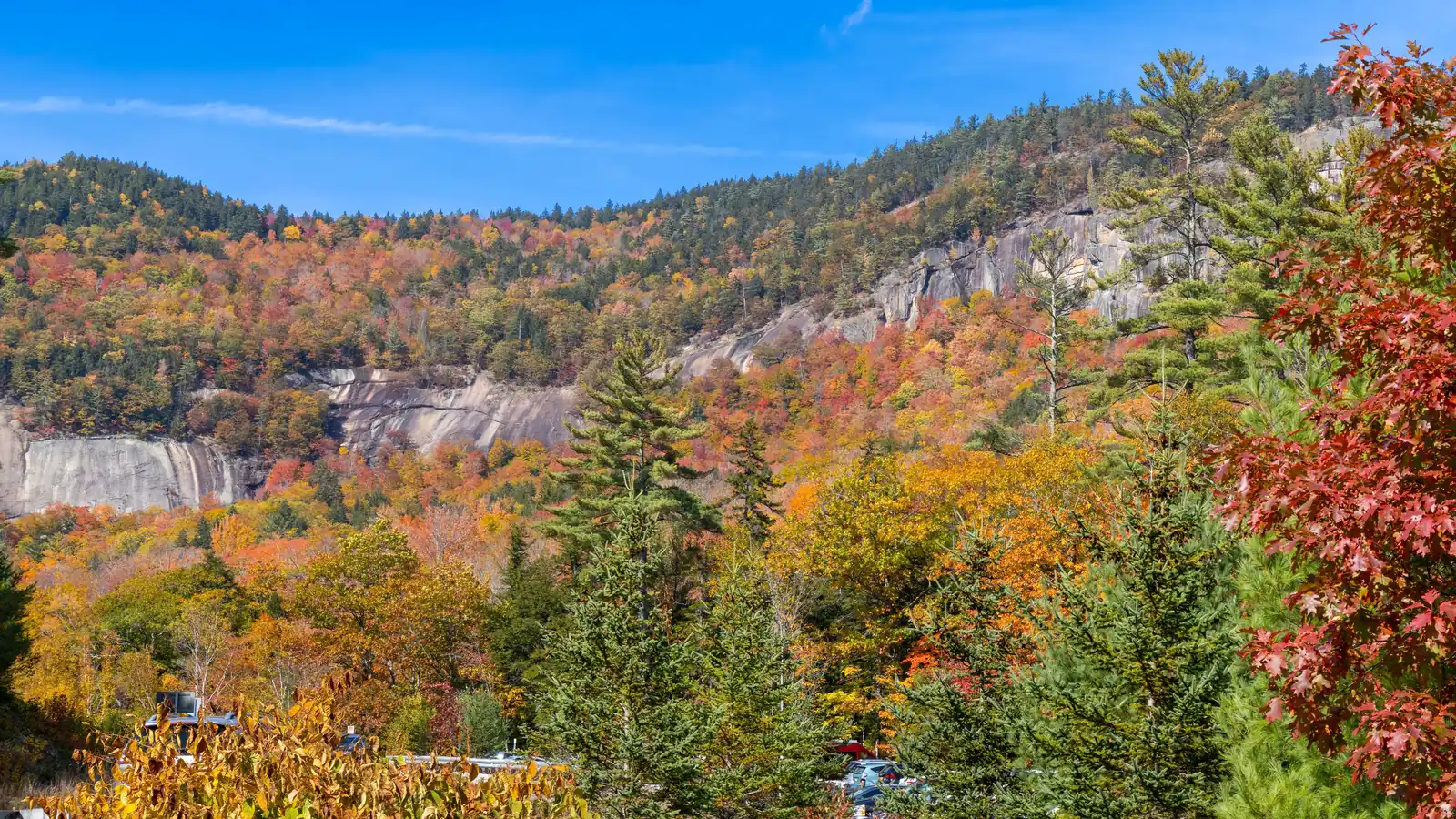
New Hampshire fall colors peak from north to south over about four weeks: the Great North Woods in the last week of September, the White Mountains in the first two weeks of October, the Lakes Region around mid-October, and the Seacoast and southern tier in the second half of October. For the White Mountains, a long-standing rule of thumb is that peak arrives within about a week on either side of Columbus Day weekend (Valley News) — in 2026 that's Monday, October 12. Higher elevations turn first, valleys and lakeshores follow, so even in one town the color moves down the mountainsides for two to three weeks. Below: the regional timing, the official New Hampshire foliage tracker, the best drives and short hikes for fall foliage in New Hampshire, and how to handle the crowds. Updated October 2026.
We sell homes in Plymouth, Campton, Waterville Valley and Lincoln, which puts us in the middle of the best foliage country in the state. This guide leans on that local knowledge, and links every fact we didn't see for ourselves to its source.
When is peak fall foliage in New Hampshire?
A New Hampshire autumn runs on cold nights and shortening days — that's what turns the leaves — so latitude and elevation decide the calendar more than anything else. A typical year looks like this:
| Region | Typical peak | Where to go |
|---|---|---|
| Great North Woods | Last week of September into early October | Route 3 north of Colebrook, the Connecticut Lakes, Dixville Notch |
| White Mountains | First two weeks of October | Kancamagus Highway, Franconia Notch, Crawford Notch, Waterville Valley |
| Lakes Region | Around mid-October | Squam Lake and Route 113, Lake Winnipesaukee from Meredith and Center Harbor |
| Monadnock and Dartmouth–Lake Sunapee | Late September to mid-October | Mount Monadnock, the Connecticut River valley |
| Merrimack Valley and Seacoast | Second half of October | Rural back roads, the coast, Portsmouth |
Sources: Visit NH foliage tracker, Yankee Magazine's New Hampshire foliage guide, and regional peak summaries compiled by More Than Just Parks.
Treat those dates as the middle of a window, not a promise. A dry late summer, an early hard frost or a big wind-and-rain storm can shift peak by a week or strip the trees early. Two things hold every year, though: the high country goes first, and the color keeps going somewhere in New Hampshire for most of October.
Where to see fall colors in New Hampshire, week by week
If you are picking dates in October, a simple plan works:
- Last week of September: go north — the Great North Woods and the high notches (Franconia, Crawford, Pinkham) start to turn first.
- First week of October: the Kancamagus Highway, Waterville Valley and the upper Pemigewasset Valley around Lincoln.
- Columbus Day weekend and the week after: the lower White Mountains valleys — Campton, Thornton, Plymouth — and the Squam Lakes.
- Mid- to late October: Lake Winnipesaukee, the southern Lakes Region, then the Seacoast.
The New Hampshire fall foliage tracker and foliage reports
The best real-time source is the state's own. New Hampshire's Division of Travel and Tourism Development runs Visit NH, which publishes three tools every fall:
- The NH foliage tracker — an interactive map of the state's regions with a slider that shows approximate color change week by week through the season. Click a region to see its latest report.
- The peak foliage map — a New Hampshire foliage map of when peak has historically arrived in each region, built from several recent seasons of reports. Use it to plan dates months ahead.
- The weekly foliage report — written region-by-region updates during the season, with what's turning and what's past.
How to use them together: pick your week with the peak foliage map in August, then check the foliage tracker and the foliage report for New Hampshire the Monday before you go and shift a region north or south if the season is running early or late. Webcams help too — the ski areas (Loon, Waterville Valley, Cannon) all run summit and base cams that show the real color on the slopes that morning.
The best fall foliage drives in New Hampshire
The best fall foliage in New Hampshire is mostly seen from the car, and these are the drives we send visitors on.
The Kancamagus Highway (Route 112)
The Kancamagus — "the Kanc" — is the most famous foliage drive in New England: about 34.5 miles of Route 112 through the White Mountain National Forest from Lincoln to Conway, with no gas stations, no restaurants and patchy cell service the whole way (Town of Lincoln). It climbs to 2,855 feet at Kancamagus Pass (Wikipedia), so it often colors up a few days before the valleys on either end.
Stops worth making, west to east: the Lincoln Woods trailhead and its suspension bridge over the Pemigewasset; the Pemi and Hancock overlooks on the switchbacks below the pass; the C.L. Graham Wangan Ground overlook; Sabbaday Falls (a short walk to a gorge falls); Lower Falls and Rocky Gorge on the Swift River; and the Albany Covered Bridge near the Conway end. Allow an hour without stops and half a day with them. Fill the tank in Lincoln or Conway before you start.
Our guide to things to do in Lincoln NH covers the Lincoln end of the Kanc and the rest of the town.
Franconia Notch (I-93 / the Franconia Notch Parkway)
Through Franconia Notch State Park, I-93 narrows to a two-lane parkway for about eight miles between Lincoln and Franconia (Wikipedia), with Cannon Cliff on one side and the Franconia Ridge on the other. Pull off for Echo Lake, Profile Lake and the Basin, a 20-foot granite pothole under a waterfall on the Pemigewasset.
One change for 2026: the Cannon Mountain Aerial Tramway is not running. The second-generation tram made its last trips in October 2025 and is being replaced, so plan on the views from the ground or from a hike this year (Cannon Mountain).
Crawford Notch (Route 302)
Route 302 runs through Crawford Notch State Park between Bartlett and Bretton Woods (Wikipedia). The notch walls, Frankenstein Cliff and the Willey House site are all roadside, and the drive past the Mount Washington Hotel at Bretton Woods, with the Presidential Range behind it, is one of the classic New Hampshire fall views. Pair it with the Kanc as a loop through Conway.
Route 3 from Plymouth to Lincoln
The quiet alternative to I-93: Route 3 follows the Pemigewasset River north from Plymouth through Campton, Thornton and Woodstock to Lincoln, past farm fields, the river and the hillsides of the southern White Mountains. It's slower than the interstate and far less crowded than the Kanc on a peak weekend. Add a detour up Route 49 from Campton into Waterville Valley, a mountain valley ringed by national forest that turns in the first week or two of October.
Route 113 around Squam Lake
For lake-and-mountain views, take Route 113 from Holderness east along the north side of Squam Lake toward Center Sandwich. The road passes the Squam Lakes Natural Science Center and the trailhead for West Rattlesnake, then winds through farmland under the Sandwich Range. The Squam Lakes usually peak a little after the mountains, around Columbus Day and the week after. Our Squam Lake area page has more on the lake and its towns.
Lake Winnipesaukee in the fall
Lakes Region fall foliage, Lake Winnipesaukee included, tends to arrive in mid-October, a week or so after the White Mountains. Route 3 and Route 25 through Meredith and Center Harbor give the easiest water views, and the hills above the lake's north shore show the color best in late-afternoon light. If the mountains are past peak when you visit, the Lakes Region is where to look next. See our Lakes Region page for the towns around the big lake.
North Conway fall foliage
North Conway is the gateway town at the east end of both the Kanc and Crawford Notch. Cathedral Ledge and Echo Lake State Park sit just west of the village, and the views back across the Saco River valley to Mount Washington are the classic North Conway foliage shot. Expect the heaviest traffic in the state on Route 16 through the outlet strip on peak weekends; the West Side Road is the local bypass.
Easy foliage hikes with big views
You don't need a 4,000-footer to see New Hampshire in the fall. These short hikes deliver open views for modest effort:
- Artists Bluff and Bald Mountain, Franconia Notch — a 1.5-mile loop from the parking area on Route 18 across from Cannon's Peabody base, with the best-known view of Echo Lake and the notch (Cannon Mountain). Go early; the lot fills on peak weekends.
- Mount Willard, Crawford Notch — about 3.2 miles round trip and roughly 900 feet of climbing to a ledge looking straight down the notch (SectionHiker).
- Arethusa Falls, Crawford Notch — the tallest single-drop waterfall in New Hampshire, about 140 feet by the AMC's estimate (Wikipedia).
- West Rattlesnake, Holderness — the Old Bridle Path is 0.9 miles each way with about 400 feet of gain to ledges over Squam Lake (Hike New England). Probably the best view-for-effort in the Lakes Region.
- Welch-Dickey Loop, Thornton — a 4.4-mile loop over open granite ledges with long views of Waterville Valley and the southern White Mountains (Trailfinder). The ledges get slick and icy in late fall; bring traction.
For more trails on our side of the mountains, see hiking near Waterville Valley.
Crowds, parking and passes
New Hampshire leaf peepers know the rule: the Kancamagus on a peak Saturday is a parking lot. Popular overlooks fill early, and the Sunday and Monday of Columbus Day weekend are the worst days on the road. A few things help:
- Go midweek or go early. Arrive at the Kanc or Franconia Notch before about 10 a.m., or save the drive for a Tuesday to Thursday.
- Know the pass rules. Driving the Kancamagus is free, but parking at designated White Mountain National Forest recreation sites — many Kanc overlooks, trailheads and picnic areas — requires a recreation pass. The Forest Service lists a $5 day pass, a $30 individual annual pass and a $40 household annual pass, sold at self-service fee tubes in the lots, at ranger stations and on Recreation.gov; America the Beautiful, Senior and Access passes are honored (USFS White Mountain National Forest). Check current prices before you go — fees change.
- State parks charge separately. Franconia Notch attractions such as the Flume Gorge run on their own tickets and reservations through NH State Parks.
- Take the back roads. Route 3 instead of I-93, Route 113 instead of Route 25, and West Side Road instead of Route 16 in North Conway.
- Book lodging early. Columbus Day weekend books out first, often months ahead, and minimum-stay rules are common.
Staying in Plymouth, Campton, Waterville Valley and Lincoln
Our corner of the state is a convenient base for fall foliage in NH because everything in this guide is within about an hour. From Exit 28 in Campton you can reach the Kanc in Lincoln in roughly 20 minutes up I-93, Franconia Notch a few minutes beyond that, Waterville Valley up Route 49, and Squam Lake through Holderness to the south. Plymouth has the restaurants and services; Campton and Thornton are quieter, with more rental homes and condos; Lincoln puts you at the start of the Kanc with Loon Mountain's gondola in town; Waterville Valley is a self-contained resort village. See our White Mountains real estate page for how these towns compare.
Buying a second home in foliage season
A lot of second-home searches in the White Mountains start on a foliage weekend, and October is a good month to look:
- You see a house at its best and its most honest. The leaves are coming down, so the views and the sun you'll really have in winter start to show. It's also the last chance to check roofs, gutters, drainage and the driveway's pitch before snow covers them.
- Timing works for ski season. An offer in October can close before the lifts open at Loon, Waterville Valley and Cannon in late fall.
- Columbus Day weekend shows rental demand. It's one of the most heavily booked weekends of the year in this corridor, alongside the ski holidays. If you plan to rent the place when you're not using it, look at how many weeks a property can realistically book across all four seasons, not just in October, and check the town's and the association's rules on short-term rentals before you buy. Our short-term rental analysis and Lincoln NH Airbnb investment guide go through the numbers.
Here's what's on the market in the towns closest to the foliage drives:
If a foliage trip has you thinking about a place of your own, our White Mountains second-home guide covers the buying side, and you can talk to our team about what's available before the snow flies.
Frequently asked questions
When is peak fall foliage in New Hampshire?
Peak moves from north to south: the Great North Woods in the last week of September, the White Mountains in the first two weeks of October, the Lakes Region around mid-October, and the Seacoast and southern New Hampshire in the second half of October. Check the Visit NH foliage tracker the week before you go, because weather can shift peak by a week either way.
Where can I find the New Hampshire foliage tracker?
The official NH foliage tracker is on Visit NH, the state tourism site, at visitnh.gov under Plan Your Trip, Fall. It has an interactive map with a weekly slider, regional foliage reports during the season, and a peak foliage map showing when each region has peaked in past years.
What are the best places for fall foliage in New Hampshire?
The Kancamagus Highway, Franconia Notch and Crawford Notch are the best-known drives. For fewer crowds, try Route 3 from Plymouth to Lincoln, Route 49 into Waterville Valley, and Route 113 along Squam Lake. Short hikes with big views include Artists Bluff, Mount Willard, West Rattlesnake and the Welch-Dickey Loop.
Do you need a pass to drive the Kancamagus Highway?
No — driving the Kancamagus is free. You need a White Mountain National Forest recreation pass to park at designated recreation sites along it, such as many overlooks, trailheads and picnic areas. The Forest Service lists a $5 day pass and annual passes, sold in the parking lots and on Recreation.gov, and accepts America the Beautiful passes.
Is Columbus Day weekend a good time to see New Hampshire fall colors?
It's often close to peak in the White Mountains valleys and the Squam Lakes, but it's also the busiest weekend of the season. If you go, start early, use back roads like Route 3 and Route 113, and book lodging well ahead. The weekdays just before or after usually have similar color and much lighter traffic.
Where is the best fall foliage near Lake Winnipesaukee?
Lake Winnipesaukee usually peaks in mid-October, after the mountains. Meredith and Center Harbor on Routes 3 and 25 have the easiest water views, and nearby Squam Lake — with the West Rattlesnake hike off Route 113 in Holderness — is the best short hike with a lake view.