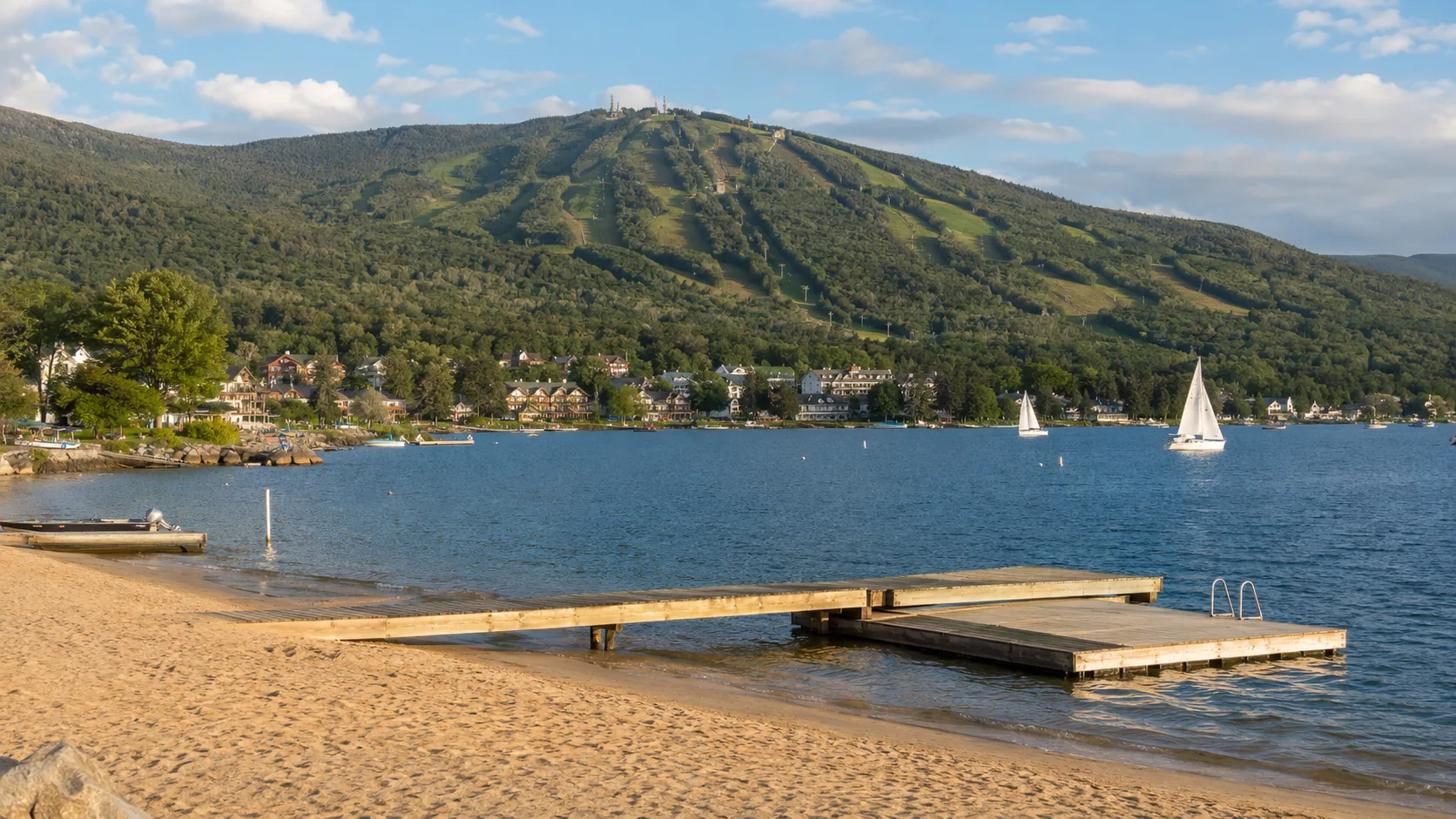

Houses for sale in Gilford NH attract two completely different buyers on the same day: the family relocating for the schools who wants to know if they can actually afford the town, and the second-home buyer who skied Gunstock in February, swam at Ellacoya in July, and wants to know why nobody told them one town contained both. This guide answers both calls.
Here's the short version before the numbers: Gilford is the only town in the Lakes Region — one of very few anywhere in New England — where the ski mountain, the big-lake beach, and the good school district all sit inside the same town lines. That combination is why people searching Gilford NH homes for sale keep running into the same problem, which is that everyone else figured it out too. Inventory is thin, the entry level is thinner, and the town's best addresses trade in a market of their own behind a gate on an island.
So this is the conversation you'd get across a desk. Real prices from the MLS as of August 2026, the neighborhoods one by one — Governors Island, Glendale, Gunstock Acres, and the wave of new construction most out-of-towners haven't noticed yet — the tax bill compared honestly to Laconia and Meredith, and the trade-offs, because Gilford has real ones and they're not the ones you'd guess.
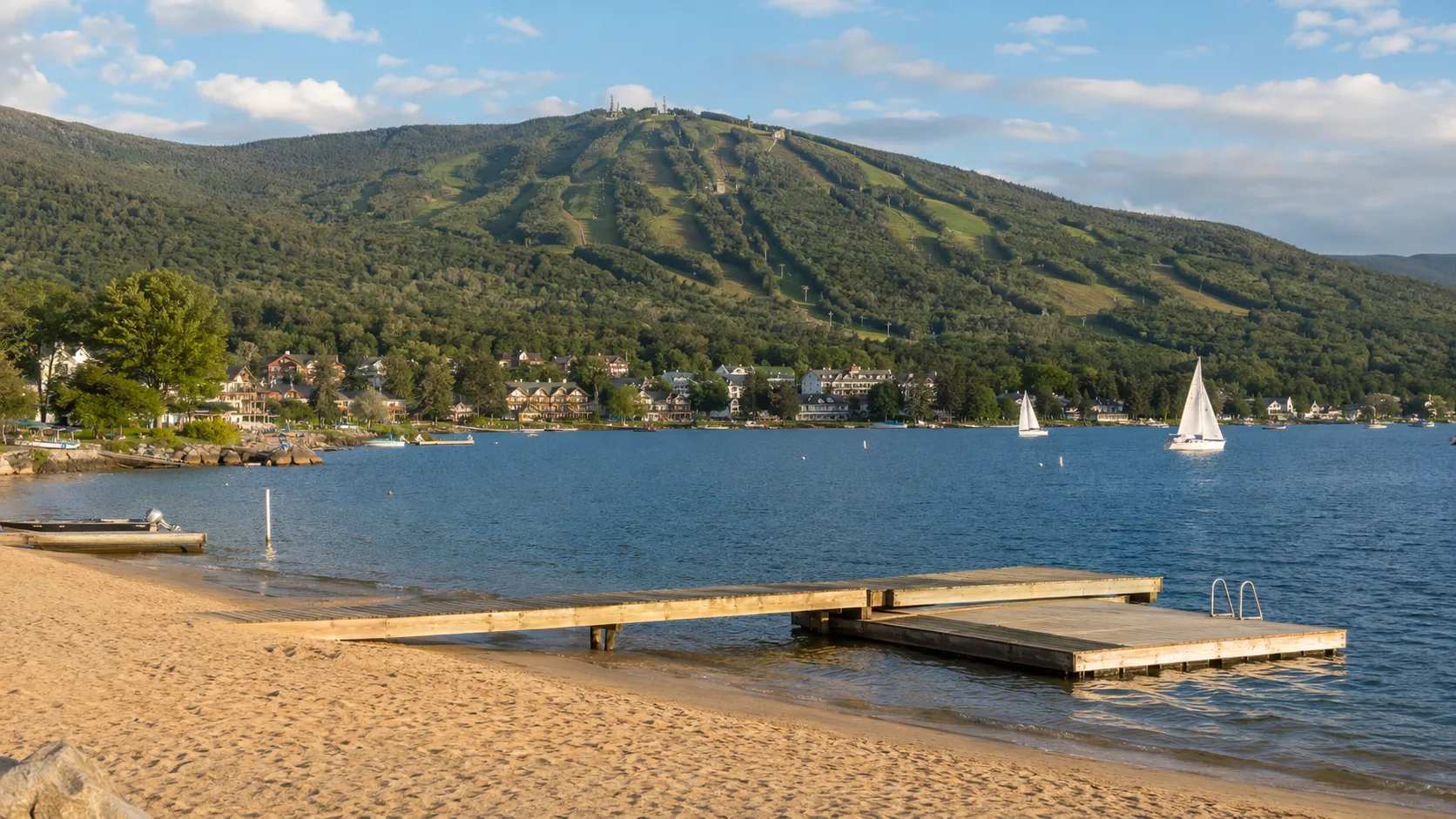
The town with all three
Start with the map. Gilford runs from the southwestern shore of Lake Winnipesaukee up into the Belknap Range, which means the town's roughly 7,800 year-round residents live between New Hampshire's biggest lake and Belknap County's highest ground. On the water side: miles of Winnipesaukee shoreline, the bridged island communities, Ellacoya State Park with its 600-foot sand beach, and the village of Glendale, where the town's docks and boat ramps put residents on the lake. On the mountain side: Gunstock Mountain Resort, the county-owned ski area, and behind it Belknap Mountain itself — 2,382 feet, the highest point in the county, with an active fire tower on the summit and a trail network that locals treat as their backyard.
In between sits a genuinely functional town: its own school district, a town beach on the big lake, the Lakes Region's mall-and-grocery commercial strip along Route 11, and the Bank of NH Pavilion, the roughly 9,000-seat amphitheater that pulls national touring acts all summer. Concord is about 40 minutes, Boston about two hours. My neighbor guide to Laconia — one town over, sharing the same hospital and the same commute — describes a city that runs the region. Gilford is the town that gets to live next to all that infrastructure without paying the city's tax rate or absorbing the city's problems, and the market prices that privilege in. Let's talk about how much.
What Gilford homes for sale actually cost
I pulled these numbers from the MLS this week, August 2026, and as always: treat any article's price table, including mine, as a snapshot with a shelf life. For live inventory, run a property search filtered to Gilford, or watch the newest listings as they hit — in a market this thin, the good ones don't wait for your Saturday browse.
As I write, there are 72 active residential listings in Gilford — 49 single-family homes, 16 condos, and 7 manufactured homes. For a town this desirable, that is not much, and it's less than half of what Laconia carries next door. The shape of it:
- The median asking price across everything is about $615,000. Single-family homes have a median of $725,000 — that's more than $50,000 above Laconia's single-family median, and the gap tells you what the market thinks of the schools, the beach rights, and the tax rate.
- Condos are the accessible door. Sixteen active condo listings run from $199,000 — a one-bedroom near the lake that's already permitted for short-term rental — up to $1.1 million for renovated waterfront in one of the lake-access associations, with the median in the mid-$400,000s.
- The entry level barely exists. Only 7 single-family homes are asking under $500,000, and the sub-$400,000 tier — 16 listings — is mostly the town's manufactured-home communities, which run $59,000 to about $220,000. A young family shopping conventional houses in the $350,000–$450,000 window will find one or two options here on a good month; that same budget opens a dozen doors in Laconia.
- The top is high and getting higher. Fourteen listings are at or over $1 million and four are over $2 million, topped by a $4.15 million new build in a hillside enclave. What's notable is what that top end is: most of it is new construction, not old waterfront.
- The stock is newer than the region's. Sixteen of the 72 listings — more than a fifth — were built in 2020 or later, and only six predate 1950. Gilford skips most of the old-mill-housing inheritance that defines Laconia's low end; the flip side is that it also skips Laconia's fixer-upper value plays.
- Median days on market is about 54 — a couple of weeks faster than Laconia. Correctly priced Gilford homes do not linger.
The neighborhoods, one by one
Governors Island. The headline address, and one of the most distinctive communities on any lake in New England: a 500-acre bridged island on Winnipesaukee, privately gated, where ownership comes with membership in the Governors Island Club — clubhouse, sand beach, tennis, the works. Something like 167 property owners on the island collectively carry roughly 15 percent of Gilford's tax base — local reporting puts the island's collective bill around $4 million a year — which tells you what the housing is worth. Island waterfront trades in the multiple millions when it trades at all; as I write this there are no waterfront listings on the island, and the sole active listing in the community is an inland one — a 4,000-square-foot Garrison colonial on 1.1 acres asking $1.795 million, moments from the water with club access but no frontage of its own. That's the pattern to understand: Governors Island inventory is scarce enough that the inland homes are seven figures, and the shorefront ones mostly change hands before you or I hear about them. If the island is your target, you want a broker watching it continuously, not a portal alert.
Glendale. The old lakeside village on the Winnipesaukee shore, and the soul of everyday lake access in this town. The Glendale town docks — two boat ramps, three docks, right beside the Marine Patrol headquarters — are reserved exclusively for Gilford residents and taxpayers, permit required April through October. Housing around Glendale is a mix of older cottages, lake-access association condos, and year-round homes on the hillside above the water; it's where the current waterfront condo listings cluster, including a fully renovated one-bedroom cottage-condo with a deeded boat slip asking $629,000. Glendale is the answer to a question I get constantly: how do I get a boat on Winnipesaukee without paying for frontage? In Gilford, you buy in town, get your resident permit, and launch at Glendale. That amenity alone quietly props up every non-waterfront home value in town.
Gunstock Acres. The biggest named neighborhood in the current inventory — a sprawling mountainside community on the Gunstock side of town, built out from the 1970s onward, with its own private beach access on the lake. Nine active listings as I write, from a $425,000 three-bedroom chalet to a $1.35 million contemporary, with the meat of the market in the $575,000–$825,000 range. This is where the "ski house that's also a lake house" buyer lands: five minutes to the lifts, fifteen to the town beach, and the association beach in between. Stock runs from dated A-frames that need work to 2019–2026 builds; inspect the older ones with mountain-weather eyes (roofs, drainage, heating systems). One line item the portals never surface: most of the neighborhood draws its water from the Gunstock Acres Village Water District, a resident-run precinct serving 750-plus homes. That's a genuine plus — no well to drill or maintain on a mountainside — but it means a flat annual water fee and a small precinct tax stacked on top of your town bill, and septic is still individual, so the older chalets get a septic inspection from me every time. None of it is a dealbreaker; it's the kind of thing you want on the closing sheet, not discovered after.
The new-construction hillsides. The quiet story in Gilford is how much of the current market is brand new. Winni Farms, a luxury development marketing Energy Star-certified homes, has four active listings between $1.6 and $2.1 million. The Stone Brook Hills enclaves hold the two most expensive listings in town at $2.675 and $4.15 million, and another new community lists at $2.35 million. Add the scattered 2025–2026 builds and new construction accounts for most of Gilford's seven-figure inventory. Builders go where the buyers are; they've concluded Gilford's schools-plus-Gunstock-plus-beach-rights bundle supports two-million-dollar spec homes, and so far the market keeps agreeing.
Everywhere else. Rolling residential roads between the lake and the mountains — capes, colonials, and ranches from the 1970s–2000s, the manufactured-home communities that hold the town's true entry level, and village-adjacent streets near the schools. This is the workhorse middle of the market: 26 of the 49 single-family listings sit between $500,000 and $900,000, and that band is where most year-round families actually land.
New Construction in Gilford NH
New construction in Gilford NH now defines the top of this market: more than a fifth of the current listings were built in 2020 or later, and new builds account for most of the town's seven-figure inventory. If that's the search you're running, a few things worth knowing before you chase it:
- Land is the constraint. The shoreline was spoken for generations ago, so new building concentrates on the hillsides between the lake and the Belknap Range. Buildable lots do surface, but mountainside sites carry real site costs — driveway, drainage, ledge, septic design — so price the lot and the site work together, never separately.
- Most of it is builder spec, not custom. The new construction you'll find in the MLS is largely spec inventory, often listed while still under construction — meaning the photos may be renderings and the completion date is part of the negotiation. Building your own home on your own lot is the slower road: line up a local builder early, and plan the timeline in seasons, not months.
- How it shows up in a search. New builds list with a recent (or "to be built") year built, so the quickest read on what's active is a search sorted to newest and screened by year — and because spec homes list at every stage of completion, a walkthrough tells you far more than the portal photos.
To watch the new inventory as it lands, browse Gilford homes on the Lakes Region page or Gilford listings on the Lake Winnipesaukee page — both run live from the MLS.
The waterfront reality
Now the honest part that separates this guide from the portal listicles: Gilford waterfront inventory is nearly nonexistent right now. As I write this in August 2026, exactly three active residential listings in town carry a waterfront flag:
- A renovated one-bedroom waterfront condo in a five-unit Glendale-area association at $629,000, with a deeded slip for a 22-foot boat and a $150-a-month fee.
- A classic Winnipesaukee cottage on Welch Island — boat-access only — with 300 feet of private frontage on almost two acres, asking $1.1 million. Island living is its own conversation (your groceries arrive by boat, and Glendale's dock permits suddenly matter a great deal), but on a frontage-per-dollar basis nothing on the mainland touches it.
- A three-bedroom condo in one of the lake's established waterfront communities at $1.1 million, with a sandy association beach and its own mooring.
That's the whole board. No mainland single-family waterfront at any price. Compare that with the spreads I walk through in my Lake Winnipesaukee home buying guide and you see the Gilford pattern: the town's premium shorefront is locked up in Governors Island and a handful of communities where inventory surfaces rarely and often trades quietly. When a mainland Gilford waterfront home does list, it prices like the scarce asset it is. If frontage is the non-negotiable and the town is the flexible part, browse lakefront homes across New Hampshire and you'll see what the same budget buys on other waters.
The workaround — and the reason I tell buyers not to despair — is that Gilford has more shared lake access per capita than any town on Winnipesaukee. The town beach gives residents 1,800 feet of sandy Winnipesaukee shorefront on Varney Point, decal-controlled, with lifeguards and a snack bar. Glendale puts your boat in the water. Ellacoya adds a state beach on Route 11. And a striking share of the current listings — by my count, descriptions on three-quarters of them — advertise beach or lake access through one association or another. In Gilford you buy the access bundled with the neighborhood instead of buying the frontage, and the math works: a $585,000 Gunstock Acres house plus a beach club plus a Glendale boat permit delivers about 80 percent of the waterfront lifestyle for about a quarter of the waterfront price. My best lakes in New Hampshire rundown makes the case for the lake itself; this town is the cheapest respectable way onto it with schools attached.
Gunstock changes the math
I ranked the Gunstock area in my best ski towns in New England piece for one reason: it's the only entry on that list where the summer asset is bigger than the winter one. The mountain itself — county-owned by Belknap County, one of the last county-run ski areas in America, with 1,340 feet of vertical and 227 skiable acres — is honest, family-scale skiing a tier below Loon or Waterville, with night skiing and summit views straight down onto Winnipesaukee. It's also well under two hours from Boston, the shortest drive of any real ski hill paired with a real lake.
What buyers underweight is what Gunstock does the other nine months. The resort runs a 260-site campground, an adventure park with ziplines and a 4,000-foot mountain coaster, and a summer events calendar; Belknap County residents get designated free-ride days as a perk of owning the place. Practically, a Gilford address means your kids ski after school in January and hike the Belknap Range trails from the same parking lot in June — the fire-tower summit of Belknap Mountain is a family-friendly two-to-three-hour round trip. For second-home buyers, Gunstock is the difference between a lake house you use twelve weekends a year and one you use forty. For year-round families, it's a municipal amenity that happens to be a mountain. Either way, it shows up in the prices — 58 of the 72 active listings mention it by name.
The tax bill, honestly
New Hampshire funds local government through property taxes, so the rate belongs in your math from day one. Gilford's 2025 rate came in at $11.85 per $1,000 of assessed value — up 5.3 percent from $11.25 the year before, and the neighbors people cross-shop sit at $12.98 (Laconia) and $10.62 (Meredith).
So Gilford runs about a dollar per thousand under Laconia and a dollar over Meredith — a meaningfully low rate for a town running its own full school district, which is the line item that usually drives rates up. Part of the answer is that Governors Island and the waterfront carry a disproportionate share of the levy; something like 15 percent of the town's tax revenue comes off one island. The standard caveats apply — rates only mean anything against that town's assessments, so compare actual bills on actual properties, and every rate resets each fall. On the current listings I can see actual figures: that $629,000 waterfront condo carries a tax bill around $4,300, and the $1.1 million lake-access condo about $6,000. I walk through the whole system — rates, equalization ratios, the view-tax folklore — in my New Hampshire property taxes guide.
The schools, since that's why half of you called
I'm a broker, not a school evaluator, so I'll give you the third-party numbers and one observation. The Gilford School District grades out around a B+ and ranks roughly #18 among New Hampshire districts on Niche; US News puts Gilford High School 26th in the state, with graduation rates in the low 90s and reading proficiency well above the state average. For a town of 7,800 to run its own K-12 district at that level is unusual, and it's the single biggest reason Gilford's family-sized homes carry a premium over the same house across the Laconia line.
The observation: in my closings, the schools are the tiebreaker more often than the driver. Buyers arrive for the lake or the mountain, then discover that the school district lets the second home become the primary home someday. That optionality is worth real money, and the market prices it whether or not you have kids.
The trade-offs nobody puts in the brochure
Concert and summer traffic. The Bank of NH Pavilion is a genuine amenity and a genuine nuisance, sometimes in the same evening. On show nights, Route 11 and the lake roads back up, and the Weirs-to-Alton corridor congests all summer regardless. Locals learn the schedule, adjust their errands, and some develop the time-honored habit of listening to the show from their decks for free. If you're touring homes near the Route 11 corridor, tour on a Saturday concert night in July before you write the offer.
The entry level is thin to the point of exclusion. Seven single-family homes under $500,000, most of the sub-$400,000 market in manufactured-home parks. If your budget is $400,000 and you need a conventional house, I'll show you what Gilford has — and then, honestly, I'll drive you to Laconia or Belmont, because the same money buys more there and the commute barely changes. And if it's water you're after on that budget, Lake Winnisquam one lake over is the value conversation I have most often.
Waterfront patience required. Three waterfront listings, none of them a mainland house. If your goal is owned Winnipesaukee frontage in Gilford specifically, plan on a long search, an off-market strategy, or both.
Short-term rentals are permitted, not free. Gilford regulates STRs through Article 22 of its zoning ordinance: if the owner doesn't live in the home, you need a conditional use permit from the Planning Board — initially good for three years — before you list it, complete with floor plans, septic proof, a fire-department sign-off, and an emergency contact who can be on site within the hour. The rules are aimed squarely at absentee commercial operators; owner-occupied casual rental is treated far more leniently. And the town keeps tuning it — the 2026 town meeting took up an amendment letting homeowner associations require the permit even where the ordinance itself doesn't, which matters if you're buying into a lake-access association with rental plans. Casual rental is workable — that $199,000 condo advertises STR capability outright — but if your purchase depends on rental income, confirm the current ordinance and permit path with the town's planning department before the offer, not after.
And the amenities are residents-only by design. The town beach and Glendale docks require residency or taxpayer status; the decal system is enforced. As a buyer this becomes your privilege the day you close — but it means you can't "try" the lake lifestyle from a rental in a neighboring town, and it's part of why Gilford trades at a premium: the town has deliberately kept its best assets off the general market.
Questions I hear every week
Is Gilford NH a good place to live?
For the right buyer, it's one of the best-rounded towns in the state: a self-contained K-12 district in New Hampshire's top 20, a residents-only Winnipesaukee beach, a county-owned ski mountain, and a genuinely safe, quiet community. The honest trade is that Gilford is car-dependent, sleepy after dark, and priced accordingly — the realistic conventional entry point is the mid-$500,000s. If you're weighing the full financial picture, no income or sales tax against those property bills, my New Hampshire cost of living guide runs that math statewide.
Does Gilford have a town beach?
Yes, and it's one of the best municipal beaches on Winnipesaukee: about 1,800 feet of sand on Varney Point, lifeguarded in season, restricted to Gilford residents and taxpayers under a decal system that is genuinely enforced. Ellacoya State Park on Route 11 adds a 600-foot state beach that anyone can use for day admission, and the Glendale docks handle the boat side.
What are taxes like in Gilford?
The 2025 rate was $11.85 per $1,000 of assessed value — under Laconia's $12.98, over Meredith's $10.62, and low for a town funding its own full school district, partly because the Governors Island waterfront shoulders so much of the levy. On a median $725,000 single-family home that pencils to roughly $8,600 a year, but rates only mean anything against assessments, so always check the actual bill on the actual property.
Can I rent out a Gilford home short-term?
Generally yes, with paperwork. If you won't be living in the home, Gilford's Article 22 requires a conditional use permit from the Planning Board before you list; owner-occupied casual rental is treated far more leniently. The rules get tuned nearly every year, so verify the current ordinance with the planning department before you buy on projected rental income.
Who Gilford fits
My honest sorting test. Gilford is right for you if you want the full four-season Lakes Region life in one town — ski hill, big-lake beach, boat access, hiking out the back door — with a school district that makes it a real place to raise kids, and you can operate in a market whose realistic conventional entry point is the mid-$500,000s. It's right for the second-home buyer who's honest that the family will use Gunstock and the town beach fifty days for every one day they'd use their own dock. And it's right for anyone playing the long game on Governors Island or the waterfront communities, provided you accept that game is played on scarcity's schedule, not yours.
It's wrong for you if you need the deep, forgiving inventory and true entry-level pricing next door — Laconia exists for exactly that, and I say so with affection for both towns. It's wrong if you must own frontage this year at a middle-class price. And it's wrong if summer crowds sour you, because Gilford's slice of the Winnipesaukee shore earns its traffic.
If you've been searching Gilford NH homes for sale and wondering why 72 listings feel like 20, that's not a data error — that's the town. Call the office. I'll tell you which associations actually deliver the beach rights they advertise, when something stirs near Governors Island, and whether your budget belongs in Gunstock Acres or one town over. The drive from my desk to the Glendale docks is about 40 minutes, and it's a nice one.