

Foreclosures in NH are power-of-sale auctions under RSA 479:25, with no court case unless the borrower files one. Once a home loan is more than 120 days past due, the lender mails a notice of sale at least 45 days ahead, advertises it for three weeks and auctions the home. There is no redemption after the sale (RSA 479:25, summarized by Nolo).
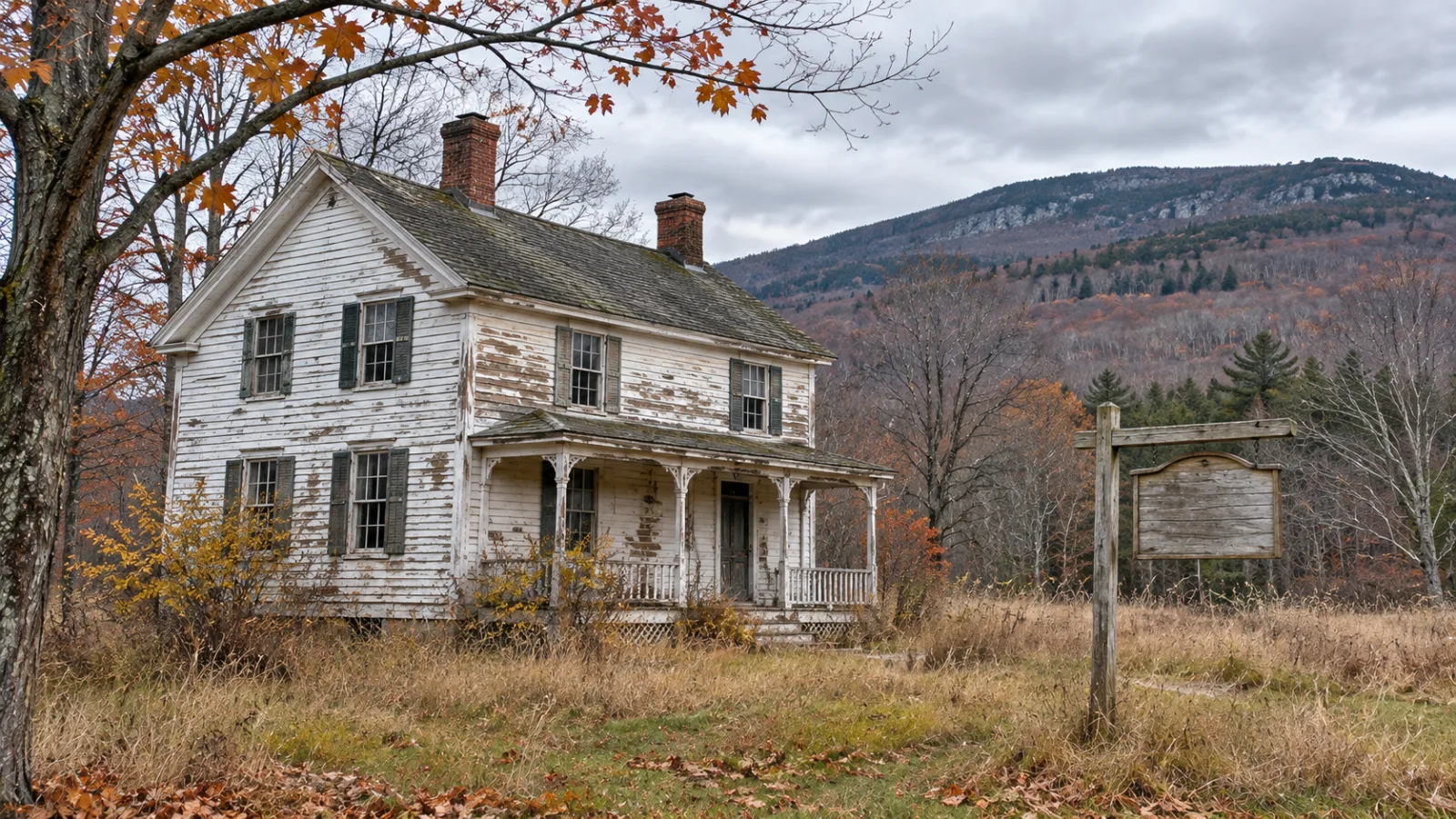
A foreclosure is a lender's forced sale of a mortgaged home after the borrower defaults, with the proceeds going to repay the loan. In New Hampshire it is uncommon: in the first half of 2026, 488 properties had a foreclosure filing, one for every 1,329 housing units, against one in 632 nationally (ATTOM, mid-year 2026).
We are a brokerage based in Campton, with a second office in Plymouth, selling across the Plymouth area, the White Mountains, the Lakes Region and the North Country. This guide names the statute or source behind each rule. It is general information, not legal advice: if you are bidding at an auction or facing a foreclosure yourself, talk to a New Hampshire real estate attorney or a HUD-approved housing counselor first. For the normal purchase process, start with our buyer's page.
Key takeaways
- Non-judicial state. The mortgage's power-of-sale clause lets the lender auction the home under RSA 479:25 without a lawsuit; the borrower's court remedy is a petition to the superior court before the sale.
- 45 days' notice, 3 weeks of publication. On a residential mortgage, the notice of sale goes to the borrower at least 45 days before the auction and runs in a newspaper once a week for three weeks.
- No redemption after the sale. The borrower can pay the full debt before the foreclosure sale (RSA 479:18) and has no right to redeem after a power-of-sale auction.
- Stopping a sale has a deadline. Paying the debt, a court injunction and a Chapter 13 filing all have to happen before the auction; a complete loss-mitigation application must reach the servicer more than 37 days before it (12 C.F.R. § 1024.41).
- Few foreclosures. NH ranked 39th of 50 states for foreclosure rate in the first half of 2026 (ATTOM).
- Buyers have four routes, plus one: short sale, auction, bank-owned (REO) on the MLS, or a HUD, VA, Fannie Mae or Freddie Mac home. Town tax deed sales are a separate path under RSA 80.
Facing a foreclosure yourself? Go straight to how to stop foreclosure in New Hampshire.
In this guide
- How do NH foreclosures work?
- How long does a foreclosure take in New Hampshire?
- How to stop foreclosure in New Hampshire
- Are there many foreclosures in New Hampshire?
- Foreclosure auction vs bank-owned (REO) vs short sale vs tax deed: the ways to buy
- NH foreclosure auctions: what happens on sale day
- Bank-owned (REO) homes: how foreclosed homes in NH reach the MLS
- HUD homes, VA homes, HomePath and HomeSteps in New Hampshire
- What is a tax deed sale in New Hampshire?
- Land foreclosures near me: bank-owned lots and tax-deeded land
- Foreclosures in Berlin NH and the North Country
- What to budget when buying a foreclosure
- Financing a foreclosed home: cash, conventional and FHA 203(k)
- How to find bank-owned homes in NH
- Frequently asked questions
How do NH foreclosures work?
NH foreclosures are power-of-sale foreclosures: the lender exercises the sale clause in the mortgage and auctions the property under RSA 479:25, with no judge involved unless the borrower goes to court first. Judicial foreclosure is also allowed, but most New Hampshire foreclosures are non-judicial (Nolo). Federal servicing rules set the first steps, and state law takes over once a sale is scheduled.
| Step | What happens | Timing | Authority |
|---|---|---|---|
| 1 | Servicer tries to reach the borrower by phone | Within 36 days of a missed payment | 12 C.F.R. § 1024.39 |
| 2 | Servicer sends written loss-mitigation options | Within 45 days of a missed payment | 12 C.F.R. § 1024.39 |
| 3 | Earliest first foreclosure step | Loan more than 120 days delinquent | 12 C.F.R. § 1024.41 |
| 4 | Notice of sale served on or mailed to the borrower | At least 45 days before the sale (residential mortgage) | RSA 479:25 |
| 5 | Notice published in a newspaper | Once a week for 3 successive weeks; first run at least 20 days before the sale | RSA 479:25 |
| 6 | Last day for the borrower to pay the full debt, or to petition the superior court to enjoin the sale | Before the sale | RSA 479:18; RSA 479:25 |
| 7 | Public auction, on the mortgaged premises unless the mortgage names another place | Date in the notice | RSA 479:25 |
| 8 | Foreclosure deed, notice and affidavit recorded; title passes on recording | Within 60 days after the sale | RSA 479:26 |
| 9 | No redemption; lender may sue for a deficiency, subject to its duty to seek a fair and reasonable price | After the sale | Murphy v. Financial Development Corp. (N.H. 1985) |
Summaries from Nolo/AllLaw; official RSA text at gc.nh.gov.
Three details sit behind the table. For business and other non-residential mortgages the notice period is 25 days, not 45 (RSA 479:25).
- The court cut-off. The notice must tell the borrower that they may petition the superior court for the county where the property sits to enjoin the sale. The federal court in New Hampshire treats that as a cut-off: when the notice requirements were met, a borrower who does not seek an injunction before the sale is barred from challenging the foreclosure's validity afterward (Londong v. Deutsche Bank, D.N.H. 2017).
- Reinstatement is contractual, not statutory. New Hampshire law gives the borrower no right to catch up the arrears, but most mortgages include one (Nolo), so a sale can be cancelled shortly before the auction.
- Deficiency. A lender that sells for less than the debt can sue the borrower for the difference, but New Hampshire case law requires the foreclosing lender to "exert every reasonable effort to obtain a fair and reasonable price under the circumstances" (Murphy v. Financial Development Corp., 126 N.H. 536 (1985), quoted by the U.S. District Court for New Hampshire in 2019).
How long does a foreclosure take in New Hampshire?
A New Hampshire foreclosure can legally run from the first missed payment to the auction in about six months, one of the shortest timelines in the country. The federal 120-day wait plus the 45-day state notice sets a floor of roughly 165 days.
ATTOM put the average time in the foreclosure process for New Hampshire homes foreclosed in the second quarter of 2026 at 157 days, the second-shortest of any state after Texas (155 days), against an average of 563 days for all U.S. properties foreclosed that quarter (ATTOM mid-year 2026 report). ATTOM counts time in the foreclosure process, which is not the same measure as days since the first missed payment.
For a buyer, the short timeline means a property spotted in the legal notices may sell about three weeks later.
How to stop foreclosure in New Hampshire
To stop foreclosure, New Hampshire homeowners have four main options before the sale date: bring the loan current or modify it with the servicer, sell the house (conventionally or by short sale) and pay the lender off, petition the superior court to enjoin the sale under RSA 479:25, or file a Chapter 13 bankruptcy. Because there is no redemption after a power-of-sale auction, each has to happen before sale day. If a notice of sale has arrived, count the days to the sale first and call a HUD-approved housing counselor or an attorney the same day. This section is general information, not legal advice.
| Way to stop the sale | Deadline | Authority |
|---|---|---|
| Complete loss-mitigation application to the servicer | Received more than 37 days before the sale | 12 C.F.R. § 1024.41(g) |
| Reinstate (pay the arrears), if the mortgage allows it | As the mortgage states, before the sale | The mortgage contract |
| Pay the full debt | Before the sale | RSA 479:18 |
| Sell, or close an approved short sale | Before the sale | Lender's payoff or approval |
| Petition the superior court to enjoin the sale | Before the sale | RSA 479:25 |
| File a Chapter 13 bankruptcy petition | Before the sale is completed | 11 U.S.C. chapter 13 |
Where do you stand?
| Stage | What the rules give you | Deadline | Who to call |
|---|---|---|---|
| Behind, no notice yet | The servicer must try to phone you within 36 days of a missed payment and send loss-mitigation options in writing within 45 days (12 C.F.R. § 1024.39) | Apply for a modification, forbearance or repayment plan now and answer every letter | Your servicer; a HUD-approved housing counselor |
| More than 120 days late | The servicer may take the first foreclosure step (12 C.F.R. § 1024.41) | Get a complete loss-mitigation application in before a sale is scheduled | A HUD-approved housing counselor |
| Notice of sale received | At least 45 days' notice on a residential mortgage (RSA 479:25). A complete application received more than 37 days before the sale generally stops the servicer from holding it while the application is under review (12 C.F.R. § 1024.41(g)) | Payoff, a petition to enjoin and a Chapter 13 filing must all come before the sale | A New Hampshire attorney, the same day |
| Sale has happened | No right of redemption; the foreclosure deed is recorded within 60 days (RSA 479:26), and the buyer must use the RSA 540 court process to recover possession | Dates in any notice to quit or court papers | An attorney or 603 Legal Aid |
Chapter 13 bankruptcy and the automatic stay
Filing a Chapter 13 petition triggers the automatic stay, which "stops the foreclosure proceeding as soon as the individual files the chapter 13 petition," according to the federal courts' bankruptcy guide. The debtor proposes a plan lasting three to five years and can bring the past-due payments current through it, but "must still make all mortgage payments that come due during the chapter 13 plan on time."
Timing decides it: the debtor "may still lose the home if the mortgage company completes the foreclosure sale" under state law before the petition is filed, and can also lose it by missing the regular payments afterward (U.S. Courts, Chapter 13 bankruptcy basics). Bankruptcy has costs and long-term credit consequences, so talk to a bankruptcy attorney before relying on it.
Short sale and deed in lieu vs foreclosure
A short sale is a sale before foreclosure in which the lender agrees to accept less than it is owed and release its mortgage; a foreclosure is the lender forcing the sale. A short sale gives the owner the chance to negotiate a written waiver of the deficiency, while a foreclosure leaves the lender free to sue for it later. If the house is already advertised for auction, the lender has to agree to postpone, and a 45-day notice leaves little room.
For a buyer, a short sale allows a real inspection and normal financing, but the lender must approve the price and costs, which often takes months. A New Hampshire short-sale contract should say plainly that it is contingent on lender approval and set a date after which the buyer can walk.
A deed in lieu of foreclosure is a third route: "an arrangement where you voluntarily turn over ownership of your home to the lender" to avoid the foreclosure process. The Consumer Financial Protection Bureau advises asking the lender to waive any deficiency in writing and warns that a tax liability may remain, so speak with an attorney or tax professional first (CFPB).
Owners with equity are usually better off selling conventionally before the auction. Our selling fast or as-is guide and a free home valuation will show whether the equity is there.
What help is available to New Hampshire homeowners?
HUD-approved housing counseling agencies advise on defaults, forbearance and foreclosure, often at little or no cost; the Consumer Financial Protection Bureau's find a housing counselor tool searches them by ZIP code. The New Hampshire Banking Department tells homeowners facing foreclosure to call 2-1-1 to find a HUD counselor or legal assistance. New Hampshire Legal Assistance provides free civil legal aid on foreclosure and property tax deeding to eligible residents, with applications taken through 603 Legal Aid at (603) 224-3333.
The pandemic-era New Hampshire Homeowner Assistance Fund is no longer an option: it stopped accepting applications on March 8, 2024, after awarding more than $36.5 million to more than 3,000 homeowners, and its closing notice referred homeowners to HomeHelpNH.org for a list of other resources (NH Housing). Be wary of anyone who asks for an upfront fee to "save your home" or asks you to sign the deed over to them.
Are there many foreclosures in New Hampshire?
No. New Hampshire's foreclosure rate is about half the national rate. ATTOM's mid-year 2026 report counted 488 New Hampshire properties with a foreclosure filing in January through June 2026, 0.08% of housing units or one in 1,329, ranking the state 39th of 50; the national figure was 0.16%, one in 632 (ATTOM, mid-year 2026 foreclosure market report).
Foreclosures: New Hampshire compared with its neighbors, first half of 2026
| State (Jan.–June 2026) | One filing per … housing units | Properties with a filing | Share of housing units |
|---|---|---|---|
| Maine | 1,034 | 727 | 0.10% |
| Massachusetts | 1,115 | 2,719 | 0.09% |
| New Hampshire | 1,329 | 488 | 0.08% |
| Vermont | 3,569 | 95 | 0.03% |
| U.S. total | 632 | 227,548 | 0.16% |
Source: ATTOM, mid-year 2026, published July 16, 2026.
The likely reason is equity: after years of rising prices, an owner who falls behind can usually sell and pay the loan off before the auction (our housing market forecast covers the price side). With about 80 filings a month statewide in the first half of 2026 by ATTOM's count, a buyer needs alerts, patience and a willingness to look at bank-owned and tax-deeded property, not just auctions.
Foreclosure auction vs bank-owned (REO) vs short sale vs tax deed: the ways to buy
For buyers of foreclosed homes, New Hampshire offers four routes, plus a fifth that is not a mortgage foreclosure at all: a town tax deed sale. They differ in who the seller is, whether you can inspect and finance, and how much title risk you take on.
| Path | Who sells | Where you find it | How you pay | Inspection and title | Risk |
|---|---|---|---|---|---|
| Pre-foreclosure / short sale | The owner, with the lender's approval of the price | MLS short-sale listings, the owner | Mortgage or cash | Normal inspection; title cleared at closing | Low to moderate, slow |
| Foreclosure auction | The foreclosing lender, through an auctioneer | Newspaper legal notices, auctioneer sites | Deposit on sale day and balance by the date in the notice, usually cash | Usually no interior access or contingencies; buyer researches title | High |
| Bank-owned (REO) | The lender that bought the home back at its own auction | MLS listings flagged Foreclosed/Bank-Owned/REO | Mortgage or cash; bank addendum | Inspection usually allowed, sold as-is | Moderate |
| HUD, VA, Fannie Mae, Freddie Mac homes | The agency or its contractor | HUD Home Store, VRM Properties, HomePath, HomeSteps, the MLS | Mortgage or cash; owner-occupants bid first on HUD, HomePath and HomeSteps homes | Inspection usually allowed, as-is | Moderate |
| Town tax deed sale | The town | Town notices; auction or sealed bid under RSA 80:80 | On the town's terms, usually cash | No warranties; former owner has a repurchase right before the sale | Moderate to high |
NH foreclosure auctions: what happens on sale day
NH foreclosure auctions are public sales held at the date, time and place printed in the legal notice, and RSA 479:25 puts the sale on the mortgaged premises unless the mortgage names another place. The lender usually bids up to what it is owed, anyone who has shown the required deposit can bid, and the highest bidder typically signs a memorandum of sale on the spot.
Not all houses for auction in New Hampshire are foreclosures: towns auction tax-deeded property under RSA 80:80, covered below, and some owners choose to sell by auction. This section covers the mortgage foreclosure sale.
The terms that bind a bidder are the ones stated in the notice, not terms set by statute. Typical terms stated in a New Hampshire notice are a deposit of several thousand dollars (often $5,000 or $10,000) by certified or bank check at the sale, the balance due within 30 to 45 days, a sale "as is" with no inspection or financing contingency, and forfeiture of the deposit if the buyer does not close. A notice can demand more or close sooner, so read the notice for the sale you plan to attend.
Before the sale, a bidder has four jobs:
- Pull the title. A foreclosure generally wipes out liens junior to the foreclosing mortgage, not senior ones; if a second mortgage is foreclosing, you buy subject to the first. Unpaid property taxes and municipal liens also stay with the property. A title company or closing attorney can run the search before the sale.
- Find out who is inside. An occupied house is a possession problem you inherit (see the budget section).
- Check the town file. The assessor's card, code violations, septic records and any current-use lien tell you what you can't see from the lawn.
- Price repairs from outside. Roof, siding, chimney, foundation and service entrance are visible; assume the systems you can't see need work, because a vacant house may have gone through a winter without heat.
Auctions are often postponed or cancelled, for example when the borrower reinstates the loan, files bankruptcy or wins an injunction, so confirm with the auctioneer the day before.
Bank-owned (REO) homes: how foreclosed homes in NH reach the MLS
A bank-owned home is a property the lender bought back at its own auction when no third party outbid it. The lender then typically assigns the home to an asset manager, who hires a local listing agent and lists it on the MLS. PrimeMLS listings carry a "Foreclosed / Bank-Owned / REO" field, which is how an agent filters them.
Buying an REO is a normal MLS purchase with a stricter seller:
- The bank's addendum controls. Your offer goes on the standard New Hampshire purchase and sale agreement, and the bank usually answers with its own addendum that overrides it: as-is, no repairs, little or no information about the property's history, limited title promises, and often a per-day charge if the buyer closes late.
- You can usually inspect, at your cost. The bank will not fix what you find, and on a winterized home the buyer usually pays to have the plumbing de-winterized, tested and re-winterized (our guide to winterizing a vacation home in New Hampshire shows what that involves). Our home inspection explainer covers what a NH inspector checks.
- The deed comes with limited promises. Banks commonly convey by quitclaim or another limited-warranty deed, so buy an owner's title insurance policy and have the closing attorney confirm the foreclosure was recorded properly.
HUD homes, VA homes, HomePath and HomeSteps in New Hampshire
Government-owned foreclosures are sold through four channels, and three of them give owner-occupants a head start over investors.
- HUD homes had FHA-insured mortgages and were conveyed to HUD after foreclosure. They are listed on the HUD Home Store website, and bids go in through a real estate broker registered with HUD. For homes listed on or after May 30, 2025, the exclusive listing period for owner-occupant buyers, HUD-approved nonprofits and government entities is 15 days; HUD's Mortgagee Letter 2025-13 cut it back from the 30 days set in 2022 (Ballard Spahr summary of Mortgagee Letter 2025-13). Investor bids open after that.
- VA homes are properties acquired by the Department of Veterans Affairs. VA markets them through a property management contract with Vendor Resource Management (VRM); they are "listed by local listing agents through local Multi Listing Service (MLS)" and can be viewed at vrmproperties.com, and VA tells buyers to contact a local real estate broker of their choice to see one (U.S. Department of Veterans Affairs). The VA page describes no veteran-only rule and no owner-occupant period, so ask the listing agent about the terms.
- Fannie Mae HomePath sells homes Fannie Mae took back on loans it owned. Its First Look period gives owner-occupants, public entities and nonprofits the first 30 days on the market without investor competition, extended from 20 days in September 2021 (Federal Housing Finance Agency).
- Freddie Mac HomeSteps is covered by the same FHFA decision: a 30-day First Look period for owner-occupants, public entities and nonprofits.
These windows have changed several times since 2021, and each listing states its own dates, so confirm the current period before you bid.
What is a tax deed sale in New Hampshire?
A tax deed sale is a town selling property it took for unpaid property taxes, and it follows RSA chapter 80, not the mortgage statute. The process is slow and heavily noticed, and the former owner keeps rights even after the town holds the deed. If a house looks abandoned but no foreclosure or tax deed has happened, see our answer on what abandoned property is in New Hampshire and whether you can claim an abandoned house.
When taxes go unpaid, the tax collector executes a tax lien on the property. The owner can redeem by paying the lien amount with interest at 14% a year from the date the lien was executed, plus costs (RSA 80:69). Two years after the lien is executed, if the property has not been redeemed, the collector executes a tax deed to the town under RSA 80:76.
At least 30 days before that deed, the collector must notify the owner by certified mail (RSA 80:77) and each mortgage holder (RSA 80:77-a). The town's governing body can refuse the deed, for example when a property would bring environmental liability (NH Municipal Association, tax deed myths).
Once the town owns the parcel, it can sell only as a warrant article or ordinance authorizes, by public auction or sealed bid unless the governing body finds another method is in the public interest (RSA 80:80).
Under RSA 80:89 the town must send the former owner a notice by certified mail at least 90 days before offering the property for sale. The former owner then has 30 days to give notice of intent to repurchase and 30 more days to pay the back taxes, interest, costs and a penalty; the penalty does not apply when the property is or was the former owner's principal residence. That notice is not required once three years have passed since the tax deed was recorded (NHMA, tax deed webinar, August 2024).
The town may keep only what it is owed. The statute once ended the town's duty to pay over excess sale proceeds three years after the deed, and the New Hampshire Supreme Court struck that limit down as an unconstitutional taking in Polonsky v. Town of Bedford (2020) (NHMA summary). The U.S. Supreme Court reached a similar result in Tyler v. Hennepin County (2023), and NHMA's 2025 guidance is that any excess goes to the former owners and lienholders however long the town has held the property (NHMA, July/August 2025).
For a buyer, a tax deed conveys only what the town had, with no warranties. Whether earlier mortgages and liens were cut off depends on whether every required notice was given, so have a title attorney review the tax deed file, and expect that a lender or title insurer may want more, sometimes a quiet-title action, before financing the parcel. Watch the town's legal notices and website for sales.
Land foreclosures near me: bank-owned lots and tax-deeded land
Land foreclosures come from two sources in the White Mountains and Lakes Region: lender-owned lots, often from a failed subdivision or construction loan, and tax-deeded land sold by towns under the rules above.
A bank-owned lot is bought like any REO, through the MLS with the bank's addendum, and the diligence matters more because the previous owner may have stopped paying before the lot was proven. Check for subdivision approval, a septic design or test pits, wetlands, road frontage, and whether the lot is in current use with a 10% land use change tax waiting for whoever develops it. Our guide to buying land in New Hampshire walks through each step, and how to know if land is buildable in NH covers test pits and permits. Any lender-owned parcels appear alongside private listings on our New Hampshire land for sale page.
Foreclosures in Berlin NH and the North Country
Foreclosures in Berlin NH draw attention because Berlin and the rest of Coös County are among the lowest-priced housing markets in New Hampshire, which puts a distressed sale there within reach of more buyers. The reasons the prices are low, from the loss of the paper mills to a shrinking population, are in our answer to why homes in Berlin, NH are so cheap. ATTOM's state report gives no count for Berlin alone; with 488 filings statewide in the first half of 2026, expect very few in any one North Country town in a given month.
Two things temper the bargain. Berlin's 2025 total property tax rate is $33.60 per $1,000 of assessed value, against $23.45 in Gorham, $21.07 in Lancaster and $11.74 in Thornton (NH DRA 2025 rates). At those rates a house assessed at $120,000 in Berlin carries a $4,032 tax bill, more than the $2,935 on a house assessed at $250,000 in Thornton; our NH property tax rates by town table compares every municipality. And a house that stood empty through a North Country winter may have frozen pipes, a failed boiler or ice-dam damage, so inspect for them.
What to budget when buying a foreclosure
Budget for the house you cannot see, the title you have not read and the people who may still be inside, on top of the purchase price.
- Repairs and systems. A full service of the heating system, a plumbing pressure test after de-winterization, a well flow and water test, and a septic evaluation. On developed waterfront property with any part of the septic system within 250 feet of the water, RSA 485-A:39 has required a septic system evaluation before the transfer since September 1, 2024.
- Title and liens. Get a title search and an owner's policy. Our closing costs guide covers the normal closing expenses, including the real estate transfer tax.
- Occupants. Under RSA 540:12 the "purchaser at a mortgage foreclosure sale" may recover possession from a person holding without right only after a written notice to quit and the RSA 540 eviction process, and the New Hampshire Supreme Court held in Evans v. J Four Realty (2013) that a foreclosure buyer may not use self-help to remove a residential tenant (opinion; NHMA summary). If the occupant is a bona fide tenant rather than the former owner, the federal Protecting Tenants at Foreclosure Act, restored permanently on June 23, 2018, requires at least 90 days' notice and lets a tenant with a lease stay until it ends unless the home is sold to a buyer who will live in it, who must still give 90 days' notice (Federal Reserve CA 18-4). Our answer on how long an eviction takes in New Hampshire gives the court timeline.
- Carrying costs. Taxes, insurance on a vacant home, utilities, plowing and heat from the day you close.
- Association arrears. On a condo, ask the association in writing for unpaid dues and special assessments on the unit before you bid.
Financing a foreclosed home: cash, conventional and FHA 203(k)
Foreclosure auctions are effectively cash purchases, while bank-owned and government-owned homes can be financed if the house is in lendable condition. At an auction, the deposit is due on sale day and the balance by the date in the notice with no financing contingency, so a lender's appraisal and underwriting rarely fit. For REO, HUD, HomePath and HomeSteps homes, a conventional or FHA mortgage is possible when the appraiser finds the house meets the loan program's property standards.
The FHA 203(k) rehabilitation mortgage exists for that gap, financing the purchase and the repairs in one loan. The Limited 203(k) covers repairs up to $75,000 (for FHA case numbers assigned on or after November 4, 2024) and a 203(k) consultant is optional; the Standard 203(k) handles larger or structural work, with a minimum repair cost of $5,000 and an FHA-approved consultant required (FHA Mortgagee Letter 2024-13). Get the pre-approval before you start watching listings; our explainer on how mortgage pre-approval works covers what the lender needs.
How to find bank-owned homes in NH
Bank-owned homes in NH are found in five places, and a serious buyer watches all of them:
- The MLS, filtered. REO listings on PrimeMLS carry the Foreclosed/Bank-Owned/REO field; ask us for a saved search with that flag for your towns and price range.
- Legal notices. RSA 479:25 requires the notice of sale to run for three successive weeks in a newspaper of general circulation, so the legal-notice pages of the statewide and local papers carry the date, time, place and terms of each sale. This is the main early warning for auctions.
- HUD Home Store, HomePath, HomeSteps and VRM Properties. The first three list their inventory by state and show the owner-occupant period for each home; VRM Properties lists VA-acquired homes.
- Auctioneers. Auction firms that run foreclosure sales post upcoming auctions and their deposit terms on their websites.
- Town notices. Towns advertise sales of tax-deeded property, which a warrant article or ordinance must first authorize (RSA 80:80).
Contact our team with the towns and the budget, and we will set up the REO and land searches for you. For legal questions about a specific sale, hire a New Hampshire real estate attorney.
Frequently asked questions
Is New Hampshire a judicial or non-judicial foreclosure state?
New Hampshire is mainly a non-judicial foreclosure state. Most mortgages contain a power-of-sale clause, and RSA 479:25 lets the lender sell the home at public auction without a lawsuit after giving at least 45 days' notice on a residential mortgage and publishing the notice for three successive weeks. Judicial foreclosure is allowed but uncommon. A borrower who wants a judge involved must petition the superior court before the sale.
How much notice do you get before a foreclosure sale in NH?
On a residential mortgage, RSA 479:25 requires the notice of sale to be served on the borrower, or sent by registered or certified mail, at least 45 days before the sale. The notice must also run in a newspaper once a week for three successive weeks, with the first publication at least 20 days before the sale. Federal rules bar the first foreclosure step until the loan is more than 120 days delinquent.
Is there a right to reinstate a mortgage in New Hampshire?
Not by statute. New Hampshire law gives a borrower no right to stop a foreclosure by catching up the missed payments, but most mortgage contracts include a reinstatement right, so read the mortgage and ask the servicer for a reinstatement figure. Separately, RSA 479:18 lets the borrower pay the full debt before the foreclosure sale. An attorney or HUD-approved housing counselor can confirm the deadline in your mortgage.
Where can you get help to stop a foreclosure in New Hampshire?
Start with a HUD-approved housing counselor, found by ZIP code through the Consumer Financial Protection Bureau's counselor search, or call 2-1-1, as the New Hampshire Banking Department advises. New Hampshire Legal Assistance gives free civil legal aid on foreclosure to eligible residents through 603 Legal Aid at (603) 224-3333. Call as soon as a notice arrives, because every way to stop a sale has to happen before the sale date.
Does New Hampshire have a redemption period after a foreclosure sale?
No. New Hampshire gives the borrower no right to redeem after a power-of-sale foreclosure auction. The borrower may pay off the full debt before the foreclosure sale under RSA 479:18. After the auction, title passes to the buyer when the foreclosure deed and affidavit are recorded, which RSA 479:26 requires within 60 days.
Can bankruptcy stop a foreclosure in New Hampshire?
Yes, if it is filed in time. A Chapter 13 bankruptcy petition triggers the automatic stay, which stops a foreclosure proceeding as soon as the petition is filed, and the plan lets the homeowner cure past-due mortgage payments over three to five years while making each new payment on time. A debtor may still lose the home if the foreclosure sale is completed before the petition is filed (U.S. Courts, Chapter 13 bankruptcy basics).
Can the lender sue for a deficiency after a foreclosure in New Hampshire?
Yes. A New Hampshire lender that sells a foreclosed home for less than the debt can sue the borrower for the deficiency. New Hampshire case law also requires the foreclosing lender to "exert every reasonable effort to obtain a fair and reasonable price under the circumstances" (Murphy v. Financial Development Corp., 1985). A borrower facing a deficiency claim should talk to a New Hampshire attorney.
Can you evict the occupants after buying a foreclosed home in New Hampshire?
Only through the court process. Under RSA 540:12 the buyer at a New Hampshire mortgage foreclosure sale must serve a written notice to quit and use the RSA 540 eviction process, and Evans v. J Four Realty (2013) bars self-help against a residential tenant. A bona fide tenant is also entitled to at least 90 days' notice under the federal Protecting Tenants at Foreclosure Act.
Are there foreclosures in Berlin, NH?
Yes, foreclosures happen in Berlin, NH, but there are few at any one time: ATTOM counted 488 properties with a foreclosure filing in all of New Hampshire in the first half of 2026, and its state report gives no count for Berlin alone. Weigh Berlin's 2025 tax rate of $33.60 per $1,000 (NH DRA) and the cost of repairs against the low purchase price.