

Mobile and manufactured homes for sale in New Hampshire are the cheapest route to ownership here — a median value of $97,400 versus $402,500 for owner-occupied housing overall. What you can borrow, and what the home will be worth, depends on three things: whether it was built after June 15, 1976, whether you own the land, and whether the park is resident-owned.
The Census Bureau's American Community Survey for 2020–2024 counts 33,722 manufactured homes in the state — 5.2 percent of housing units. In Grafton County the share is 7.2 percent, with a manufactured-home median of $102,700 against a county-wide $344,500. In the Pemigewasset and Baker valleys, where a modest site-built house has moved out of reach on a local wage, that gap is the difference between owning and renting.
New Hampshire is also unusual in this market. Resident ownership of manufactured housing communities was invented here — the first co-op in the country closed in Meredith in 1984 — and the New Hampshire Community Loan Fund's published list ran to 156 resident-owned communities holding 9,446 homes when we read it in September 2026. The Concord Monitor reported in July 2026 that a majority of the roughly 400 parks in the state are owned by private companies (older accounts put the total nearer 450), so resident ownership covers somewhere between a third and two fifths of parks. State law — RSA 205-A — gives every park resident rights that change what a buyer is actually purchasing.
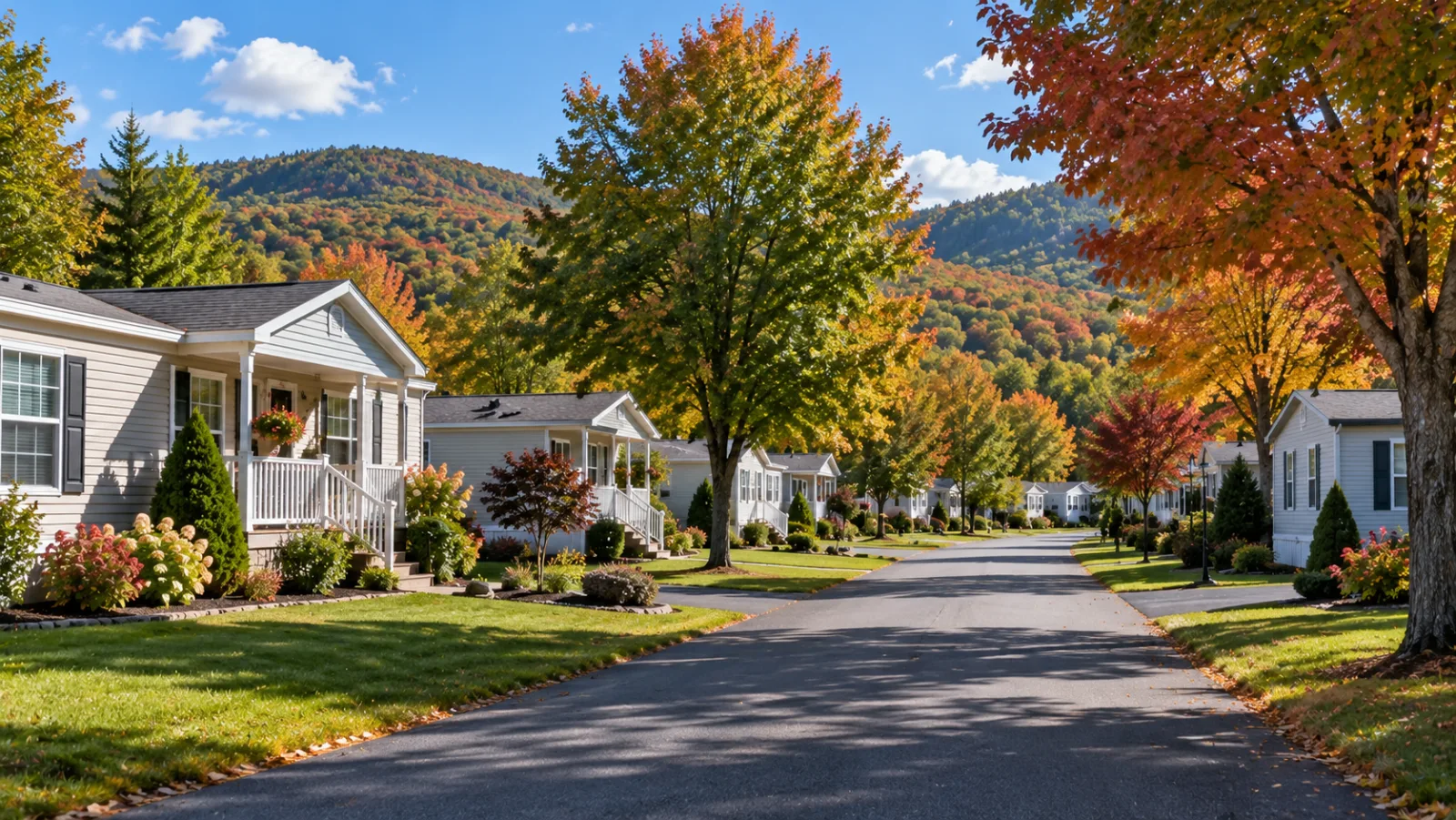
Mobile, manufactured or modular: what is the difference?
Sellers use the three words interchangeably. A lender, an appraiser and an insurer do not.
| Type | Built to | Financing | What it means for you |
|---|---|---|---|
| Mobile home (before June 15, 1976) | No federal standard | FHA, VA, USDA, Fannie Mae and Freddie Mac will not lend | Cash, seller financing or a specialty chattel loan — and your eventual buyer is cash too |
| Manufactured home (June 15, 1976 on) | Federal HUD Code, on a permanent steel chassis | Chattel loan on a leased lot; mortgage once affixed to land you own | Red HUD certification label outside each section, paper data plate inside |
| Modular home | State building code, set on a conventional foundation | Like any site-built house | Not a manufactured home; none of the chattel problems below apply |
Ask for the certification label number and photograph the data plate before you write an offer. The plate — usually inside a kitchen cabinet, a bedroom closet or near the electrical panel — records the wind zone and roof load zone the home was built to, which in New Hampshire snow country matters (see the inspection section). For modular and other factory-built construction on your own lot, see our guide to building a new home in New Hampshire.
The three ways to own a manufactured home in New Hampshire
Everything else in this guide follows from which of these you are buying.
1. The home on land you own. Once placed on a site and tied into utilities, the home is deemed a building under RSA 477:44 and can be treated as real estate. Conventional, FHA, VA and USDA financing become possible, the appraiser uses comparable sales, and the home rides the land's value — which in Grafton County has generally meant appreciation. It is also the most expensive way in, because you are buying land. Starting from raw acreage? Read our guide to buying land in New Hampshire first; septic design, frontage, driveway permits and test pits apply exactly as they would for a stick-built house.
2. The home in an investor-owned park. You own the structure; a landlord owns the ground and you pay monthly lot rent. The home is typically financed as chattel — personal property — with shorter terms and higher rates, and lot rent runs alongside the loan payment indefinitely. RSA 205-A protects you, but it does not cap the rent. Over a twenty-year hold, the rent trajectory is the biggest financial variable you do not control.
3. The home in a resident-owned community (ROC). You own the structure and a membership share in a cooperative that owns the land under the whole community. The co-op sets its own site fees, makes its own rules and answers to its members. This is the New Hampshire model.
How a New Hampshire co-op (ROC) works
On June 1, 1984, residents of Meredith Center Cooperative bought their park with a loan from the then-new New Hampshire Community Loan Fund, after local banks declined to lend to a cooperative. The Loan Fund's ROC-NH program has supported conversions ever since, and the national organization it spun off, ROC USA, has taken the model to other states. Eighteen of the 156 New Hampshire co-ops, with 650 homes between them, are in Grafton County.
What a buyer is purchasing:
- The home, outright — the same as in any park.
- A membership share. ROC USA describes a typical share as $250 to $500, refunded when you leave. It is not an equity stake; it is the price of a seat and a vote.
- One household, one vote. Members elect a board that sets the budget, hires the manager and brings big decisions to the membership. ROCs here are corporations under RSA 301-A, so bylaws, budgets, minutes and reserve balances exist and you are entitled to see them before you buy.
- Site fees that cover costs, not profit — roads, water and wastewater, plowing, reserves and the community's purchase loan. ROC USA's research reports ROC site fees rising an average of 0.9 percent a year against 7.1 percent in commercially owned communities.
- Security of tenure. The community cannot be sold out from under members by an owner who decides the land is worth more as something else.
A co-op does not make lot fees disappear. It makes the people who set them the same people who pay them.
Co-ops near Plymouth, per the Loan Fund's list: in Plymouth, Whip-O-Will Hill Village Cooperative (66 homes, resident-owned since 1989), Pine Gate Cooperative (34, since 2022) and Carpenter Park Cooperative (16, closed August 31, 2026); in Campton, Two Rivers Mobile Home Community Cooperative (94); in Ashland, Rural Bend Cooperative (28); in Bristol, Bristol Freedom Cooperative (21, since 1996); Newfound Acres Cooperative in Bridgewater (21); Town Line Village Cooperative in Holderness (72); and Woodstock Cooperative (31). Homes in these rarely sit.
What rights does RSA 205-A give a park resident?
New Hampshire's manufactured housing park law is among the stronger tenant statutes in the country. Read it as part of due diligence, not after a problem starts.
Eviction only for listed reasons, with long notice. RSA 205-A:4 allows termination for six reasons only, and RSA 205-A:3 sets the notice (served as RSA 540:5 prescribes and also by first-class mail); RSA 205-A:5 requires the notice to state the reason.
| Ground for termination (RSA 205-A:4) | Minimum written notice |
|---|---|
| I. Nonpayment of rent, utility or incidental service charges | 30 days — curable by paying all arrears plus $15 before the notice expires |
| II–V. Breaking laws or ordinances on manufactured housing, damage beyond wear and tear, repeated disturbance of other tenants, or violating the park's reasonable written rules (II and V only after written notice and a chance to comply) | 60 days |
| VI. Condemnation or change in the use of the park | 18 months |
A park owner may change the written rules without the tenant's consent only on 3 months' written notice.
Rent increases: no cap, but real procedure. New Hampshire has no rent control, and the state Board of Manufactured Housing has no jurisdiction over rent. RSA 205-A:6 requires every term of the tenancy disclosed in writing up front, and any increase explained with at least 60 days' written notice. Each rent-increase notice must say, in bold, that residents can force mediation at the park owner's expense if the increase exceeds $15 a month and an adult from at least 51 percent of the homes signs a petition. The same section bars a late fee on rent paid in full within 7 days of the due date. Ask any park for five years of rent history; a manager who will not produce it has told you something.
Notice and a chance to buy when the park is sold. Under RSA 205-A:21, an owner may not finally accept an offer to sell the park without first giving every tenant 60 days' notice by certified mail, with a copy of the signed offer, and also notifying the New Hampshire Housing Finance Authority and the New Hampshire Manufactured Housing Association. The owner must consider a residents' offer and negotiate in good faith, and residents who sign a purchase agreement get a reasonable extra period to arrange financing. This is the machinery behind every New Hampshire co-op; ROC-NH is who residents call when that letter arrives.
A state board for disputes. The Board of Manufactured Housing, administered through the Office of Professional Licensure and Certification, hears disputes over park rules and certain statutory provisions for a $25 filing fee, designed so residents can present their own case without a lawyer. It cannot decide rent.
Towns cannot zone manufactured housing out. RSA 674:32 requires municipalities to give reasonable and realistic opportunities for manufactured housing on individual lots in most residential districts or in parks and subdivisions, and to allow reasonable expansion of parks that existed as of July 1, 2024.
Financing: chattel loan or mortgage?
The first thing a lender asks is whether the home is personal property or real property.
Chattel lending — the home alone. A home on a leased lot, in an investor-owned park or a co-op, is usually financed as personal property: shorter amortization and a meaningfully higher rate than a mortgage for the same amount, because the collateral sits on somebody else's ground. The federal program built for this is FHA Title I, which insures loans on a manufactured home, a lot, or both. Maximum terms are 20 years and 32 days for a home or a single-section home and lot, 25 years and 32 days for a multi-section home and lot, and 15 years and 32 days for a lot alone. On an existing home the loan cannot exceed 95 percent of the lower of price or appraised value. HUD adjusts the dollar caps annually under 24 CFR 201.10; the most recent set we could date, for case numbers from March 29, 2024, was $105,532 for a single-section home, $193,719 for a multi-section home and $43,377 for a lot. Get the figure in force for your case number from a participating Title I lender.
The New Hampshire exception: Welcome Home Loans. The Community Loan Fund makes fixed-rate first-mortgage loans of 5 to 30 years on new and pre-owned manufactured homes in a resident-owned community, or on land the borrower owns or is buying, with no private mortgage insurance, no limit on the home's age and no minimum credit score (a satisfactory repayment record is expected). The Loan Fund does not publish a rate or down-payment percentage — ask for both. Its Your Turn program adds a $35,000 deferred loan toward down payment and closing costs on a new Energy Star home placed in a ROC or on your own land; separate income-limited help exists for pre-owned homes. Both are first-come, first-served, so prequalify early. A 30-year fixed loan with no PMI beats a 20-year chattel loan, and it is the strongest practical argument for buying in a ROC rather than an investor-owned park.
Real-property mortgages — home and land together. Once a post-1976 home is permanently affixed to land you own and treated as real estate, conventional, FHA Title II, VA and USDA loans open up (USDA eligibility covers most Pemi-Baker towns). All require a permanent foundation with hitch, axles and wheels removed, and documented certification labels and data plate. Fannie Mae also requires a home at least 12 feet wide with at least 400 square feet of finished area, and will not buy a loan on a unit previously installed or occupied at another site.
Ask about MH Advantage and CHOICEHome. These are Fannie Mae's and Freddie Mac's programs for factory-built homes with site-built features — pitched roof with eaves, porch, perimeter foundation, garage or carport, better insulation — identified by a label near the HUD data plate. Fannie allows up to 97 percent loan-to-value on MH Advantage (against 95 percent for an ordinary manufactured home) and appraises against site-built comparables; Freddie's CHOICEHome is similar. If you are ordering a new home, ask the dealer whether the model qualifies before you sign.
Why co-op financing needed a state fix. Fannie Mae's Selling Guide makes manufactured homes in co-op projects ineligible, and homes on ground leases ineligible unless the project is a Fannie-approved condo or PUD — which writes the ROC model out of ordinary conventional lending. New Hampshire Housing and the Community Loan Fund run a New Hampshire-specific arrangement with Fannie Mae to buy mortgages on homes in this state's ROCs, a route most states do not have.
Our New Hampshire home buyer guide covers pre-approval, inspection contingencies and closing, which work the same whatever the construction type.
Can you convert a manufactured home to real property in New Hampshire?
Yes, and it is the highest-leverage move available to an owner here. Under RSA 477:44, manufactured housing (as RSA 674:31 defines it) is deemed a building once it is placed on a site and tied into utilities, and buildings on land the owner does not own are treated as real estate for transfer. New Hampshire does not run manufactured homes through a motor-vehicle-style certificate of title the way many states do: ownership moves by a recorded deed at the county registry, using statutory manufactured housing warranty and quitclaim deed forms. The Pew Charitable Trusts, in an August 2026 fact sheet, calls New Hampshire the only state that automatically titles manufactured homes as real estate even where the owner does not own the land.
When you own the land, the steps are:
- Own the lot — the conversion fully works only when the same party owns home and ground.
- Set the home on a permanent foundation meeting the lender's and the town's requirements, hitch, axles and wheels removed, properly anchored.
- Tie into permanent utilities — well or municipal water, approved septic or sewer, permanent electrical service.
- Record the deed in the statutory form and clear any personal-property lien.
- Tell the assessor, so home and land are carried together.
What it buys you: 30-year mortgage financing at conventional rates, a real-estate appraisal, a standard homeowner's policy, and a resale any buyer with an ordinary mortgage can complete. A home no ordinary buyer can finance sells for less, every time.
How are manufactured homes taxed in New Hampshire?
RSA 72:7-a makes manufactured housing taxable as real estate in the town where it sits. Where the home is on someone else's land, the tax on the home is assessed to the home's owner, not the landowner, and unpaid tax is a lien on the home that takes priority. So in a park or co-op you get a town tax bill for the structure on top of your lot rent or site fee (the land tax is inside the rent); on your own land, one bill covers both. A home assessed in the five figures typically produces a bill in the hundreds to low thousands in Grafton County towns. Our New Hampshire property tax guide explains rates and assessments, and the Plymouth property tax guide works through one town.
What to inspect on a manufactured home in New Hampshire
Hire an inspector who knows this housing stock; a generalist will miss most of this list.
- HUD label and data plate. Missing on a post-1976 home is a financing problem first. Check the roof load zone: a home built for a southern load zone and trucked north is a real structural concern under New Hampshire snow, and any addition, carport or roof-over changes the load path.
- Frame, piers and anchors. Steel I-beams straight and dry; piers plumb, on footings below frost depth, shims tight; tie-downs present and tensioned. Doors and windows out of square usually trace to frost heave under an inadequate pier.
- Skirting and frost protection. Skirting keeps wind off the floor and water lines from freezing; it should be intact and vented, with insulation and heat tape where the supply line comes up.
- Roof. Older low-slope metal roofs need periodic coating; for a shingled roof-over, ask whether it was engineered for the weight and permitted.
- Marriage line. On a double-wide, check the interior ceiling seam for staining and the exterior gasket and flashing.
- Plumbing and wiring. Grey polybutylene supply pipe is a known failure and insurability issue; aluminum branch wiring from the late 1960s–1970s needs proper terminations. Confirm the electrical service suits how the home is heated.
- Heating cost. Older units are thinly insulated. Ask for twelve months of fuel and electric bills, check the belly wrap under the floor, and confirm a heat source that works in a power outage.
- Whether it has been moved. Relocation means jacking, splitting and resetting — and Fannie Mae will not buy a loan on a home previously installed elsewhere.
- Water and septic. Community systems in most parks; yours on owned land. Test a well for bacteria, arsenic, radon and uranium, and have the septic located and inspected.
Park due diligence: documents to read before you offer
- The lease or occupancy agreement — term, renewal, and whether the park can approve your buyer when you sell.
- The park rules — pets, vehicles, sheds, decks, fences, guests, subletting, 55-plus restrictions. Violations are grounds for termination.
- Five years of rent or site-fee history, and what drove the increases.
- What the rent covers — water, sewer, trash, plowing, roads. A lower rent that excludes water and plowing is not lower.
- Who owns the water and wastewater systems, when they were last upgraded, and whether they are under any NHDES order. Deferred capital needs become assessments in either kind of park.
- In a co-op, the financial package — bylaws, budget, reserve balance, acquisition-loan balance, two years of minutes, and any pending special assessment. Treat it like condominium diligence.
- The park's status — co-op or investor-owned, and whether an RSA 205-A:21 sale notice has been issued.
Where mobile and manufactured homes are near Plymouth
Inventory is thin and moves fast. Communities cluster on the flat, serviceable ground — along the Pemigewasset in Plymouth, Campton and Ashland, along Route 3 and the Tenney Mountain Highway in Plymouth, and toward Newfound Lake in Bristol and Bridgewater — with a smaller number of homes on their own lots in Campton, Thornton and Rumney. Plymouth is the center of the market because the jobs and services are there: Plymouth State University, Speare Memorial Hospital and the I-93 interchanges. Our Plymouth, Campton and Thornton comparison sets out how the three towns differ on taxes, commute and services.
What to expect: homes inside the co-ops often change hands informally, so being known to the board or to an agent who works these communities matters; manufactured homes on their own acreage are the scarcest and most valuable category; pre-1976 units trade for cash; and some homes never reach the MLS.
If you are weighing this against renting, our guide to rentals in Plymouth NH covers local rents, and Plymouth homes under $500,000, Campton homes under $500,000 and statewide NH homes under $200,000 show the entry-level market. You can filter the whole region on our property search. If what you really want is a seasonal place rather than a primary home, our guide to camps and cabins for sale in New Hampshire covers the other low-cost corner of the market.
What it costs to own, compared with a site-built starter home
The published medians above are values across the whole stock, not prices for any particular home. This table sets out what you pay under each structure and where the risk sits; fill in the dollars for the specific park and home.
| Cost line | Home on a leased lot (park or co-op) | Manufactured home on land you own | Site-built starter home |
|---|---|---|---|
| Purchase price | Lowest — the structure only | Middle — structure plus land | Highest |
| What you finance | Chattel loan, or a Welcome Home Loan in a ROC | Real-property mortgage after conversion | Conventional, FHA, VA or USDA |
| Typical term | 15–25 years chattel; up to 30 with the Community Loan Fund | Up to 30 years | Up to 30 years |
| Rate | Highest for chattel; competitive for a ROC program loan | Conventional | Conventional |
| Monthly lot rent or site fee | Yes, indefinitely | None | None |
| Property tax on the home | Billed to you under RSA 72:7-a | One bill for home and land | One bill |
| Property tax on the land | Inside your rent or site fee | Yours | Yours |
| Water, septic, roads, plowing | Usually in the rent — confirm | Yours, including well and septic replacement | Yours |
| Insurance | Specialty manufactured-home policy | Standard policy once converted | Standard |
| Biggest financial risk | Site-fee increases you do not control | Well, septic and site costs | Maintenance and taxes |
| Biggest upside | Lowest entry cost in the region | Land appreciation with low structure cost | Full market appreciation |
For the wider household budget, see our cost of living in New Hampshire post; arriving from out of state, the moving to New Hampshire guide.
Do manufactured homes appreciate in New Hampshire?
On land you own, it behaves like real estate. The land carries the value, the structure is a depreciating improvement, and any buyer with a conventional or government mortgage can buy it from you.
On a leased lot, it often does not. You own a structure that ages, and your resale price is capped by what the next buyer can finance on chattel terms and by what the site fee does to their monthly budget. In a well-run co-op with stable fees, homes hold value respectably and sell quickly, because the monthly cost is predictable and Community Loan Fund financing is available to the next buyer. In an investor-owned park with a steep rent trajectory, every dollar of rent increase is a dollar off what a buyer can pay for the house.
Stated plainly: on owned land you are buying an asset; in a co-op, a low, member-controlled monthly cost and reasonable liquidity; in an investor-owned park, today's affordability with somebody else controlling tomorrow's. All three can be the right answer — for a household that wants to stop renting around Plymouth, a retiree who wants single-level living and a predictable bill, or a buyer who already has land. It is a poor fit for anyone who needs fast appreciation or a short-term-rental investment. If you already own a house and want a second small dwelling instead, our NH accessory dwelling unit guide covers New Hampshire's ADU law.
Frequently asked questions
Can you get a mortgage on a mobile home in New Hampshire?
Yes, with conditions. A home built after June 15, 1976, permanently affixed to land you own and treated as real estate, qualifies for conventional, FHA, VA or USDA mortgages. A home on a leased lot is usually financed as personal property through FHA Title I or a chattel loan, though the Community Loan Fund's Welcome Home Loans offer up to 30 years fixed in co-ops. Pre-1976 homes qualify for no federal program.
What is the difference between a chattel loan and a mortgage on a manufactured home?
A chattel loan treats the home as personal property, like a vehicle, so it is used when you do not own the land. Terms are shorter — often 15 to 25 years — and rates are higher. A mortgage treats home and land together as real estate, which requires a post-1976 home on a permanent foundation on land you own, and brings 30-year terms at conventional rates.
What is a resident-owned community in New Hampshire?
A manufactured housing community whose residents collectively own the land through a cooperative corporation under RSA 301-A. Each household owns its home, buys a membership share of a few hundred dollars that is refunded on departure, and gets one vote; an elected board sets site fees. New Hampshire started the model in 1984 and had 156 co-ops holding 9,446 homes on the Community Loan Fund's list in September 2026.
How much notice does a New Hampshire mobile home park have to give before evicting someone?
Under RSA 205-A:3, at least 30 days for nonpayment of rent or charges, 60 days for grounds such as damage, repeated disturbance or breaking the park's written rules, and 18 months for condemnation or a change in the park's use. The notice must state the reason, and a nonpayment eviction can be stopped by paying all arrears plus $15 before the notice period ends.
Do park residents in New Hampshire get to buy the park if it is sold?
They get a statutory opportunity. RSA 205-A:21 bars an owner from finally accepting an offer without first giving every tenant 60 days' notice by certified mail, with a copy of the signed offer. The owner must consider a residents' offer and negotiate in good faith, and residents who sign a purchase agreement get extra time to arrange financing. ROC-NH helps residents organize and finance the purchase.
Can a mobile home park in New Hampshire raise the rent as much as it wants?
There is no rent cap, and the Board of Manufactured Housing has no say over rent. RSA 205-A:6 requires at least 60 days' written notice with an explanation, plus a notice that if the increase exceeds $15 a month and adults from 51 percent of the homes petition, residents can require mediation at the owner's expense. In a co-op, members set the site fee themselves.
How are manufactured homes taxed in New Hampshire?
Under RSA 72:7-a, manufactured housing is taxed as real estate by the town where it sits. Where the home is on someone else's land, the tax on the home is billed to the home's owner, so a park or co-op resident typically gets a town bill for the structure on top of the lot rent or site fee, which carries the land tax. On land you own, one bill covers both.
Are modular homes the same as manufactured homes in New Hampshire?
No. A modular home is built in a factory to the state building code, set on a conventional foundation, and financed, appraised and insured exactly like a site-built house. A manufactured home is built to the federal HUD Code on a permanent steel chassis. The distinction decides your loan options and your resale market, so confirm which one a listing describes before you offer.
If you are trying to work out whether a home you found is financeable, whether the park is a co-op, or what its lot rent has done over five years, talk to us — those are answerable questions, and worth answering before you offer.