

New Hampshire has eighteen lift-served ski resorts worth planning a trip around, plus a deep bench of cross-country centers. By region, they are:
- White Mountains, off I-93: Loon Mountain (Lincoln), Cannon Mountain (Franconia), Waterville Valley and Bretton Woods (Carroll).
- Mount Washington Valley: Attitash (Bartlett), Wildcat (Pinkham Notch), Cranmore (North Conway), Black Mountain (Jackson) and King Pine (East Madison).
- Lakes Region and central NH: Gunstock (Gilford), Tenney Mountain (Plymouth), Ragged Mountain (Danbury) and Campton Mountain (Campton).
- Southern NH and the Upper Valley: Mount Sunapee (Newbury), Pats Peak (Henniker), Crotched Mountain (Bennington), Dartmouth Skiway (Lyme) and Whaleback (Enfield).
The biggest are Loon (2,190 feet of vertical, Ikon Pass), Cannon (the highest lift-served summit, Indy Pass), Waterville Valley (Indy) and Bretton Woods (the most skiable acres, independent); Vail runs Attitash, Wildcat, Mount Sunapee and Crotched on the Epic Pass.
If you're sorting through New Hampshire ski places for a trip or a second home, the table below lines up all the ski mountains in New Hampshire on the numbers that matter: town, vertical, trails, lifts, the latest posted adult day ticket and pass affiliation. A separate section compares the major cross-country ski centers, from Bretton Woods and Jackson XC to Waterville Valley and Great Glen. The second half of this guide covers what most ski roundups skip: what a condo or a house costs near each mountain.
Every figure was checked in September 2026 (Loon's stats re-checked in October) against the resorts' own published statistics and ticket pages, the Ski NH member listings and the pass operators' 2026/27 rosters. Where a resort and a secondary source disagree, we give the resort's number and say so. Two things go stale fastest and are dated accordingly: pass lineups, which shift every autumn, and Cannon's aerial tramway, which is out of service for a rebuild with no announced return.
New Hampshire ski resorts compared
| Resort | Nearest town | Vertical | Trails | Lifts | Adult day ticket (latest posted) | 2026/27 pass |
|---|---|---|---|---|---|---|
| Loon Mountain | Lincoln | 2,190 ft | 73 | 13 | Dynamic — see loonmtn.com | Ikon |
| Cannon Mountain | Franconia | ~2,180 ft | 98 incl. glades | 9 (tram out of service) | See cannonmt.com | Indy |
| Wildcat | Pinkham Notch (Jackson) | 2,112 ft | 48 | 5 | Dynamic — see site | Epic |
| Waterville Valley | Waterville Valley | 2,020 ft | 62 + 5 glades | 10 | Dynamic — see waterville.com | Indy |
| Attitash | Bartlett | 1,750 ft | 76 | 8 | Dynamic — see site | Epic |
| Mount Sunapee | Newbury | 1,510 ft | 67 | 8 | Dynamic — see site | Epic |
| Bretton Woods | Carroll | 1,500 ft | 63 + 36 glades | 9 | See brettonwoods.com | Independent |
| Tenney Mountain | Plymouth | 1,500 ft | 53 | 4 | $74 advance / $89 flexible (2026/27) | Indy |
| Gunstock | Gilford | 1,340 ft | 44 + 5 glades | 8 | $109 weekend / $94 midweek (2025/26) | Independent |
| Ragged Mountain | Danbury | 1,250 ft | 57 | 5 | $89 weekend online, $109 window (2025/26) | Indy |
| Cranmore | North Conway | 1,200 ft | 60 incl. glades | 7 | $134 weekend / $104 midweek (2026/27) | Independent |
| Black Mountain | Jackson | 1,100 ft | 45 | 5 | See site | Indy |
| Crotched Mountain | Bennington | 1,016 ft | 25 | 5 | Dynamic — see site | Epic |
| Dartmouth Skiway | Lyme | 968 ft | 30 | 4 | $60 peak / $40 regular, online (2026/27) | Indy |
| Pats Peak | Henniker | 770 ft | 28 | 11 | See site | Indy |
| Whaleback | Enfield | 700 ft | 30 | 3 | $50 weekend (posted regular-season rate) | Indy |
| King Pine | East Madison | 350 ft | 17 | 6 | $87 peak weekend (2026/27) | Indy |
| Campton Mountain | Campton | 313 ft | 3 runs | 2 | $45 day and night (FY26) | Own passes |
Ticket prices are the resorts' own posted adult rates as of September 2026; the big mountains price by date and sell cheapest online in advance, so treat "see site" as a reason to book early. Secondary listings such as the Indy Pass site show slightly different trail and lift counts for a few small hills (King Pine, Dartmouth, Whaleback); we use the resorts' figures where they publish them.
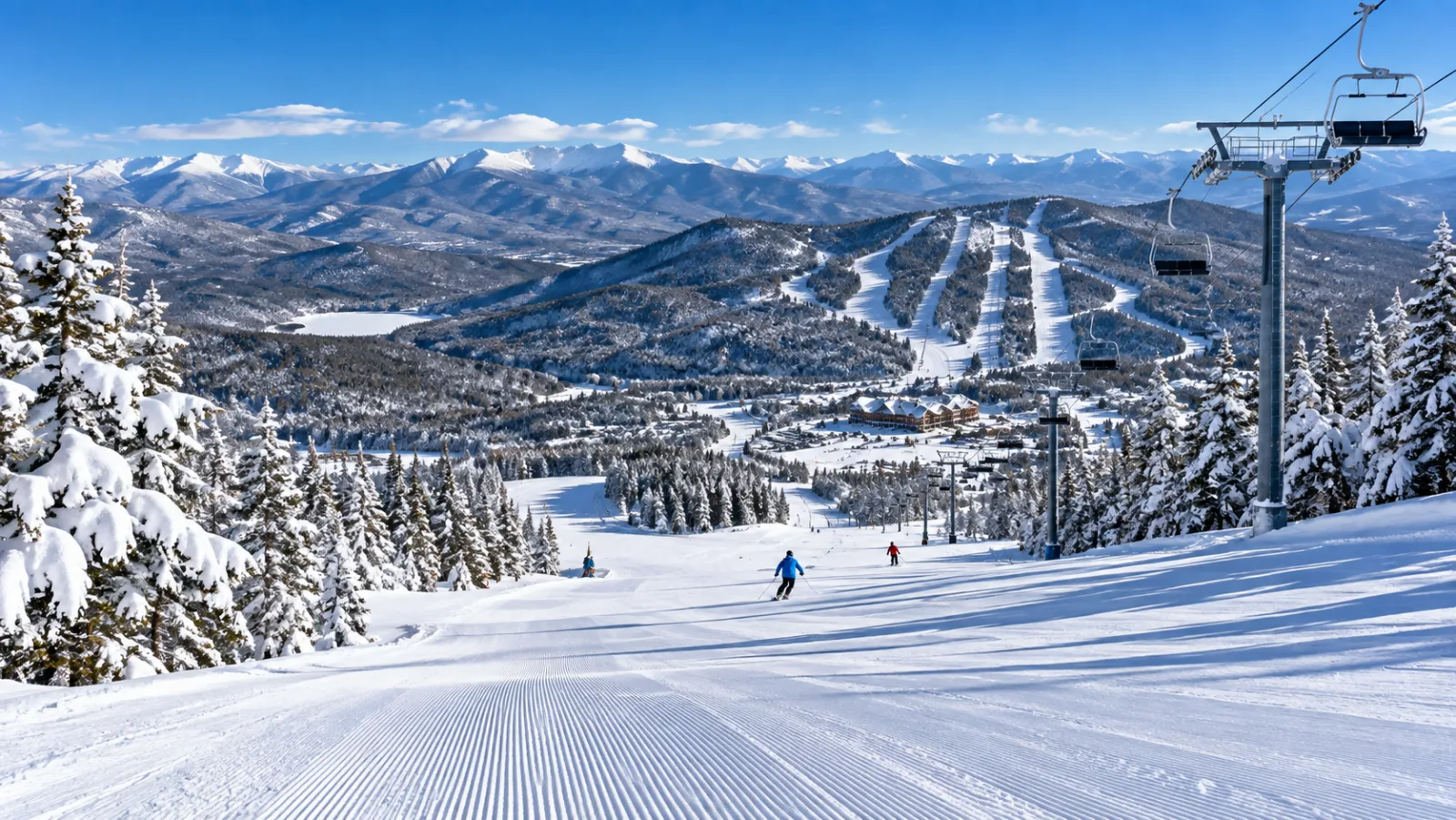
How New Hampshire's ski areas sit on the map
Four highways explain nearly everything about where people ski here.
I-93 runs north out of Boston through Concord and Plymouth and into Franconia Notch. It serves Waterville Valley (Exit 28, then eleven miles up Route 49), Loon (Exit 32, at the traffic light in Lincoln), and Cannon (Exit 34B, on the Franconia Notch Parkway). It is the corridor that made the White Mountains a weekend market, and it is why the towns along it — Campton, Thornton, Lincoln, Woodstock — trade at prices that have very little to do with their own economies.
Route 302 peels east from Twin Mountain past Bretton Woods and down through Crawford Notch into Bartlett and the Mount Washington Valley. Route 16 comes up from the Seacoast through Conway and North Conway to Jackson, Pinkham Notch and Gorham. Together they define a second cluster with five ski areas inside twenty-five miles of each other.
I-89 runs northwest from Concord toward the Upper Valley and picks up Mount Sunapee, Ragged, Whaleback and the Dartmouth Skiway. Route 11 and Route 3 get you to Gunstock in Gilford, on the hill above Lake Winnipesaukee.
The practical consequence: a Boston household can be at Pats Peak or Crotched in about an hour and a quarter, at Gunstock or Sunapee in well under two, at Waterville or Loon in about two, and at Wildcat in something over three. Drive time is the single biggest predictor of how many days you will actually ski, which makes it the single biggest input into where you should buy.
The best places to ski in New Hampshire: the White Mountains majors
These four are, by most measures, the best ski resorts in New Hampshire. They carry the state's reputation, and they are genuinely different mountains.
Loon Mountain
Loon is the most modern lift fleet in New Hampshire and the easiest big mountain to reach in New England: 2,190 feet of vertical across 403 skiable acres, 73 trails, six terrain parks, and thirteen lifts including a four-passenger gondola and an eight-place Doppelmayr D-Line bubble chair. Snowmaking reaches 63 of the 73 trails, and the resort describes its system as the most powerful in the state, which is not marketing — Loon opens early and holds its base through thaws that shut smaller hills down. Base elevation is 860 feet; North Peak tops out at 3,050. Loon is also building Black Ridge, 272 acres of expert, natural-snow glades east of North Peak reached from the existing North Peak Express; it is closed to the public in 2026/27 and targeted for 2027/28, when Loon says it will become New Hampshire's largest ski area at 675 skiable acres.
For Lincoln NH skiing beyond Loon, the other ski areas near Lincoln NH are Cannon, about fifteen minutes north through Franconia Notch, and Waterville Valley, roughly forty minutes away by I-93 and Route 49. That is three big mountains from one base, which is a large part of why Lincoln condos rent so well in winter.
Who it suits. Intermediate cruisers, families who want a gondola and a food court, and park riders — Loon's parks are the best-built in the state. Steeps skiers will run out of pitch by lunch on day two.
The reality. Loon is off Exit 32 and the Ikon Pass sends it national traffic, so a January Saturday means the main lots fill early and you finish on a shuttle from an overflow lot. Arriving before the first chair or after the late-morning rush solves most of it. The pass is the full Ikon at seven days and the Ikon Base at five.
Waterville Valley
Waterville is a town built as a ski resort, and it skis like a mountain designed by someone who wanted everyone to have a good day: 2,020 feet of vertical from a 4,004-foot summit on Mount Tecumseh, 265 skiable acres inside a 500-acre permit, 62 trails and five glades, ten lifts led by a high-speed six-pack with a bubble, and 100 percent snowmaking coverage. The longest run is 1.9 miles. Night skiing runs on Exhibition, Lower White Caps and the Lower Pasture, served by the Exhibition T-Bar and the Lower Pasture carpet — a lower-mountain operation, not the full hill.
Who it suits. Families with a wide spread of abilities, intermediate skiers who want to lap a fast chair, and anyone allergic to crowds — the valley is a dead end, so the only people there are people who came to be there. It is also the birthplace of American freestyle skiing, and the terrain parks still reflect that.
The reality. Route 49 from Exit 28 is eleven miles of two-lane road that gets slow at 8:30 on a holiday Saturday and slow again at 4:00, and there is no alternate route in winter — Tripoli Road, the back way to Woodstock, closes for the season. Waterville is an Indy Pass destination. For the direct comparison people actually search for, we wrote Loon versus Waterville Valley as its own piece.
Cannon Mountain
Cannon is the state-owned one, inside Franconia Notch State Park, and it is the mountain New Hampshire skiers get defensive about. The summit is 4,080 feet — the highest lift-served summit in the state — over a 1,900-foot base, with 287 skiable acres, 98 trails and glades and snowmaking on 192 acres. Cannon's stats page lists nine lifts for 2026/27 and enumerates them: one detachable quad, two fixed-grip quads, three triples, a fixed-grip double, a T-bar and a handle tow. The adjacent Mittersill terrain, off a base of 1,850 feet, adds old-school, lightly tamed skiing that most resorts bulldozed out of existence thirty years ago.
Cannon and Loon both claim the longest vertical in New Hampshire, and Cannon's own numbers are the reason to be careful with the claim. Its stats page declines to print a figure at all — it says only "the longest vertical drop in NH" — while the summit and base elevations it does publish subtract to 2,180 feet, which is what Ski NH lists. Loon publishes 2,190. The defensible statement is that the two are within about ten feet of each other and the ranking turns on method: Cannon's drop is a single continuous fall line, Loon's spans peaks.
The tramway is not running. Cannon's own page says the second-generation tram is "RETIRED and will not operate summer 2026"; the state park listing says "CLOSED October 26, 2025. Tram II has been retired! A third-generation Tram is in the works." A structural analysis of the existing towers began in September 2025 and was due to finish that December. As of mid-September 2026 neither Cannon nor New Hampshire State Parks has published a construction schedule, a contractor, a cost or a target opening season, and there is no Tram III entry in the state's current-projects list. The chairlifts run normally. If the tram is the reason for the trip, call before you drive — this is the fact on this page most likely to change without the page changing with it.
Who it suits. Skiers who want pitch, wind and weather, and do not need a heated bathroom at the top. Cannon gets scoured in a northwest wind and it is genuinely cold. It is also on the Indy Pass, which makes it one of the great value propositions in the East.
Bretton Woods
Bretton Woods bills itself as New Hampshire's largest ski area and the acreage supports it: the resort publishes "464 acres of skiing and snowboarding, 63 trails, 36 glades, and nine lifts," among them the Skyway Gondola and the BEQII high-speed quad, with snowmaking on 92 percent. Ski NH lists it slightly larger at 468 acres and 104 trails. All of that sits on a comparatively gentle 1,500 feet of vertical from a 3,100-foot summit, facing directly across at Mount Washington and the Presidential Range. Ski Magazine named it the number one resort in New Hampshire for 2026, largely on snow quality and grooming.
Who it suits. Intermediates, families, and anyone who values grooming and uncrowded corduroy over vertical. It is the best beginner-to-intermediate progression in the state. Experts will find the glades interesting and the lift-served pitch limited.
The reality. It is the farthest of the four from Boston — Route 302 in Carroll, well past Franconia Notch — which is precisely why the parking lots are not a problem. Bretton Woods is independent: not on Epic, Ikon or Indy. The Bretton Woods ski area sits on Route 302 in the town of Carroll, NH, beside the Omni Mount Washington Resort.
The Mount Washington Valley group
Five ski areas, one valley, and the widest spread of character anywhere in the state. If you're searching for Conway NH ski resorts, this is the whole list: Attitash, Wildcat, Cranmore, Black Mountain and King Pine are the ski mountains near Conway NH, all within about half an hour of North Conway village.
Attitash, in Bartlett on Route 302, is two connected mountains — Attitash and Bear Peak — with 1,750 feet of vertical, 311 acres, 76 trails, eight lifts and 98 percent snowmaking. It is a real intermediate-to-advanced mountain with genuinely long runs, and it is run by Vail Resorts on the Epic Pass and the Northeast Value Pass. It has also been the Vail property New Hampshire skiers complain about most, generally about lift reliability and staffing; go on a weekday and most of that complaint evaporates.
Wildcat, across Route 16 in Pinkham Notch, is the serious one: 2,112 feet of vertical, 225 acres, 48 trails, five lifts, and the Wildcat Express quad putting you on the summit in under seven minutes, staring directly into Tuckerman Ravine on the face of Mount Washington. It has been ranked first in the East for scenery by Ski Magazine's reader poll more times than anyone has bothered to count. It is also exposed, cold, and frequently wind-holds. Epic Pass.
Cranmore, a mile from downtown North Conway, is 1,200 feet of vertical, 170 acres, 60 trails and glades, seven lifts, four terrain parks and 100 percent snowmaking, on a sunny south-facing slope. It runs night skiing, included with a season pass, though the resort had not posted which nights for 2026/27 when we checked in September. It is run by the Fairbank Group, which also operates Jiminy Peak in Massachusetts and Bromley in Vermont, and it is independent — not on Epic, Ikon or Indy. Cranmore guarantees a minimum of 100 operating days, it is the best learn-to-ski mountain in the valley, and it is the only one you can walk to from a hotel and a restaurant.
Black Mountain in Jackson is the oldest story in the group. It has been running since 1935, was among the first areas in the country with a lift, and the overhead J-bar that ran here was the first of its kind. It is 1,100 feet of vertical, about 140 acres, 45 trails and five lifts — small, unpretentious, cheap, and the place Mount Washington Valley locals send their kids. The Fichera family ran it from 1995 until, in the mountain's own words, John Fichera "fully transferr[ed] the ownership and stewardship of Black Mountain to the experienced and impassioned team at Indy Pass to keep the mountain open." It is on the Indy Pass.
King Pine, at Purity Spring Resort in East Madison, is 350 feet of vertical, 50 acres, 17 trails, six lifts and 100 percent snowmaking, with lift-served tubing, a skating pond and a cross-country and snowshoe reserve on the same property. It exists to teach people to ski, and it is very good at it. Indy Pass.
The reality for the whole valley. Route 16 through North Conway on a holiday Saturday is the worst traffic in ski New Hampshire, and it has nothing to do with skiing — it is the outlet strip. Locals use the West Side Road and the Route 16 bypass. Bear Notch Road, the shortcut from Bartlett to the Kancamagus, closes in winter.
The Lakes Region and the southern hills
These are the mountains that get skied on a Tuesday night and after work, and they carry more New Hampshire skiers than the majors do.
Gunstock, in Gilford, is owned by Belknap County and overseen by the Gunstock Area Commission — a genuinely unusual arrangement, and one that has produced more than one round of public drama. The skiing is excellent for what it is: 1,340 feet of vertical from a 2,300-foot summit, 227 skiable acres, eight lifts (a high-speed quad, two quads, two triples and three carpets), 98 percent snowmaking, night skiing on 25 trails and seven lifts, a Nordic center and a tubing hill, with Lake Winnipesaukee laid out below you the whole way down. The trail count that gets quoted two ways resolves cleanly for 2026/27: the resort's own stats page says "44 (plus 5 glades)," which is where the 49 comes from, and Ski NH lists the 44. It is independent of Epic, Ikon and Indy. From Boston it is well under two hours.
Ragged Mountain in Danbury sits off I-89 with 1,250 feet of vertical, 250 skiable acres inside a 2,100-acre holding, 57 trails and glades, five lifts — a high-speed six-pack, a high-speed quad, a triple and two carpets — and snowmaking on 85 percent of the runs. Ragged changed hands in November 2025: Pacific Group Resorts sold it to SF Mountain Co, LLC, six local investors who grew up skiing there, with the existing general manager staying on. That matters here because Ragged's reputation rests on aggressively priced season passes, and pass pricing is the first thing new owners revisit. The glades ski better than the trail map suggests. Indy Pass.
Pats Peak in Henniker is 770 feet of vertical, 115 acres, 28 runs and eleven lifts with 100 percent snowmaking, and it is the most efficient teaching machine in the state — three separate beginner areas and what it claims are the longest top-to-bottom beginner runs in New Hampshire, plus night skiing, tubing, and a Saturday-night bundled admission that covers lift, rental and lesson. The Patenaude family built it and has owned it without interruption since it opened on January 5, 1963, which in this state is the exception rather than the rule. It is an hour and change from Boston. Indy Pass.
Mount Sunapee in Newbury is the largest of the southern areas — 1,510 feet of vertical, 233 acres, 67 trails, eight lifts, 97 percent snowmaking, with a dedicated learning area on South Peak — about ninety minutes from Boston, and on the Epic Pass. Its ownership is the one most often described wrongly. The land is not Vail's: the ski area sits on state land inside Mount Sunapee State Park, and it is run under a Lease and Operating Agreement dated 1998 and amended in 2016 and 2018. Vail Resorts is the lessee, not the owner, and a Mount Sunapee Advisory Commission exists under RSA 12-A:29-a specifically "to advise the Commissioner and meet with the lessee." Along with Cannon, it means two of New Hampshire's better-known mountains are public land, which is a different long-run risk profile from a privately held hill.
Crotched Mountain, on the Bennington–Francestown line in the Monadnock region, is 1,016 feet of vertical, 100 skiable acres, 25 trails, five lifts — including The Rocket, southern New Hampshire's only high-speed quad — and 100 percent snowmaking. Its selling point is night skiing: Tuesday through Saturday until 9 p.m., with "Midnight Madness" on select Saturdays. Epic Pass.
Small ski places in New Hampshire worth knowing
These are the small ski hills in NH. A national roundup never writes about them, and they are the part that matters most to families.
Campton Mountain, at 24 Parker Road in Campton, is our home hill and the hardest area in this guide to find numbers for — it publishes no trail count, acreage or snowmaking figure of its own. What is established: it was cut in 1969 as one of the key amenities of the Locke family's 863-acre Waterville Estates development, it is overseen by the Waterville Estates board, it has also traded under the names Locke Waterville and Mad River Run, and it went dark for part of the 2000s before reopening in 2011. New England Ski History puts the vertical at 313 feet, with three runs off the top of a Stadeli double chairlift installed for the 1969–70 season and a surface lift serving the lower part of one of them.
The things the mountain does publish are the ones that matter to a family. Snowmaking arrived recently — the well was drilled and the pumps tested in 2024, after a feasibility study that started back in 2013 — which makes the season less of a natural-snow gamble than it was, though a starter system does not buy a Thanksgiving opening. It is open to the public, and the FY26 window rates are $45 for day and night together, $35 for night only, $25 for the rope tow alone and free for children five and under. Recent seasons have run Friday 4:00 to 9:00, Saturday 10:00 to 4:00 and 5:00 to 9:00, and Sunday 10:00 to 4:00, with the lodge kitchen open Thursday through Saturday evenings. Call before you drive; the schedule moves with the weather and with staffing.
That is the whole argument for the corridor in one place: a six-year-old goes from terrified to linking turns in four afternoons, for the price of a movie, twenty minutes from the door of a house in Campton or Thornton that costs a third of what a Waterville condo costs.
Dartmouth Skiway in Lyme Center is Dartmouth College's hill — two facing mountains, 968 feet of vertical, 104 acres, 30 trails, four lifts and snowmaking on 60 acres. It is the home mountain of the Dartmouth ski teams and is open to the public, and it is on the Indy Pass.
Whaleback in Enfield, off Exit 16 on I-89, is 700 feet of vertical, 85 acres, 30 trails, three lifts and 67 percent snowmaking, and Ski NH calls it the only night-skiing option in the Dartmouth–Lake Sunapee region. It is not owned by anyone in the ordinary sense: Whaleback is a 501(c)(3) charitable organization, run as a community mountain and sustained by donations as much as by ticket sales. Indy Pass.
Tenney Mountain in Plymouth is the cautionary tale and the case study. By its own numbers it is 1,500 feet of vertical from a 2,100-foot summit, 130 skiable acres, 53 named trails and four lifts, and it is operating as of September 2026 — running fall chairlift rides, selling 2026/27 passes and advance day tickets at $74, and listed on the Indy Pass for a second season — after a sixty-year record of closing and reopening under successive owners. In March 2026 Plymouth voters approved a Tenney Mountain Overlay District 530 to 160, a zoning change the current owner requested in order to build around the base. The relevance to this article is blunt: a mountain's ownership is an input into the value of every property that looks at it, and the Tenney base condos have repriced with each cycle. The full history and how to underwrite a purchase at the base is in our piece on Tenney Mountain in Plymouth NH.
Cross-country skiing in New Hampshire
New Hampshire cross-country skiing is some of the best in the East, and it gets less attention than the alpine side. Four of the state's Nordic networks run to 65 kilometers or more, the Mount Washington Valley alone has four touring centers, and most Nordic day passes cost less than a third of a big-mountain lift ticket. If you're comparing cross-country ski resorts in New Hampshire, these are the ones to plan around.
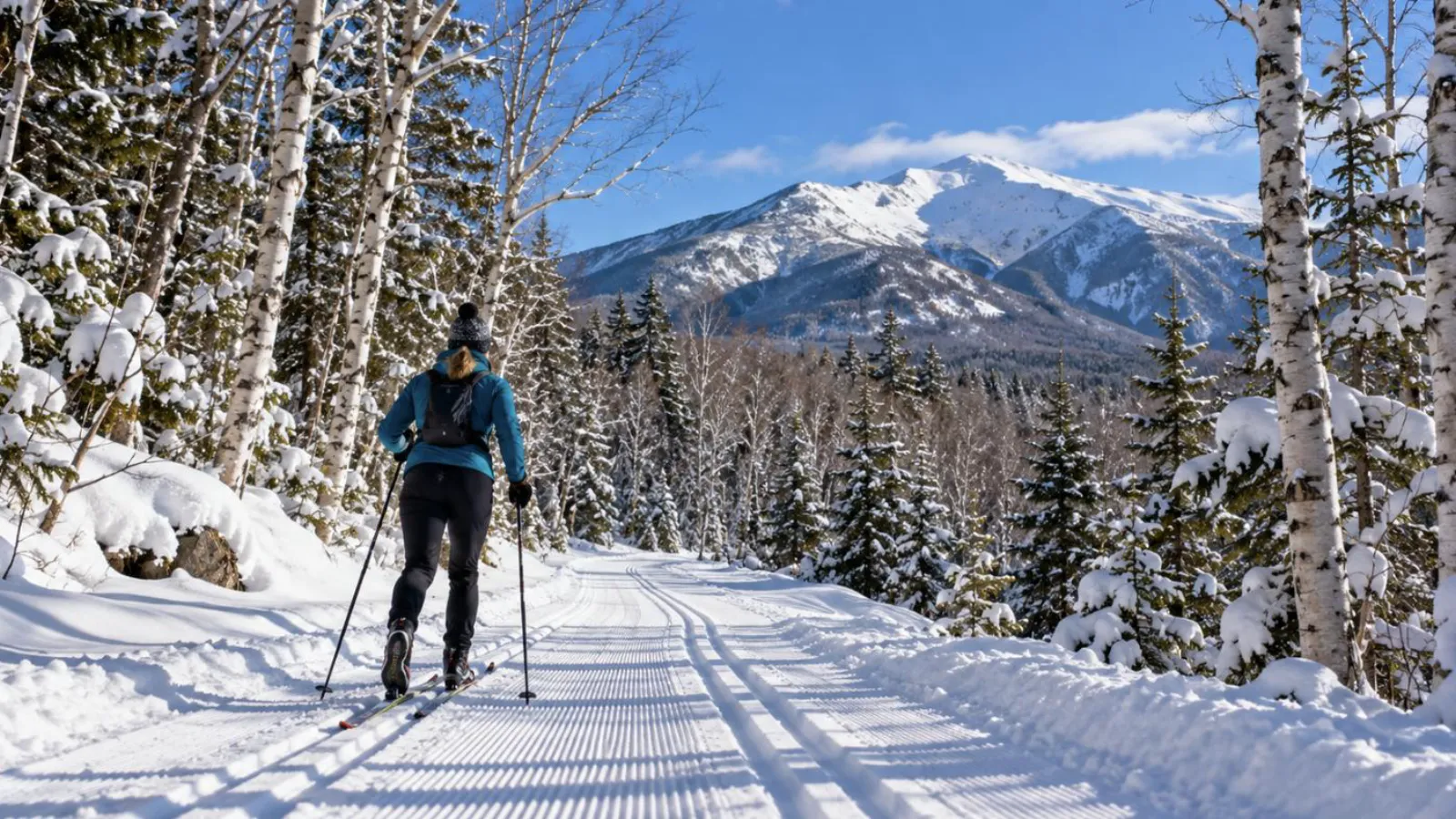
Kilometers, grooming and prices below were checked on each center's own website, or its Indy Pass listing, in October 2026. Most centers had not posted 2026/27 day rates yet, so the price column shows the latest rate posted and says which season it is for. Where a center doesn't publish a day rate online, we say so rather than guess.
| Nordic center | Town | Trails | Grooming | Rentals | Adult day trail pass (latest posted) | Pass |
|---|---|---|---|---|---|---|
| Bretton Woods Nordic Center | Carroll | 100+ km | Classic and skate; snowshoe and fat-bike use with a pass | Skis and snowshoes, reserve online | Not posted online, call 603-278-3322 | Independent |
| Jackson XC | Jackson | 100+ km, about 60 trails | Groomed nightly | Yes, at the touring center | See jacksonxc.org | Indy |
| Waterville Valley Nordic Center | Waterville Valley | 70+ km | Classic and skate; all trails open to snowshoes; fat-bike trails | Classic and skate skis, snowshoes, fat bikes, pulk sleds | $28 (2026/27 Nordic season pass $261) | Independent |
| Bear Notch Ski Touring | Bartlett | 65+ km | Most trails groomed with a beginner track; dogs allowed everywhere | Classic $23, skate $28 | $22; age 16 and under free with a paying adult | Independent |
| Great Glen Trails | Pinkham Notch (Gorham) | 45 km | About 20 km of groomed carriage roads, plus ungroomed singletrack | Salomon classic and skate skis, snowshoes, fat bikes | Sold at the base lodge, not posted online | Indy, new for 2026/27 |
| Franconia Inn / Franconia Village XC | Franconia | 30 km | Groomed and ungroomed, mostly narrow trails through the woods | Yes, at the inn | Not posted online; free for inn guests | Indy |
| Mt. Washington Valley Ski Touring | Intervale / North Conway | 30 km | Classic and skate | Yes | See site; reduced season pass for Conway residents | Independent |
| Gunstock Nordic Center | Gilford | 27 km | Classic and skate, plus snowshoe-only trails | Yes, limited quantities | $22 midweek / $26 weekend, ages 30–59 (2025/26) | Independent |
| Loon East Ridge trails | Lincoln | Logging-road network along the Pemigewasset | "Groomed periodically" | None | No pass price posted | n/a |
Bretton Woods: the biggest network in the state
The Bretton Woods Nordic Center runs out of the clubhouse at 210 Mount Washington Hotel Road. It describes its trails as "more than 100 km of maintained trails at one of the largest cross-country ski areas on the East Coast," with classic, skate and snowshoe terrain spread across the open fields below the Mount Washington Hotel and up into the woods toward the alpine area. One trail pass covers skiing, snowshoeing and fat biking. Rentals have to be reserved in advance through the resort's online store, and the center runs group and private lessons in classic, skate and snowshoeing. Bretton Woods doesn't post its daily trail-pass price online, so call the Nordic desk before you go. The Presidential Range view is the same one the alpine skiers get, without the lift line.
Jackson XC: ski from the village
The Jackson Ski Touring Foundation, known as Jackson XC, is a nonprofit, and its Indy Pass listing puts the network at more than 100 kilometers on about 60 trails, groomed nightly. What sets it apart is the layout. The trails start in the middle of Jackson village and run, in the listing's words, from "fairways to forests, riverbanks to mountainsides," much of it across private land whose owners let skiers through. You can walk out of an inn and click in. That arrangement also affects the real estate, since many Jackson homes have a ski trail crossing the property. Our Jackson NH real estate guide explains what to ask about a trail agreement before you buy.
Waterville Valley: Nordic and alpine in one town
The Waterville Valley Nordic Center is in Town Square and grooms more than 70 kilometers for classic and skate, running out of the village into the White Mountain National Forest. Every trail is open to snowshoes, and some trails are set aside for fat bikes. Its posted adult full-day trail pass is $28, a full-day adult ski rental is also $28, and the 2026/27 Nordic +Plus season pass is $261 for adults. For a household with one alpine skier and one Nordic skier, this is the easiest place in the state to keep everyone happy. Both centers are a few minutes apart, and the Waterville Valley four-seasons guide covers the rest of what the valley offers.
The Mount Washington Valley: four centers and a town forest
No other part of New Hampshire has this many Nordic options this close together.
- Great Glen Trails is at the base of the Mount Washington Auto Road. It has 45 kilometers of Nordic terrain, about 20 of them groomed carriage roads that are tracked on both sides for two-way traffic, plus ungroomed singletrack. Dogs are allowed. Rentals are first-come, first-served, and you buy the trail pass at the base lodge. The SnowCoach that runs up the Auto Road leaves from the same building. Great Glen joins the Indy Pass for 2026/27.
- Bear Notch Ski Touring on Route 302 in Bartlett has more than 65 kilometers of riverside, meadow and hill trails. It has the lowest posted day rate of the larger centers on this list, $22 for an adult and free skiing for up to two children 16 and under with a paying adult. Well-behaved dogs are welcome on the whole network.
- Mt. Washington Valley Ski Touring grooms about 30 kilometers for classic and skate through Intervale, Kearsarge and North Conway. That includes Whitaker Woods, the town-owned forest a short walk from North Conway village. Conway residents and taxpayers can buy a reduced-price season pass.
- Jackson XC, described above, is ten minutes north on Route 16.
If you're weighing a house in the valley partly for the Nordic skiing, our guide to North Conway and the ski areas near North Conway NH covers the towns. A home near Intervale or Jackson puts three of these networks within a fifteen-minute drive.
Franconia, Lincoln and the Lakes Region
- Franconia Inn runs about 30 kilometers of trails on its own land, with views of the Kinsman Range. Most of them are narrow trails through the woods and across meadows rather than wide groomed roads. Inn guests get a free trail pass, and the network is on the Indy Pass as Franconia Village XC. It's a short drive from Cannon, which makes Franconia one of the few towns where you can ski Cannon's lifts in the morning and cross-country trails in the afternoon.
- Loon's cross-country offering is its East Ridge trails, which follow old logging roads along the Pemigewasset and up the shoulder of Black Mountain, and Loon says they're "groomed periodically," with no rentals and four parking spots at the Wanigan Road trailhead. If you live in Lincoln and want a real touring center, Waterville Valley is the closest one.
- Gunstock Nordic Center in Gilford grooms 27 kilometers for classic and skate, with separate snowshoe-only trails, on the resort's Cherry Valley Road side. It's the main groomed Nordic option in the Lakes Region, a little under two hours from Boston.
The New Hampshire winter activities guide covers snowshoeing, skating, snowmobiling and tubing alongside these centers.
Buying for cross-country skiing
Buying for cross-country skiing works differently from buying for the lifts. You don't need to be near a lift. You need to be close to a trailhead, and ideally close enough to ski from the door. In Jackson that's often possible. In Waterville Valley the Nordic center is in Town Square, so a walk-to-lift condo is also walk-to-Nordic. From Campton or Thornton, the Waterville Valley trails are about twenty minutes up Route 49. Nordic-first buyers also tend to care more about a house on a quiet road with land than about slopeside access, which makes them a good fit for the corridor. They also don't pay the ski-in/ski-out premium described below.
Which pass covers what for 2026/27
Re-verified against the pass operators' own 2026/27 rosters in September 2026. This is the column most likely to be out of date next autumn, so check before you buy.
| Pass | New Hampshire areas |
|---|---|
| Ikon | Loon Mountain only — 7 days on the full pass, 5 on the Base, 2–4 on a Session pass |
| Epic (incl. Northeast Value) | Attitash, Wildcat, Mount Sunapee, Crotched Mountain — all four operated by Vail Resorts |
| Indy | Waterville Valley, Cannon, Black Mountain, Ragged, Pats Peak, King Pine, Dartmouth Skiway, Whaleback, McIntyre, Tenney and Veterans Memorial in Franklin — plus Jackson XC, Great Glen, Franconia Village and Eastman on the Nordic side |
| Independent | Bretton Woods, Cranmore, Gunstock |
The 2026/27 Indy Pass sold out and went off sale before the season started, which is now the normal pattern; if the Indy lineup is part of why you are buying near Cannon or Waterville, buy the pass in spring, not in November.
The pass question is a resale question as much as a skiing question. An Ikon mountain draws buyers from outside the region and prices its surrounding condos accordingly; an Indy mountain draws a regional, price-conscious buyer and the real estate follows. Neither is better. They are different demand curves, and a buyer should know which one they are standing on.
What it costs to own near each cluster
This is the half of the question the ski magazines do not answer. Statewide context first. Redfin's August 2026 figures put the New Hampshire median sale price at $537,761, up 1.5 percent year over year, with a median 44 days on market and about three months of supply — 1,563 homes sold against 6,130 listed, and 38 percent of sales still closing above asking. That is a market that has stopped climbing steeply but has not turned: better supplied than it was two years ago, still tilted to sellers. Ski-town submarkets diverge sharply from that statewide number in both directions.
Lincoln and Loon. The densest condo market in the White Mountains, and the one with the most resale liquidity, because Loon's Ikon traffic creates a national buyer pool. Inventory runs from studio and one-bedroom units in older 1970s and 1980s associations through townhouses to new luxury construction, and the spread between the bottom and the top of the market here is wider than anywhere else on this list. Rental demand is four-season — Loon in winter, the Kancamagus and the summer attractions the rest of the year — which is why carrying costs pencil more easily here than at any other New Hampshire ski town. The development-by-development detail lives in our guide to Lincoln NH condos near Loon Mountain, the Loon corridor condo communities page lists each association with live listings, and the town market is at Lincoln NH real estate and the two-town view at Lincoln and Woodstock.
Waterville Valley. A capped market. The town is surrounded by the White Mountain National Forest, so the supply of new units is effectively fixed, and the housing stock is overwhelmingly condominium and townhouse with a thin band of single-family homes above it. In the mid-2026 listing data we track, the valley's median list price works out to roughly $281 per square foot with homes averaging around 50 days on market — a slower market than the Lakes Region, because the buyer pool is seasonal and deliberate rather than urgent. Association dues are the number to underwrite, not the sale price. Start with the Waterville Valley condo guide, the live Waterville Valley condos for sale, and the town market page.
Campton and Thornton, the value corridor. These two towns at Exits 28 and 30 sit twenty minutes below Waterville Valley and twenty-five minutes below Loon, which means one house can serve two mountains. Mid-2026 list-price medians in the data we track run around $250,000 in Campton, against roughly $419,000 in Plymouth — both directional rather than definitive, because these are small towns where a handful of listings swings a median. What the corridor reliably buys is land and square footage: single-family homes on acreage, year-round roads, and a tax and price structure that has nothing to do with a resort. This is where a family that wants a real house rather than a ski locker ends up — and where Owl's Nest Resort, on Route 49 in Campton and Thornton, adds a golf-and-lake community between the two mountains. The town-by-town comparison, including how Plymouth's services and Thornton's acreage change the calculation, is in Plymouth versus Campton versus Thornton.
Mount Washington Valley. Bartlett, Jackson and Conway are three different markets sharing a valley. Bartlett has the Attitash condo inventory and the Route 302 corridor; Jackson is the postcard village with the covered bridge and the Nordic network, and prices like it; Conway is the working town with the deepest year-round inventory and the best value per square foot in the valley. The North Conway area page covers the whole cluster. Short-term rental rules vary by town here and have been actively debated, which is a due-diligence item, not a footnote.
Bretton Woods and Carroll. The thinnest inventory on this list and the most seasonal. Carroll is a small town with a big resort in it, most of the housing is second homes, and the market moves slowly in both directions — you wait for the right listing and you wait again when you sell. The offset is that nothing new is coming: the resort is hemmed by the national forest and the Presidential Range. Our Bretton Woods real estate guide and the Bretton Woods area page cover it.
The Lakes Region around Gunstock. Gilford is the only town on this list where the ski area is the second reason people buy. Winnipesaukee is the first, and it dominates the price structure. Roche Realty Group's July 2026 review counted 539 single-family sales across the 25 Lakes Region towns in the first half of the year, totalling more than $436 million, at a median of $535,000 — up 10.3 percent year over year — with a median of just 16 days on market and 546 homes listed at a median asking price of $699,000. Condominium unit volume fell about 12 percent while the condo median rose 17.6 percent to $485,000, which is the signature of a thinning low end rather than a softening market. Waterfront is what pulls those medians: 29 Winnipesaukee waterfront houses closed in the half at a $2.3 million median. Off-water Gilford, up toward the mountain, is a materially different and more attainable market than the shoreline, and it is the one that puts a chairlift about ten minutes from the driveway.
Sunapee. The Dartmouth–Lake Sunapee region is its own economy — Dartmouth Health, Colby-Sawyer, an hour and a half from Boston — and it prices closer to a commuter market than a resort one. It sits outside our core service area, which is worth saying plainly rather than pretending otherwise.
| Cluster | Typical buy-in (our market read, Sept 2026) | Drive to the lifts | Short-term rental viability | Year-round livability |
|---|---|---|---|---|
| Lincoln / Loon | Entry condos in the low-to-mid six figures; townhouses and new build well above | 0–10 min | Strongest in the region, four-season | Good — groceries, hospital access, plowed roads |
| Waterville Valley | Condo-dominated, entry to mid six figures; single-family above that | 0–5 min, walk or shuttle | Steady but seasonal | Limited services; a dead-end road in February |
| Campton / Thornton | The value floor of the region; houses and land, not condos | 20–25 min to two mountains | Good, and improving as Lincoln prices rise | Best on this list — schools, year-round neighbors |
| Mt. Washington Valley | Wide range; Conway attainable, Jackson premium | 5–20 min | Strong, but check the town's STR rules | Good in Conway, thinner in Bartlett and Jackson |
| Bretton Woods / Carroll | Thin inventory, second-home pricing | 0–10 min | Moderate; low year-round base | Limited — a small town, a long way from a supermarket |
| Gilford / Gunstock | Lake-driven; off-water far more attainable | 10 min | Summer-led rather than winter-led | Strong — full services, real town |
Those bands are our own read of current asking prices across these markets, not published MLS medians. Prices in small resort towns move on a handful of transactions, so use them to orient yourself and then look at live inventory.
Ski-in/ski-out, walk-to-lift, shuttle-served and drive-to
These four words describe a price ladder, and buyers routinely pay for a rung they will not use.
- Ski-in/ski-out means you can click in at your door and ride back to it. In New Hampshire this is a small, specific set of buildings, and it commands the highest price per square foot and usually the highest association fees on the mountain — snow management, private lift maintenance and trail-side landscaping all land in the budget. It is worth real money on a rental listing and it is worth real money to a household with small children and a lot of equipment.
- Walk-to-lift means a few hundred yards on a plowed path. It captures most of the daily convenience at a meaningful discount, and it is the rung we point most buyers at. In Waterville Valley, the difference between walking and driving is a five-minute walk across Town Square.
- Shuttle-served means a resort or association shuttle picks you up. It works beautifully on a powder Saturday and badly at 3:30 when everyone wants to leave at once. Check the actual winter schedule, not the summer one, and check whether the shuttle runs midweek.
- Drive-to is everything else, and it is where the value is. Ten minutes of driving costs you about fifteen minutes a day and saves you a great deal of money per square foot, which is why the Campton and Thornton corridor works: you are drive-to for two mountains instead of walk-to for one.
The honest framing: the fee premium on ski-in/ski-out is charged every month for twelve months and used on perhaps twenty days. If you will genuinely ski fifty days a season, it pays. If you will ski fifteen, it does not, and the money is better spent on square footage further down the hill.
Buying for rental income versus buying for use
These are two different purchases and they want two different properties.
If it is for you, optimize for the things that make you go: drive time, a garage or a mudroom, a real kitchen, and enough bedrooms that inviting people is not a logistics problem. Buy in a town you would visit in September. A house in the corridor that you use forty weekends a year beats a slopeside studio you use eight.
If it is for income, optimize for the things that make a listing convert: sleeping capacity, proximity to a lift, parking that works when it snows, and an association that permits nightly rental — which is the first thing to verify and the one most often assumed. Check the condo documents, not the listing agent's summary. Then check the town: short-term rental regulation in New Hampshire is set town by town, and several of the towns in this article have revisited their rules recently. For the Lincoln market specifically, where the nightly-rental numbers are deepest, the underwriting detail is in our Lincoln NH short-term rental investment guide.
The arithmetic to be honest about: across most New Hampshire ski condos, short-term rental income covers carrying costs — taxes, dues, insurance, utilities, management — rather than the mortgage. A property that cash-flows after debt service exists, but it is generally a larger, higher-capacity unit bought well, not an entry-level studio bought at the top of the market. Run the numbers with a management fee in them, a realistic occupancy rather than a peak-week one, and a line for the special assessment that every twenty-year-old association eventually levies.
This is general information, not tax or legal advice; your attorney and the town assessor have the current answers for a specific property.
What people get wrong about buying near a ski area
Vertical is the wrong headline number. In a Northeast that has warmed measurably, snowmaking capacity and base elevation decide how many days a mountain is actually good. Waterville and Pats Peak cover 100 percent of their terrain; Loon can point its system at 63 of 73 trails; Bretton Woods sits at 92 percent and gets more than 200 inches of natural snow a year besides. A mountain with 1,500 feet of well-covered, high-base vertical will out-ski a mountain with 2,000 feet of thin cover in a February thaw, every time. Ask about pumping capacity and base elevation before you ask about the trail count.
The small hills are where families actually learn. Nobody's child learned to ski on the Ikon Pass. They learned on a $25 rope-tow ticket at Campton Mountain, a night lesson at Pats Peak, a Saturday program at King Pine or Black Mountain. Buying twenty minutes from a big mountain and five minutes from a small one is a better configuration for a family with young children than the reverse, and it is considerably cheaper.
A mountain's ownership changes the real estate around it. This is the least intuitive one and the most expensive to get wrong, and it is not a historical point — three of these mountains changed hands or status in the last two years. When Vail acquired the Peak Resorts portfolio, the pass affiliation of four New Hampshire mountains changed overnight and so did their demand profile. When Black Mountain passed from the Fichera family to the Indy Pass team, a mountain that looked like it might close became a mountain with a plan. Ragged sold in November 2025, from a multi-resort operator to six local investors, and pass pricing is the first lever new owners pull. Tenney has repriced the condos at its base repeatedly across sixty years of opening and closing. Worth knowing too that Cannon and Mount Sunapee sit on state land — Cannon run by the state itself, Sunapee leased to Vail under a 1998 agreement — which caps what can be built at their bases in a way a private hill's ownership does not. If your thesis for a purchase is "the mountain will keep running," write down what happens to your number if it does not.
Nobody checks the road in February. Assessors, brochures and listing photos are all summer documents. Drive the access road on a Sunday in February before you write an offer, and find out who plows it and whether it is town-maintained or a private association road with its own assessment.
The part only a local brokerage writes
A few specifics that do not appear in ski roundups and cost people money here.
Exit 28 and Route 49. The eleven miles from I-93 into Waterville Valley is the only way in or out in winter. It is well maintained, but it is two lanes, and a spinout at the Campton Pond bridge backs the whole thing up. Households that ski Waterville on weekends learn to leave the valley at 3:15 or 5:00, never 4:00.
Loon's parking. The main lots at Exit 32 fill first, then South Peak, then you are on a shuttle. Paid and reserved parking has become the norm at the larger New England resorts, and it changes the math on whether "twenty minutes away" is actually slower than "slopeside plus a shuttle ride."
Private roads. A great many mountain-adjacent properties in Campton, Thornton, Bartlett and Waterville Valley sit on private or association-maintained roads. That means a road association, an annual assessment, and a plowing arrangement you inherit. It also affects financing on some loan products. Ask for the road maintenance agreement in writing.
Septic and water in a seasonal build. A lot of the housing stock near these mountains was built as seasonal in the 1970s and 1980s and converted to year-round later. The inspection items that recur here are undersized septic systems for the current bedroom count, shallow wells, heat tape on exposed plumbing, and roofs that were never framed for the snow load they now carry. In a condo, the equivalent question is the reserve study.
Town-line arithmetic. Property tax rates are set town by town in New Hampshire, and two houses ten minutes apart on the same road to the same mountain can have materially different bills. Compare the actual bill on the actual parcel at the town office, not the rate.
Waterville Estates is an association and a unit of government before it is a ski hill. Campton Mountain is one amenity of a roughly 700-home development that also runs four pools, tennis and pickleball courts, a pond beach and two places to eat. Owning inside it means two things on top of the mortgage: association dues, $948.85 for 2026, and a village district tax on top of the town rate — about $5.67 per $1,000 in 2025, which took the effective Campton-side rate to roughly $23.13. Two houses on the same road can sit on opposite sides of that line, one paying both and getting the amenities and the ski hill, the other paying neither. Asking prices will not tell you which; the deed and the tax card will. The full breakdown is in our Waterville Estates guide, linked above.
The small hill's calendar is not the big hill's. Campton Mountain proposed a mid-January opening for the 2026 season rather than a Thanksgiving one. If a family's plan depends on the local hill being open over Christmas week, check that year's schedule; the same caution applies to every hill here under about 1,000 feet of vertical.
Frequently asked questions
What is the best ski resort in New Hampshire?
The best skiing in NH depends on what you want. For modern lifts and reliable early-season snow, Loon. For grooming and beginner-to-intermediate progression, Bretton Woods, which Ski Magazine ranked first in the state for 2026. For steep terrain, weather and the highest lift-served summit at 4,080 feet, Cannon. For a family with mixed abilities in a self-contained village, Waterville Valley. For scenery facing Mount Washington, Wildcat. For cross-country, Bretton Woods and Jackson XC each run more than 100 kilometers of trails.
What is the biggest ski resort in New Hampshire?
It depends on the measure. Bretton Woods has the most skiable terrain today, at 464 acres by its own count. Loon has the most vertical at 2,190 feet, with Cannon within about ten feet of it, and Loon says its Black Ridge expansion will make it the state's largest ski area, at 675 acres, when it opens, targeted for 2027/28.
How many ski resorts are in New Hampshire?
Ski NH represents around thirty operating alpine and cross-country areas, of which eighteen are lift-served alpine mountains a visitor would plan a trip around: Loon, Cannon, Waterville Valley, Bretton Woods, Attitash, Wildcat, Cranmore, Black Mountain, King Pine, Gunstock, Tenney, Ragged, Mount Sunapee, Pats Peak, Crotched, Dartmouth Skiway, Whaleback and Campton Mountain. The rest are small local hills, college hills and Nordic centers, which are disproportionately where New Hampshire residents actually ski.
Which New Hampshire ski resorts are on the Ikon, Epic and Indy passes?
For 2026/27, Loon is the only New Hampshire mountain on the Ikon Pass. Vail's four — Attitash, Wildcat, Mount Sunapee and Crotched — are on the Epic Pass. The Indy Pass has the deepest lineup: Waterville Valley, Cannon, Black Mountain, Ragged, Pats Peak, King Pine, Dartmouth Skiway, Whaleback, McIntyre, Tenney and Veterans Memorial, plus four Nordic centers (Jackson XC, Great Glen Trails, Franconia Village and Eastman). Bretton Woods, Cranmore and Gunstock sell only their own passes. Lineups change every autumn, so confirm before buying.
Is the Cannon Mountain aerial tramway running?
No. The second-generation tram closed on October 26, 2025 and has been retired so a third-generation tram can replace it; Cannon says it "will not operate summer 2026." As of September 2026, neither Cannon nor New Hampshire State Parks has published a construction schedule, cost or target opening. Cannon's nine chairlifts and surface lifts run normally, so skiing is unaffected — check the tramway page before planning a trip around the ride.
What is the best cross-country ski resort in New Hampshire?
For size, Bretton Woods Nordic Center and Jackson XC each have more than 100 kilometers of trails. Bretton Woods has the Presidential Range views and the resort facilities, and Jackson XC lets you ski straight out of a village. Waterville Valley grooms more than 70 kilometers from its Town Square. Bear Notch in Bartlett and Great Glen Trails in Pinkham Notch are the best picks if you want to bring a dog. Gunstock is the main Nordic option in the Lakes Region.
How much does cross-country skiing cost in New Hampshire?
Far less than alpine. The latest posted adult day passes we found were $22 at Bear Notch, $22 midweek or $26 on weekends at Gunstock (2025/26), and $28 at Waterville Valley. Waterville's 2026/27 Nordic season pass is $261. Rentals at those centers run about $23 to $28 a day. Bretton Woods, Jackson XC and Great Glen sell day passes at the counter, so check their sites or call before you go.
Which New Hampshire ski areas have night skiing?
More than most people expect. Gunstock lights more terrain than anyone else in the state, Crotched runs until 9 p.m. Tuesday through Saturday with midnight sessions on select Saturdays, and Pats Peak, Cranmore, Whaleback, Campton Mountain and Waterville Valley all run after dark — Waterville's on its lower mountain only. McIntyre in Manchester sells an evening ticket. Schedules vary by night and season, so check the current calendar.
Is Waterville Valley or Loon better for skiing?
They suit different skiers. Loon has more terrain (403 acres to Waterville's 265), more lifts, the Ikon crowds and, from 2027/28, the Black Ridge glade expansion. Waterville has a compact mountain with 100 percent snowmaking, night skiing, a walkable village and quieter weekends. Our full head-to-head comparison of Loon and Waterville Valley, linked earlier in this guide, goes further, and hiking near Waterville Valley covers the rest of the year.
Where to start
If you are choosing a mountain, ski three of them this season before you buy anything — the difference between Cannon and Bretton Woods on the same January weekend will tell you more than any statistics table. If you are choosing a property, start from drive time and work backwards, because the number of days you use it is the only variable that makes the rest of the math work. If you're also weighing Vermont and Maine, we compare them in the best ski towns in New England for a second home. The White Mountains market overview is the wide view, and our guide to buying a White Mountains second home covers the process end to end.
Owl's Nest Real Estate sells the condos, houses and land around these mountains from offices in Campton and Plymouth, and most of us ski them. If you want an honest read on which cluster fits how you actually ski and what you actually want to spend, talk to us.