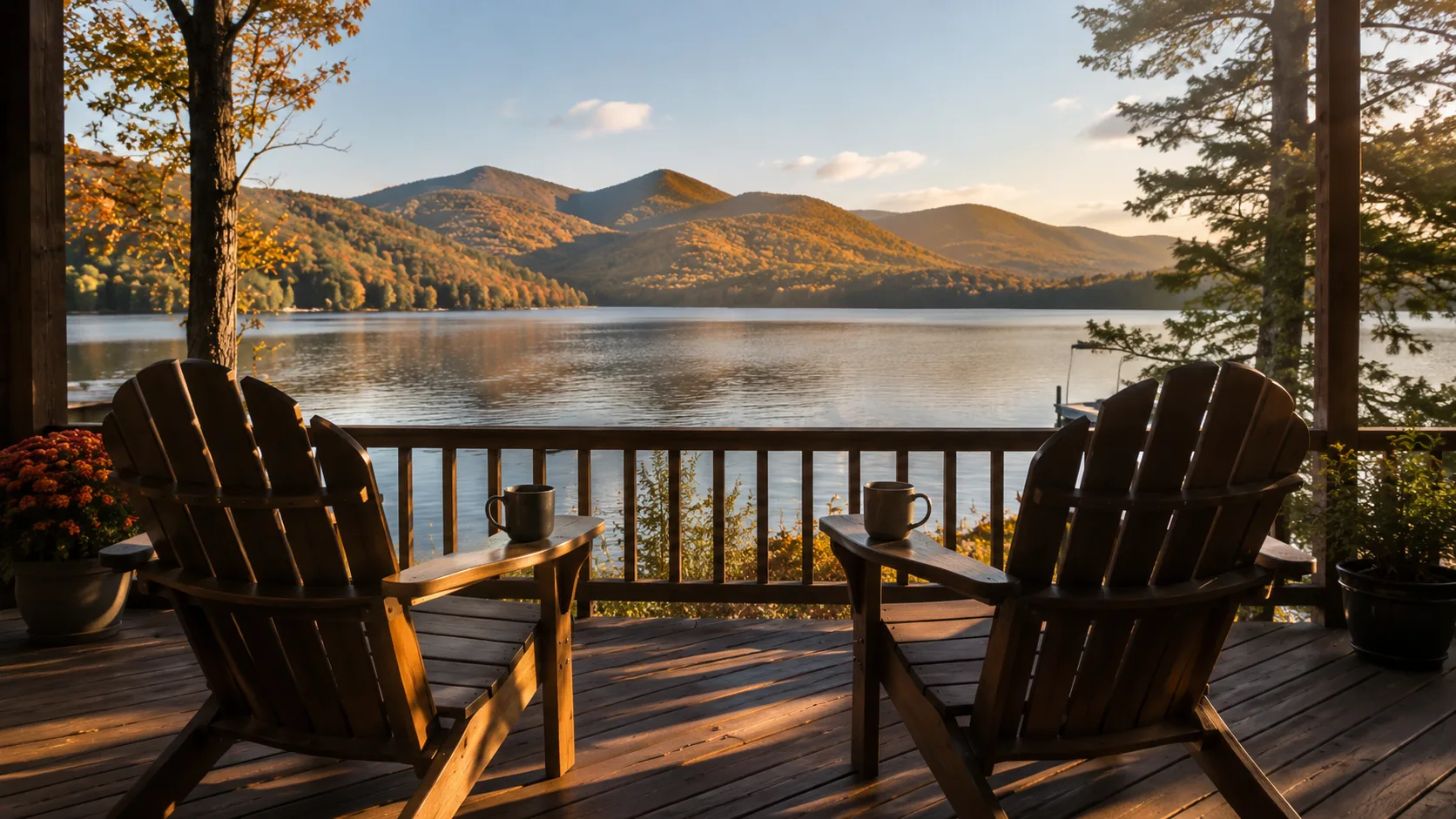

Retiring to New Hampshire means a state that taxes no pension, no 401(k) withdrawal, no Social Security check and no estate — arithmetic a couple in their early sixties in Massachusetts, Connecticut or New Jersey can do in one sitting, usually right after remembering the week they spent on Winnipesaukee in 1987.
Enough of those couples have now made the move — into lake towns, ski towns, downtown condos, and 55+ communities — that the pattern is clear: the internet version of this decision is right in places and silent in others. The general version of the conversation lives in the moving to New Hampshire guide; this is the retirement edition, with the numbers that belong on the legal pad.
Is New Hampshire a good place to retire
The short answer: for retirees whose plan is built around keeping their money and being outside, New Hampshire is one of the best answers in the country. For retirees whose plan is built around warmth, walkability everywhere, and a major hospital ten minutes away, it needs more thought — sometimes the answer is still yes, but it's yes to a specific town, not to the state in general.
Here's the honest scorecard. On the money side, New Hampshire is close to unbeatable in the Northeast: no tax on any form of retirement income, no sales tax, no estate or inheritance tax. On lifestyle, the Lakes Region and the White Mountains offer the kind of four-season retirement people actually stay busy in — boating in July, foliage in October, and more than a few of my seventy-year-old clients still skiing forty days a winter. On the costs, property taxes are genuinely high and fall hardest on people with fixed incomes, winters are five real months, and once you get north of the lakes, the drive to a specialist becomes part of your planning.
The rest of this guide is those three paragraphs, expanded and priced.
The retirement tax math
Most states advertise some retirement tax break. New Hampshire's position is simpler: there is nothing to break, because the tax doesn't exist. Let me stack it up, because the pieces compound.
No tax on Social Security. New Hampshire has no personal income tax, so your Social Security check is untouched by the state — not phased out, not partially exempt, just not taxed.
No tax on pensions, 401(k) or IRA withdrawals, or capital gains. Same reason. Whether your retirement runs on a municipal pension, systematic withdrawals from a portfolio, or selling appreciated stock, the state's share is zero.
No tax on interest and dividends — anymore. This is the one that changed recently and the one out-of-date articles still get wrong. For decades New Hampshire's asterisk was the Interest and Dividends Tax, which hit exactly the kind of income retirees live on. That tax was fully repealed effective January 1, 2025, which made New Hampshire one of the only states with no personal income tax of any kind. For a couple drawing $60,000 a year off a portfolio, that repeal wasn't a footnote — it was the last reason to hesitate, removed.
No sales tax. Furnishing the new house, buying the boat, buying the snowblower — nothing at the register. Retirees notice this faster than anyone, because retirement spending is spending, not saving. And with the I&D repeal, New Hampshire became the only state in the country with no income tax and no sales tax at either the state or local level — even Alaska's towns charge local sales tax.
No estate tax, no inheritance tax. New Hampshire levies neither an estate tax nor an inheritance tax, and no gift tax either. Only the federal estate tax applies, and with the federal exemption where it sits, most families never touch it. If part of your retirement plan is what you leave behind, the state stays out of that too.
The Tax Foundation ranks New Hampshire's overall tax burden among the lowest in the nation, and for retirees specifically the gap versus the rest of the Northeast is wider than the rankings show, because retirement income is exactly the income New Hampshire doesn't tax and neighboring states do.
Now the other side of the ledger, because I promised you the honest version.
The property tax bill on a fixed income
Everything above gets paid for somewhere, and in New Hampshire it's paid at the town tax bill. The statewide average rate in 2025 was about $17.10 per $1,000 of assessed value, the average single-family bill runs north of $8,000, and rates vary enormously town to town — from under $3 in tiny Hart's Location to over $36 at the high end. I wrote a full guide to how New Hampshire property taxes actually work — how a rate is built, why assessed value isn't market value, and why you can't compare towns on the raw rate. Read it before you compare any two towns; it will save you from the most common mistake retirees make here.
For retirement planning, four things matter most.
First, the rate is a town-by-town decision, so where you buy is a tax decision. The Lakes Region towns retirees favor happen to sit at the friendly end of the table: 2025 rates were $10.62 in Meredith, $11.85 in Gilford, and $12.98 in Laconia, all well under that $17.10 state average, with lake towns like Moultonborough as low as $5.33. A $500,000 condo in Gilford carries roughly $5,900 a year; the identical assessment in an average-rate town is $8,550. Over a twenty-year retirement that difference is a car.
Second, the elderly exemption exists, and nobody will tell you about it. Under RSA 72:39-a, every town offers an exemption that subtracts a town-set amount from your assessment — not your bill — once you turn 65, with larger amounts at 75 and again at 80. The catch, and the reason I can't print a table: each of the state's municipalities sets its own exemption amounts and its own income and asset limits, and they range wildly — some towns knock $100,000 or more off a qualifying assessment, others far less, and the income limits that decide whether you qualify at all are a local choice above a modest state floor. The Department of Revenue's exemption overview explains the machinery; the actual numbers live at your town office. One more mechanic that surprises people: you must have been a New Hampshire resident for at least three consecutive years before the April 1 of the year you claim it, so if you're arriving from Massachusetts at 66, this exemption starts in year four, not year one — plan the early years' budget accordingly. The application is Form PA-29, due April 15, and the town will not chase you down to tell you that you qualify. I raise it with every retiree client, and about half have never heard of it. Before you choose between two towns, call both assessing offices and ask for their elderly exemption amounts and limits — it's a ten-minute call that can be worth thousands a year.
Third, the state has a rebate for lower-income homeowners. The Low and Moderate Income Homeowners Property Tax Relief program refunds part of the state education portion of the tax for homeowners with adjusted gross income up to $37,000 single or $47,000 married, on homes valued up to $220,000. The window is rigid — file between May 1 and June 30, no exceptions — and the check is modest, but for a single retiree on Social Security in a small Franklin ranch, it's real money for one form.
Fourth, if you served, there's a credit with your name on it. Under RSA 72:28, the veterans' tax credit comes straight off the tax bill itself — not the assessment — every year. The standard credit is a token $50, but towns can adopt an optional credit of up to $750 a year, and many of the towns in this guide have. It stacks with the elderly exemption, it uses the same Form PA-29 and the same April 15 deadline, and like the exemption, the amount is a town-by-town choice you should ask the assessing office about before you pick between two towns. A large share of my retiring buyers are veterans, and I'd guess fewer than half were told this credit exists.
My plain advice: model the property tax bill into your retirement budget the way you'd model a health premium — as a line that exists forever and drifts upward — and then choose your town partly on that line. The retirees who get in trouble here aren't the ones who knew the bill; they're the ones who fell in love with the "no taxes" headline and met the December tax bill as a stranger. For the complete monthly picture — utilities, plowing, insurance, all of it — I broke down the real cost of living in New Hampshire separately.
Where retirees actually settle
I can tell you where retiring New Hampshire buyers actually close, because a growing share of my closings are exactly that. These are the towns that come up again and again, with real asking-price medians from the MLS as I write this in August 2026. Treat the medians as a snapshot, not scripture — check what's actually listed the week you're shopping.
Laconia — the practical pick. A real small city on three lakes with a walkable, genuinely revived downtown, and — this matters more every year after 65 — a 137-bed hospital with a 24/7 emergency department inside the city limits. Single-family listings run a median around $650,000 and condos around $545,000, with entry points well below both, and the $12.98 tax rate is the price of actually having services. It's also home to two of the best-known 55+ options in the state, which I'll get to below. I wrote a full guide to living in Laconia — retirees are a growing share of my closings there, and it's the town I recommend most often to couples who want lake life without isolation.
Meredith — the postcard with services. Winnipesaukee's front porch: a walkable downtown wrapped around the bay, restaurants, year-round bustle, and the lowest tax rate of the three at $10.62. You pay for the charm — single-family asks run a median around $739,000, condos around $650,000 — but for retirees who want to walk to dinner and the dock, Meredith is the town people picture when they picture this retirement.
Gilford — the four-season play. The southwest shore of Winnipesaukee with Gunstock ski area in town, resident beach rights people actually use, and an $11.85 rate. The single-family median asks around $712,000, but here's the retiree-relevant number: Gilford's condo median sits around $442,000, much of it in association developments where somebody else owns the snowblower. For the couple that wants the boat in July and the chairlift in January, this is the answer — my Gilford buying guide covers it neighborhood by neighborhood.
Wolfeboro — the classic. "The Oldest Summer Resort in America" is the retirement brand of the Lakes Region — a genuinely beautiful walkable downtown on Winnipesaukee's quiet eastern shore, with a hospital (Huggins) right in town. It's priced like the classic it is: single-family asks run a median around $810,000. Retirees who summered here for forty years retire here anyway, and I understand completely.
Plymouth — the college town with a hospital. This is my corner of the state, and it's underrated for retirement. Plymouth State University keeps the downtown alive — restaurants, a movie theater, lectures and hockey games you can actually attend — and Speare Memorial Hospital is right there. The single-family median asks around $435,000, the lowest of any town on this list except Franklin, and a new 55+ community is being built in town as I write. It's also the retirement base for skiers: Loon and Waterville Valley are each about twenty-five minutes up the road. The trade: Plymouth's tax rate ($23.77 in 2025) is the highest on this list, so run the elderly-exemption call I described above.
Franklin — the value play. New Hampshire's smallest city, at the meeting of two rivers and a short drive from Winnisquam and Newfound, has spent a decade reinventing itself around a whitewater park of all things. The median single-family ask is about $400,000 and the entry points run far lower — as I write, there are two homes in a Franklin 55+ community asking $285,000 each. It's a working city, not a postcard, and for retirees stretching a fixed income to get near the lakes rather than on them, it's the honest answer. If being on the water is the point, my best lakes in New Hampshire rundown covers which waters give you the most for the money, and the Winnipesaukee buying guide goes deep on the big lake's eight town markets.
55 and over communities in NH
Every retirement search here eventually asks about 55 and over communities in NH, so let me map the real landscape — because it's more varied, and in places far cheaper, than people expect. As I write this in August 2026, roughly 140 active listings statewide sit in age-restricted or 55+ communities, and they break into three very different products.
Resident-owned and manufactured-home communities — the value tier. The best-known in my region is Briarcrest Estates in Laconia, a large 55+ manufactured-home community where a well-kept 2-bedroom, 1,442-square-foot 1990 home is currently asking $319,000 (MLS 5084593). That's a real house with a garage in a lake city for less than half the Laconia single-family median. Others worth knowing: Eagle's Rest in Alton (a 3-bedroom backing to conservation land, asking $265,000), Gilford's 55+ parks like Edge of Woods II (four active Gilford listings between about $115,000 and $220,000), the Birch Hill over-55 co-op in Wolfeboro (two actives around $329,000–$355,000 — the cheapest way into Wolfeboro by a wide margin), and Mountainvale Village in Conway (actives from $99,900 to $184,900). The homework in this tier is the ownership structure: some communities are resident-owned cooperatives where you buy a share, others charge lot rent, and the monthly fee and what it covers vary park to park. I read those documents with clients before any offer.
New-construction 55+ neighborhoods — the single-level tier. This is the fastest-growing product in the state, because builders finally noticed what retirees actually want: one level, two bedrooms, a real garage, and no stairs. Mountain View Farm in Plymouth is the one in my backyard — a new 55+ community of Ritz-Craft-built single-level homes, with six active listings from $308,900 (2-bed, 2-bath, 1,278 square feet) up to about $425,000, brand new, five minutes from Speare Memorial and the Plymouth downtown. Meredith Bay Village, one of the Lakes Region's established 55+ condo communities, has two actives at $439,000 and $649,000. Just south of the lakes, Cross Mill Village in Northfield is selling newly built 2-bedroom single-level condexes in the mid-$500,000s. Farther south — where these communities are thickest — the price of the same product roughly doubles: 55+ condo projects in towns like Atkinson run from the low $600,000s well past $1 million. The Lakes Region discount on age-restricted new construction is one of the quietest good deals in the state.
Continuing care — the full-service tier. For retirees planning past the healthy-and-hiking years, Taylor Community in Laconia is the region's nonprofit continuing care retirement community — independent-living cottages and apartments with assisted living and nursing care on the same campus, plus satellite campuses in Wolfeboro. You won't find Taylor on the MLS; it works on an entrance-fee and monthly-fee model rather than a deed, which is precisely the point — you're buying the guarantee that the next level of care is down the hall, not down the interstate. Taylor doesn't publish its fee schedule, so call them directly — and when you do, ask for the entrance fee by unit type, what the monthly fee covers, and crucially, the refund terms on the entrance fee if you leave or pass away, because those terms vary widely between contracts and matter enormously to your estate. It's not a real estate transaction, but I bring it up with clients anyway, because for some couples it's the right answer and I'd rather lose a commission than watch someone buy the wrong house.
One honest note on the whole category: age-restricted supply is thin relative to demand, especially in the Lakes Region, and the good listings move. If a 55+ community is your plan, get your search set up early and be ready to act.
The healthcare map, honestly drawn
I tell every retiree client the same thing: in your sixties you shop for a view, and in your eighties you shop for a hospital, so buy the house that works for both. Here's the actual map for my part of the state.
The flagship is Dartmouth Hitchcock Medical Center in Lebanon — the state's only academic medical center, with a National Cancer Institute-designated comprehensive cancer center. From the western Lakes Region it's about an hour; from Wolfeboro, closer to two. That's where the serious things get referred, and its distance from your driveway belongs in your decision.
In the heart of the Lakes Region, Concord Hospital's Laconia campus — the former Lakes Region General — gives Laconia, Gilford, and Meredith a 137-bed hospital with a 24/7 emergency department minutes away, backed by the main Concord campus forty minutes south. This is a bigger deal than most buyers realize: in plenty of otherwise lovely NH towns, the nearest ER is 45 minutes on a good day.
Up my way, Speare Memorial in Plymouth is a 25-bed critical access hospital — excellent for everyday care, an ER, and surgical services, with the complicated cases referred to Lebanon or Concord. Wolfeboro has Huggins, North Conway has Memorial. The pattern to understand: the small hospitals are genuinely good at what they do, and what they do is defined. A healthy 65-year-old near Speare is well covered. Someone managing a condition that needs a specialist every month should weight Laconia, Concord, or the Upper Valley more heavily — and I will say exactly that to your face if you tell me your situation, because selling you the wrong town helps neither of us.
The trade-offs nobody puts in the brochure
I'd rather you hear these from me now than from your own driveway in February.
Winter is five months and it's physical. Snow removal isn't a line item, it's a lifestyle decision. A plow contract runs a few hundred to over a thousand a season depending on the driveway; roofs need watching for ice dams; walkways need clearing before the mail carrier arrives. The retirees who thrive here either genuinely like winter or engineer it away — which is the single best argument for a condo or a 55+ community where the association owns the problem. When a client in their seventies falls in love with a big colonial on two acres with a north-facing driveway, part of my job is to ask who's shoveling it in 2036.
The property tax bill doesn't retire when you do. It's the one major cost here that rises independent of your income. Between the town's rate-setting and revaluations, budget for drift — file the veterans' credit the April after you close if you qualify, and put the elderly exemption on the calendar for your third April as a resident.
Distances are real. North of the lakes, the specialist, the airport, and the good grocery store all get farther apart. Delivery options thin out. If your retirement picture includes frequent flights to grandchildren, Manchester's airport is an hour-plus from most of the Lakes Region and more from the mountains.
The single-level house is the scarcest product in the state. New Hampshire's housing stock is old and vertical — capes, colonials, chalets. Genuine one-level living is rare enough that ranches and single-level condos carry a premium and sell fast, which is exactly why the new 55+ construction in Plymouth and Northfield is being absorbed as fast as it's built. If stairs are already a consideration, start your search earlier than feels necessary.
And February is February. No state tax policy fixes it. The couples who last here treat winter as a season to use — or budget for three weeks somewhere warm and come home for the best summer and fall in the country.
Questions I answer every week
Is New Hampshire a good state to retire in?
For retirees who want to keep their money and stay active outdoors, yes — arguably the best in the Northeast. The state taxes no retirement income of any kind, there's no sales or estate tax, and the Lakes Region delivers a genuine four-season retirement. The honest caveats: property taxes are high and land hardest on fixed incomes, winter is five real months, and healthcare access varies sharply by town — so retire to a specific town you've vetted, not to the state in general.
Does New Hampshire tax retirement income?
No — none of it. There's no state income tax, so Social Security, pensions, 401(k) and IRA withdrawals, and capital gains are all untaxed. The old asterisk, the Interest and Dividends Tax, was fully repealed effective January 1, 2025, so portfolio income is now untaxed too. What you'll pay instead is the property tax, which averaged about $17.10 per $1,000 of assessed value statewide in 2025 and varies enormously by town.
What are 55+ communities like in New Hampshire?
More varied and cheaper than most people expect. They come in three tiers: manufactured-home and co-op communities (roughly $100,000 to $350,000 — Briarcrest in Laconia is the best-known in the Lakes Region), new-construction single-level neighborhoods (about $309,000 to the mid-$500,000s in central New Hampshire, roughly double that south of Concord), and continuing care communities like Taylor in Laconia, which work on entrance fees rather than deeds. Supply is thin and good listings move fast.
Can I get a property tax break as a retiree in New Hampshire?
Three real programs exist. Every town offers an elderly exemption (RSA 72:39-a) that cuts your assessment starting at 65, with bigger cuts at 75 and 80 — but the amounts and income limits are set town by town, and you need three consecutive years of NH residency first. The state's Low and Moderate Income relief program refunds part of the education tax for incomes up to $37,000 single or $47,000 married. And veterans can claim a town-adopted credit of up to $750 a year off the bill itself. All three require you to apply — nobody applies for you.
Let's plan it on a legal pad
Retiring to New Hampshire is a spreadsheet decision and a Tuesday-afternoon decision, and you need both to be right. The spreadsheet: your income untaxed, your purchases untaxed, your estate untaxed, against a property tax bill we can predict town by town, minus an exemption most people never claim. The Tuesday afternoon: what's within fifteen minutes of the house — the water, the trail, the pharmacy, the hospital, the coffee.
My team and I do this exact exercise with retiring buyers every month. We'll pull the actual tax rate and elderly exemption numbers for any town you're weighing, tour you through Briarcrest and Mountain View Farm and the Gilford condo associations in one day, and tell you honestly whether your budget works better in Meredith or two miles inland. Start with the newest listings across our markets, read the moving guide if you haven't, and then call the office. I still answer my own phone, and the retirement calls are my favorite ones — you've done the hard part already. Now we just have to find the right town.